
- Understanding the strengths and limitations of welding, riveting, and adhesives is vital for durable, cost-effective metal assemblies.
- Choosing the right method depends on factors like load paths, material compatibility, required serviceability, and production scale.
- Hybrid methods can often deliver the best results by balancing immediate strength, long-term durability, and manufacturing flexibility.
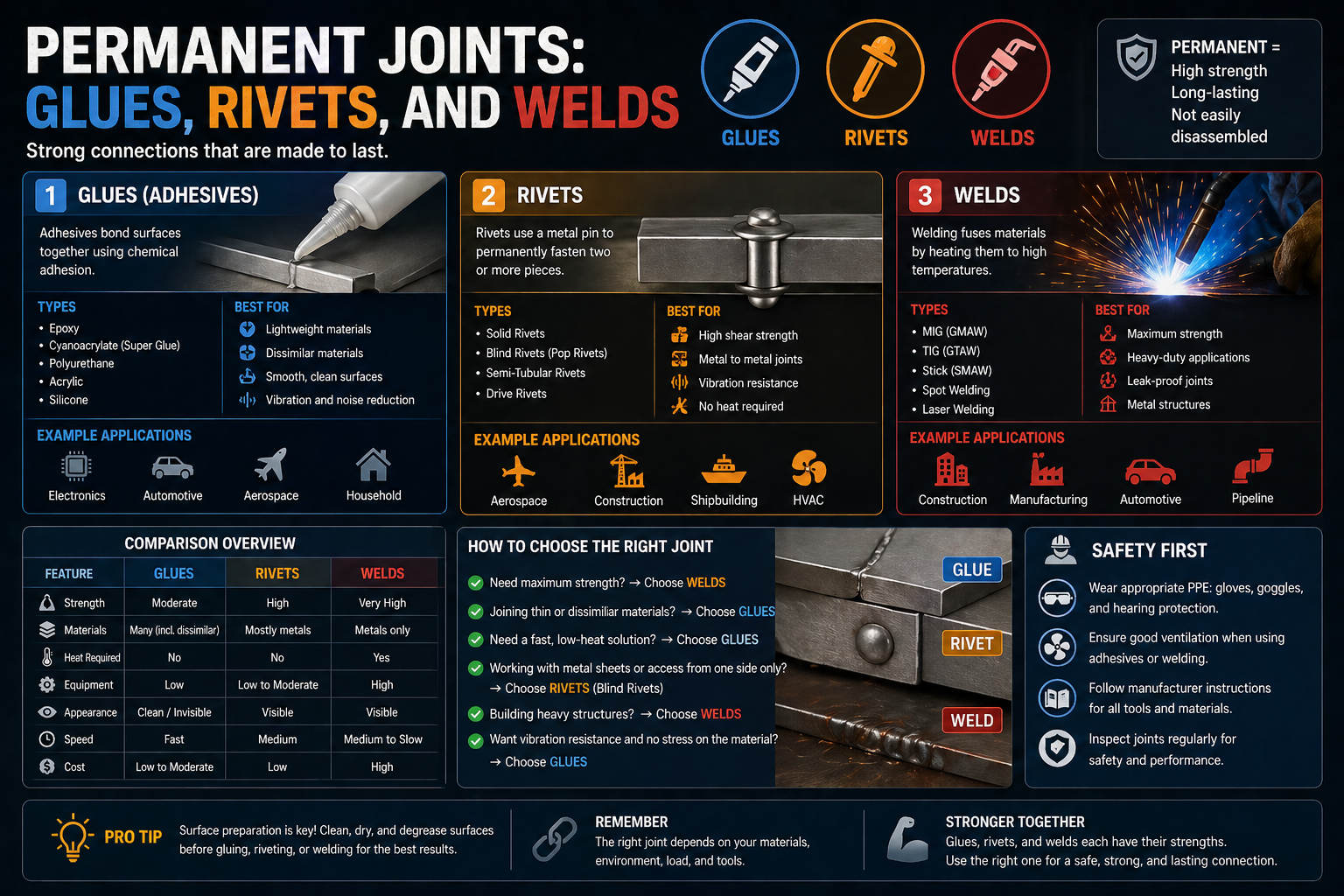
When it comes to putting metal parts together for the long haul, few decisions impact your finished product as much as choosing a joining method. Whether you’re designing a complex industrial assembly, working on an automotive project, or just tackling a repair in your garage, the call between glues, rivets, and welds can make or break your success. It’s not just about holding things in place—it’s about strength, reliability under stress, future repairs, and even the beauty of a clean finish.
This guide pulls together the deepest insights from leading resources and technical guides—plus a healthy dose of real-world engineering smarts—to give you an all-encompassing look at permanent joining methods: how they work, why they fail, and exactly when each is the right fit. Whether you’re a designer, maker, or industrial engineer, buckle up: we’ll cover everything from the basics to the granular details that can save you money, time, and frustration down the line.
An Overview of Permanent Joining Methods
Permanent joints in metal fabrication refer to methods that create secure, long-lasting bonds between two or more components. Unlike temporary fasteners (like bolts and screws), permanent joints are designed with the intention that the parts won’t be separated—at least, not without destroying the joint or causing damage. The three most common methods are:
- Welding: Fuses metal parts together using heat, often with a filler material.
- Riveting: Mechanically fastens parts using metal pins or rivets, creating strong interlocked joints.
- Adhesives: Bonds parts chemically using substances like epoxies, acrylics, or cyanoacrylates.
Each method comes with a unique set of attributes, and choosing the right one is rarely about finding a universal “best”—it’s about considering load paths, materials, costs, aesthetics, serviceability, and production constraints. Below, we’ll unpack everything you need to know to make informed decisions.
Welding: The Heavyweight of Permanent Joints
Welding is the go-to for many industrial and structural applications because it literally fuses metals at the atomic level. It creates joints with remarkable strength and rigidity—when done correctly, the bond can be as strong as (or even stronger than) the parts being joined. Here’s what you need to know about welding as a permanent joining technique:
How Welding Works
Welding almost always involves melting the edges of the parts to be joined—sometimes called the parent metals—and then allowing them to solidify together. Often, a filler material of similar composition is added to reinforce the joint and fill any gaps. High temperatures are most common, but there are processes (like ultrasonic welding) that use friction or vibration at lower temperatures, especially for thin or delicate materials.
Main Welding Methods Used in Sheet Metal
- Shielded Metal Arc Welding (SMAW/Stick): Uses a consumable, flux-coated electrode. Simple and portable, great for ferrous metals, outdoor repairs, and construction, but less precise and messier.
- MIG (Metal Inert Gas)/Gas Metal Arc Welding (GMAW): Feeds a constant wire electrode and uses a shielding gas. Widely used for speed and automation. Cleaner, no need to chip flux slag, good for mass production.
- TIG (Tungsten Inert Gas)/Gas Tungsten Arc Welding (GTAW): Uses a non-consumable tungsten electrode with or without a separate filler rod. Ideal for thin sheet, stainless steel, aluminum, and titanium. Offers high precision and the most attractive, smooth welds, but requires great skill and is slower than MIG.
- Spot Welding: Common for joining thin sheets in automotive or appliance fabrication. Electrical resistance at the join generates the heat; very quick but limited to overlapping joints.
- Flux-Cored Arc Welding (FCAW): Similar to MIG but uses a flux-filled wire for self-shielding. Excellent for outdoor or dirty work where shielding gas isn’t practical.
- Laser Welding/Electron Beam Welding: Specialist techniques for high-precision joints in aerospace, medical, and electronics, offering minimal distortion—sometimes used in advanced industrial settings.
Pros of Welding
- High-strength, rigid joints—often the strongest possible bond for metals
- Wide range of materials (ferrous and non-ferrous) can be welded—though material compatibility and melting points must be considered
- Smooth, visually appealing finishes with the right technique and post-processing
- Supports diverse joint geometries (butt, lap, tee, and corner joints)
- Ideal for high-volume, automated production—especially MIG/TIG/spot welding
Cons of Welding
- Permanent—joints are extremely difficult or destructive to disassemble
- Heat distortion, especially problematic for thin sheet metal in precision applications
- Requires skilled labor (especially TIG), specific equipment, and safety precautions
- Energy-intensive: needs electricity and sometimes shielding gases
- Welding different metals is challenging; not all alloys are weldable together
- Heat-affected zones can weaken adjacent metal or introduce internal stresses
Where Welding Shines
Welding’s unparalleled strength and permanence make it the top pick for:
- Automotive frames, chassis, and many structural components
- Aerospace and defense assemblies
- Bridges, ships, and large metal fabrications
- Appliances, construction, and heavy machinery
But it’s not always the right fit—especially if you need future maintenance, are joining dissimilar materials, or are working with very thin or sensitive metals susceptible to heat distortion.
Riveting: Robust Mechanical Fastening for Metal Joints
Riveting is a classic technique for permanent or semi-permanent metal assembly solutions—especially where welding is impractical, and there’s a risk from heat or a need for easier inspection and maintenance. The basic idea? Mechanically secure two or more pieces by driving a metal fastener (the rivet) through aligned holes and deforming the tail to clamp everything together.
How Riveting Works
To create a riveted joint, holes are drilled or punched in the parts to be joined, the rivet is inserted, and then its tail is deformed—either by hammering, pressing, or setting with a rivet gun—so both head and tail anchor the rivet in place. This forms a tight, load-bearing mechanical lock. Once installed, the rivet usually cannot be removed without destroying it, making the joint effectively permanent.
Main Types of Rivets and Joints
- Solid Rivets: Classic one-piece rivets hammered or pressed into shape. Used in aircraft, bridges, and ships.
- Blind Rivets (Pop Rivets): Enable riveting when you can access only one side of the assembly. Very common in consumer products and light assembly.
- Tubular/Semi-Tubular Rivets: Hollow or partially hollow, reducing setting force. Used for lighter-duty or thin materials.
- Lap Joints: Overlapping plates joined along the overlap—a robust, time-tested design.
- Butt Joints: Plates meet edge-to-edge, joined by riveting through cover plates/straps on one or both sides (single or double strap butt joints).
- Chain and Zig Zag Arrangements: Refer to the alignment of multiple rivets along the joint. Chain places rivets in straight lines; zig zag staggers them for improved stress distribution.
Pros of Riveting
- Excellent for joining thin sheet metals and dissimilar or non-ferrous materials (like aluminum and copper)
- No heat, so no risk of warping, melting, or distorting sensitive parts—great for assemblies needing precise dimensions or involving pre-finished surfaces
- Robust and reliable in vibration-prone environments (provided joint is designed correctly)
- Inspection and quality assurance is easier and more straightforward than with many welding processes
- Can sometimes be disassembled for repairs (especially with specialty rivet types)
Cons of Riveting
- Weight: Rivets add more mass than welds or adhesives
- Requires pre-drilled or punched holes—these weaken the plates and may create stress points or leak paths
- Corrosion risk at the interface—if different metals are used, galvanic corrosion may occur
- More labor-intensive and time-consuming than welding for large productions (multiple steps: drill, set, inspect, sometimes replace)
- Bulging or visible heads not always aesthetically pleasing
Where Riveting is Best
- Aircraft and aerospace structures (iconically used in aircraft skins and frameworks)
- Bridge building and ship construction
- Consumer products where heat could damage finishes (kitchenware, electronics cases)
- Assemblies that require periodic inspection or partial disassembly
Design Considerations for Riveting
Proper edge distances, hole quality, and material thickness are essential. If the plate is too thin or the hole is too large, the joint risks elongation, loosening, or shearing. Correct rivet selection based on load type (shear vs. tensile loads) is crucial, and attention must be paid to corrosion—don’t pair dissimilar metals unless protected.
Adhesive Bonding: Modern Chemical Solutions for Metal Joining
Adhesive technology has come a long way, and for many assemblies, gluing metals is a competitive option. Instead of mechanically clamping or melting the base parts, adhesives bond by forming chemical links at the interface. The science is complex, but the results can be surprisingly strong and reliable—sometimes even outperforming traditional joints in specific applications.
How Adhesive Bonding Works
Adhesives form joint strength by distributing loads across the entire bond area. Common adhesives used for metals include:
- Acrylic Adhesives: Fast-curing, excellent for harsh environments—often used in transportation, electronics, and construction.
- Cyanoacrylates: Better known as ‘super glue’; provide fast, strong bonds, but joints can be brittle and inflexible.
- Epoxies: Highly resistant to chemicals and extreme temperatures; can be formulated for flexibility or rigidity.
Adhesive bonding doesn’t create holes in the material (which preserves strength and prevents leak paths), and it can provide a protective seal against moisture and chemicals.
Pros of Adhesive Bonding
- Loads are spread across the joint—with no stress concentrations from holes or localized thermal effects
- Helps prevent corrosion between dissimilar metals, as the adhesive blocks direct contact and acts as an insulator
- No heat or mechanical distortion—perfect for thin, delicate, or pre-finished surfaces
- Excellent for joining irregular shapes or very large surface areas
- Can lower production costs by reducing part complexity (no need for fasteners or brackets)
Cons of Adhesive Bonding
- Generally lower mechanical strength than welding or well-designed riveting in structural applications
- Susceptible to environmental degradation—especially from moisture, chemicals, temperature swings, or UV light
- Performance heavily dependent on surface preparation—grease, dirt, or oxidation can cripple bond strength
- Requires curing time—may be hours or longer for full strength
- May complicate future disassembly or repair, especially if the adhesive is designed as permanent
When and Where to Use Adhesives on Metals
- Assemblies needing a large, continuous sealed surface (like automotive glass and composite-metal interfaces)
- Electronic housings and appliance panels where service loads are lighter
- Where corrosion or insulation between parts is a requirement
- Prototyping or situations where minimizing labor or minimizing part weight is important
Key Design Factors for Adhesives
- Type of stress: Cleavage, peel, shear, and tensile—adhesives are best in shear, worst in peel loads
- Surface cleaning and preparation: Absolutely vital—unclean metal, moisture, or poor mixing ruins bonds
- Environmental exposure: Match the adhesive to temperature, moisture, UV, and chemical resistance needs
- Hybrid joints: Adhesives excel when paired with spot welds or rivets, leveraging both mechanical strength and stress distribution
Permanent Joining in Practice: Application-Driven Choices
The most appropriate method for a permanent metal joint must always be determined by a combination of design, service, material, and production requirements. Integrating these factors ensures the effectiveness and durability of the joint.
1. Load Path and Type of Forces
Welds perform very well under direct shear and tensile loads that pass through the welded zone.
Rivets are ideal when the primary load is shear—they may loosen or fail under excessive tensile or peel forces unless reinforced by design.
Adhesives excel in shear-dominated scenarios and offer lower resistance under peel loads unless combined with mechanical elements.
2. Material Compatibility
- Welding: Requires materials with compatible melting points and suitable alloys to achieve good results.
- Riveting: No melting issues, making it perfect for joining dissimilar metals (like aluminum and steel), though galvanic corrosion must be prevented.
- Adhesives: Can join almost any combination, though surface chemistry and finishes influence bond strength.
3. Serviceability and Lifecycle Needs
If future maintenance (disassembly or inspection) is expected, rivets or mechanical fasteners are preferable to welding or permanent adhesives. Some adhesives are specifically designed to allow future repairs if selected appropriately.
4. Production Throughput and Scalability
Welding can be easily automated and may be the fastest solution at scale, though initial investment is high. Riveting is slower and involves manual steps, while adhesives require curing time that can impact efficiency if not properly managed.
5. Dimensional Stability and Finish
Welding carries a risk of thermal distortion, especially in thin parts. For applications requiring high precision or aesthetic finishes, rivets or adhesives may be preferable. Adhesives, in particular, provide smooth surfaces and can reduce vibration and noise.
6. Cost and Resource Required
Welding is often the most economical option at very high volumes, though it involves equipment, electricity, and skilled labor costs. Riveting has higher labor and material costs but avoids capital and safety expenses. Adhesives can reduce costs in lightweight or complex assemblies, though not always in heavy structures.
Troubleshooting and Common Mistakes in Permanent Joints
Even with careful selection, joint failures often stem from recurring issues—identifying them early helps reduce claims, rework, and production delays.
- Heat distortion in welds: Trying to control geometry or tolerances in welded thin-sheet joints leads to warping and displacement. Always consider heat input and use fixturing or post-processing corrections.
- Lack of reinforcement in thin materials: Using screws or rivets without local reinforcement can lead to worn threads or pulled-out rivets. Adding inserts, backing plates, or reinforcements is recommended.
- Adhesive delamination: Most failures begin with poor surface preparation, incorrect adhesive selection for the environment, or improper application (voids, air bubbles).
- Rivets in incorrect load orientation: When the primary load is peel or tension, rivets may fail. Re-evaluate the design if loads are not primarily shear.
Hybrid and Advanced Joining Methods
In real-world production, combining different techniques is often necessary to achieve the best results. Hybrid systems leverage the advantages of multiple methods—such as adhesives + welds or rivets + adhesives—to create more reliable and durable assemblies.
- In vehicles and industrial enclosures: Structural adhesives distribute loads and reduce vibrations, while welds or rivets provide immediate strength.
- Appliances and electronics: Adhesives insulate dissimilar materials, while rivets or welds handle mechanical loads.
- Repairs: In some cases, adhesives are used alongside rivets or screws to restore strength or watertightness after weld failures or cracks.
Hybrid combinations mitigate the weaknesses of each individual process; if an adhesive might fail under peel stress, a nearby rivet or weld absorbs that load. The key is ensuring compatibility in terms of heat, curing time, and environmental exposure.
Case Study: Sheet Metal Fastening Method Selection in Practice
In high-production environments, every detail matters: not just joint strength, but also cycle time, repeatability, and supplier capabilities. Experts at Manufyn use a rigorous Design for Manufacturability (DFM) process to validate joint selection. This includes analyzing load paths, verifying material thickness, and evaluating exposure to environmental factors.
Options for automation, inspection, and scalability are reviewed. When risks are identified—such as thread stripping in thin sheets, welding distortion, or adhesive failure—alternatives or hybrid system rules are proposed. Early DFM validation avoids costly surprises in production, ensuring quality and reliability from the start.
Quick-Reference: Checklist for Permanent Joint Selection
- Does the joint load path match the strength profile of the chosen method? (Shear, peel, tensile)
- Has material compatibility been validated, including thickness and galvanic corrosion risk?
- Does the process meet required production speed and allow inspection or repair?
- Is the joint resistant to expected thermal, chemical, and environmental conditions?
- Does the design allow future maintenance or disassembly if needed?
- Have hybrid options been explored for improved reliability?
Pitfalls to Avoid as You Scale Production
Solutions that work in prototypes or small batches may fail at scale. Rivet installation, bonding on unprepared surfaces, or welding distortion can quickly escalate in large production runs. Always conduct production-scale testing before committing to a method for thousands of units.
If you choose the right method from the start—considering all these factors—your assemblies will not only last, but also withstand real-world use and the test of time, while maintaining a professional finish. The key lies in evaluating trade-offs and, in many cases, combining techniques to achieve best-in-class results both in the workshop and on the production line.