
- The Nancy Grace Roman Space Telescope is NASA’s next-generation flagship, aiming to unravel the mysteries of dark energy, exoplanets, and cosmic structure.
- Equipped with cutting-edge instruments, Roman offers a panoramic field of view 100–200 times greater than Hubble’s infrared view.
- Roman’s mission leverages international collaboration, advanced engineering, and unprecedented survey power to map billions of galaxies and thousands of exoplanets.
- Set to launch on a SpaceX Falcon Heavy, Roman’s data will transform astronomy by illuminating our understanding of the cosmos.
The world of astronomy is on the verge of a breakthrough, with the soon-to-launch Nancy Grace Roman Space Telescope poised to change our understanding of the cosmos like never before. While advancements like the Hubble and James Webb telescopes have offered us stunning glimpses into the universe, Roman is set to leap even further, tackling questions that have eluded humanity for decades—questions about dark matter, dark energy, and the very origins of planets and stars.
What sets Roman apart is not just its size or advanced technology, but also its powerful synergy between panoramic vision and scientific focus. Designed for large-scale, high-resolution surveys and pinpointed investigations, its legacy promises to advance astrophysics in ways no other mission has before. Get ready to explore what makes the Nancy Grace Roman Space Telescope a truly unique mission—and one of NASA’s most ambitious projects to date.
Who Was Nancy Grace Roman?
The space telescope is named in honor of Dr. Nancy Grace Roman, a pioneering astronomer who was NASA’s first Chief of Astronomy and became known as the “Mother of Hubble,” thanks to her leadership on the Hubble Space Telescope. Her vision shaped decades of astronomical discovery, and the Roman Space Telescope’s mission reflects her commitment to both innovation and exploration. She championed the importance of space-based observatories, forever altering the trajectory of astronomical research.
From WFIRST to Roman: The Telescope’s Evolution
Roman’s origins stretch back to proposals for the Wide-Field Infrared Survey Telescope (WFIRST) and the Joint Dark Energy Mission (JDEM). Initially conceived in the early 2010s, WFIRST aimed to investigate dark energy and survey space for exoplanets. But the project’s fortunes changed dramatically in 2012, when the National Reconnaissance Office donated two 2.4-meter mirrors—the same size as Hubble’s, but designed for even wider views—for possible use by NASA. This unexpected gift set the stage for an expanded vision and more ambitious scientific objectives, propelling the telescope program into the spotlight.
As the mission concept matured, it also integrated expertise and contributions from diverse international partners: the European Space Agency (ESA), the French Space Agency (CNES), Japan’s JAXA, and the Max Planck Institute for Astronomy all came aboard to help deliver various components. With the potential to directly image exoplanets and map vast swaths of the universe, the telescope entered formal engineering design and, in 2020, was officially renamed for Nancy Grace Roman.
Roman’s Core Mission Objectives
The Nancy Grace Roman Space Telescope is uniquely designed to tackle some of the boldest questions in modern astrophysics:
- What is the true nature of dark energy, and why is the universe’s expansion accelerating?
- How common are exoplanets—especially Earth-like or potentially habitable worlds—across our galaxy?
- What are the structural and evolutionary processes that govern the cosmos, from galaxies to stars and black holes?
With its robust survey capabilities and technological sophistication, Roman bridges the gap between detailed, focused observations and immense, comprehensive sky surveys. Its mission aims include:
- Conducting the most detailed census yet of exoplanets in the Milky Way, using gravitational microlensing and direct imaging.
- Investigating the chronology of the universe and cosmic structure formation, measuring the effects of dark energy, and examining whether general relativity holds at the largest scales.
- Providing crucial complementary data to European missions like Euclid and studying galaxy clusters, voids, cosmic explosions, and supermassive black holes.
Telescope Design and Engineering
The Roman Space Telescope is no ordinary observatory—it’s engineered for versatility, scale, and precision.
Key Technical Specs
- Primary Mirror: 2.4 meters (7.9 feet) in diameter, equivalent in size to Hubble’s, but optimized for wide-field imaging.
- Mission Duration: 5 years (baseline), with potential for extended operations.
- Expected Data Output: 20,000 terabytes of data in five years—the equivalent of roughly 3,000 modern smartphones full of storage!
- Launch Mass: 4,166 kg (9,184 lbs); Dry Mass: 4,059 kg (8,949 lbs); Payload Mass: 2,191 kg (4,830 lbs) including instruments and the telescope.
- Power: 2.5 kW.
- Location: Sun-Earth L2 Halo Orbit—about 1 million miles from Earth for stable, cold, and interference-free observing.
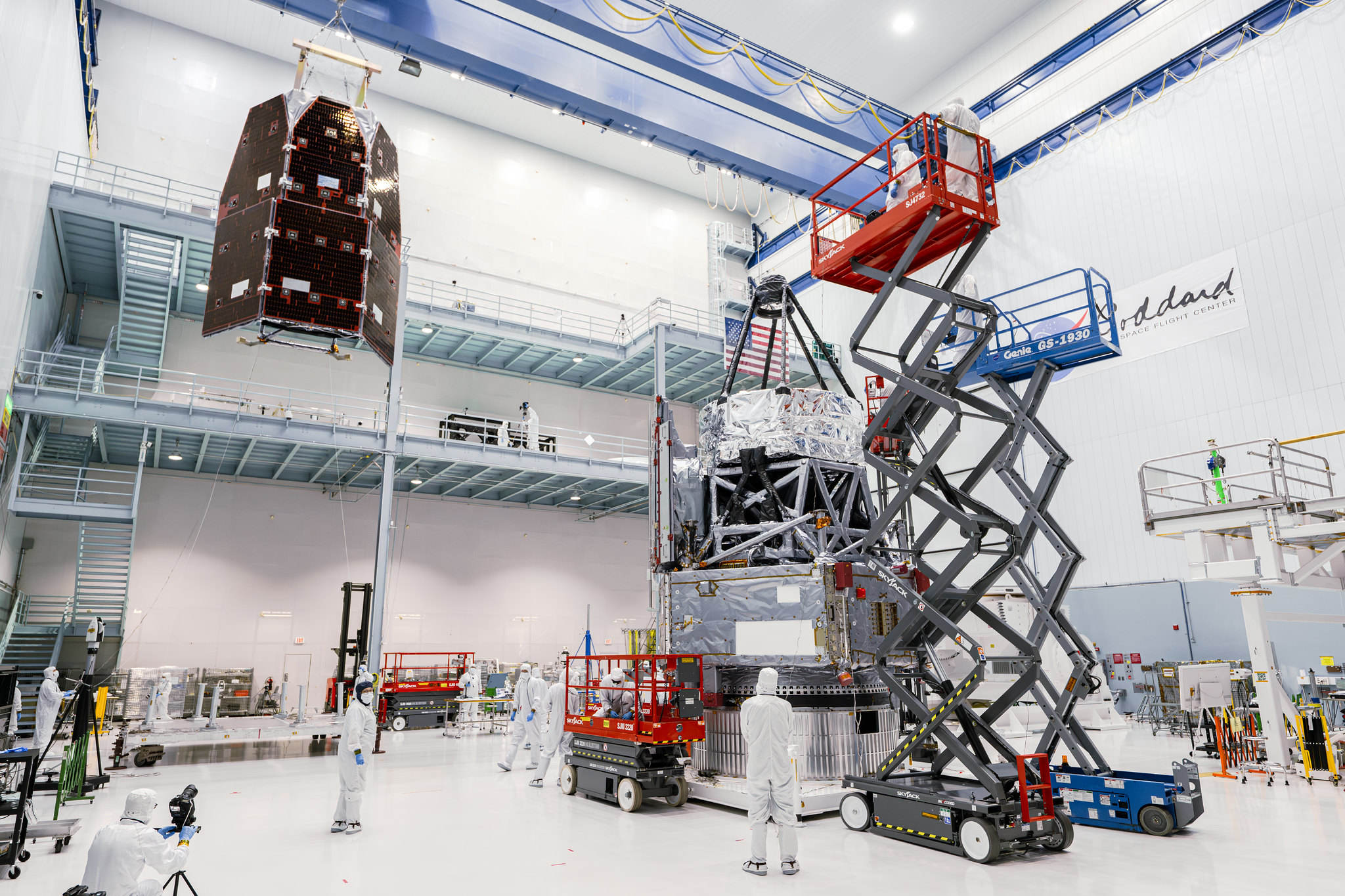
Constructed and led by NASA’s Goddard Space Flight Center in Maryland, Roman incorporates the latest engineering advances. The telescope is designed on a three-mirror anastigmat system, chosen for superb image quality across a wide field of view. Key hardware and components come from an international network of partners and contractors, notably Ball Aerospace (opto-mechanical assembly), Teledyne Scientific (detectors), Harris Corporation (optical telescope assembly), and more. Testing and integration efforts have taken the telescope through spin tests, white room assembly, and the final construction phases, concluding in late 2025.
Primary Instruments: Wide-Field Power and High Contrast Imaging
Wide-Field Instrument (WFI)
Roman’s Wide-Field Instrument is a 288—or, by some sources, 300—megapixel camera that sits at the heart of the mission. It covers visible and near-infrared wavelengths (0.48–2.3 microns), allowing it to pierce interstellar dust and capture celestial phenomena invisible from Earth-based observatories. Its field of view is vast—about 100 times wider than Hubble’s at comparable resolution, or 200 times in infrared.
- Detector Array: 18 H4RG-10 detectors from Teledyne, each using HgCdTe technology.
- Resolution: 0.11 arcseconds, giving Roman sharp vision over huge areas of the sky.
- Spectroscopy: Equipped with both high-dispersion grism and low-dispersion prism assemblies, the WFI enables slitless spectroscopy for analyzing thousands of galaxies and supernovae in a single observation.
- Science Focus: Survey billions of galaxies, chart cosmic acceleration, and conduct the most complete search for exoplanets to date.
- Survey Scope: The WFI’s unique design means it can assemble wide-field maps of the universe at a resolution never achieved in previous space telescopes.
Coronagraph Instrument (CGI)
The Roman Coronagraph Instrument is designed to block the overwhelming glare of stars, making it possible to directly image their orbiting exoplanets. Unlike previous coronagraphs, the CGI uses innovative dual deformable mirrors for starlight suppression, aiming to achieve a part-per-billion reduction in stellar glare. It also provides slitless spectroscopy, probing the compositions of planetary atmospheres in remarkable detail.
- Wavelength Range: Focused on visible to near-infrared (575–825 nm).
- Capability: Will allow Roman to image planets as close as 0.15 arcseconds to their host stars—reaching analogues of Jupiter and Saturn around nearby systems.
- Demonstration: CGI serves as a pathfinder technology for future missions such as NASA’s Habitable Worlds Observatory.
Where Will Roman Observe? Its Orbit and Launch
Roman’s orbit places it at the Sun-Earth L2 Lagrange point, about a million miles from Earth. This position provides both stability and an ideal vantage point, free from Earth’s thermal and magnetic interference. Other high-profile telescopes like James Webb, Gaia, and Euclid also occupy this prized location.
- Launch Vehicle: Scheduled aboard a SpaceX Falcon Heavy rocket from Kennedy Space Center in Florida.
- Status: As of late 2025, construction was completed, with mission integration and pre-launch tests underway.
- Launch Timeline: While the mission was long slated for a May 2027 launch, current estimates indicate that the telescope could launch as early as September 2026—potentially ahead of schedule.
Mission Timeline: From Concept to Countdown
- 2010: Decadal Survey by the National Research Council recommends Roman (then WFIRST) as the top astronomy priority for the decade.
- 2012: NRO donates two 2.4-meter mirrors, revolutionizing the design.
- 2016: NASA’s formal approval and entry into development; the “AFTA” portion of the name is dropped.
- 2020: NASA Administrator Jim Bridenstine announces the telescope will honor Nancy Grace Roman.
- 2021–2025: Assembly, integration, spin testing, and completion of major hardware.
- 2026 (Likely Launch): Final preparations, integration onto the Falcon Heavy, and readiness for interplanetary travel.
- 2026–2027: Commissioning phase and start of science operations.
The Science: Unlocking the Universe’s Deepest Secrets
Probing Dark Energy and the Expansion of the Universe
One of Roman’s main scientific goals is to understand why the universe’s expansion is accelerating. Dark energy—a mysterious force making up about 70% of the universe—remains one of astrophysics’ greatest enigmas. Roman attacks the problem with three independent survey techniques:
- Baryon Acoustic Oscillations (BAO): Measuring “ripples” left over from the early universe’s plasma, helping to constrain dark energy models.
- Type Ia Supernovae: Tracking “standard candle” cosmic explosions to gauge cosmic distances and the rate of acceleration.
- Weak Gravitational Lensing: Observing the subtle warping of light from distant galaxies—caused by the gravity of unseen mass (like dark matter)—to map cosmic structure.
The Hunt for Exoplanets
Roman uses two powerful techniques to search for worlds beyond our solar system:
- Gravitational Microlensing: The telescope monitors more than 100 million stars for weeks at a time, looking for temporary brightening caused by planets passing in front of background stars. This allows Roman to detect planets even smaller than Earth—including “free-floating” planets wandering through interstellar space, possibly down to Mars mass.
- Direct Imaging: Through the CGI, Roman will capture direct images and spectra of exoplanets orbiting nearby stars. This can reveal the chemical fingerprints of exoplanet atmospheres for the first time at large scale.
Roman is projected to discover up to 2,500 new exoplanets during its initial five-year mission, significantly advancing our understanding of planetary diversity and the potential for life beyond Earth.
Mapping the Cosmos: Galaxies, Supernovae, and Black Holes
Roman’s surveys will create panoramic maps of billions of galaxies across time and space—a boon for understanding how structures form and evolve. It will observe stellar explosions (supernovae), galactic mergers, the birthplaces of stars and planets (cosmic nurseries), and track the growth of supermassive black holes at the centers of far-off galaxies. For the Milky Way, Roman’s “Galactic Plane Survey” aims to provide our deepest-ever look into our galaxy’s crowded, mysterious core.
International Collaboration and Partnerships
Roman’s spectacular goals depend on teamwork across continents. NASA’s Goddard team leads overall project management, spacecraft and instrument development, and mission integration. The Jet Propulsion Laboratory in California heads up development of the Coronagraph Instrument. The Space Telescope Science Institute (STScI) in Baltimore serves as the Science Operations Center, while IPAC (Infrared Processing and Analysis Center) manages science data products.
- European Space Agency (ESA): Works alongside NASA on hardware and data processing, especially for cosmological studies.
- CNES (France): Contributes scientific planning, hardware, and data analysis expertise.
- JAXA (Japan): Proposed key upgrades to the coronagraph, including polarimetry modules that can probe planetary disks around other stars.
- Max Planck Institute (Germany): Involved in specialized instrumentation, such as the coronagraph’s filter wheels.
Related Projects and Missions
Roman is built on the legacy of previous “Great Observatories” and works synergistically with upcoming missions:
- Hubble Space Telescope: Roman’s primary mirror is the same size as Hubble’s, but its field of view is orders of magnitude larger.
- James Webb Space Telescope (JWST): Webb specializes in deep, pointed observations while Roman provides big-picture surveys; their data sets are complementary.
- ESA’s Euclid Telescope: Studies dark energy and dark matter using different techniques and wavelengths, providing essential cross-validation for Roman’s results.
- Xuntian: China’s planned space observatory, also targeting large-scale sky surveys in the coming decade.
How Roman Will Transform Astronomy
Roman’s immense survey speed and precision make it a 21st-century powerhouse for discovery. In just its first five years (with the strong possibility of mission extension), the telescope is expected to:
- Map more than a billion galaxies, including their shapes, motions, and environments.
- Find over 100,000 distant exoplanets, revealing much more about the frequency and nature of planetary systems.
- Collect data on cosmic structures—clusters, filaments, and voids—that define how matter is arranged on the grandest scales.
- Detect primordial black holes and perhaps even test alternative theories of gravity and cosmic origin.
Its potential impact on astronomy and cosmology will be enormous, making it possible to study the universe at levels never even imagined before and offering new perspectives to answer essential questions about our origin and destiny.