
- ,
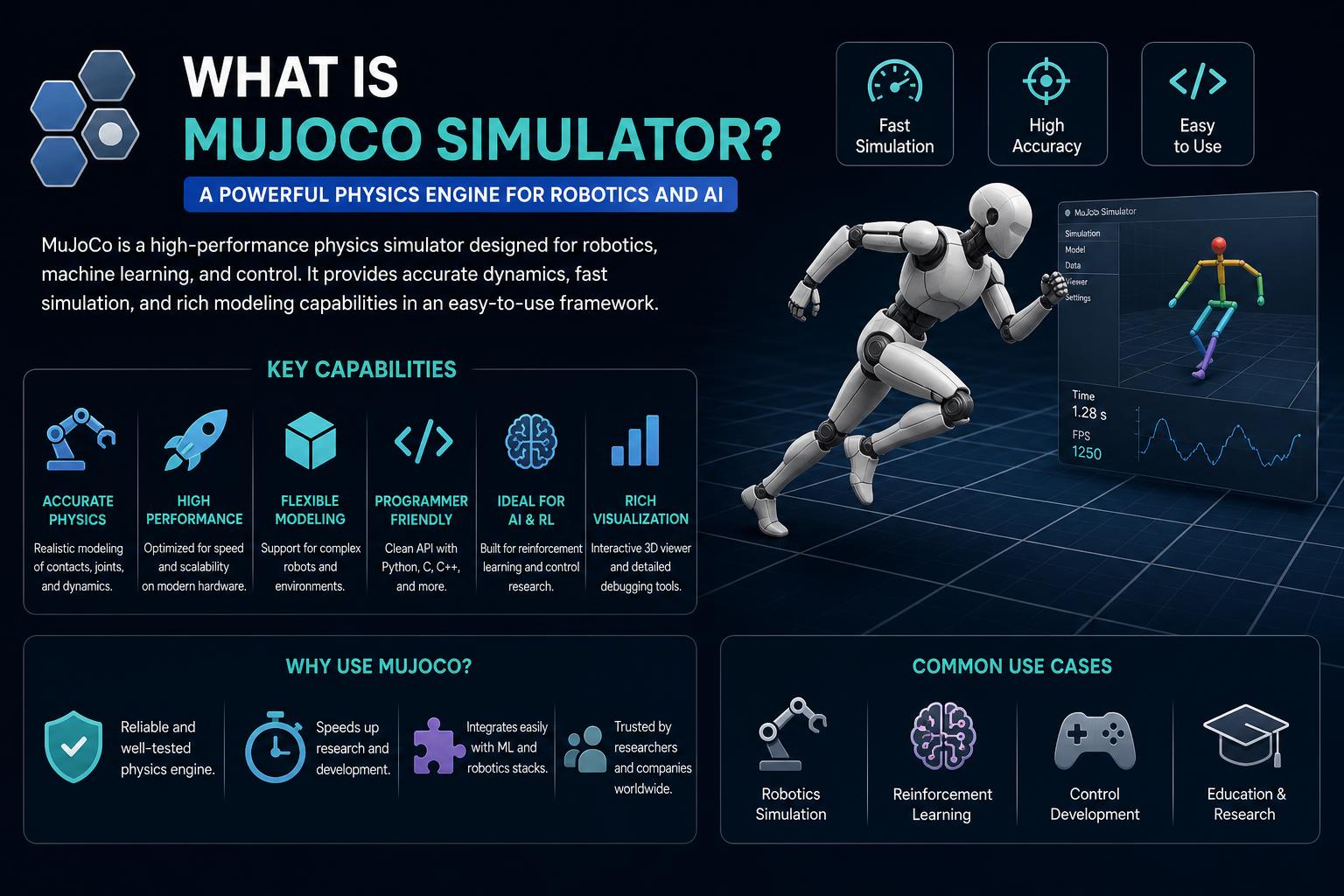
- MuJoCo is a high-performance, open-source physics engine ideal for contact-rich robotics simulation.
- It features efficient contact modeling, extensible APIs, and generalized coordinate-based representations.
- The platform supports advanced optimal control, reinforcement learning, and detailed biomechanical modeling.
MuJoCo, or Multi-Joint Dynamics with Contact, has rapidly become a staple in advanced robotics and physics simulation. Originally built in the early 2010s, it was designed to address the growing need for fast, accurate, and flexible simulations in robotics, biomechanics, animation, and even machine learning. Since its launch, MuJoCo has evolved from a proprietary tool to a free, fully open-source engine, with the backing of Google DeepMind and a thriving international community.
For anyone delving into research topics, robotics development, or complex animation—especially where realistic physical interactions are key—understanding what MuJoCo brings to the table is critical. Let’s dig into the ins and outs of MuJoCo, why it has become so important, the technology behind its physics simulation, how it’s used across a variety of fields, and the practical details that set it apart from rivals like PhysX or Bullet. Plus, we’ll explore how to get started and leverage its powerful features in your own projects.
What is MuJoCo? An Overview
MuJoCo stands for Multi-Joint dynamics with Contact and is a general-purpose physics engine tailored towards tasks that demand both performance and fidelity in simulating the physical world.
Originally conceived at the University of Washington’s Movement Control Laboratory and later commercialized by Roboti LLC, MuJoCo was subsequently acquired by Google DeepMind in 2021. Under DeepMind’s stewardship, it was open-sourced in 2022 under the Apache 2.0 license, which dramatically broadened access and accelerated community development. Today, you can freely download the engine from the official MuJoCo website or access the source on GitHub.
The primary design goal of MuJoCo is to empower research and engineering in areas where modeling contacts between articulated bodies is essential—think robotics arms grasping objects, humanoid robots walking, or simulating muscle-driven motion in biomechanics. At its heart, MuJoCo combines exceptional computational speed, accurate contact handling, and a flexible modeling language that appeals particularly to scientists and engineers.
Main Features and Capabilities of MuJoCo
What makes MuJoCo so attractive to researchers and developers? It isn’t just about simulating physical systems, but doing so with an advanced set of tools, customizable workflows, and extensible APIs. Here are some of the fundamental features that define the platform:
- Generalized Coordinates: Simulates systems using joint-space representation, making it ideal for complex kinematic models like robots.
- Robust and Efficient Contact Dynamics: Instead of relying on legacy spring-damper approaches or oversimplified physics, MuJoCo leverages modern convex optimization to guarantee unique, stable results—crucial where contact behavior determines overall system behavior.
- Model-Based Optimization: Built specifically with optimal control, data-driven system identification, and state estimation in mind, rather than just animation or gaming physics.
- Powerful Scene Description with MJCF: Includes a human-readable XML modeling language, MJCF, for creating and editing physics models, along with a compiler that translates these models into optimized runtime structures.
- Open, Cross-Platform Implementation: Maintained in C and C++, with comprehensive Python bindings and support for popular environments like Unity and GPU-accelerated backends.
- Native Interactive 3D Visualization: Comes with a built-in OpenGL visualizer to explore model behavior during simulation, debug scenarios, or design robotic systems.
- Extensible Plugin System: Easily augmented to support new actuators, sensors, constraints, or physics features without changing the core engine.
These features combine to form a platform particularly well-suited for both classic simulation tasks and cutting-edge AI, reinforcement learning, and robotics experiments.
MuJoCo’s History: From Academia to Open Source
MuJoCo was initially developed by Emanuel Todorov and colleagues as a response to the limitations they encountered in existing simulation engines. Most engines at the time struggled with the need for high precision in contact modeling, slow execution speed, or cumbersome modeling workflows.
By 2012, MuJoCo’s academic debut caught the attention of robotics and biomechanics communities worldwide, aided by its citation in thousands of research papers and its reputation for enabling novel research. After commercialization as a proprietary product, it eventually found its way into the hands of Google DeepMind, whose AI and robotics teams made extensive use of its unique solver and modeling approach. Recognizing the value for the entire scientific community, DeepMind open-sourced MuJoCo, inviting contributions and accelerating its technical reach.
This open-source pivot has triggered an explosion of activity, from core engine improvements to ecosystem projects like MuJoCo Playground, batch-rendering stacks, and in-depth guides and tutorials.
How MuJoCo Stands Out Among Physics Engines
Several physics engines are available, but MuJoCo’s appeal lies in three intersecting areas: simulation fidelity, customizability, and performance.
- Generalized vs. Cartesian Coordinates: Unlike gaming-focused engines, MuJoCo primarily works in joint-space (‘generalized coordinates’), making it far more natural for modeling robots. Instead of patching contacts on roomfuls of boxes, you can build articulated mechanisms with realistic joint limits, couplings, and actuations.
- Analytically-Invertible, Soft Contact Model: While most contact models in simulators like Bullet or PhysX are based on non-convex or NP-hard problems (linear/nonlinear complementarity), MuJoCo reformulates contacts as a convex optimization problem. This means reliable, fast, and stable simulations—even with complex interactions (friction, rolling, dry/slip behavior).
- Unified Scene Representation: Through its MJCF modeling language (a well-documented, extensible XML format), researchers can script or hand-author intricate models, from muscle-tendon systems reminiscent of biomechanics, to complex multi-body robots with sensors and actuators.
- Optimization for Researchers: At its core, MuJoCo isn’t just for pretty pictures or games. Optimization tasks—state estimation, trajectory optimization, system identification—are first-class citizens. Its API gives direct access to all state variables, forces, and solver internals for custom workflows.
Put simply, MuJoCo’s solver is remarkably efficient, running much faster than real time in many scenarios, but also predictable and stable for scientific reproducibility.
Key Technical Features: What’s Under the Hood?
Simulating reality is tough—MuJoCo achieves this by thoughtfully engineering each piece of its engine, data structures, and user interfaces.
1. Efficient, Thread-Safe Data Design
MuJoCo’s computation separates models (mjModel, describing all static system properties) from data (mjData, containing all state and intermediate computations). This separation means you can simulate multiple scenarios, parallelize experiments, or switch between states—all on the fly, without extra allocations (“zero memory allocation after initialization”).
2. Solver Choices for Contact and Dynamics
Depending on your needs, MuJoCo supports multiple numerical solvers:
- Newton Solver: Quadratic convergence for fast, accurate solutions (recommended for most applications).
- Conjugate Gradient: Useful in high-dimensional or ill-conditioned problems.
- Projected Gauss-Seidel: Handles elliptic friction cones, balancing performance and stability.
These solvers work seamlessly with the engine’s unified constraints, including soft/rigid contacts, joint and tendon limits, dry friction, and more.
3. Advanced Modeling of Tendons, Soft Bodies, and Flexible Objects
MuJoCo can simulate minimum-length path tendons (as in robotic arms or simulated muscles), ropes, cloth, and other deformable objects through composite constraints. Macros in MJCF make it easy to define complex assemblies without repetitive coding.
4. Versatile Actuation and Sensor Models
You can model electric motors, pneumatic/hydraulic cylinders, biological muscles, or even custom actuators. Actuation models are built to be richly parametric, supporting both conventional controls (PD, torques) and advanced, biologically-inspired systems.
5. Interactive and Fast Visualization
The built-in 3D visualizer (leveraging OpenGL) provides real-time rendering of models, forces, contacts, and sensor data. Features include skeleton overlays, inertia visualization, force/torque vectors, shadows, custom camera controls, and the ability to perturb a running simulation by “grabbing” parts of the model interactively.
6. Cross-Platform and Extensible
MuJoCo supports Linux, Windows, and macOS, with precompiled binaries and Python bindings distributed via PyPI. The engine can be embedded directly into custom C/C++ or Python workflows or used with external platforms like Unity for more complex visualizations.
7. GPU-Accelerated Backends
Through projects like MJX (JAX) and MuJoCo Warp (by NVIDIA), you can offload large-scale, parallel simulations to GPUs. These backends utilize the same mjModel/mjData interface, simplifying code portability and unlocking new research in deep reinforcement learning and large robotic populations.
8. Plugin Ecosystem
Developers can create shared library plugins to register new physics behaviors, actuators, or sensors with the simulation engine. This makes MuJoCo highly adaptable as research pushes into new territories.
Modeling with MuJoCo: The MJCF Modeling Language
Central to MuJoCo’s ease-of-use and flexibility is MJCF (MuJoCo XML Scene Description). Unlike some engines that force you to work with obtuse binary blobs, MJCF is a straightforward XML dialect, fully documented, and designed for both human readability and programmatic editing.
Imagine designing a robotic arm with multiple degrees of freedom, custom actuation, sensors, and a variety of geometric shapes—MJCF makes this approachable:
- Concise, Readable Syntax: Easily specify world bodies, joints, geoms, tendons, constraints, sensors, and visual elements in a handful of lines. Extensive defaults mean you rarely need to define every parameter.
- Extensive Macros and Defaults: CSS-like inheritance for parameter values, plus high-level macros for creating repeated structures such as grid meshes or linked segments.
- Support for MJCF and URDF Models: You can load models from both MuJoCo’s native MJCF and the robotics-standard URDF, enhancing interoperability with large open-source robot model libraries.
The workflow is simple: write your .xml model, use the MuJoCo compiler to create an optimized model, and then run it in simulation or export it for sharing.
Deep Dive: Simulation Pipeline and Computation
Under the hood, MuJoCo’s simulation pipeline is tightly optimized for both speed and modularity. Here’s a simplified breakdown:
- Model Definition: Write your model in MJCF or URDF and compile with MuJoCo’s XML compiler.
- Initialization: The model is compiled into an mjModel data structure, containing all static properties.
- Simulation Data Setup: Create mjData objects (can be many per model, supporting parallelism).
- Stepping: Call mj_step() (or its modular components) to advance simulation by one timestep, handling all forces, contacts, and integration.
- Custom Extensions: User-defined callbacks can introduce new forces, actuators, or collision behaviors with efficiency.
- Visualization and Analysis: Native GUI or programmatic access to all physical states, forces, sensor values, etc.
One big advantage is the level of control you have over the simulation: advanced users can break up the simulation pipeline, run just parts of it (for custom analysis or parallel sampling), or adjust solver settings at runtime for experimenting with performance and accuracy trade-offs.
Units, Stability, and Simulator Nuances
MuJoCo does not enforce a system of physical units—it’s up to you to use a consistent metric (MKS). Internally, quantities like gravity and density have defaults that assume MKS, but the engine is agnostic as long as all numbers stay consistent. This flexibility allows you to scale problems for efficiency, but you must remain vigilant to keep everything aligned.
Because of its highly optimized, mathematically rigorous solvers, MuJoCo can often run at thousands of simulated steps per second, even for complex scenes. However, like all physics engines, instability can occur if you push time steps too far or construct models with poor parameterization. Fine-tuning time steps, contact “softness,” and the right solver can yield a perfect balance of speed and stability.
Collaboration, Community, and Ecosystem
After its open sourcing, the MuJoCo ecosystem has flourished.
- Official Documentation and Tutorials: The best place to learn is the documentation, which contains everything from installation guides and API references to highly detailed discussions of the underlying math.
- Open Community and Support: Google DeepMind and the community handle questions through GitHub Discussions and Issues—a great place to ask for help, report bugs, or suggest features.
- Python, C, and C++ APIs: Python is the most popular interface (through PyPI), but there are also native C/C++ APIs plus integrations with Unity and ML frameworks (e.g., JAX, PyTorch).
- Cool Projects and Extensions: Notable community efforts include MuJoCo Playground, which streamlines robot learning on real robots; converters for OpenSim, SDFormat, and OBJ files; and exporters that let you leverage existing CAD models.
- Real World Impact: Thousands of research projects, control suites, and competitions rely on MuJoCo for their simulation and training, making it one of the most widely cited and respected simulation engines in the field.
Installation Guide: Getting Up and Running with MuJoCo
Getting started is straightforward, especially after the transition to open-source. Here’s a quick roadmap for most users:
- Visit the official site or GitHub repository to download the compatible binaries for your OS (Linux, Windows, or macOS).
- Unpack the distribution into your chosen directory.
- For Python projects, simply run pip install mujoco (possibly within a virtual environment or conda environment).
- Set up environment variables (e.g., MUJOCO_PY_MUJOCO_PATH, LD_LIBRARY_PATH) if needed for certain wrappers (mujoco-py or third-party packages).
- Explore the provided examples, built-in viewer (simulate), and documentation for further setup or custom builds. There are also IPython/Colab notebook tutorials available for interactive exploration.
The engine is lightweight, and you can validate your installation with simple scripts included in the documentation or community guides. If you want to integrate with machine learning libraries or simulation clusters, the community provides specialized wrappers and utilities.
How MuJoCo Is Used: Applications and Case Studies
MuJoCo’s versatility has made it the default engine in several high-profile research projects and robotics competitions.
Robotics Research and Development
Whether for industrial arms, humanoids, quadrupeds, or dexterous hands, MuJoCo is a favorite for simulating articulated mechanisms interacting with complex environments. Its ability to model contact-rich behaviors, friction, and actuation enables rapid prototyping of controllers before deploying to hardware, speeding up innovation while protecting expensive robots from risky early-stage tests.
Biomechanics and Physiology
Thanks to its tendon modeling and flexible constraint system, researchers can replicate animal or human musculoskeletal systems. This makes it possible to study movement, analyze injury scenarios, or even design bionic limbs and exoskeletons.
Machine Learning and Reinforcement Learning
# As a core tool for deep reinforcement learning, MuJoCo powers major control suites (like DeepMind Control Suite) and is a favorite in competitions (eg. OpenAI Gym / Gymnasium). The speed and stability allow massive parallelization for training AI agents on locomotion, manipulation, and navigation tasks, enabling breakthroughs in deep RL.
Animation, Gaming, and Graphics
Though not its primary use case, MuJoCo’s high-performance contact solver and soft-body support have made it a contender for generating realistic procedural animations and even game prototypes, particularly for simulations requiring physically plausible movement or interaction.
Breaking Down Model Elements: Bodies, Geoms, and Sites
Understanding MuJoCo’s “language” is key to unlocking its full capability.
- Bodies: Represent physical parts, organized hierarchically to form kinematic or dynamic trees typical of robotic arms or skeletons. Each body contains spatial frames and inertial properties.
- Geoms: Define the visual and collision shapes—think spheres, capsules, meshes—each attached to a body. Geoms can be convex or decomposed for non-convex shapes, and have attributes for color, texture, mass, and more.
- Sites: Lightweight objects for marking points of interest, routing tendons, attaching sensors or defining target locations. Sites cannot collide but are crucial for referencing and controlling.
This separation allows for efficient computation, flexible modeling, and clearer debugging; for example, you can attach multiple geoms to a single body to render or simulate a complex robot, while sites can specify rewards or observation points in reinforcement learning environments.
Joints and Actuators: Enabling Movement
Movement in MuJoCo is powered by joints, which control the degrees of freedom (DOFs) allowed between connected bodies.
- Joint Types: Hinge, slide, ball, and free joints allow for a wide range of mechanisms, from rotating limbs to floating objects.
- Generalized Coordinates: Instead of specifying every position separately, the system encodes the internal DOFs via joint variables, with forward kinematics computing each body’s position/orientation.
- Actuators: Add input forces (motors, muscles, PD controllers, etc.) to joints, enabling complex movement with model-based controls, custom force laws, and biologically realistic muscles.
This arrangement aligns with how real robotic systems and biological creatures operate, making the simulator particularly powerful for both engineering and biological investigations.
Contacts, Friction, and Constraints: Simulating Realistic Interactions
One feature that defines MuJoCo is its best-in-class modeling of contact interactions. Physical “touch” between rigid bodies, including friction, compliance, and collision, is notoriously difficult to simulate accurately and efficiently. MuJoCo’s solution:
- Soft, Convex Contact Models: All contact dynamics (including friction, rolling, sliding, and limits) are handled via convex optimization—allowing both speed and a unique solution (important for inverse dynamics).
- Customizable Softness and Slip: Parameters (solref, solimp) let users tune how “spongy” or “sticky” contacts behave. For situations needing zero slip (e.g. no sliding at all), an optional post-processing solver is available, although this sacrifices the convex optimization guarantee.
- Flexible Constraints System: Include dry friction, tendon constraints, equality constraints, and more, all unified under a single mathematical framework.
- Per-Island Parallelism: The constraint solver auto-discovers independent “islands” in the system, allowing for scalable parallel computation.
The upshot is that behaviors like robot feet contacting a rough surface, hands grasping irregular objects, or soft tissues interacting, can be simulated both efficiently and realistically.
Visualization, Debugging, and Analysis Tools
MuJoCo offers robust real-time visualization out of the box, using its own OpenGL-based GUI. Features include:
- 3D Rendering of meshes, geometric primitives, and textured shapes.
- Visual overlays for skeletons, inertia boxes, contact forces, normals, and external perturbations.
- Interactive tools to manually apply forces or perturb objects—essential for debugging control strategies or verifying model responses.
- Integration with scripting and batch rendering pipelines for advanced analysis or video export.
These native tools are augmented by third-party integrations—for example, game engine plugins (Unity), browser-based renderers for sharing results, or batch renderers for generating datasets for AI training.
Common Pitfalls and Nuances
No simulator is perfect, and MuJoCo’s power is matched by its need for careful modeling and parameterization. Common tips and caveats:
- Divergence: Simulations can “blow up” if time steps are too large or if physical parameters create unrealistic forces (e.g., initializing in penetration or using overly stiff contacts).
- Unit Consistency: As MuJoCo doesn’t enforce units, mixing centimeters with kilograms and seconds will cause chaos—stick to a single consistent system throughout!
- Surprising Collisions: Parent-child bodies typically won’t collide, but static parents (like a floor) are exceptions—so you may need to adjust collision filtering in the XML as needed.
- Softness/Slip: Some users are surprised by gradual sliding (even with high friction). Solref and solimp settings tightly control this, but often require lower time steps and careful tuning.
- Names and IDs: Most elements can be left unnamed, but names are required when cross-referencing (e.g., tendons, actuators). Internally, the engine indexes everything using zero-based integer IDs.
Ecosystem and Interoperability
The MuJoCo ecosystem extends well beyond the core engine:
- Bindings and Language Support: Native support for C, C++, Python; plug-ins for Unity and Python ML tooling; and ongoing efforts for seamless integration with emerging languages.
- Conversion Utilities: Easily import models from OpenSim, SDFormat, OBJ, or Onshape via specialized converters, supporting seamless reuse of models from other toolchains.
- Machine Learning Integrations: Tools for exporting simulation data for reinforcement learning, compatibility with Gymnasium, RLlib, and other RL libraries; community-run environments for benchmarking agent performance.
- Platform Support: Pre-built binaries are available for major OS platforms and architectures, including ARM and x86 Linux, Windows, and macOS (universal binaries for Apple Silicon and Intel).
This robust ecosystem ensures researchers can move fluidly between simulation, control, training, and deployment workflows.
Versioning, Licensing, and Community Participation
MuJoCo adheres to a monthly release rhythm, uses a modified semantic versioning scheme, and is licensed under Apache 2.0—a highly permissive, business- and research-friendly license.
Community guidance, style guides, and issue reporting are handled via GitHub, making the project accessible for contributions, bug fixes, and discussion. Creative Commons licensing covers documentation, images, and demonstration videos, supporting educational and derivative uses.
Success Stories and Recognition
MuJoCo is one of the most widely cited simulation engines in robotics and AI literature, with thousands of academic citations and extensive use within both public and proprietary research environments. The DeepMind Control Suite, dozens of robotics labs, and benchmark competitions rely on it for dependable, accelerated simulation. Notably, the MuJoCo Playground project won the Outstanding Demo Paper Award at RSS 2025, reflecting the impact MuJoCo has had in advancing robot learning at scale.
Despite the occasional critique (including, amusingly, some skepticism on Reddit about its use outside corporate research), MuJoCo continues to grow its adoption in universities, independent labs, and commercial ventures of all sizes.
Getting Help, Reporting Bugs, and Contributing
If you run into trouble or have ideas for improvements:
- GitHub Discussions: For general help, feature suggestions, or technical Q&A, post in the Discussion section of the MuJoCo repository.
- GitHub Issues: For bug reports, upstream feature requests, or deeper codebase discussions.
- Community Guides and Forums: While Reddit is a popular venue for informal discussion, more substantive help comes from GitHub and the official documentation’s community links.
- Contributions: Reviewed via standard pull requests, following the project’s contributors’ guide and coding standards.
Whether you’re a seasoned developer or a first-time roboticist, the combination of extensive documentation, active issue tracking, and a collaborative ethos ensures newcomers can become contributors in short order.
Best Practices and Advanced Tips for MuJoCo Users
- Stay Consistent with Units: Always use one system (MKS or CGS) for all your lengths, masses, and times. This prevents hard-to-debug errors.
- Tune Contact Parameters Early: Don’t wait for instability crises—adjust solref, solimp, and time steps for your models up front.
- Leverage Multi-threading and Parallelism: For machine learning or statistical sampling, create multiple mjData instances and run them in parallel threads.
- Reuse Existing Models: Explore the universe of open-source MJCF/URDF robots—the community has ported everything from classic manipulators to new experimental creatures.
- Visualize and Interact: Use the built-in viewer often. Being able to “grab” and perturb your simulated robots leads to better designs, better mechanics, and faster debugging.
For advanced users, digging into the lower-level API unlocks custom computation pipelines, real-time controllers, or direct integration with optimization and analysis frameworks.
From its academic origins to its open-source transformation, MuJoCo has become an essential bridge between theory and practice in robotics, biomechanics, and AI. Its unique approach to contact, generalized coordinates, model-based optimization, and flexible modeling language offers a toolkit unmatched for innovation. As the community grows—spanning students, industrial labs, and hobbyists alike—the engine is poised to continue powering the next generation of intelligent, physically-grounded machines.