
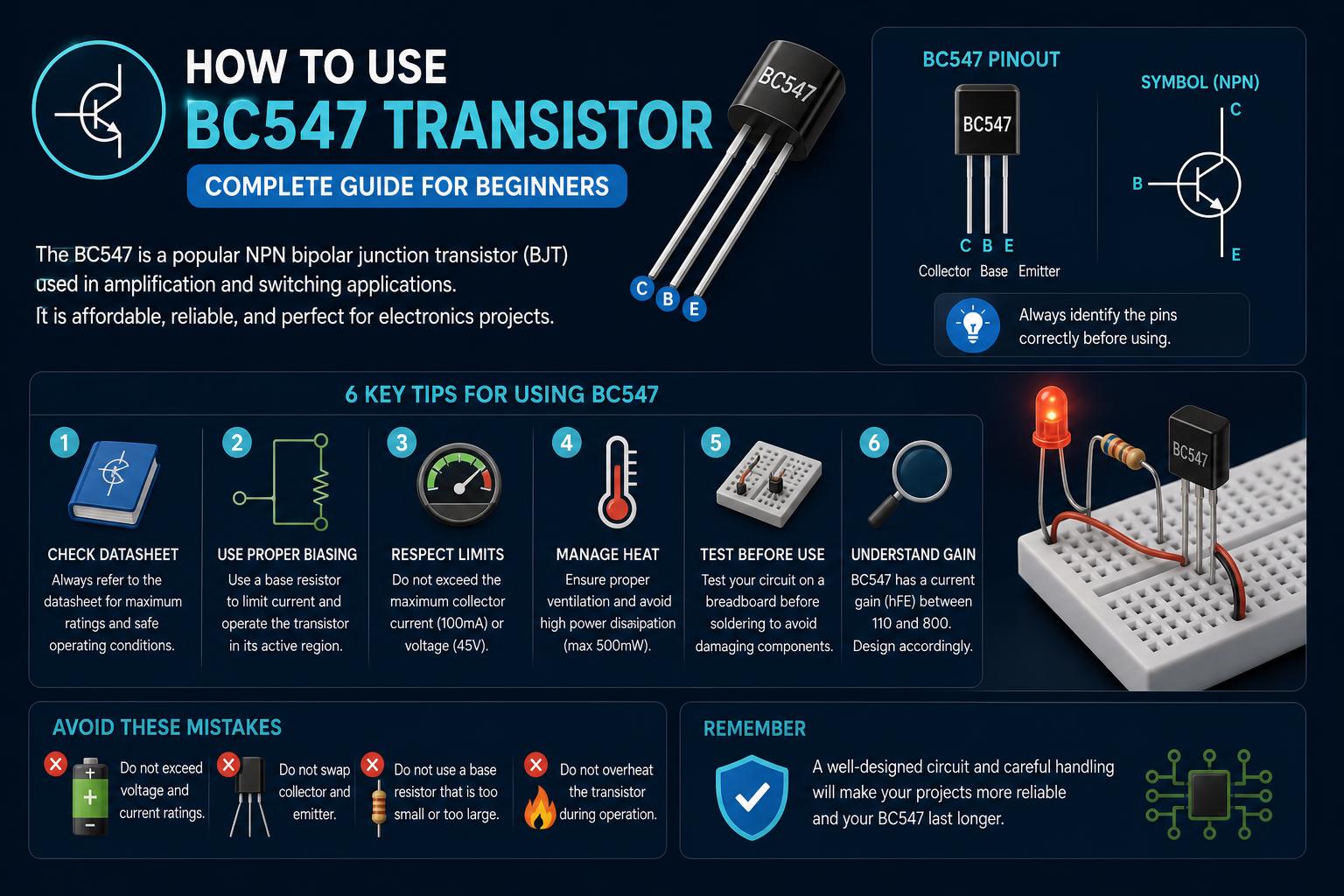
- BC547 excels in affordability, versatility, and high signal gain for low-power electronics.
- Proper usage includes knowing pinout, ratings, and common practical circuits like light switches and amplifiers.
- Authenticity matters—buy from trusted distributors, and test for faults to ensure long-term reliability.
The BC547 transistor is one of those staple components every electronics enthusiast or engineer has encountered, whether you’re just starting out with simple prototypes or tackling smarter automation projects. This tiny NPN BJT, packed inside a compact TO-92 package, might fly under the radar at first glance – but its capabilities, broad usage, and wallet-friendly price make it an absolute go-to for loads of low-power applications. From powering up LEDs to acting as the heart of reliable switching circuits, the BC547’s versatility speaks for itself.
If you’ve ever wondered why this unassuming three-legged device dominates DIY kits, sensor modules, and everyday electronics, you’re in the right place. Below, you’ll find a well-rounded guide uncovering everything from BC547’s inner workings to hands-on troubleshooting, essential pinout details, technical specs, practical circuit ideas, failure causes, cross-reference tips, and where to buy the genuine article with confidence. Let’s demystify the BC547 with practical advice and real-world applications anyone can use – hobbyist or professional.
Main Features That Make BC547 a Standout in Low-Power Electronics
When it comes to prototyping or commercial grade low-power circuits, the BC547 stands tall due to a special set of features and benefits that set it apart. Here’s why it’s such a frequent choice:
- Highly Affordable: Sourced in bulk, BC547s often cost less than two cents per unit, making them perfect for mass production or cost-effective hobby projects.
- Extensive Gain Range: With a DC current gain (hFE) that varies from 110 up to 800 (depending on type variant), this NPN transistor handles both precise small-signal amplification and robust switching.
- Space-Saving Package: The tiny TO-92 form factor fits easily in breadboards, perfboards, or densely-packed PCBs—ideal for space-conscious designs or upgrades.
- High Voltage Handling: This transistor can tolerate voltages up to 45V between collector and emitter, shielding your design from scary voltage spikes during load switching or irregular supply.
Technical Specifications at a Glance
Knowing what a component can do (and where its limits are) is essential before dropping it into a circuit. Here’s the vital stats for BC547:
| Specification | Value |
| Type | NPN Bipolar Junction Transistor (BJT) |
| Maximum Collector Current (Ic) | 100mA |
| Maximum Collector-Emitter Voltage (Vce) | 45 V |
| DC Current Gain (hFE) | 110–800 (suffix dependent: A/B/C) |
| Package | TO-92 |
| Maximum Power Dissipation (Pd) | 500–625 mW (varies by manufacturer) |
BC547 is available in three suffix variants (A, B, C), each denoting a gain range:
- BC547A: hFE 110–220
- BC547B: hFE 200–450
- BC547C: hFE 420–800
Pinout Details and How to Test Your BC547
Recognizing pin functions is crucial to prevent errors and smoke (literally) on the workbench! For the TO-92 package, facing the flat front, pins are arranged from left to right as follows:
- Pin 1 – Collector: This is the high-side output, usually connecting to the load (like an LED or relay).
- Pin 2 – Base: The control terminal. It typically receives a small current from a microcontroller or signal source, often routed indirectly via a resistor to avoid overcurrent.
- Pin 3 – Emitter: Usually connected to ground in classic NPN switching arrangements.
Testing your BC547 using a multimeter (in diode mode):
- Connect the red probe to Base and black to Emitter; a reading of roughly 0.7V means the junction is healthy.
- Reverse probes should give ‘OL’ (open circuit), confirming correct diode behavior in the BJT’s internal structure.
Maximum Ratings and When to Play it Safe
Pushing any transistor beyond its limits risks permanent damage, instability, or even total circuit failure. Here are the critical maximums to keep firmly in mind (and read the datasheet for your chosen manufacturer, as there are slight variations):
| Parameter | Value | Description |
| Collector Current (Ic) | 100mA (DC); 200mA peak | The device shouldn’t carry more than 100mA continuously |
| Collector-Emitter Voltage (Vceo) | 45–65V | Manufacturer-dependent; respect datasheet |
| Collector-Base Voltage (Vcbo) | 80V | Reverse bias maximum across collector-base |
| Emitter-Base Voltage (Vebo) | 6–8V | Beyond this, the base-emitter junction is at risk |
| Power Dissipation (Pd) | 500–625 mW | Consider heatsinking or pulsed operation in confined layouts |
| Junction Temperature (Tj) | -65°C to 150°C | Superior for industrial environments |
| Transition Frequency (fT) | 150–300MHz | Important for RF or signal amplification circuits |
Practical Circuits to Build with BC547
Let’s get hands-on—here are some everyday applications showing how this transistor puts in work in practical electronics.
- LED Driver Circuit: Used when an LED draws more current than a microcontroller pin can handle by itself.
How it works: Input voltage (e.g., from Arduino 5V) is fed into the base via a resistor (typically 220Ω); the collector connects to the anode of the LED, which passes through another resistor (e.g., 100Ω) before reaching ground via the emitter. The transistor switches the higher current needed by the LED, while the microcontroller only provides a small base drive.
- Audio Preamplifiers: BC547’s gain makes it a classic for first-stage audio boosting, whether for microphones or signal pick-up from sensors.
Design tip: The gain of a simple preamp with this transistor can be estimated as RC/RE (collector resistor divided by emitter resistor). With typical values (RC = 4.7kΩ, RE = 100Ω), you’ll see a clean, boosted output—great for guitar pedals or DIY audio gear.
- Relay Driver with Flyback Diode: When you want to toggle larger loads safely—like relays, buzzers, or motors—you can drive a relay coil with the BC547 and protect it against voltage spikes using a diode like the 1N4007 across the coil terminals.
Base resistor calculation: For safe switching, you’ll want a value such that RB ≤ (Vin – 0.7V) / (Ic / hFE_min). This protects your transistor and ensures the coil energizes reliably.
- Light-Sensitive Switch: Turning on a buzzer or LED based on ambient light is easy by linking an LDR (light-dependent resistor) and a fixed resistor in a voltage divider; the output feeds the BC547’s base, making the collector circuit act as an automatic switch.
- Darlington Pair for Super-High Gain: For weak input signals or when microcontrollers can’t supply much current, pair a BC547 with a powerhouse like the PN2222 NPN in Darlington configuration—giving you effective gain up to 10,000! Amplification for change detection or complex logic becomes a breeze.
More ideas and inspiration can be found on electronics project blogs such as NextPCB, where real-world implementation details are shared.
Choosing Alternatives: Compatible Substitutes for the BC547
Sometimes the BC547 might be out of stock, or a project’s requirements nudge you toward a close cousin due to gain, voltage, or package needs. Check out these commonly used equivalents and their differences:
| Part | Maximum Current (Ic) | Voltage (Vce) | Notable Characteristics |
| 2N2222 | 800mA | 40V | Much greater current capability, often in metal-can TO-18 package |
| BC548 | 100mA | 30V | Lower maximum voltage |
| 2N3904 | 200mA | 40V | Comes in through-hole and SMD (SOT-23) for compact layouts |
If you need to drive more than 100mA, look at robust Darlington devices such as the TIP120, while for modern, surface-mount designs, alternatives like MMBT3904 (SOT-23) and BC847 are pin-compatible and available everywhere.
Avoiding Faulty and Counterfeit Parts: Buying Genuine BC547
With counterfeits on the rise, it pays to stick to authorized distributors when sourcing BC547 transistors for critical designs. Safe bets include global names such as LCSC, Mouser Electronics, Digi-Key, and trusted local resellers. Authentic BC547s carry clear markings: the part number (plus variant: A, B, or C) and a unique lot code.
If in doubt, test the hFE using an Arduino-based transistor tester before deploying a bulk shipment in your design.
BC547: Common Issues and Field-Tested Solutions
No component is infallible. Here are the most typical headaches and what to do about them:
- Thermal Runaway: Symptoms appear as a rapid drop in gain (hFE), excess heat, and sometimes the classic burnt smell. A failsafe fix is always to use an emitter resistor of at least 10Ω; this provides negative feedback and prevents disaster. Si quieres entender mejor cómo funciona un transistor, puedes consultar qué hace un transistor.
- Electrostatic Discharge (ESD) Damage: Spike surges, even from handling, can fry junctions. Work on anti-static mats and connect yourself with wrist straps for safety.
- Overcurrent Stress: Never force the transistor to carry more than 100mA or operate beyond its Vce rating. For unknown failures, use your multimeter in series with the collector to check currents in-circuit, especially in experimental builds.
Often, high-frequency oscillations when using BC547 in amplifiers can be fixed by placing a 100pF capacitor between collector and base, which acts as Miller compensation—often quickly resolving instability issues.
BC547 FAQ: Real-World Questions, Straightforward Answers
- Can the BC547 drive 12V relays?
- If the relay’s coil current is within 100mA, yes. For heavier-duty relays (250mA and above), switch to a higher-powered device like a MOSFET or the TIP120 Darlington.
- Why do I have oscillations in my BC547 audio amplifier?
- Excessive gain can cause feedback loops. Lay down a 100pF ceramic cap from collector to base, and you’ll likely settle things.
- Which SMD part shares specs with BC547?
- Look for MMBT3904 and BC847 (SOT-23 package). Both offer similar performance for surface-mount layouts, perfect for modern compact gadgets.
BC547 Project Inspiration: Learn and Build
Bursting with ideas and want a starting point? Take advantage of technical guides and online communities dedicated to practical electronics and hands-on BC547 circuits. Expert blogs like NextPCB’s deliver circuit breakdowns, component selection tips, and supply-chain insights, ensuring your projects run seamlessly. The official BC547 datasheet (see SparkFun’s PDF) is also essential reading when integrating the BC547 into professionally engineered systems.
From simple sensor switches to robust audio front ends, mastering the BC547 gives your designs a professional edge at a hobbyist’s price. Remember, the mix of high availability, electrical resilience, and simplicity in use propel this little NPN workhorse into core electronics lore. Whether you’re buying from well-known distributors, diagnosing faults, or pushing its capabilities with creative circuits, the BC547 rewards careful design with years of reliable service.
What Does a Transistor Do? In-Depth Guide to Structure, Function and Applications