
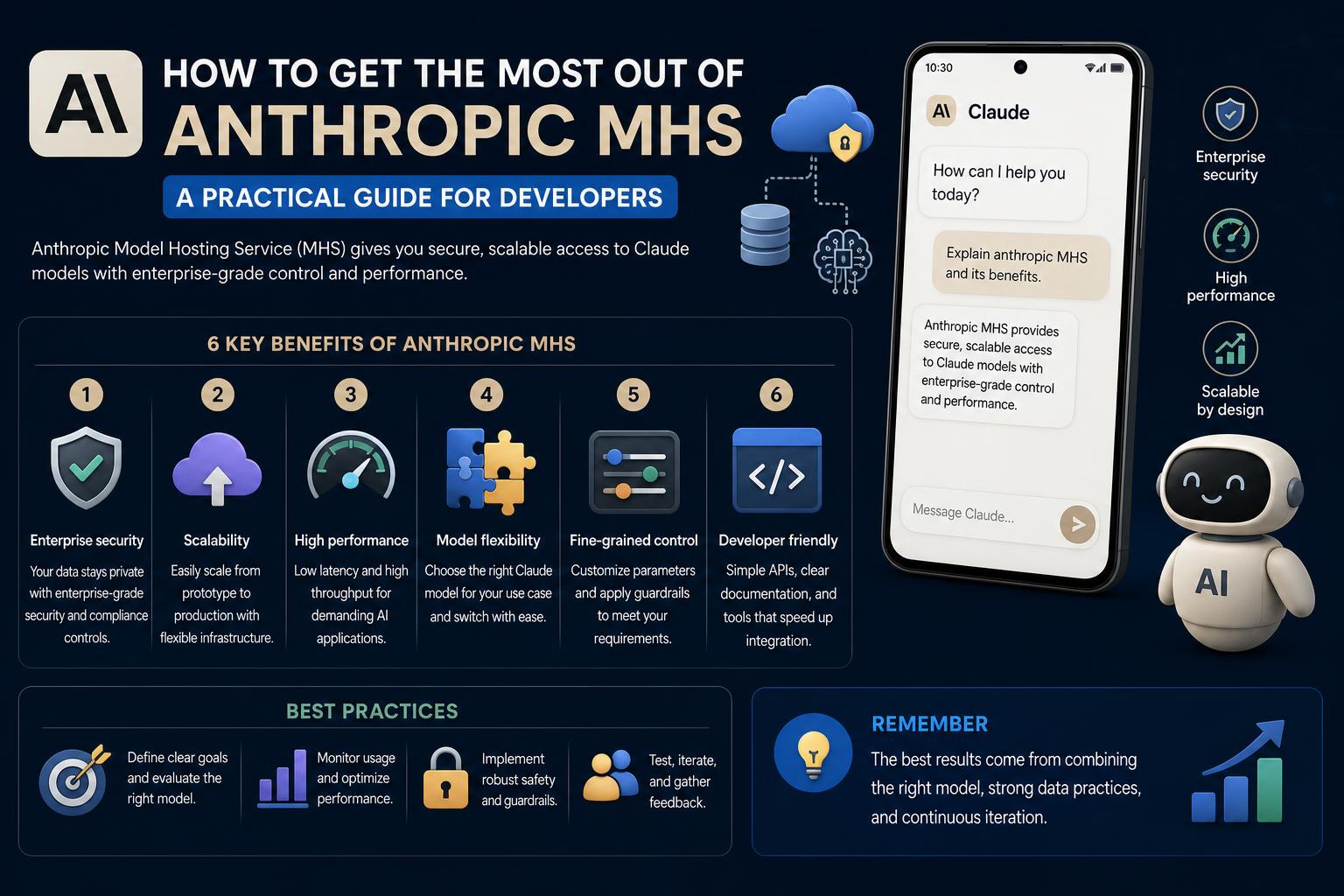
- The Model Hardware Standard (MHS) enables safe, standardized AI control of physical devices across labs and factories, aiming to reduce integration times from weeks to hours.
- MHS provides key benefits such as reusable drivers, improved interoperability, live monitoring, and robust safety enforcement at the device level.
- Limitations involve the need for programmable interfaces and human supervision for complex tasks, but pilot studies have showcased impressive reliability improvements and accelerated experimentation.
Artificial intelligence is moving from software alone to interacting with the physical world in real-time. This shift is revolutionizing how scientific labs and manufacturers operate, and at the heart of this transformation is Anthropic’s Model Hardware Standard (MHS). With its research preview launched in August 2026, MHS promises to let AI agents seamlessly discover, operate, and monitor real devices like microscopes and robotic arms, all under a shared, enforceable safety specification.
Let’s explore in detail how MHS is changing the way AI collaborates with devices, the engineering that makes it possible, its benefits and limitations, and what early pilots & partners reveal about the future of automated experimentation and manufacturing. Whether you’re deep in robotics or just curious about the fusion of AI and hardware, understanding MHS is crucial for anyone watching the evolution of lab automation, industrial control, or next-gen AI applications.
What Is the Model Hardware Standard (MHS)?
The Model Hardware Standard (MHS) is a shared framework and protocol developed by Anthropic in collaboration with HHMI’s Janelia Research Campus. It enables AI models to discover, interface with, and operate physical devices with programmable endpoints. Unlike legacy integration approaches where each lab or manufacturer had to laboriously handcraft device integrations, MHS creates a standardized pathway for devices to be accessed, understood, and controlled by any AI agent or system in a safe, repeatable manner.
MHS is not a model or a device itself but a specification and software driver that sits between any device with an API and the AI agent. This means it is both model-agnostic (not tied to a particular LLM or AI engine) and hardware-agnostic (able to support any programmable instrument or connected IoT device). Any agent, whether Anthropic’s Claude or a third-party model, can leverage the same control interface using standard protocols like the Model Context Protocol (MCP), command line, or API-based drivers.
Why Did Anthropic Create MHS?
The traditional landscape of scientific hardware integration is fragmented and inefficient. Most laboratories and factories face weeks or months of setup when trying to connect their specialized equipment. Devices from different vendors rarely communicate natively, requiring teams of experts to build custom adapters every time a new piece of hardware is added.
Anthropic’s motivation for MHS is to slash this integration time to just hours or minutes, drive repeatable, safe AI orchestration of multiple devices, and capture operational expertise into reusable code and safety constraints. The ultimate goal: accelerate discovery, experimentation, and automation in any domain relying on networked equipment with programmable endpoints.
How Does the Model Hardware Standard Work?
MHS centers on a standardized driver that wraps every device, translating a unified set of commands and descriptions across the physical-digital divide. Here’s how the architecture operates in practice:
- Device Abstraction Layer: Each physical device is paired with an MHS driver. This acts as a translation layer, exposing a simple set of primitives—primarily “read” (like reading temperature) and “write” (such as setting a speed or limit).
- Device Self-Description and Discovery: All devices announce their presence and describe their characteristics in a standard, machine-readable format. This enables AI agents to automatically discover not just the device but also its capabilities, measurement options, adjustable parameters, and enforced safety limits, even if the agent has never seen this specific equipment before.
- Safety Enforcement at the Driver Level: Safety constraints, such as maximum temperatures or forbidden motion ranges, are enforced by the MHS driver itself—not by the AI agent or model reasoning alone. If an agent attempts an unsafe action, the driver blocks execution regardless of higher-level intent.
- Natural Language Mapping: Users can describe their device’s features, physical context, and operational boundaries using plain English in the driver’s metadata tags. The system can also let an agent “interview” a user to fill out these details. This data is then synthesized into a reference profile, making operational knowledge both explicit and standardized.
- Three Control Pathways: Agents can direct devices via the Model Context Protocol (which uses JSON-RPC for interaction), command lines, or code files/API scripts. This flexibility allows both live orchestration and deterministic scripted sequences.
When a workflow grows complex or needs robust speed, the AI can compile its learned process into a repeatable script, running deterministically without continual agent supervision. This hybrid approach—live reasoning followed by deterministic automation—has proven critical in successful pilots.
Real-World Case Studies and Demonstrations
The practical potential of MHS comes alive in the pilot projects conducted by early adopters and key industry partners. Let’s explore what these studies show:
Genentech: Protein Assay Automation
Genentech used Claude (Anthropic’s AI) to orchestrate a multi-step protein assay using three devices: a liquid handler, robotic arm, and plate reader. The AI had to calibrate different flow rates for water versus a dense protein solution—an operation that usually takes a specialist coding for each parameter combination. Through experimentation, the model settled on reliable settings (e.g., 140 microliters/second for water, 10 for protein), overcoming equipment errors and validating results against expert-prepared references. This level of calibration and recovery, typically manual and laborious, became automated and self-correcting.
HHMI Janelia: Unified Imaging Workflows
Before MHS, a single microscope rig at Janelia required coordination of seven programs written in different languages, none integrated. Adding a device was a multi-day event. With MHS drivers, the integration dropped to minutes. Launching experiments became a one-click affair. Researchers could remotely monitor all instruments from a unified dashboard, and real-time closed-loop microscopy allowed on-the-fly parameter adjustment during live experiments. This compression of setup time and centralization of monitoring represented a step-change in operational efficiency.
QuEra: Autonomous Laser Stabilization on Quantum Hardware
QuEra’s quantum computers depend on ultra-precise laser locking for stability. Traditionally, regaining lock required multi-minute expert interventions with a sluggish 58% success rate. Using four Claude instances running in an overnight feedback loop (one to hypothesize, others to generate, run, and analyze scripts), MHS-enabled controllers slashed recovery time to seconds and boosted success rates to 99.3%. A key detail: the resulting processes are turned into plain, inspectable code files. AI is instrumental in process discovery, but finished routines run deterministically—no agent needed during operation. Machine learning becomes a catalyst for robust automation, not a permanent dependency.
Who Is Building with MHS?
The research preview of MHS attracted a wide array of industry leaders, including:
- Amazon Web Services: Adding support through Strands Robots, a library for connecting AI agents to physical devices.
- Tecan: Integrating MHS on their Fluent liquid handling platforms.
- Universal Robots: Planning broad support across their robotic arms.
- QIAGEN: Testing MHS on nucleic acid purification systems for troubleshooting and resilience improvements.
- Doosan Robotics: Conducting trials on automated QA via robotic arms.
- Automata: Introducing MHS support to their LINQ lab automation stack.
- Danaher: Exploring smart instrument scaling for automated research and development.
- MBF Bioscience: Developing MHS drivers for their microscope control software.
- Hugging Face: Integrating MHS with the LeRobot robotics library.
- Raspberry Pi: Enabling MHS for popular boards and camera modules.
This partner ecosystem signals an emerging industry standard, not just a vendor-specific tool for Anthropic’s Claude models. Hobbyists and smaller labs may soon benefit, as drivers spread to consumer-level hardware.
Benefits of the Model Hardware Standard
- Dramatically reduced setup and integration times: Early adopters report a shift from weeks or months of manual programming to just hours or days thanks to reusable MHS drivers.
- Device and vendor interoperability: One agent interface can manage multiple hardware brands, reducing the need to rewrite code for each instrument.
- Safety built-in at the hardware boundary: The MHS driver enforces safety rules so agents can’t operate outside safe zones, dramatically reducing risk when AI interacts with real-world systems.
- Knowledge sharing and reusability: Operational parameters, best practices, and recovery routines encoded in drivers mean that specialist insights become available to every future operator or AI agent.
- Continuous experiment monitoring: Agents can oversee 24/7 operations, triggering live interventions or flagging exception events with minimal human oversight.
Important Limitations and Challenges
The current MHS specification is a research preview, and builders must be aware of its limitations:
- AI physical reasoning remains immature: Early pilots revealed AIs still struggle with nuanced physical phenomena, like the effects of air bubbles in precise pipetting or diagnosing hardware failures. Human intervention and supervision are often needed in such contexts.
- Requires programmable device endpoints: Devices without software interfaces or APIs are not supported, though future drivers may address this through built-in integrations.
- Behavior is only as robust as the driver definition: If a device’s safety profile is incomplete or ambiguous, operational risks remain. Manufacturers and users need to collaboratively maintain detailed, accurate device manifests.
- Regulatory compliance questions: New legislation in Europe, such as the EU Machinery Regulation (2023/1230 from January 2027), may mean that safety logic encoded in an MHS driver could be considered a “safety function,” requiring formal certification.
- Security considerations: Connected devices can present new surfaces for attack. Current best practice is to isolate operational technology, use least-privilege permissions, and log every agent command for audit.
- Cost and resource usage: Running intelligent agents continuously involves non-trivial compute and network costs, especially for real-time or high-throughput environments.
MHS vs. Previous Standards and Protocols
MHS does not replace protocols like SiLA 2, OPC UA, or ROS 2, but instead complements them by providing a ‘smart layer’ for AI-driven device control. Where legacy protocols expect human-crafted recipes or schedulers, MHS is designed for AI agents capable of learning operational logic or adapting workflows in real time.
Organizations already invested in automation standards can wrap their legacy systems in MHS drivers, making new or old equipment accessible and upgradable as AI capabilities gather pace. Importantly, the additional layer of self-description, safety, and live reasoning-to-code transition is unique to MHS, enabling more robust, transparent operation than generic device communication protocols.
[relacionado url=”https://www.ikkaro.net/matter-1-4/”]
Deployment Recommendations and Pilot Steps
Interested in running your own pilot? Early reports outline a proven path:
- Catalog your equipment: List all devices and document the interfaces (API, command line, job files, etc.) each one supports.
- Choose a clear, bounded workflow: For instance, automate monitoring of a long experimental run or orchestrate a specific multi-instrument process.
- Install or create MHS drivers for each target device: Explicitly describe safety limits and operational parameters before allowing write operations.
- Start with read-only access: Let your AI agent observe and analyze workflows safely before incrementally introducing control commands (with human review for sensitive actions).
- Codify stable routines: As robust sequences emerge, convert them to scripts or code files for repeatable, deterministic execution, benchmarking improvements versus previous manual methods.
Security, Privacy, and Lifecycle Management
Security and privacy remain at the forefront of MHS-driven automation. For pilots in regulated or data-sensitive environments, it’s critical to:
- Enforce network segmentation: Keep operational hardware isolated from wider networks.
- Apply least-privilege permissions: Both at the agent and driver layer, ensuring agents only have access needed for specific, approved operations.
- Maintain robust logging and audit trails: Each command, response, and resulting data should be traceable, timestamped, and attributed for compliance and fault diagnosis.
- Understand service boundaries: Cloud-hosted AI services (using Claude, for example) may have data retention policies (e.g., deletion of API data within 30 days, as with Anthropic or AWS ‘zero data retention’ options). On-prem or self-hosted options may not be available yet.
Model lifecycle: Know your provider’s model release, retirement, and regression notification practices. Anthropic, for instance, commits to a minimum 60-day notice before retiring released models.
The Future of AI-Integrated Hardware with MHS
Anthropic has committed to releasing the Model Hardware Standard as open source following the research preview phase. Along with deployment guidance and safety findings, the project intends to expand to more devices—potentially enabling end-to-end automation of complex workflows in research, industry, and even consumer contexts.
Success will hinge on several triggers: a widely adopted open-source license, enthusiastic uptake from third-party AI and robotics vendors, seamless driver integration by equipment manufacturers, and clear regulatory pathways in critical sectors.
The first to benefit will be those ready to blend technical integration know-how with supervisory skills—people able to direct, verify, and iterate on AI-driven automation safely and responsibly.
Anthropic’s Model Hardware Standard marks a pivotal turning point in how AI interacts with the real world, granting agents the tools to control, optimize, and monitor hardware of all kinds, accelerating experimentation and operational efficiency in labs, factories, and beyond. While current limitations mean skilled oversight remains crucial, the standard’s blend of interoperability, robust safety, and reusability is already giving early adopters a glimpse into tomorrow’s automation landscape. For organizations facing slow, manual equipment integration or seeking to scale their automated operations, tracking the evolution of MHS—and piloting its tools—could provide a decisive edge as AI’s role in the physical world becomes mainstream.