
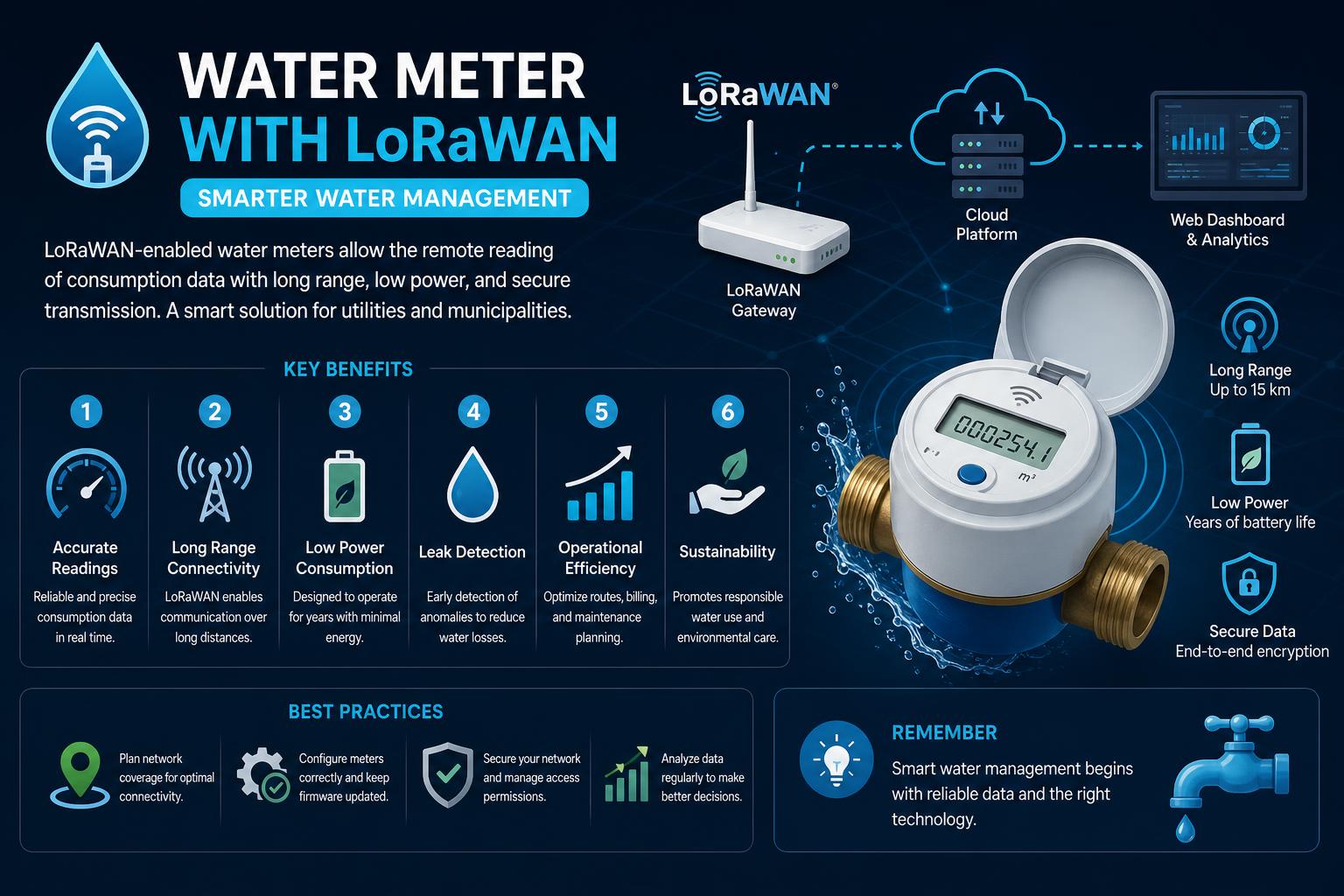
- LoRaWAN water meters enable automated, long-range data collection for smarter water management
- Integrations with cloud and on-premise systems deliver real-time analytics and remote control
- Proper planning and robust hardware ensure reliability, long battery life, and flexibility for different applications
With the rapid growth of smart infrastructure and IoT solutions, water management is undergoing a major transformation. Across cities, industries, and even in rural spaces, utilities and property owners are turning to advanced water meters featuring LoRaWAN (Long Range Wide Area Network) to solve some of the most pressing challenges of water conservation, leak detection, and remote management.
From reducing water waste to cutting labor-intensive manual readings, LoRaWAN smart water meters are reshaping how we think about consumption, billing, and infrastructure longevity. If you’re considering deploying a LoRaWAN water meter, or just trying to wrap your head around how the technology stacks up against traditional methods, this article walks through real-life use cases, technical details, deployment tips, and the genuine benefits and challenges providers are experiencing in the field.
What is a Water Meter with LoRaWAN?
A water meter with LoRaWAN integrates a standard water flow measurement device with wireless radio technology, unlocking remote communication and data transfer across long distances and even through challenging environments. The LoRaWAN protocol excels in low-power, long-range connectivity and is ideal for sprawling utility networks, underground installations, or remote facilities where standard wireless options or mobile networks fall short or are cost-prohibitive.
Typically, these meters are equipped with battery-operated LoRa modules and robust sensors that regularly transmit accurate usage data, alert operators about leaks in real time, and provide rich analytics for optimizing consumption, all without the need for technicians to visit each unit for manual readings.
Core Features and Advantages of LoRaWAN Smart Water Meters
- Remote, automated meter reading: Real-time data capture eliminates manual readings and allows billing to reflect actual consumption. This not only cuts operational costs but enables faster detection of anomalies such as leaks or unauthorized use.
- Leak detection and loss prevention: Continuous monitoring coupled with instant alerts means infrastructure managers can jump into action before significant waste or damage occurs. In many networks, early intervention is key to saving thousands of gallons and averting costly repairs.
- Detailed consumption analytics and reporting: From monthly reports to granular hourly usage breakdowns, both end-users and utilities gain a clear picture of water usage patterns. This facilitates more responsible consumption and aids in regulatory compliance.
- Long-range, low-power design: LoRaWAN excels at covering large areas with minimal gateways, even in environments where conventional wireless struggles, including underground networks or with obstacles like metal utility box lids.
- Flexible integration: Whether you’re retrofitting existing meters or rolling out brand-new installations, LoRaWAN meters and pulse counters are designed for easy upgrades and secure cloud-based data management.
Transforming Water Utilities and Building Management
The traditional challenges faced by water suppliers, facility managers, and property owners go far beyond just reading a meter – inaccurate readings, undetected leaks, high manual labor, and poor data availability can all add up to significant losses.
LoRaWAN-based smart water metering changes the game by allowing real-time, remote access to water consumption, environmental data such as temperature and humidity, and offering integration with cloud platforms for instant visualization and control. This technology not only improves efficiency but plays a vital role in sustainability. For utilities dealing with resource scarcity, accurate, continuous data feeds make a measurable difference in saving water and money for both the provider and the customer.
How Do LoRaWAN Water Meters Actually Work?
These meters operate by combining a water flow sensor with a LoRaWAN communication module. Here’s a typical deployment workflow:
- Installation: Meters are installed at desired monitoring points (individual flats, industrial units, irrigation pivots, etc.). They can be new smart devices or, through solutions like the Milesight EM300-DI, existing mechanical meters upgraded with a pulse counter.
- Data capture: As water flows through, the meter or pulse counter records usage, which is then converted into digital data packets.
- LoRaWAN transmission: At predefined intervals, the meter wirelessly sends its readings to a nearby LoRaWAN gateway, even if there are significant obstacles or the meter is located underground or behind heavy metal lids.
- Data aggregation and processing: The gateway forwards the data over the internet (using Ethernet, Wi-Fi, LTE, etc.) to a central cloud service or a secure local server (such as the ITS Edge Cabinet or Milesight IoT Cloud).
- User access and action: Both operators and end-users can access this data via web dashboards to monitor usage, identify problems, and optimize conservation efforts – all remotely, without need for physical inspections.
Deployment Options: Cloud vs On-Premise
Depending on the organization’s requirements, LoRaWAN water meter systems can be deployed using a fully cloud-based or a local, on-premise model.
- Cloud platforms: Systems such as Milesight IoT Cloud enable centralized monitoring and management across multiple sites, buildings, or municipal services, aggregating readings for detailed analytics and reporting.
- On-premise (local) solutions: Deployable with platforms like ITS Edge Cabinet, this approach keeps all data local within a facility, which is ideal for sensitive sites or those without reliable internet – yet still provides powerful visual dashboards and historical consumption reports.
Common Use Cases and Scenarios
LoRaWAN smart water meters are proving versatile and effective in a wide range of environments:
- Residential utility metering: Automating readings in homes and apartment blocks streamlines billing and detects issues before they escalate.
- Industrial and commercial facilities: Detailed flow and pressure monitoring helps businesses control costs and ensure regulatory compliance.
- Irrigation and agriculture: Precision tracking of water usage in fields maximizes crop yield and minimizes waste, with remote alerts for leaks or abnormal consumption.
- Underground networks and remote locations: With long-range capabilities and durable, waterproof hardware (like the IP67-rated EM300-DI), even buried pipes or isolated infrastructure can be monitored effortlessly.
Featured Hardware Solutions and Platforms
Several manufacturers and solution providers are propelling the adoption of LoRaWAN in water management. Noteworthy examples, as seen in current market leaders’ deployments, include:
- Milesight EM300-DI LoRaWAN Pulse Counter: Designed to retrofit existing mechanical meters, this device delivers remote reading capabilities with ultra-low power usage, batteries that last up to a decade, and waterproof construction for challenging placements. Users benefit from integrated temperature and humidity monitoring, and advanced features such as accumulated or real-time counting. For monitoring and control, the Milesight IoT Cloud provides unified dashboard visualization and secure remote access.
- UG67 Outdoor LoRaWAN Gateway: Part of the Milesight ecosystem, this gateway reliably collects meter data and transmits it to the intended cloud or local destination, even over large areas or in adverse conditions.
- LineMetrics Smart Building Platform: Offers an all-in-one solution for plug-and-play monitoring without the need for complex network setups. Hardware, connectivity, platform integration, support, and security updates are bundled for a hassle-free experience. Within three minutes of installation, users can be reviewing data in the LineMetrics Cloud.
- ITS Solutions: The ITS Water LoRaWAN system delivers flexibility between local-only monitoring (Edge Cabinet) or Internet-based aggregation and reporting (ITS Cloud). This supports multi-site deployment with shared dashboards and historical trends.
Why Choose LoRaWAN Over Other Wireless Solutions?
Unlike Wi-Fi or mobile data connections, LoRaWAN is specifically engineered for IoT scenarios where long-range, penetrating power, and near-zero energy consumption are critical. A few important advantages are:
- Reduced infrastructure requirements: Fewer gateways are needed to cover the same area as hundreds of Wi-Fi routers or mobile repeaters, yet the network can penetrate basements, vaults, and through heavy metal or concrete obstacles.
- Unmatched battery life: Many LoRaWAN devices, especially when used in pulse counting scenarios or with optimized reading intervals, achieve 5 to 10 years of continuous operation on a single set of batteries.
- Lower operational costs: With automated readings, utilities cut fleet costs and minimize human error, while gaining accurate data streams.
However, range and penetration can vary based on the deployment environment. Community feedback (such as on Reddit) suggests that metal lids and dense urban construction may reduce LoRaWAN range under certain circumstances – for example, some users report ranges below 300 meters in urban canyons when meters are deeply buried or covered by substantial metal. In these cases, network planning and gateway density must be considered during project design.
Implementation and Maintenance Considerations
Deploying a successful LoRaWAN water metering project involves careful hardware selection, robust network planning, and attention to ongoing management:
- Device durability: Prioritize meters and pulse counters with weatherproof and tamper-resistant features, such as IP67-rated casings for outdoor or underground scenarios.
- Battery longevity: Choose solutions that support years of use without replacement to minimize maintenance visits, as seen with high-capacity options offered by leading vendors.
- Platform integration: Whether preferring cloud-based analytics or on-premises security, ensure your solution supports seamless integration with your billing, alerting, and maintenance systems. Many modern platforms, like those from Milesight and ITS, allow for extensive customization of data reporting, visualization, and export to existing business processes.
- Gateway planning: Especially in dense or obstructed areas, plan sufficient gateway coverage to ensure reliable data delivery, considering environmental factors and potential range limitations.
Key Benefits for Stakeholders
- Utilities and city planners: Enjoy streamlined operations, reduced manual labor, precise tracking, and predictive maintenance, contributing to lower costs and improved service quality.
- Industrial and commercial property managers: Use data insights to optimize consumption, rapidly address leaks, and fulfill regulatory reporting requirements, often with remote management functions.
- Residential users: Gain transparency in billing, receive timely alerts about unusual usage, and adopt sustainable water usage patterns backed by real-time feedback.
Some users and operators are even exploring creative integrations, such as combining water data with environmental or building management systems for truly intelligent automation throughout whole facilities or city grids.
Limitations and Real-World Challenges
Despite all these strengths, there are still hurdles and factors to consider when moving to LoRaWAN-based water metering:
- Coverage and interference: The range can be hampered by dense obstacles, heavy metal, or underground placement – thoughtful site surveys and sometimes additional gateways are needed for robust signals.
- Standardization and compatibility: Retrofits can be complex if not all existing meters support pulse output or are compatible with current LoRaWAN modules – checking your infrastructure is critical before investing.
- Data privacy and security: With increased digital access comes a need for robust security protocols; reputable platforms incorporate strong encryption, access control, and regular updates to mitigate cyber risks.
- Cost vs ROI: Upfront investments in hardware and infrastructure are present, but most organizations report significant savings in manpower, leak-related loss, and better asset longevity over time.
The Future of LoRaWAN Water Metering
LoRaWAN continues to set the standard for large-scale smart metering deployments thanks to its unique combination of low-power consumption, vast coverage potential, and proven resilience in tough conditions. New offerings from vendors like Milesight, LineMetrics, and open platforms such as ITS are making plug-and-play deployment easier, especially for users new to IoT or with limited technical resources. In addition, increasing regulatory pressure to curb water waste and the drive for sustainable construction means adoption will only accelerate.
What truly sets LoRaWAN apart is its adaptability with both new and existing meters, generous battery life, and effortless integration with cloud or local monitoring systems. From municipalities to building operators, the technology is unlocking new levels of insight and efficiency, transforming water management from reactive routine to proactive excellence.