
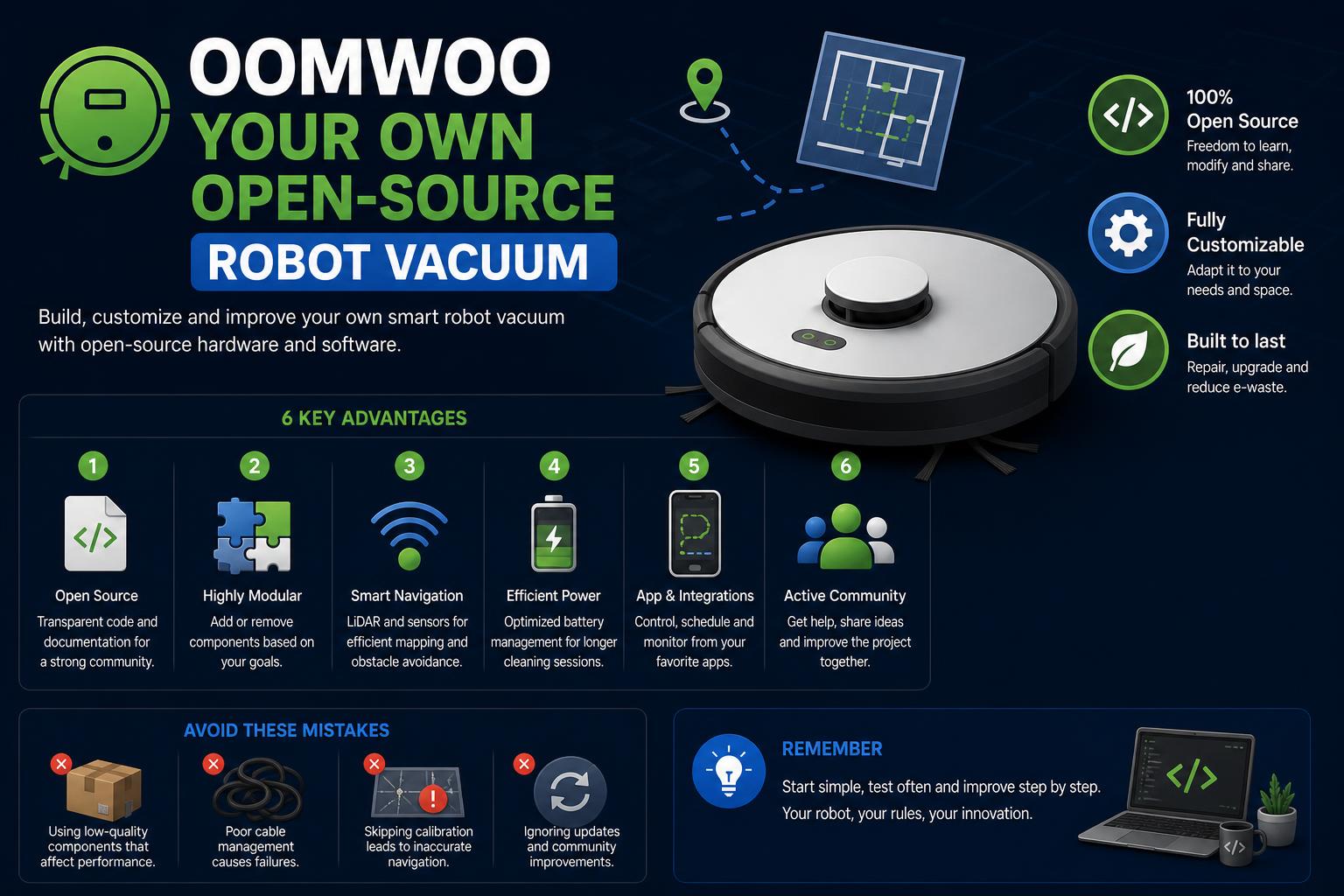
- OOMWOO is a fully open-source, cloud-free robot vacuum anyone can build and customize.
- The community-driven project splits hardware and software into modules for easy collaboration and hacks.
- Security, privacy, and local control are central: no cloud required, no vendor lock-in, no cameras on board.
- Builders can start today in simulation while the first build instructions and BOM are being finalized.
What if you could build your own robot vacuum, hack it to your heart’s content, and never worry about creepy cloud cameras, data leaks, or running into vendor barriers? Welcome to OOMWOO, the bold open-source vacuum project shaking up the smart home scene. With the first commits and development milestones dating to mid-2026, the project has rapidly stirred up excitement across open hardware communities, DIY forums, and privacy circles. But what exactly is OOMWOO, what makes it different from anything you can buy off the shelf, and why is it generating buzz even before the first real-world builds roll off the 3D printer?
This is your ultimate, detailed guide to OOMWOO: from its open, cloud-free roots and modular approach, to what you can (and can’t) build right now, the insider details the news missed, and how you can get hands-on—whether you’re a seasoned ROS developer or a curious maker eyeing your first hardware hack.
Understanding OOMWOO: The Open-Source Vacuum Revolution
OOMWOO is a fully open-source, home robot vacuum that you build yourself, from 3D-printed parts and off-the-shelf components—driven by a Raspberry Pi, 2D LiDAR for navigation, and cutting-edge open software stacks like ROS2 and micro-ROS. The project’s name, OOMWOO, is actually a rotational ambigram: flip it 180° and it reads the same, cleverly echoing the way the robot roams your floors in all directions.
But OOMWOO isn’t just a robot kit; it’s a community-driven, completely DIY-friendly platform with privacy and hackability at its core. Everything—from the chassis files and hardware lists to firmware and control software—is being built (and shared!) in the open, majorly on GitHub and the official Maker’s Pet site (OOMWOO Project page). Whether you want to assemble a vacuum, develop modules, or take the whole system in wild new directions, you’re invited to contribute—or just build.
Key Principles: Why OOMWOO Exists and What Sets It Apart
- 100% open source and open hardware: Every design file, PCB schematic, and line of code is available under the Apache License 2.0 (hardware files also under a recognized open hardware license, to be confirmed).
- Truly local operation: OOMWOO functions completely cloud-free; none of your home data, floor plans, or device controls leave your local network unless you choose.
- Modular by design: Both hardware and software are split into independent modules—for example, cleaning logic, SLAM navigation, sensor/electronics, chassis models, etc.—each tracked and contributed via the Requests For Contribution (RFC) board. Multiple contributors can claim and advance modules in parallel.
- Maker- and hacker-friendly: All parts can be sourced by yourself, and the robot is designed to be easily fixable, upgradable, and highly customizable—even for those wishing to retrofit legacy vacuums.
- Native integration with Home Assistant: Seamless home automation and direct control, right out of the box, with no vendor lock-in.
- No privacy-invading cameras: The reference build relies on LiDAR and bumper sensors only—no onboard cameras pointing at your private spaces.
Where Is OOMWOO Right Now? (Summer 2026 Development Status)
OOMWOO is in a fast-moving, early stage—much of the groundwork is public, but the physical build is not yet ready for most users. Here’s the clear-eyed breakdown:
-
- No official bill of materials (BoM) is published yet. It’s targeted for release around mid-July 2026 as the first working prototype completes validation.
- 3D-printable chassis files aren’t released yet. These are planned as the initial BoM stabilizes and parts fit is confirmed.
- The development environment and simulation is ready today. You can fully run and contribute using ROS 2, Gazebo, and the published robot URDF—and get hands-on with the vacuum’s virtual twin, even without hardware.
Anyone can contribute modules and documentation.
- Code, docs/specs, simulation and part-research modules are actively being claimed and merged by community volunteers.
- A convenience kit will be available, but never required. Makers can source motors, PCB, brushes, gaskets, and LiDAR themselves, or purchase the kit from Maker’s Pet once released.
Bottom line: If you want a working DIY vacuum, you’ll need to wait until at least late July 2026 for parts lists and build instructions. If you’re here to help shape the future of open hardware, there’s plenty to do right now in code, design, and documentation—all before the robot ever touches carpet.
How OOMWOO Works: Hardware, Software, and the Roadmap
Core Hardware and Tech Stack
- Compute Brain: Raspberry Pi 5 (4GB required for mapping and navigation), with communications and auxiliary control via ESP32 running micro-ROS on some modules.
- Sensors: A budget 2D LiDAR sensor, used for real-time mapping (SLAM) and collision-free navigation; bumper and other mechanical sensors for physical presence awareness and handling obstacles too short for LiDAR.
- Chassis: Fully 3D-printable (planned), designed for reliability and DIY repair and upgrades—no “throwaway” build quality.
- Electronic Control: Custom or off-the-shelf PCB motor/sensor driver, designed for ease of assembly and sourcing. Firmware modules open for custom development and contributions.
- Integration: Native Home Assistant support for local automation, plus optional modules for additional features (including future stretch goals like an app store and integration with broader open-source robotics projects such as LeRobot or OpenClaw).
Software Ecosystem
- ROS 2 & Nav2: OOMWOO’s navigation and control core is built on ROS 2 (Robot Operating System), leveraging the Nav2 stack for mapping, path planning, and cleaning logic.
- Simulation and Testing: The ROS 2 Gazebo simulation environment is fully functional—allowing anyone to clone the repository, spin up the virtual robot, and start building or tweaking modules without needing hardware in hand.
- Community Module Model: Contribution is tracked through modular RFCs (Requests for Contribution) which can be claimed, developed, and submitted as pull requests. Each module represents a specific function or hardware subassembly, from 3D models of brushes to specific code features for cleaning logic or sensor drivers.
Why Security and Privacy Are Major Selling Points
OOMWOO’s strongest differentiator is its dedication to local operation and privacy-first hardware design. Unlike most commercial vacuums—which often require cloud accounts, transmit data offsite, and sometimes even feature onboard cameras—OOMWOO’s reference design is committed to:
- Zero cloud requirement. Full cleaning, mapping, and scheduling functions are run locally on your hardware—no vendor servers in the loop.
- No device cameras. Only 2D LiDAR and bumper sensors are used for navigation. This avoids the uncomfortable privacy leaks and even hacking risks that have plagued mainstream vacuums (see: DEF CON 2024, where multiple DEEBOT vacuums were remotely accessed via Bluetooth, and robot vacuums in over 6700 homes exposed live floor plans and video feeds due to weak security).
- No vendor lock-in. All files, firmware, and design docs are open source, with clear permission for you to modify, upgrade, or repair as you wish. Even the kit, once released, is strictly optional.
OOMWOO’s Unique Module System: Open-Source Done Right
A major source of excitement—and what sets OOMWOO apart structurally—is its explicit modular dependency model. Most open-source hardware projects start with grand ambitions but stall quickly when bottlenecked by a single developer or linear timeline. OOMWOO flips that by splitting both the hardware and codebase into clearly defined modules (for example, ‘urdf-gazebo-sim’, ‘part-specs’, or ‘source-3d-models’).
How it works:
- You browse the RFC board to pick a module—whether it’s creating 3D part models, researching and documenting part specs, building cleaning logic for navigation, or writing ROS drivers.
- Multiple community contributors can claim the same module in parallel; the best implementation is eventually merged.
- Documentation modules welcome those who prefer specs and how-to guides over code.
- The module dependency graph ensures “green” (ready) modules can be worked right now, while “amber” (blocked on dependencies) and “blue” (needs real hardware) are clearly marked so you don’t waste cycles on stalled features.
This approach decentralized the project and directly empowers the community to build and iterate rapidly—even before a physical prototype has shipped.
What You Can Actually Build (and What You Can’t) – July 2026 Edition
Here’s the practical situation right now:
- Physical builds are not possible yet for most makers. There’s no final BoM, no printing files or assembly guide, and no prototype has completed a real-world cleaning session. You can’t print it, order parts, or assemble the robot today.
- The software/simulation environment is ready. If you’re technically inclined, you can clone the GitHub repo (OOMWOO GitHub), install ROS 2 and Gazebo, and run the virtual OOMWOO vacuum through simulated cleaning. This is where you can contribute to development, help validate modules, and test out navigation, mapping, or cleaning algorithms in a virtual setting.
- Those with hardware expertise, especially in electronics or firmware, can get ahead by researching sensor specs, prototyping custom PCB designs (once repo details drop), or planning 3D-printed parts and mechanical assemblies.
Do not expect to put one together in a weekend—yet. All press, dev updates, and project docs are clear that the hardware is still in the “design and RFC” stage, with v0 build as the first milestone. Mid-July 2026 is targeted for the first complete build instructions, with the development team and early alpha testers closing in on a validated BoM and fit/finish for all components.
OOMWOO vs. Existing Options: Comparison with Valetudo
Many advanced users may already be familiar with Valetudo, the open-source package for “de-clouding” commercial vacuums (like Roborock, Dreame, Xiaomi, etc.). Here’s how OOMWOO is different:
- Valetudo lets you root existing vacuums to re-enable local-only control and Home Assistant integration—but it requires invasive disassembly, voiding warranties, and permanently altering vendor firmware. Not casual-user territory.
- OOMWOO starts from scratch. You build the robot, firmware, and even the apps yourself, with every file open and hackable. There’s no need to risk bricking a working vacuum (or tracking down an increasingly rare supported model).
- OOMWOO is a true ground-up open project; if you need something that “just works” today, stick with commercial vacuums or Valetudo. But for total control, hackability, and privacy, OOMWOO is unmatched.
Secret Sauce, Gotchas, and Builder’s Caveats (What the News Misses)
Most coverage skips over the real-life limitations and the nuanced details that matter to genuine makers:
- Minimum hardware requirements: OOMWOO’s first release requires a Raspberry Pi 5 (minimum 4GB RAM) due to the memory burden of LiDAR mapping and navigation. Older Pi boards (like the Pi 3B+) are underpowered and not supported.
- LiDAR’s physical limits: The 2D LiDAR sensor rides about 10 cm above the floor, leaving it “blind” to objects lower down (such as cables, socks, or small toys). The robot’s bumper is tasked to handle these, so floors cluttered with low obstacles present a challenge for the current design.
- Retrofitting is a future possibility. While the roadmap includes the ability to retrofit legacy vacuums, a key snag is the loss of proprietary docking/charging sensors if you yank the existing PCB. Builders may need to engineer new solutions for reliable docking.
- Realistic budget expectations: The cited goal is $100-$200 for parts (not including the Raspberry Pi), but without a published BoM or finalized kit pricing, these figures are estimates. Watch for cost shifts once the first hardware kits are released this summer.
- Kit pricing is still a mystery. Although a Maker’s Pet convenience kit is announced, no price is yet public. Any budgeting should wait until final figures are live, as real costs might shift when all components—including custom PCBs and motors—are bundled.
Contributing, Building, and Learning: How To Get Involved Right Now
If you’re itching to help or simply learn, the best path is to dig into OOMWOO’s simulation environment and module development. Here’s how to jump in:
- Clone the GitHub repository from https://github.com/makerspet/oomwoo and review the design documents (especially modules and dependency graphs).
- Install ROS 2 and Gazebo on your system (Linux, or WSL2 on Windows is supported)—follow the official guides for setup. Within about 15 minutes, you’ll have a virtual OOMWOO running in a test environment.
- Pick a greenlit (ready) module: these change regularly, but current examples are the URDF robot model for Gazebo simulation, 3D source models, and part-spec documentation. Avoid modules flagged as “on hold.” Contribute via pull requests per project guidance.
Expert tip: Start with documentation or “part-specs” modules if you’re new. This lowers the contributions barrier, allows rapid integration, and offers visibility into hardware development even before the BoM is finalized.
What’s Next? The OOMWOO Timeline and What To Watch For
- Mid-July 2026: First bill of materials, 3D files, and (potentially) the parts kit to be released after successful prototype builds.
- August 31, 2026: v0 community target for contributing and merging first-wave modules (simulation, core cleaning logic, initial hardware control, etc.).
- Ongoing: Incremental module releases and community-driven enhancements, with a long-term roadmap hinting at an app store, LeRobot integration, and experimental upgrades (like vision-based navigation or legacy vacuum retrofits).
OOMWOO is a unique invitation to make hardware, hack software, learn advanced robotics, and join a privacy-first DIY movement. Even though you can’t build a physical device today (unless you’re deep in the trenches with the dev team), you can participate, learn, or prepare for launch—whether your goal is a smarter home or to push robot vacuums into a fully open-source future. Keep an eye on the official project site and GitHub repo for build files, contributor guides, and the latest progress—because when the final BoM drops, open hardware will never look the same again.