
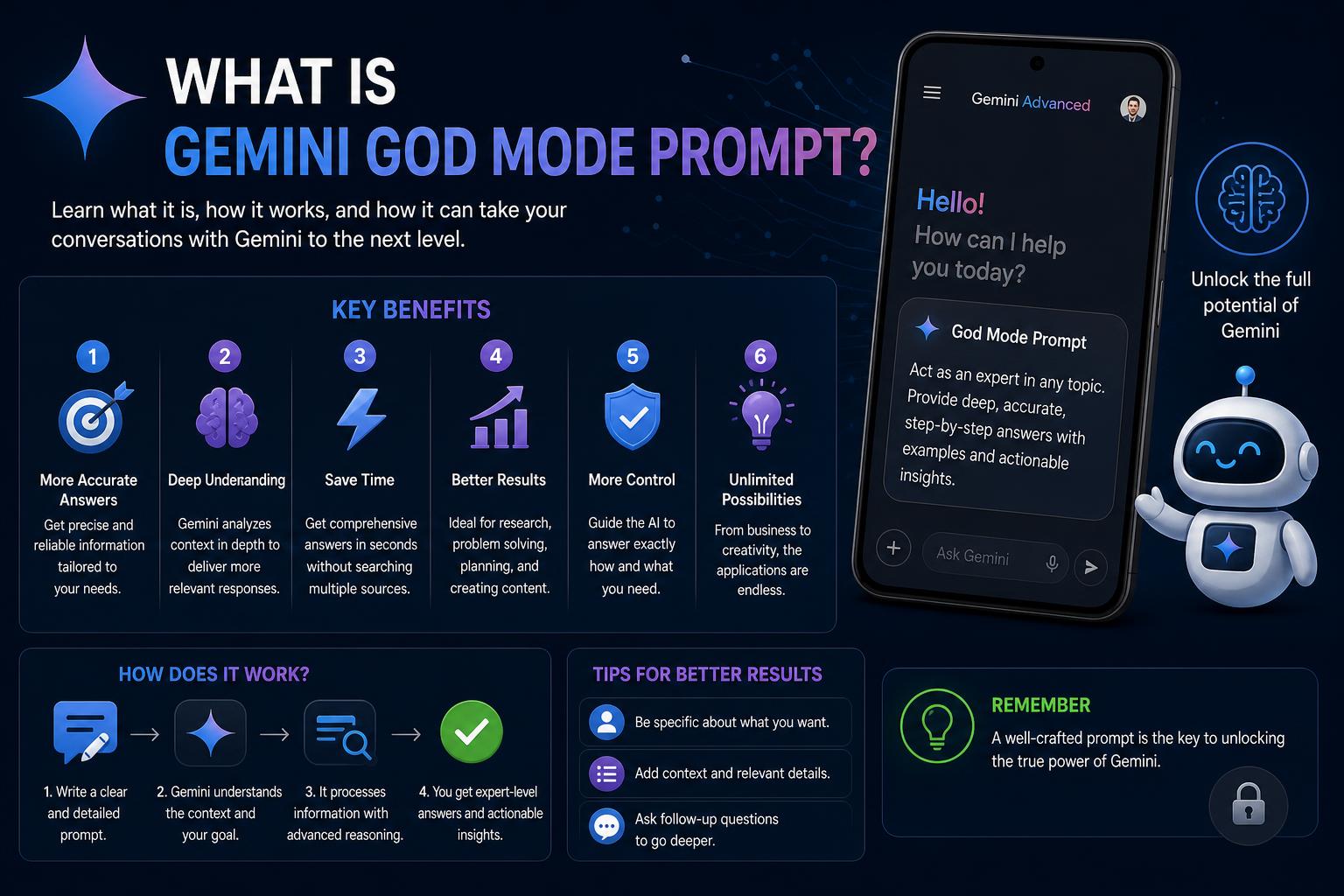
- God Mode prompts transform Gemini from a basic chatbot into a powerful, analytical AI assistant or auditor, capable of leveraging external data, enforcing advanced workflows, and adopting custom personas or expert roles for specialized tasks.
- Integrating structured data, rigorous procedural steps, and explicit user involvement in the setup creates outputs vastly superior to generic AI responses, ensuring high precision and a tailored fit for real-world use cases like audits, content optimization, or code reviews.
- God Mode prompts are universally applicable across platforms including Gemini, ChatGPT, Claude, and coding agents, with unique architectures that allow them to adapt to user style, enforce discipline, and even dynamically request missing context.
- Thorough use of ranked protocols, checks, and context gathering ensures factual, actionable, and citation-ready outputs, making these prompts essential for SEO, technical writing, or any domain demanding clarity, depth, and reliability.
Imagine unlocking a hidden switch in your favorite AI, instantly making it more analytical, less generic, and infinitely sharper. That’s the promise behind the famous ‘God Mode Prompt’ for Gemini and other modern large language models. If you’ve ever felt your AI was playing things too safe—producing polite but predictable answers or missing the mark on strategy or insight—this is the breakthrough you’ve waited for.
In this deep-dive, you’ll learn exactly what the Gemini God Mode Prompt is, how it works under the hood, why leading prompt engineers swear by it, and how it elevates generative AI results from ‘meh’ to ‘wow.’ Whether you’re an SEO pro, developer, or just want your AI assistant to stop acting like a rookie, this article will give you the inside scoop—plus proven frameworks and engineering tips that work across Gemini, ChatGPT, Claude, and even AI coding agents.
What is the ‘God Mode Prompt’ in Gemini?
The term ‘God Mode Prompt’ refers to an advanced, highly structured AI prompt designed to unlock the full analytical power of large language models like Gemini. Instead of simply asking the AI a question, you provide a detailed protocol, rich with explicit steps, external data integration, and precise personas—effectively upgrading your AI from a friendly chatbot into a cold, expert-level auditor or consultant.
God Mode prompts radically change how Gemini and similar models interpret, process, and deliver information. They go beyond basic requests by enforcing discipline: every response is deeply reasoned, layered, non-generic, and (often) contextually grounded in data you provide. These prompts demand explicit confirmation of context, strategically pause for missing information, and follow multi-step frameworks that can include game theory, rigorous audits, and even personality mapping.
The Origins and Purpose of God Mode Prompts
The God Mode Prompt isn’t magic—it’s prompt engineering at its finest. Prompt engineers and power users developed these approaches to counteract common weaknesses in mainstream LLMs: shallow outputs, excessive politeness, or hallucinated solutions. By treating the AI less like a conversational bot and more like an expert system with rules, constraints, and workflows, you force the model to operate with maximal focus, objectivity, and domain-specific insight.
Some of the most popular God Mode Prompts emerged from technical communities like r/PromptEngineering on Reddit, where users experimented with design patterns that put Gemini in a metaphorical ‘straitjacket’—not allowing it to move forward unless every input, every context, was explicitly acknowledged or provided. This is the antithesis of ‘guessing what the user probably meant.’
Key Features of a Gemini God Mode Prompt
- Strict Context Enforcement: The AI refuses to answer until you provide, or specifically skip, crucial documents, data, or instructions (such as contracts, notes, or invoices).
- External Data Retrieval (RAG): Integrates with retrieval-augmented generation setups—allowing Gemini to pull facts from Google Sheets, Drive uploads, or custom ‘DNA’ style docs, rather than invent results.
- Multi-Step Analytical Agenda: Typically includes seven or more sequential analysis steps (summary, sentiment, bias audit, first-principles breakdown, game theory, dialectic, etc.), mimicking expert workflows.
- Persona & Style Mapping (‘Shadow’ Document): Gemini can adopt any writing voice you provide—your email DNA, a literary style, or even rap lyrics—by mapping its responses to your custom ‘Shadow’ document uploaded via RAG.
- Unvarnished Output: Politeness and meaningless pleasantries are banned. The AI produces raw, tactical insights so you get only what matters.
- Zero Hallucination Policy: If the required information doesn’t exist in your provided databases, the AI must admit it—not fabricate answers.
How the God Mode Protocol Works: Step by Step
For a concrete example, here’s how a popular Gemini ‘God Mode Audit’ protocol operates in practice:
- Initialization: The user activates the protocol, which sets up a cold, strategic persona and initiates the analytic agenda. Gemini enters ‘God Mode’.
- Context Gathering: The model halts, requesting essential documents. Only when context is provided (or explicitly skipped) does the audit proceed.
- Data Validation: Gemini scans your database/files for everything it needs; if data is missing, it stops until resolved.
- DNA Mapping: The AI analyzes your custom ‘Shadow’ file for writing style or strategic tone, ensuring outputs match your preference—even emulating your typical email cadence or adopting a literary/creative voice.
- Seven-Step Analysis: – Summary and insight compression – Tonal and sentiment mapping – Bias and risk audit – First-principles breakdown of key points – Game-theory and strategic modeling (such as Nash Equilibria) – Dialectic counterpoint generation – Meta-context synthesis (mapping timing, relationships, or hidden variables)
- Output Constraints: The AI delivers results in a format you specify (hierarchical, tables, bullet points, etc.) in your chosen language or structure.
- Final Output: The generation is filtered of unnecessary politeness or AI clichés and mapped precisely to objective, actionable insights drawn from your unique input stack.
The real secret sauce? God Mode prompts don’t just produce answers—they orchestrate a rigorous process that is nearly impossible to replicate accidentally.
Using Custom Personas and DNA Mapping
One of the most innovative parts of a God Mode prompt is ‘DNA Mapping’, where Gemini is not just answering a prompt, but adopting your tone, voice, or even subcultural lingo. Want your AI to sound like Hemingway, Faulkner, or your favorite rapper? Just upload a style doc as the ‘Shadow’ file, and the prompt config enforces that style on every output. The days of generic ‘AI-speak’ are over.
This approach isn’t limited to formal business communication. You can use your own sent emails for business-style responses, or mix things up by selecting a creative or aggressive persona for negotiation, outreach, or technical documentation. The system is flexible—as long as your ‘DNA’ document is thorough, Gemini can replicate that voice with surprising fidelity.
Enhancing Depth and Precision: Multi-Layered Analysis
God Mode is all about depth—and ensuring nothing gets missed or skipped. It forces the model to deconstruct every request into atomic steps, each analyzed and synthesized independently:
- Sentiment & Tone Mapping: Parses for sarcasm, urgency, or subtext.
- Bias and ‘Third Rail’ Audit: Highlights hidden biases, risk signals, or prejudice in the text/data.
- First-Principle Analysis: Breaks requests down to their irreducible components—no fluff, just core facts.
- Strategic Modeling: Applies game theory to identify the best moves, optimal responses, or negotiation tactics.
- Dialectical Counterpoint: Instantly generates the most potent counter-arguments or alternative perspectives, strengthening strategic planning.
- Meta-Contextual Synthesis: Connects current timing, interpersonal relationships, and organizational structure to the main analysis—making the output far richer than a standard AI reply.
External Knowledge Integration and Zero Hallucination
Retrieval-Augmented Generation (RAG) is fundamental to God Mode prompts: the model is not allowed to ‘make up’ facts or invent details. Instead, it must draw exclusively from what’s available in your RAG-connected files or external knowledge bases (e.g., Google Drive uploads, Google Sheets, project docs). This ensures technical accuracy, factual reliability, and rigorous audit trails for every recommendation or analysis.
If the relevant data is missing, Gemini stops and asks for it—or forces the user to confirm that it should proceed without. This level of discipline elevates God Mode outputs far above classic AI answers, where hallucination is a lurking risk.
AI Prompt Engineering: From Chatbot to Super-Consultant
Most users interact with Gemini as a basic chatbot, asking generic questions and hoping for a solid answer. In God Mode, the dynamics change. You’re now treating AI like a world-class consultant, architect, or senior engineer—with the processes and rigor to match.
Instead of flimsy, vague instructions, you assign explicit roles (‘act as a Senior Brand Strategist…’), specify decades of hypothetical experience, and demand stepwise, reasoned outputs. You tell Gemini to ‘think step-by-step,’ highlighting potential pitfalls before delivering solutions—a radical shift from one-shot Q&A.
Designing Your Own God Mode Prompt: Methodologies & Protocols
Several proven architectures for God Mode prompts are circulating, from GitHub’s GodPrompt for coding agents to proprietary SEO-focused frameworks. Each is built on similar building blocks:
- Stop & Ask Protocol: AI pauses execution to request missing project or context details—no more guesswork.
- Diagnostic Audits: Immediate gap analysis and recommendation scaffolding, based on the data you provide.
- Reusable ‘Production Grade’ Prompt Templates: Rather than writing prompts from scratch every time, you use robust templates for blogs, audits, code reviews, or technical write-ups—with all the right switches activated.
- Dual Output: The system delivers both a finished result and the meta instructions for how the prompt was engineered—so users can learn, adapt, and reuse workflows.
- Universal Core: God Mode prompts are designed to work across mainstream models (Gemini, ChatGPT, Claude) and even deploy to coding environments as agent skills or CLI plugins.
Practical Applications: From SEO to Development and Beyond
Gemini God Mode Prompts aren’t just for technical audits—the frameworks are broadly applicable:
- SEO & Content Optimization: Use expert-level protocols (like those found on HackerNoon) for content audits that address not just keywords but AI citation, E-E-A-T signals, entity recognition, schema markup, and authority features. This ensures your posts are ready for both traditional search and AI-generated answer engines.
- Code Reviews, Refactoring, and Debugging: Systems like GodPrompt enforce disciplined engineering processes—think TDD, debugging gates, and explicit scope management—by routing all coding tasks through stepwise protocols, trailing verification and reducing errors.
- Strategic Planning, Marketing, and Super-Consulting: Instantly elevate briefs, plans, or campaigns by making Gemini adopt expert personas and requiring a step-by-step breakdown before action. The AI asks for critical business context, analyzes competitive dynamics, and proactively flags blind spots.
- Business and Negotiation: Map negotiation style, risk assessment, and even pressure tactics by drawing on experts like Cialdini, Kahneman, or Chris Voss—thanks to prebuilt archetypes integrated into the prompt’s RAG configuration.
- Personalization at Scale: The DNA mapping function ensures every output matches your brand voice or personal writing style, dramatically improving engagement and authenticity.
Frameworks, Checklists, and Output Standards
Best-in-class God Mode prompts go beyond advice—they deliver full implementation checklists, redline/optimized rewrites, and measurable impact predictions. Take, for instance, the detailed SEO frameworks shared on HackerNoon:
- Comprehensive Analysis: From titles and meta descriptions to deep GEO/AEO factors (structured data, AI citation, schema.org markup), the God Mode prompt covers every aspect, not just surface-level tweaks.
- Prioritized Fixes and Impact Estimates: Each output ranks urgent fixes, groups suggestions by criticality, and estimates likely SEO or engagement gains for each improvement—so users can act efficiently.
- Actionable Rewrites and Checklists: The report includes specific before-and-after text samples and a checklist to guide implementation in order of value delivered.
- Balanced Human & AI Optimization: Recommendations maintain author intent, voice, and human engagement, never sacrificing readability for technical wins.
Universal Protocols: Portability Across Platforms
A significant advantage of these prompts is their universality. Whether you’re installing a full protocol as a custom Gem in Gemini (gemini.google.com), loading it as a GitHub Copilot plugin, or pasting it into OpenAI’s custom instructions, the workflow is always the same: one entry point, zero need to juggle multiple skills or context files.
For developers, this means slashing the learning curve—there’s no guessing which skill to activate or manual workflow switching. The prompt adapts dynamically to the task at hand. If you need to go deeper (e.g., for debugging), protocol files load only when context demands it, minimizing context window ‘token’ costs.
Comparing God Mode to Traditional Multi-Skill Systems
Why not just use dozens of specialized prompts? As the GodPrompt project shows, multi-skill agents are often inefficient: users forget which skill is best for which task, documentation is hard to maintain, and context can easily be lost. God Mode solves this by providing one workflow skill with automatic routing, replacing dozens of micro-prompts and reducing both effort and error risk.
‘Stop & Ask’ and Diagnostic Auditing: Raising the Bar
Another key differentiator is the ‘Stop & Ask Protocol’. Instead of forging ahead blindly, the AI pauses, requests more context, or conducts a diagnostic audit. This eliminates the worst-case scenario where crucial project details are omitted—a chronic problem with barebones chatbot prompts.
Applying God Mode for Content, Code, and Business Strategy
Let’s break down just how transformative the God Mode methodology can be, whether you’re a content creator, engineer, or business leader:
- In Content Creation: No more vague SEO advice. You get page audits that address featured snippets, structured data, entity linking, and even AI voice optimization for platforms like Google AI Overviews and Bing Copilot.
- For Coding: Every commit, fix, or refactor passes through phases—understand, plan, execute, verify, deliver—making each output safer, more reliable, and more maintainable.
- In Strategy: Bring in advanced frameworks from renowned behavioral scientists or business strategists, automating analysis and cross-pollinating best practices from multiple industries.
Takeaways, Tips, and Maximizing the God Mode Prompt
To get the most from God Mode, start by feeding the prompt ample context: supply documents, business objectives, or even lists of strategic goals so every output is targeted, thorough, and grounded in actual data—not guesswork.
- Use the ‘Implementation Checklist’ and ‘Actionable Rewrites’ first. These steps guarantee the fastest wins and the biggest impact, based on AI’s prioritization of what matters most.
- Leverage the DNA mapping to maintain your brand’s voice and to personalize outputs for every client, stakeholder, or audience segment.
- Iterate and refine: God Mode isn’t a magic bullet; it’s a precision tool. Your original expertise and insight matter—layer them on top of what Gemini uncovers for best results.
Gemini God Mode Prompt is a powerful new lens for AI—turning basic Q&A into expert-level, nuanced, and context-rich analysis. It delivers outputs that not only answer, but anticipate, strategize, and even challenge assumptions, making it an invaluable asset for anyone who wants to transcend vanilla AI interactions. By applying its architecture—whether you’re optimizing SEO, auditing code, or designing business strategy—you maximize both human creativity and AI’s data-driven potential, all while minimizing risk and maximizing insight.