
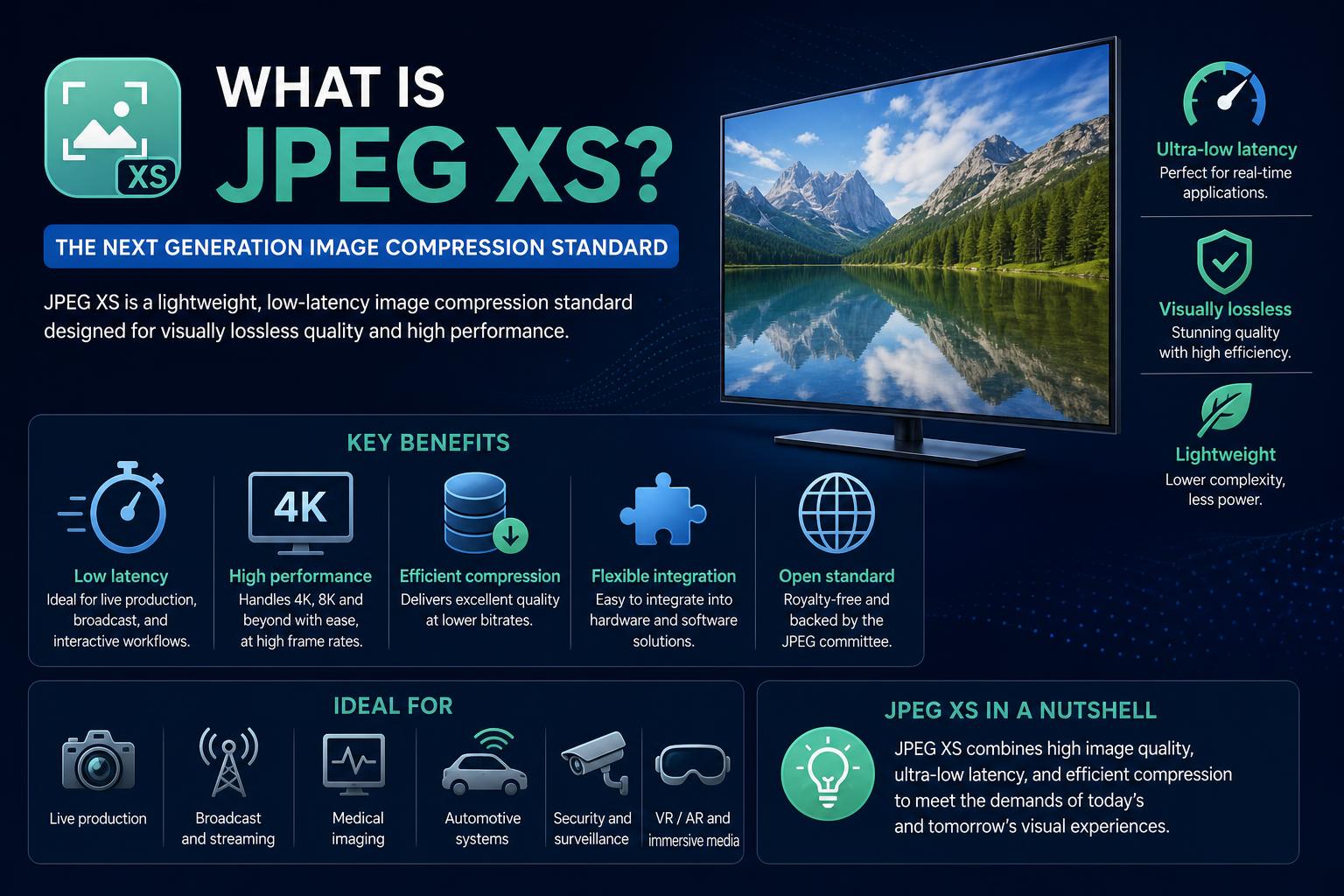
- JPEG XS is revolutionizing professional video workflows with its ability to deliver visually lossless quality at ultra-low latency, making it ideal for broadcasting, VR, and live event production.
- The codec’s unique combination of fast intra-frame compression, hardware efficiency, and precise bitrate control enables seamless transmission of rich video content over standard networks and storage, even at 4K/8K resolutions.
- Unlike traditional codecs like HEVC, JPEG XS is focused on real-time, high-fidelity delivery wherever immediate user feedback and uncompressed-like image integrity are essential—serving as a cornerstone for next-generation broadcast and AV-IP systems.
As the digital world continues to demand ever-higher video resolutions, smooth real-time streaming, and rapid content delivery for everything from professional broadcasting to autonomous vehicles, image and video compression standards must evolve to meet the challenge. One of the latest and most exciting advancements in this space is JPEG XS. Although it might sound like just another entry in the JPEG family, JPEG XS brings an entirely new philosophy to the table—optimized for lightning-fast processing, minimal latency, and preserving near-perfect image quality even during compression.
If you’ve ever wondered how live sports are delivered in pristine 4K over standard IP networks, how VR headsets achieve seamless visual experiences, or why certain broadcasting tech giants are raving about ‘mezzanine codecs’, then understanding JPEG XS could change how you think about video technology. In this deep dive, we’re going to pull back the curtain on JPEG XS—decoding its history, technical core, applications, differences from codecs like H.265/HEVC, and why it’s making waves in the professional audio-visual and broadcasting industries.
What Is JPEG XS?
JPEG XS, standardized as ISO/IEC 21122, is an advanced image and video codec engineered specifically to address scenarios where ultra-low latency, high image fidelity, and low hardware complexity are not merely nice-to-haves but absolute necessities.
Born from the minds of the Joint Photographic Experts Group (JPEG)—the same group that brought us the original JPEG and JPEG 2000—JPEG XS sets itself apart by blending both visually and mathematically lossless compression with a suite of features tailored for demanding real-time workflows. Unlike conventional codecs that chase the highest compression rates (sometimes at the cost of responsiveness or image clarity), JPEG XS is all about keeping your live streams, uncompressed feeds, or ultra-responsive systems as close to real-time and artifact-free as possible.
Where Did JPEG XS Come From?—A Brief History
Back in 2016, as broadcasters, VR developers, and systems engineers struggled with escalating video bandwidths thanks to 4K/8K resolutions, HDR, and higher frame rates, JPEG launched an open call for a new codec that would be easy to implement, fast, and razor-sharp in quality. The result: A collaboration between technology powerhouses such as intoPIX and Fraunhofer IIS culminated in what we now know as JPEG XS.
In 2019, after successful showcase demos at international events like NAB Show and the International Broadcasting Convention, the standard was officially released as ISO/IEC 21122. Far from being a static milestone, JPEG XS has seen new editions in 2022 and 2024, bringing features like direct RAW Bayer/CFA compression, mathematically lossless coding, support for HDR, and even temporal differential coding for more advanced applications.
Core Philosophy and Naming
Unlike older JPEG standards, there’s no official definition for “XS”, but the name was deliberately chosen to evoke “extra small” (referring to computational footprint and bitrates) and “extra speed”—both crucial for its target use cases.
Key Features That Define JPEG XS
- Visually Transparent (Lossless) Compression: JPEG XS can compress most images at ratios of 2:1 to 10:1 with imperceptible (or mathematically zero) loss, passing stringent ISO/IEC 29170-2 visual quality benchmarks. This is pivotal for professional applications where every pixel matters.
- Ultra-Low Latency: The codec introduces only a tiny end-to-end delay—typically around 1 to 32 lines of video, not full frames. In other words, it’s possible to compress and decompress a stream with almost no perceptible lag, which is critical in live production, interactive applications, VR, and gaming.
- Low Complexity for Flexible Implementation: JPEG XS is designed to run efficiently on CPUs, GPUs, FPGAs, and ASICs—even on platforms where memory, logic, or power are restricted. Parallelism is baked in, allowing implementers to exploit their chosen hardware platform’s strengths, whether that’s multi-core CPUs, highly parallel GPUs, or low-latency hardware circuits.
Other cutting-edge features include:
- Exact Bitrate Allocation: Developers can dial-in precise output bitrates—perfect for matching a given connection’s bandwidth (like Gigabit Ethernet), which is vital for stable streaming over networks with fixed capacities.
- Multi-Generation Robustness: JPEG XS maintains its visual integrity after repeated encode-decode cycles (important if a signal passes through a chain of multiple devices without accumulating visible artifacts).
- Comprehensive Color and Bit Depth Support: Formats span classic RGB, YUV, RAW Bayer (common in digital cameras and automotive sensors), and high dynamic range content—up to a full 16 bits per component.
- Support for Mathematical Lossless Coding (MLS): For mission-critical scenarios (archiving, medical, scientific), JPEG XS can do bit-exact, mathematically lossless compression with no data loss, supporting up to 12 bits/component in current standards and up to 16 bits in newer profiles.
- Advanced Buffer and Flow Control: Thanks to continuous monitoring and dynamic rate adjustment, streams don’t underflow or overflow decoder buffers, guaranteeing reliability in live broadcast scenarios.
- Direct Compression of RAW Bayer/CFA Data: The strategically developed Star-Tetrix Color Transform lets JPEG XS compress RAW sensor data natively, avoiding premature demosaicing and letting image processing decisions (such as noise reduction and interpolation) be deferred to later in the production pipeline.
Why Did We Need JPEG XS?
In today’s professional video workflows, the sheer volume of uncompressed data for formats like 4K60 4:4:4 HDR or 8K can be astronomical—far beyond what many cables or network links can handle. Uncompressed 4K video at 60fps with high color precision can require more than 10 Gbit/s, while most affordable IP networks, storage systems, or SDI cables top out far below that.
JPEG XS steps in to bridge the gap—delivering close-to-uncompressed visual quality with just a fraction of the bitrate and doing so at wire-speed: no frame delays, no buffering headaches, and low enough computational burden that both hardware and software encode/decode solutions can work seamlessly in real time.
Technical Overview—How Does JPEG XS Work?
Under the hood, JPEG XS is a snapshot-based (intra-frame) codec, reliant on wavelet transformation instead of the block-based DCTs you might find in classic JPEG or the predictive tricks used in H.264/H.265 video codecs.
Core Steps in JPEG XS Compression
- Component Upscaling and (Optional) Decorrelation: Input image pixels are normalized and upscaled to a standard precision (usually 20 bits), and may be decorrelated via a reversible component transform (like an RGB to YUV approximation) to optimize for compression.
- Wavelet Transform: A set of highly efficient 5/3 Daubechies wavelet filters removes spatial redundancies. The trick here is that wavelet transforms are performed more extensively on horizontal lines (five passes) than vertical, reducing both the need for frame buffers and the accompanying delay.
- Prequantization: Coefficient values produced by the wavelet transform are mapped to a 16-bit representation using dead-zone quantization, shaping how much compression is possible at a given quality level.
- Rate Control and Quantization: Depending on your target bitrate, coefficients are quantized to the most suitable level determined by the codec’s adaptive algorithms—still preserving fine visual detail.
- Entropy Coding: JPEG XS employs a minimalistic entropy coding process (unlike the context-adaptive schemes in H.265/HEVC)—coding lines in several strategic passes (for significance, bitplane counts, raw bit values, and optionally sign bits).
- Codestream Packing: Finally, all elements (coefficient data and essential metadata) are packed into a marker-based codestream, much like classic JPEG implementations.
Profiles, Levels, and Sublevels—Customizing JPEG XS for Every Use Case
JPEG XS is anything but one-size-fits-all. The standard is divided into multiple profiles, levels, sublevels, and Frame Buffer Bandwidth (FBB) levels—each tailoring functionality and performance for specific use cases or hardware targets.
- Profiles: These define subsets of coding tools suited to certain applications (e.g., different chroma subsampling, maximum resolutions, or Bayer support). From Light to Main to High and Bayer-specific profiles, the list is extensive to ensure interoperability and efficiency for everything from SDI studio feeds to automotive camera data logs.
- Levels: Specify maximum image dimensions, pixel rates, and throughput requirements. For instance, Level 1 enables support up to 2K images at high frame rates, while Level 8K-3 can cater to gigantic 8K/16K video walls or cameras.
- Sublevels: Tweak the maximum allowable bits-per-pixel for encoded streams in each level, constraining bandwidth even further. If your hardware or network is capped, JPEG XS lets you stay within those limits.
- Frame Buffer Bandwidth Levels: If you’re leveraging advanced features like Temporal Differential Coding (TDC), these further control the buffering/throughput requirements expected from your implementation.
Key Application Domains for JPEG XS
Let’s take a closer look at where JPEG XS shines brightest:
- Professional Broadcasting & Video-over-IP: With the television and Pro AV industries moving towards IP-based production (SMPTE 2022/2110, AV-over-IP), JPEG XS makes it possible to transmit 4K/8K HDR video streams across standard or even existing cables by squeezing massive streams into manageable bitrates without introducing the destructive lag associated with heavier codecs. For example, 4K60 4:2:2 video (usually over 10 Gbit/s) can be pushed over a single 3G-SDI at a 4:1 compression ratio, keeping all real-time workflows intact.
- Real-Time Video Storage: Internal video recording devices (like broadcast cameras using SSDs or SD cards) can store high-quality, high-bitrate video that would otherwise exceed the storage medium’s data rate limits—again, all with negligible delay and no visible compromise on quality.
- Sensor Compression: In automotive, industrial machine vision, and digital stills photography, JPEG XS enables direct compression of RAW sensor data—including Bayer/CFA data—allowing sensor designers to offload heavy image processing from cameras to later stages in the workflow. This opens up flexibility for post-production and artistic adjustments.
- Virtual & Augmented Reality, Telemedicine, Gaming, and Drones: For scenarios involving head-mounted displays or remote operation (e.g., drone piloting, telesurgery), human latency perception becomes the determining factor in user experience. JPEG XS is tuned so finely that the delay it introduces is measured in microseconds, perfect for these ultra-interactive fields.
- Memory Buffers and Omnidirectional Video: JPEG XS enables real-time image storage in RAM or VRAM, acting as a ‘mezzanine’ layer and facilitating complex video switching or editing in live studios or control centers.
JPEG XS Transmission and File Formats—Where Does the Data Go?
Delivering video is about more than just compressing it—you need efficient methods to transmit, store, and wrap that data for further use. JPEG XS addresses this holistically through multiple standards and technologies:
- RTP Payload Format (RFC 9134): JPEG XS gets its own official payload definition for the Real-Time Transport Protocol, allowing seamless live IP video streaming in professional environments. for more.
- SMPTE ST 2110-22: JPEG XS can be seamlessly integrated into broadcast-over-IP workflows using SMPTE’s media over IP infrastructure standards.
- MPEG Transport Streams: With recent updates (ISO/IEC 13818-1:2023), JPEG XS is fully supported for carriage within MPEG-TS—a mainstay for broadcast and professional video services.
- Internet Protocol Media Experience (IPMX): JPEG XS plays a role in AV-over-IP with the IPMX open standard, used for distributing video and audio over Ethernet in pro AV markets and corporate environments.
- GenICam (GenDC): The generic camera control interface has been updated to allow JPEG XS compressed data for machine vision and industrial automation applications.
Comparing JPEG XS to Other Codecs (H.265/HEVC, JPEG 2000, AV1, etc.)
So how does JPEG XS stack up against the likes of H.265/HEVC, JPEG 2000, AV1, and others? It’s not aiming to win the ultra-high-compression battle. Let’s unpack how its unique feature set plays out in typical workflows.
JPEG XS vs. H.265/HEVC
| Feature | JPEG XS | H.265/HEVC |
|---|---|---|
| Compression Type | Intra-frame (every frame compressed independently) | Inter-frame (uses temporal prediction across frames) |
| Latency | <1ms (line-based, virtually zero in live scenarios) | 100–1000ms (due to frame dependencies and GOP structures) |
| Compression Efficiency | 2:1 to 10:1 (focuses on visually lossless) | 50:1 to 200:1 (optimized for bandwidth-limited, not latency-sensitive apps) |
| Typical Use Cases | Live and remote broadcasting, IP video transport, VR/AR, automotive, KVM systems | OTT streaming (Netflix, YouTube), VOD, long-haul broadcast, consumer devices |
| Computational Complexity | Low (suitable for hardware implementation on FPGAs, ASICs, and efficient in software) | High (demanding CPU/GPU resources for encoding/decoding) |
| Licensing | Royalty-free for most broadcast ecosystem uses (XS codec IP pools) | Patent-encumbered with complex royalty structures (MPEG LA, HEVC Advance, Velos Media, etc.) |
The primary impact of this codec in professional environments is clear: it delivers real-time communication, excellent image quality, simple hardware and software compatibility, and near-zero latency.
JPEG XS vs. JPEG 2000 and JPEG XL
JPEG 2000 and JPEG XL are more versatile codecs for different applications, such as storage or compressed files, focusing on efficiency and flexibility in file-based workflows. JPEG XS, on the other hand, is optimized for live streams, high speeds, and low latency, making it ideal for real-time broadcast scenarios where every millisecond and every pixel counts.
Core Standards Parts and Ecosystem
JPEG XS is actually a suite of standards, each dedicated to a specific part of the process:
- Part 1: Core Coding System (ISO/IEC 21122-1) – Defines the core codec, algorithms, syntax, and processes to precisely encode and decode image/video frames.
- Part 2: Profiles and Buffer Models (ISO/IEC 21122-2) – Specifies typical codec configurations for hardware and software, ensuring compatibility and buffer models for low latency.
- Part 3: Transport and Container Formats (ISO/IEC 21122-3) – Standardizes how JPEG XS codestreams are wrapped for transmission or storage in formats like MP4, MPEG-2 TS, or HEIF.
- Part 4: Conformance Testing (ISO/IEC 21122-4) – Establishes how to validate implementations, devices, and software to ensure interoperability and correctness.
- Part 5: Reference Software (ISO/IEC 21122-5) – Offers open implementations in standard ISO C11 for encoders and decoders, aimed at developers and vendors.
Leading Supporters and Reference Implementations
Major industry players have joined forces:
- intoPIX: Played a key role in the formation of JPEG XS, providing reference implementations and essential patents, with its TiCoXS SDKs and hardware/software solutions for CPUs, GPUs, FPGAs, and ASICs. The TiCoXS range is widely adopted in broadcast and professional video environments.
- Fraunhofer IIS: Offers SDKs and tools for pure IP transfer, including HD, 4K, and 8K streaming with sub-frame latency features.
Patent Licensing and Industry Adoption
JPEG XS contains patented technology, but unlike some codecs, it is distributed under reasonable and non-discriminatory (RAND) terms through a central patent license. This model facilitates its adoption in the professional industry, reducing barriers and complexities in the pipeline. It is important to consider that royalty costs may vary depending on usage and deployment, so it is recommended to carefully review the licenses.
Practical Examples of JPEG XS in Action
- In-studio interconnections and live coverage—where a millisecond of delay can mean missing a crucial moment in live sports broadcasts or eSports.
- Remote post-production and multi-node collaboration, transmitting high-quality signals with almost no delay.
- Cloud workflows and edge streaming—in automotive, drones, and machine vision, JPEG XS sends data with the lowest possible latency.
- KVM-over-IP systems in control rooms—enabling ultra-responsive remote control and monitoring.
Recent Updates and Awards
JPEG XS continues to evolve. The third edition, from 2024, introduces Temporal Differential Coding (TDC), a wavelet-domain technology for greater frame decorrelation. The second edition added RAW Bayer support and mathematically lossless coding. In 2025, it received the prestigious EMMY® award for technical innovation in broadcasting.
Bandwidth Savings—Examples
| Video Stream Type | Native Throughput | Common Transmission Link | Link Capacity | Typical Compression Ratio |
|---|---|---|---|---|
| 2K 60fps 4:2:2 10bpc | 2.7 Gbit/s | HD-SDI | 1.33 Gbit/s | ~2:1 |
| 4K 60fps 4:2:2 10bpc | 10.6 Gbit/s | 3G-SDI | 2.65 Gbit/s | ~4:1 |
| 2K 60fps 4:2:2 10bpc | 2.7 Gbit/s | 1G Ethernet | 0.85 Gbit/s | ~3:1 |
| 2K 60fps 4:4:4 12bpc | 4.8 Gbit/s | 1G Ethernet | 0.85 Gbit/s | ~6:1 |
| 4K 60fps 4:4:4 12bpc | 19.1 Gbit/s | 10G Ethernet | 7.96 Gbit/s | ~2.2:1 |
| 8K 60fps 4:2:2 10bpc | 42.5 Gbit/s | 10G Ethernet | 7.96 Gbit/s | ~6:1 |
| 8K 120fps 4:2:2 10bpc | 84.9 Gbit/s | 25G Ethernet | 21.25 Gbit/s | ~4:1 |
These compression ratios allow broadcast and professional AV networks to transport streams that would be impossible with affordable infrastructure, without compromising quality or real-time response.
FAQs and Typical Use Case Decision Guide
- Is JPEG XS better than H.265 for video streaming?
For high-quality live and professional scenarios with low latency, undoubtedly. For mass streaming with bandwidth constraints, HEVC is usually preferred, albeit with higher latency. - Why isn’t JPEG XS used on platforms like Netflix or YouTube?
Because those platforms prioritize compression efficiency to maximize streaming capacity and massive compatibility, even if it introduces more delay; JPEG XS focuses on ultra-low latency and perfect real-time quality. - Can JPEG XS replace H.265?
Not directly; it is complementary, especially in workflows where low latency and fidelity are fundamental, such as live broadcast, remote control, and real-time production. - When to choose JPEG XS over HEVC?
When your application requires real-time feedback, near-zero latency, and visually lossless preservation throughout the pipeline, such as in live events, studio connections, or remote systems.
JPEG XS: Who’s Using It and Where Can You See It in Action?
- Live broadcasters and live events: Major networks and producers are already using JPEG XS to move high-quality signals across global facilities, revolutionizing remote production and sports broadcasts.
- Professional AV integrators: IP routing and video presentation systems leverage JPEG XS to ensure instantaneous switching and artifact-free display.
- AR/VR innovators: Augmented reality headset manufacturers and developers rely on its minimal latency for seamless, immersive experiences.
- Automotive and machine vision: Camera feeds in autonomous vehicles and smart factories use JPEG XS for real-time data transmission with no delay.
JPEG XS in the General Compression Landscape
With a market full of different codecs (JPEG, JP2, JPEG XL, AV1, H.264, HEVC, ProRes, among others), it’s easy to get lost. JPEG XS isn’t for everything, but rather a highly focused solution: the ideal choice when you need near-lossless quality, instantaneous response, and easily interoperable hardware/software. It is clear that in scenarios where every millisecond and every pixel matter, JPEG XS stands out as the best option.
Future Outlook and Standardization
The standard continues to be updated, with JPEG releasing new versions and growing support in software and hardware. Given the rapid migration towards IP and software-defined platforms, JPEG XS will surely play an even more important role in the future of professional audiovisuals, cloud production, and machine vision.
This standard has established itself as a robust answer to current production and transmission challenges, making it indispensable in demanding and mission-critical workflows.
What Is a Real-Time Operating System (RTOS)? The Complete Guide