
- NEXT-100 is a high-pressure xenon gas time projection chamber aiming to detect neutrinoless double beta decay, which could determine if neutrinos are their own antiparticles.
- The detector features advanced energy and tracking planes, sub-percent energy resolution, and multiple layers of shielding for ultra-low backgrounds.
- Located deep underground in Spain, NEXT-100 is part of a global scientific collaboration and acts as a stepping stone for future, even more sensitive detectors.
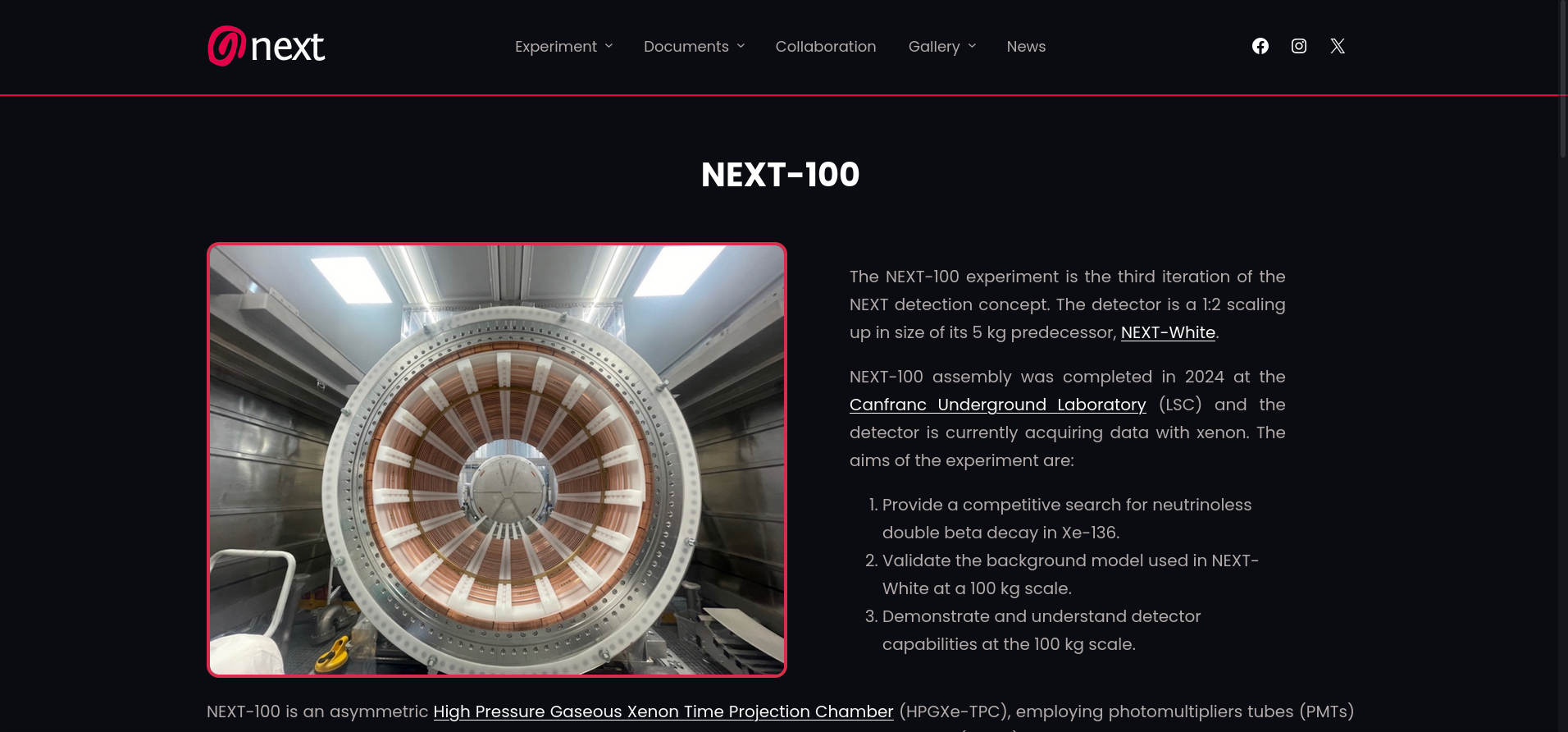
The search for rare and elusive physical phenomena often pushes detector technology to new frontiers, and the NEXT-100 detector is a prime example of this quest. This state-of-the-art instrument is designed to tackle one of particle physics’ most enigmatic puzzles: the possibility of neutrinoless double beta decay in xenon gas. Unlocking the secrets behind this process could reveal unprecedented insights into the fundamental nature of neutrinos and why the universe is composed mostly of matter rather than antimatter.
But what exactly is the NEXT-100 detector? And why has it captured so much attention in the scientific community? In this article, we’ll break down the technical aspects, unique features, goals, and significance of the NEXT-100 project, blending cutting-edge research with an easy-to-read approach. Get ready to discover how a collaboration of scientists and engineers is striving to make history beneath a mountain in Spain!
Understanding the Basics: What Is NEXT-100?
At its core, NEXT-100 is a high-pressure gaseous xenon time projection chamber (HPGXe-TPC) meticulously engineered to detect and study neutrinoless double beta decay (0νββ) of Xenon-136 (136Xe). The name ‘NEXT’ stands for Neutrino Experiment with a Xenon Time Projection Chamber. This detector is the latest installment in the NEXT experiment series, following the successful pilot detector, NEXT-White.
The main scientific objective of the NEXT-100 detector is to find evidence that neutrinos are their own antiparticles. If neutrinoless double beta decay is observed, it will dramatically alter our understanding of particle physics and cosmology, potentially identifying neutrinos as Majorana particles—a unique prediction of certain extensions to the Standard Model. This could provide a clue as to why the universe contains more matter than antimatter.
Where Is the NEXT-100 Detector Located?
The NEXT-100 detector is situated at the Laboratorio Subterráneo de Canfranc (LSC) in Spain, deep underground under Mount Tobazo in Huesca. The laboratory’s location, shielded by roughly 800 meters of rock, provides an ideal environment by greatly reducing the background noise from cosmic radiation. This isolation is essential for detecting the exceedingly rare events NEXT-100 seeks to identify.
Furthermore, a specialized radon abatement system ensures air near the detector remains free from 222Rn gas; this is vital, since radon decay can produce unwanted background signals that would obscure the rare events under study.
How Does NEXT-100 Work? Key Technological Features
The NEXT-100 detector is a marvel of modern experimental physics, relying on a combination of high-pressure gaseous xenon, precision sensors, and advanced shielding. Here’s a closer look at its technological components:
- High-Pressure Xenon Gas Chamber: The detector’s active volume is filled with 100 kg of xenon gas, pressurized up to 15 bar (or 13.5 bar in some running conditions). This allows for high-density tracking of ionizing events within a compact, cylindrical space about 1 meter in diameter and 1 meter in length.
- Time Projection Chamber (TPC): This core element enables the reconstruction of ionizing particle tracks in three dimensions. When a charged particle passes through the xenon gas, it leaves behind both scintillation light and an ionization trail. The chamber’s electric field then drifts the electrons to the anode region for precise spatial and energy measurement.
- Electroluminescence (EL) Amplification: By creating a strong electric field near the anode (between the gate and anode mesh, only 1 cm apart), the drifting electrons are accelerated, producing electroluminescent photons. This method amplifies the signal in a highly controlled manner, resulting in excellent energy resolution and low noise.
- Dual-Plane Sensor Design: There are two sensor planes—one for energy (energy plane) and one for tracking (tracking plane). Sixty photomultiplier tubes (PMTs) record the energy of detected events, while 3584 silicon photomultipliers (SiPMs), organized into DICE boards, reconstruct the spatial pattern of each event. The PMTs are isolated by sapphire windows and the SiPMs are focused on the electroluminescence region for superior accuracy.
- Reflective and Wavelength-Shifting Materials: The inner surfaces of the field cage are lined with polytetrafluoroethylene (PTFE) panels coated in tetraphenyl butadiene (TPB). PTFE enhances light collection by diffuse reflectivity, while TPB shifts the 170 nm xenon scintillation light to 420 nm, making the light detectable by SiPMs and PMTs at much higher quantum efficiency.
- Multi-layer Shielding: The detector vessel, made of stainless steel, is surrounded by a 12 cm thick copper shield to reduce external background radiation. Around this, a “lead castle” structure provides further protection, and the mass of rock overhead adds another layer.
- Precision Field Uniformity: To ensure uniform drift of electrons, the field cage employs 52 evenly spaced rings and 150 resistors in the drift and buffer regions, creating a reliable field gradient.
Evolution from NEXT-White to NEXT-100
NEXT-100 representa una cantidad significativa en escala respecto a su predecesor, el detector NEXT-White. Aunque NEXT-White operaba con solo 12 PMTs y 1792 SiPMs, NEXT-100 aumenta su capacidad de detección a 60 PMTs y 3584 SiPMs. Esta expansión permite un volumen fiducial mayor y una sensibilidad aumentada a eventos de desintegración extremadamente raros.
Goals and Scientific Significance
The primary aim of the NEXT-100 detector is to search for neutrinoless double beta decay of 136Xe. If successful, this would signal that neutrinos are Majorana particles—they are their own antiparticles—which is a crucial hypothesis for understanding the matter-antimatter asymmetry of the universe.
The sensitivity of NEXT-100 is designed to push the boundaries of current physics:
- Background Rate: Its configuration is expected to achieve an extremely low background rate of 10-3 counts / keV / kg / year.
- Sensitivity: With three years of data, the detector should reach sensitivity to a half-life for neutrinoless double beta decay up to 6 × 1025 years at 90% confidence level.
- Energy Resolution: The system delivers a sub-1% FWHM energy resolution at the Q-value of the decay (2458 keV), with measurable results showing about 0.9% FWHM at the 2615 keV calibration line, which extrapolates to 0.93% FWHM at Qββ.
How Events Are Detected: From Ionization to Data
When a potential double beta decay occurs, the process inside NEXT-100 follows these steps:
- Energy Deposition: A double beta decay event in the gaseous xenon releases two electrons, which deposit energy by ionizing and exciting the xenon atoms.
- Prompt Scintillation & Ionization Trail: The event first creates a quick flash of scintillation light and a trail of ionization electrons along the path of the emitted particles.
- Electron Drift: An electric field inside the TPC drives the liberated electrons towards the anode.
- Electroluminescence Signal: As electrons reach the region near the anode mesh, they are accelerated, generating electroluminescent photons. This produces a second, more intense flash of light proportional to the initial energy deposit.
- Readout by PMTs and SiPMs: The energy plane (PMTs) records the total light yield, while the tracking plane (SiPMs) reconstructs the track’s 2D pattern and, together with the drift time, enables 3D event reconstruction.
- Data Analysis: Sophisticated algorithms analyze the information to distinguish signal events (potential double beta decays) from background noise, using both the energy signature and pattern of charge deposition.
This dual capability—calorimetry from PMTs and detailed tracking from SiPMs—boosts the experiment’s sensitivity and enables robust background suppression through topological event identification.
Why High Radiopurity and Background Suppression Matter
Detecting rare decay events demands near-zero background noise. Unwanted signals from cosmic rays, environmental radioactivity, or intrinsic contamination can swamp potential 0νββ events. NEXT-100 employs multiple strategies:
- Material Screening: All detector materials are carefully selected for radiopurity to minimize naturally occurring radioisotopes.
- Layered Shielding: Copper and lead barriers, plus the underground location, greatly reduce external and cosmogenic backgrounds.
- Radon Removal: As mentioned, an active ventilation system ensures air inside the detector vicinity is constantly filtered of radon isotopes.
- Precision Calibration: Alpha decays from the 222Rn chain and external radioactive sources, such as Th-228, are used to meticulously calibrate response and monitor stability over time, ensuring trustworthy data quality.
NEXT-100’s stable operation has demonstrated a constant electron lifetime in the drift volume, confirming both the gas purity and detector integrity—a key requirement for robust long-term measurements.
Stepping Stones to the Future: The Next Stages
The NEXT collaboration does not stop with NEXT-100. Their roadmap extends to even more ambitious detectors:
- NEXT-HD: Envisioned as a symmetric detector with two back-to-back TPCs and a tenfold increase in fiducial mass. This will further boost sensitivity and confirm technical choices at even larger scales.
- NEXT-BOLD: A planned upgrade introducing the innovative concept of barium tagging. By detecting the barium ion formed as a result of double beta decay, this method could feasibly eliminate virtually all background, turning NEXT into a nearly background-free experiment with transformative discovery potential.
International Collaboration and Impact
NEXT-100 is the result of a vast international effort. The project involves over a hundred scientists and engineers from across the globe, coordinated through the multi-institutional . Teams at DIPC, the Canfranc laboratory, and numerous universities contribute to every facet of design, construction, data analysis, and theoretical interpretation.
Support for NEXT-100 and its successor projects comes from a range of scientific bodies, including the European Research Council Synergy Grant (ERC-2020-SyG – 951281 – BOLD). The collaboration has also fostered an environment for training new generations of physicists and engineers, offering ample opportunities for students and postdocs to gain hands-on experience at the frontier of particle physics research.
By pushing detector technology to new levels, the lessons learned at NEXT-100 influence not just neutrino physics, but the broader field of rare event searches—from dark matter to neutrinoless double beta decay using other isotopes.
Recent Progress and Status
As of spring 2024, the assembly of NEXT-100 was completed and the detector began its first operations. Initial runs at low pressure were dedicated to instrumentation tests and calibration in preparation for physics-quality data collection. Throughout its first months, NEXT-100 has proven to operate stably with both argon and xenon gases at a range of pressures and drift fields, consistently displaying the excellent energy resolution its designers promised.
Highlights from recent calibrations include:
- Stable electron lifetimes—critical for reliable event detection and energy measurement.
- Demonstrated linear response and sub-percent (0.93% at Qββ) FWHM energy resolution using Th-228 sources.
- Validation of key technologies—including high-pressure vessel performance, light collection optimization, and low-background operation.
What Sets NEXT-100 Apart?
The combination of superb energy resolution, outstanding background suppression, and detailed event topology sets NEXT-100 above other current-generation detectors in the search for 0νββ. Its scalable design paves the way for even more ambitious and technologically advanced experiments.
The NEXT-100 detector stands as a testament to how determination, ingenuity, and collaboration can open doors to answering the deepest mysteries of nature.