
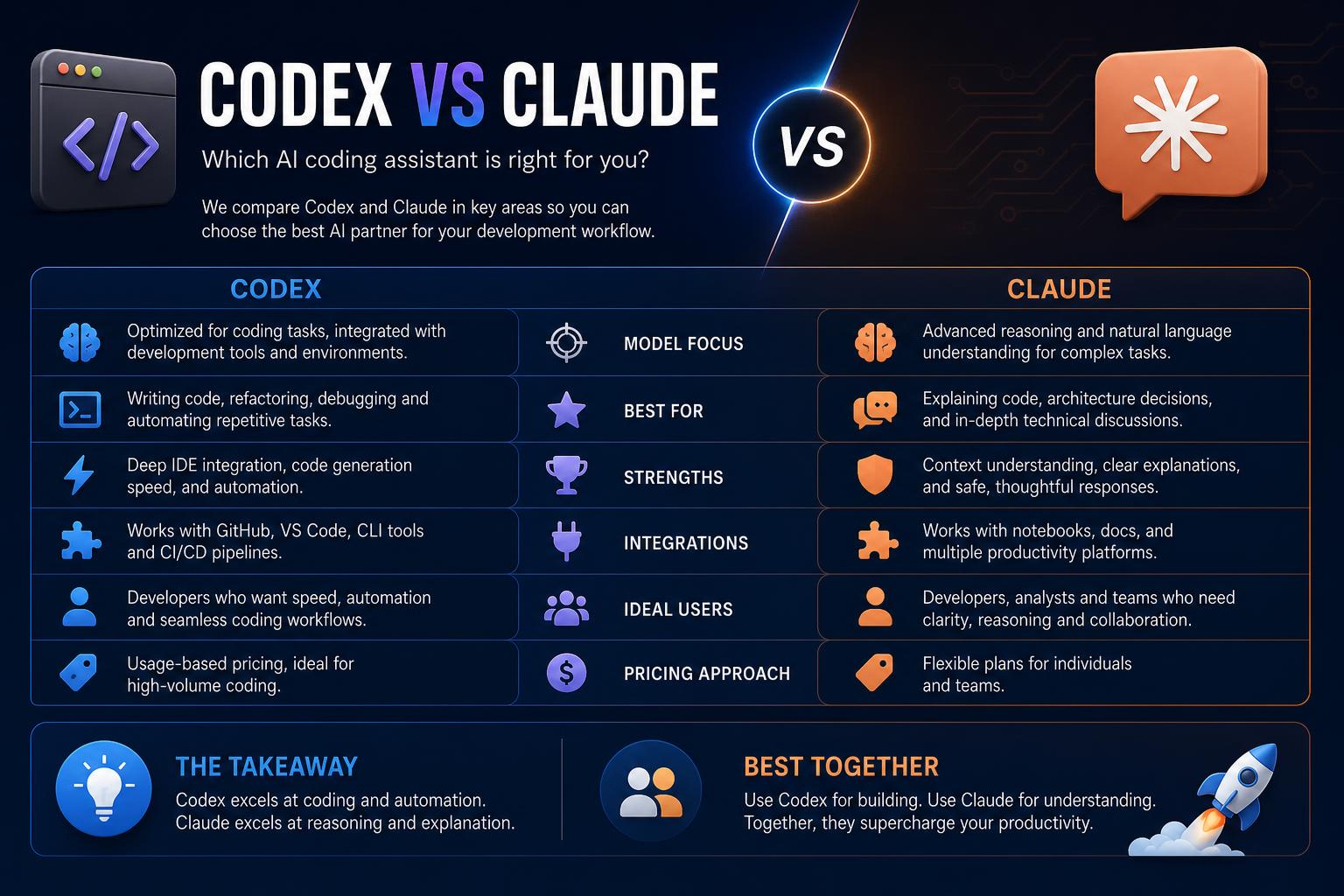
- Both Codex (by OpenAI) and Claude Code (by Anthropic) lead 2026’s AI coding agents, each excelling in unique developer workflows.
- Codex is favored for robust cloud-based delegation, backend reliability, and cost efficiency, while Claude Code wins in local integration, frontend/UI work, and harness customization.
- Pricing, interface, extensibility, and permission models are distinct—knowing your team’s priorities is crucial.
- Most advanced users run both agents in parallel, leveraging their strengths for different coding contexts.
2026 has redefined what AI coding agents mean for developers—not just automating code but fundamentally changing how teams and solo engineers ship, review, and architect software. The two standouts in this heated landscape are OpenAI’s Codex and Anthropic’s Claude Code. While “Codex vs Claude” debates fill forums and social feeds, the answer isn’t so much about which is better overall, but which fits your workflow, budget, and the nature of your projects.
This article unpacks the competition across every meaningful angle: from speed and price to how each agent integrates with your stack, handles context, and extends through custom skills. We’ve distilled real-world reviews, benchmark stats, developer anecdotes, and technical deep-dives—complemented by external documentation where gaps exist—into the most exhaustive, natural-language comparison you’ll find for 2026’s two flagship coding agents.
The AI Coding Agent Landscape in 2026
Just a few years ago, coding agents were side project novelties—now, they’re must-have tools for professional development workflows. Codex and Claude Code stand as the market leaders, each representing the vision and ecosystem of their creators. Codex, a product from OpenAI, and Claude Code, developed by Anthropic, have quickly evolved to dominate both casual and enterprise projects.
The competition is fierce for one reason: developers increasingly offload real-world software engineering to these agents, trusting them with everything from feature implementation to code review, from backend APIs to pixel-perfect UIs.
OpenCode: The Ultimate Guide to the Open-Source AI Coding Agent
Introduction to Codex and Claude Code
Codex (OpenAI)
Codex is OpenAI’s agentic software engineering product, seamlessly integrated across CLI, desktop, mobile, and cloud surfaces. Launched in its current form in May 2025, Codex now includes a dedicated CLI, VS Code extension, web interface, iOS app, desktop application, and even a newly minted Chrome extension. At its core are state-of-the-art GPT-5 family models: GPT-5.5 (flagship), GPT-5.3-Codex, and other fine-tuned variants for different use-cases and price levels.
Codex’s defining metaphor is ‘delegating to a junior engineer’: you specify the task, Codex works asynchronously—often in isolated, secure cloud sandboxes—and delivers a ready-to-review diff, complete with logs and citations.
Key highlights:
- Multi-platform reach: CLI, IDE (VS Code, Cursor, JetBrains), mobile apps, and web surfaces.
- Cloud sandbox execution: All code changes run in containers for safety.
- Configuration via AGENTS.md: Open-standard, also compatible with other tools (e.g., Cursor, Aider).
- Support for skills and plugins: Customizable workflows, skill installation, and integration with the broader ecosystem.
- Native integrations: Deep hooks into PR reviews, GitHub, Slack, and more.
Claude Code (Anthropic)
Claude Code is Anthropic’s terminal-centric, programmable AI agent, meticulously built to live inside your core developer loop. It is deeply integrated into your local environment, with full access to code files, git history, and shell commands. Launched initially for the CLI, Claude Code has expanded to include VS Code, JetBrains, desktop apps, and a new web interface since October 2025, plus comprehensive mobile support.
Powered by a suite of tuned Anthropic models (including Opus 4.8, Opus 4.7, Sonnet 4.6), Claude Code is designed for long, interactive sessions where the agent plans, edits, tests, and commits collaboratively.
Claude Code’s standout features:
- Direct terminal execution: Agents have live access to your local files, which means rapid iteration for code, tests, and scripts.
- Deep harness customization: Skills, hooks, subagents, dynamic workflows, and a growing plugin marketplace.
- CLAUDE.md configuration: Powerful, hierarchical, and project-specific instruction files with advanced memory features.
- MCP server support: For external system integration—with seamless connections to services like GitHub, Linear, Gmail, and many others.
- Granular permission control: Per-tool approval prompts safeguard your environment, with flags for auto-mode workflows.
Main Differences at a Glance
- Codex is best for: Developers wanting cross-platform reach, safety-by-default through sandboxing, asynchronous work, competitive pricing for high usage, and reliable backend or code review tasks.
- Claude Code excels for: Power users prioritizing programmatic customization, direct integration with local environments, advanced extensibility via skills/hooks, nuanced permission settings, and industry-leading UI/Frontend agent work.
- Pricing structure: Both typically start at $20/month, but meaningful usage on Claude Code usually means stepping up to the Max plan ($100/month), while Codex’s Plus tier offers extended runtime for the same price.
- The most advanced developers use both, routing different tasks to the right tool and combining strengths.
Feature-by-Feature Comparison: Codex vs Claude Code
1. Pricing and Subscription Tiers
Price is where choices are often made before technical factors even enter the conversation. On paper, both Codex and Claude Code use a similar subscription structure, but their effective usage at base tiers diverges:
- Codex (OpenAI):
- Free: $0/month (limited, throttled access for basic tasks)
- Go: $8/month (expanded access, still constrained)
- Plus: $20/month (extended Codex usage, priority support, more cloud tasks, access to GPT-5.5-Codex)
- Pro: $100 or $200/month (5x or 20x higher limits, high-intensity workflows)
- Business/Enterprise: Custom plans for teams, large-scale usage
- Claude Code (Anthropic):
- Pro: $20/month (includes Claude Code, but usage limits are quickly reached in real-world coding workflows)
- Max: $100-$200/month (5x or 20x the Pro quota—required for heavy all-day developer work)
- Team/Enterprise: Custom for larger organizations
Real-world consensus: At the $20/month mark, Codex typically offers more usable agent time per dollar. Most developers working full time hit their caps with Claude Code Pro well before those on Codex Plus. However, the pricing debate compresses if you’re running agents for hours each day—at higher commitment, both rapidly add up to $100+ monthly. It’s important to monitor both plan limits and per-task token consumption, especially for long-running, tool-heavy sessions.
2. Model Capabilities and Performance
Both agents are built on top-tier large language models, fine-tuned for code, documentation, and engineering workflows.
- Codex (OpenAI): Primarily leverages the GPT-5.5 and GPT-5.3-Codex models in 2026. These are robust, reliable, and particularly strong at backend automation, code reviews, and long-context reasoning, as well as providing a ‘steady hand’ for iterative work. GPT-5.5’s default status aligns Codex closely to other OpenAI products like ChatGPT Plus.
- Claude Code (Anthropic): Uses Opus 4.8/4.7 and Sonnet 4.6. These models are widely celebrated for nuanced instruction following, superior frontend/UI code generation, easy extensibility for custom workflows, and their ‘agentic’ approach (coordinating complex workflows and multi-step operations in a single session).
Benchmarks show close results; Codex often outpaces Claude Code on terminal logic, while Claude Code takes the lead on frontend/UI work and complex orchestration. The critical factor is not raw model power—they’re both world-class for 2026—but the differences in harness, context handling, and prompt engineering.
For rigorous tasks requiring bulletproof backend implementations or compaction across long codebases, Codex is noted for reliability. For frontend, design, and user interface projects, developer sentiment consistently places Claude Code ahead, creating visually appealing and modern components out of the box.
3. Architecture and Execution Environment
The most practical difference is where and how each agent executes your code.
- Codex: Executes all operations inside OpenAI-managed cloud containers/sandboxes. This isolates agent actions from your machine by default, increasing safety and reducing the risk of unintended environment damage. Three permission modes—Suggest, Auto Edit, and Full Auto—let you pick the right balance, all with enforced kernel-level isolation (macOS: sandbox-exec, Linux: bubblewrap/Landlock, Windows: PowerShell sandbox).
- Claude Code: Runs directly inside your local terminal by default, with real access to your files, scripts, and git history. Though it prompts for destructive actions (and can be run in ‘auto’ mode for uninterrupted flows), it places greater responsibility on the developer and requires more attention to per-action permissions.
For institutional settings needing absolute safeguards, Codex’s kernel-level enforcement is a major plus. For engineers needing deep and frictionless workflow integration, Claude Code’s local execution enables more flexibility—and risk.
4. Context Management and Long Sessions
Real innovation shows up in the way each agent manages context—tracking session history, handling tool outputs, and remembering architectural decisions over hours or days.
Claude Code’s context window can reach 1 million tokens (in beta), enabling it to persist intricate session histories and compress project states efficiently. This means you can return to the same coding session hours or even days later, and Claude Code will recall specific logic, mistakes, or fixes previously applied, improving reliability as projects grow more complex.
Codex truncates older context (often removing the ‘middle’ first), which may cause it to lose sight of earlier architectural choices in very long sessions. However, for shorter, discrete coding cycles and PR review, Codex excels at re-orienting quickly and picking up where a previous review left off.
Summary: Claude Code wins for ‘deep memory’ and long, tool-heavy tasks; Codex is steadier for shorter, frequent handoffs and change delegation between teammates.
5. Skill, Plugin, and MCP Ecosystem
Extensibility is a cornerstone for both tools, but Claude Code’s harness ecosystem is notably deeper and more open.
- Claude Code: Features subagents, a wide selection of programmable skills (SKILL.md), multi-agent workflows, hooks (26+ lifecycle events for scripting), dynamic workflows (a.k.a. ultra-code orchestration), and an expanding plugin marketplace. Most skill/plugin formats are open—Anthropic even created the Agent Skills standard (adopted across multiple agents).
- Codex: Focuses on AGENTS.md instructions (an open community standard respected by Cursor, Aider, OpenCode, etc.), MCP (Model Context Protocol) for tool integrations, and native support for delegating PR/file changes in collaborative scenarios. Skill and plugin support is slightly more curated, emphasizing official OpenAI-vetted workflows over the broad, varied Claude ecosystem.
Both agents support connecting to MCP servers for third-party integrations (e.g., Composio, GitHub, Linear, Gmail, Sentry, Firecrawl). Plug-and-play installation takes a single command in either, but Claude Code reads and plans against live tool schemas, resulting in fewer unexpected tool responses or failed integrations. Both agents can leverage hosted connectors, and the skill/plugin interoperability makes the ecosystem genuinely interchangeable for teams running mixed setups.
6. Permissions, Safety, and Workflow Controls
Agent safety is increasingly critical—nobody wants an AI to accidentally wipe a codebase or leak credentials.
- Codex: Defaults to the highest level of isolation, enforcing sandbox boundaries at the OS/kernel level, limiting file/network access, and clearly segmenting permission scope among Suggest, Auto Edit, and Full Auto modes. Agent actions are tightly controlled, predictable, and transparent, making Codex attractive for larger teams and enterprise compliance.
- Claude Code: Uses a finely granulated prompt system for tool permissions—any potentially destructive action can prompt for developer confirmation. This is safer for solo iteration but can feel interruptive without proper configuration, which is why many power users switch to –dangerously-skip-permissions for long sessions (sacrificing some safety for flow).
Summary: Codex is safer by default via sandboxing, while Claude Code gives more hands-on control to advanced users once permissions are tuned.
7. User Experience Across Platforms
Modern engineering doesn’t happen on just one device. Codex and Claude Code differ significantly in user experience continuity.
- Codex: With a unified experience across CLI, VS Code, desktop, web, mobile, and Chrome, Codex excels in cross-platform hand-off. You can start coding on your phone, switch to VS Code at your desk, and wrap up in the web UI—all while preserving context, history, and capabilities. The ChatGPT desktop app integration ensures a smooth, well-designed interface, and the browser/voice support is lauded by users.
- Claude Code: Remains terminal-first in design ethos, though desktop, web, and mobile extensions are catching up. While it wins favor for a fast iteration loop and customizable prompts, desktop UX and voice mode remain a step behind Codex in polish and continuity.
Feedback: Codex wins on seamless, device-independent workflows; Claude Code is preferred for command-line-first, deeply integrated local environments.
8. Instruction Following, CLAUDE.md vs AGENTS.md, and Skills
Instruction adherence and skill management shape how well agents adapt to your unique project requirements.
- Codex: Reads AGENTS.md files (open standard). Instructions cascade downward from the repo root, so deeper files override general ones. Codex is known for rigorous instruction following—on backend tasks, it stays within the boundaries you set and asks clarifying questions.
- Claude Code: Uses CLAUDE.md files, supporting hierarchical, path-based, and auto-memory extensions for advanced customization. For much of 2025-2026, Claude lagged in strict obedience—sometimes improvising in ways that irked users. But the Opus 4.8 model and mid-session system messages have closed that gap, and skills now override behavior cleanly on demand. Claude also pioneered the open Agent Skills format, making custom skills portable between agents.
Most real-world developers report that Codex is slightly better at persistent obedience and change tracking, while Claude Code is now the leader in skill extensibility and workflow automation.
9. Practical Performance: Speed, Output Quality, and Specialization
You’ll see both camps claiming speed, output quality, and reliability—but the benchmarks and lived user experience show nuanced differences, especially as both agents continually improve with each update.
Speed: Claude Code is renowned for fast feedback, great for interactive debugging (especially frontends/UI work). Codex spends more time “thinking” before edits, providing bulletproof diffs and higher reliability for backend and long-duration autonomous runs. Codex outputs visible tokens slightly faster; Claude Code’s perceived speed shines in the local terminal.
Output quality: Blind user tests and Reddit aggregate polls indicate Claude Code scores about 67% wins on frontend/UI generations, while Codex dominates backend and PR automation. Claude Code’s advantage on large refactors, architecture, and debugging is credited to its skill plugin/hook ecosystem and nuanced contextual reasoning.
Specialization: Claude Code should be your first stop for modern frontend tasks, CSS/React/Vue state, and multi-step feature building within the terminal. Codex is trusted for backend services, code reviews, and as the agent backing official cloud PR bots.
10. Real User Sentiment and Community Feedback
Forums, social media, and CTO reviews repeat the same theme: both agents are usable for serious work, but their strongest fans use them differently.
- Codex: Praised for reliability, sensible default behaviors, and cost efficiency at the $20/month tier—widely regarded as the “heavy lifter” for backend, refactoring, and PR reviews. Critiques mainly target bland or outmoded frontend output and a tendency to sprawl diffs across multiple files, making manual PR review time-consuming.
- Claude Code: Developers rave about frontend/UI quality and the depth of customization, especially for team ramp-ups, onboarding, or complex project scaffolding. Downsides focus on rapid consumption of Pro tier quotas ($20 is ‘gone in hours’ for heavy workflows), and the need to upgrade to Max for real production use.
11. Harness Engineering and Automation Depth
The harness is what turns a model from a chatbot into a true coding agent—managing context, handling tools, error states, and complex workflows.
Codex focuses on a simple core loop with clear delegation and review. Features like Best-of-N runs, PR comment delegation (@codex), self-review browser iterations, and efficient cloud execution shine in high-velocity teams and open-source project automation.
Claude Code, by contrast, enables deeper manipulation: advanced team onboarding automation (/team-onboarding), headless mode for CI hooks, progressive skill disclosure, and the most comprehensive event-driven hook system. Dynamic workflows allow you to orchestrate dozens of subagents—great for large, interconnected tasks like full-stack feature builds or multi-repo orchestration.
Summary: Build automated pipelines with Codex; unleash customized, multifaceted workflows with Claude Code.
12. Benchmarks: Quantitative Differences
Head-to-head benchmarks (e.g., by Composio.dev and Firecrawl.dev) show that while both agents pass the same number of tool-based tasks, Claude Code typically completes in less elapsed time and with fewer tool calls, while Codex uses resources more efficiently and at a lower out-of-pocket cost. For example, a benchmark of complex Composio use cases saw Claude Code complete workflows with 90 fewer actions than Codex, but at a 58% higher cloud bill for the same outcome.
Both achieve similar success rates in test suites, so your personal value equation may focus on: do you prize speed and interactivity (Claude Code), or maximal cost efficiency and cross-surface delegatability (Codex)?
Real-World Workflow Examples: When to Choose Which?
Go with Claude Code if:
- You need deep customization and can leverage an open ecosystem of skills, hooks, and dynamic workflows.
- Your primary work is UI/frontend-heavy or highly interactive feature building—Claude consistently outperforms for modern frontend code and rapid terminal feedback.
- You value session context that persists across long builds, and you rely on hierarchical, programmable CLAUDE.md instructions.
- Your organization has already invested in the Anthropic/Skills ecosystem or needs tight integration with local scripts, secrets, and shell operations.
Opt for Codex if:
- Your workflow involves backend automation, PR/code review, or cross-platform work (CLI, IDE, web, mobile, Chrome) and you want seamless continuity.
- You want safety-by-default: the comfort of OS-level sandboxing and a smoother permission model for team compliance.
- You are budget-sensitive and want the most runtime per dollar ($20/month goes much further on Codex’s Plus plan unless you exceed large-scale workloads).
- You need robust integration with mainstream agent standards (AGENTS.md), making it easier to collaborate with mixed-tool teams or migrate projects among agents.
Can You Use Codex and Claude Code Together?
Absolutely—and in fact, this is what the savviest engineers and teams actually do. Both agents speak the MCP protocol, and their skill/plugin systems (though not identical) have substantial overlap. Most unique features can be mirrored with a modest investment in config or plugin cross-mapping, and tools like Firecrawl, Composio, and others provide official guides for setting up dual-agent workflows.
Typical patterns:
- Frontend/UI implementation, rapid iteration, and workflow automation on Claude Code.
- Backend refactoring, PR automation, async task delegation, and review workflows on Codex.
Both can be used in parallel for especially hard or nuanced engineering problems, comparing output or double-checking critical changes before deployment. Subscription overlap is often minimal at the $100/month threshold for organizations already invested in AI development tools.
Notable Limitations and Areas for Future Growth
Neither agent is perfect—and your decision will be shaped as much by your pain points as by their features. For instance:
- Codex’s frontend output, while technically correct, is consistently described as lacking aesthetic appeal and creativity—it’s reliable but lifeless. Advanced users work around this by handing Codex a Figma design or using image models to specify UI expectations.
- Claude Code, lauded for frontend and skill automation, can frustrate users by rapidly burning through Pro tier quotas, requiring costly Max upgrades for day-long sessions, and can be unpredictable in strict instruction adherence (though Opus 4.8 improved this).
- Neither tool offers full live web access out of the box: real-time search and docs lookup must be pipelined through MCP skill servers such as Firecrawl or custom scrapers.
Codex and Claude Code in the Broader Ecosystem
If your context is enterprise app development under strict governance, both agents are slightly off the mark—tools like Superblocks offer more robust audit logs, compliance, and RBAC features. However, most developer teams still rely on Codex or Claude Code for direct engineering work, with specialized platforms reserved for operations or analytics teams.
Both tools’ pace of improvement (major updates every quarter or faster) means any current advantage could flip soon—the best approach is to stay nimble and keep both agents up-to-date and cross-tested against your hardest developer bottlenecks.
The 2026 showdown between Codex and Claude Code isn’t just about technical specs—it’s about understanding your own workflow, choosing your agent for each scenario, and not being afraid to combine strengths. The frontier now lies not in who has the “smarter” model, but in who builds the harness, skills, and automation that continuously push the limits of AI-powered software engineering.