
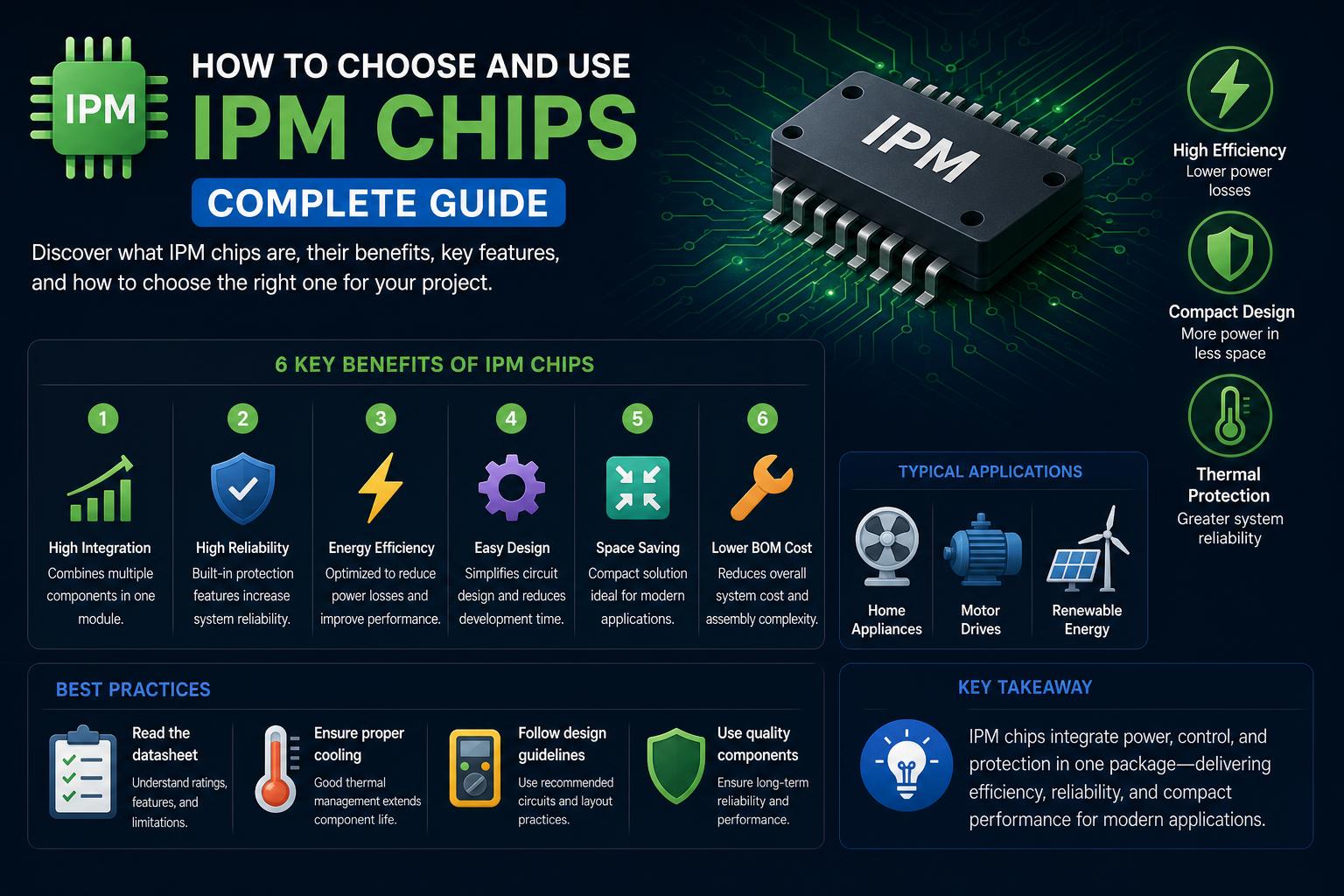
- Intelligent Power Modules combine power switching, advanced control, and protection features in compact packages.
- Major manufacturers like Infineon and Mitsubishi offer diverse IPMs tailored for motor drives, renewable systems, and industrial automation.
- Material technology and packaging innovations provide high reliability, thermal stability, and enhanced safety in challenging environments.
Intelligent Power Module chips (IPM chips) are at the forefront of modern power electronics, supporting a wide range of industrial and consumer applications that demand efficiency, safety, and robust performance. Despite their seemingly inconspicuous role, these modules have become essential building blocks for reliable motor control, renewable energy conversion, and smart appliances. From driving the compressor in your air conditioner to keeping wind turbines spinning smoothly, IPMs blend power and intelligence within a compact footprint.
As the technology landscape continues to evolve, understanding how IPM chips operate, their unique features, and their potential applications can make a significant difference for designers, DIY enthusiasts, and engineers alike. If IPMs have ever sounded mysterious, this guide will demystify them, delve into their inner workings, and provide a detailed panorama of what makes them so vital for current and next-generation power solutions.
What is an Intelligent Power Module (IPM)?
An Intelligent Power Module, or IPM, is a highly integrated semiconductor device designed to handle complex power switching tasks while embedding advanced control and protection features. In essence, it merges a “power module” (typically using IGBT, FET, or BJT transistors as switching elements) with specialized circuits that allow precise, fail-safe operations.
The ‘intelligent’ aspect comes from the sophisticated integration of drive logic, communication, and protection mechanisms, enabling the IPM not only to switch power but also to monitor conditions, communicate faults, and defend itself from hazardous scenarios like short circuits or overvoltage.
Core Structure and Working Principles of IPM Chips
At the heart of IPM chips lies a careful combination of power semiconductor switches and gate driver circuits, all closely monitored and controlled by integrated logic and protective technologies. Typically, an IPM includes:
- Power switching elements, usually IGBTs (Insulated Gate Bipolar Transistors), though FETs and BJTs are also found depending on application needs.
- Gate driver circuits designed to switch transistors efficiently using fast, stable voltage control and ample current capacity, ensuring minimal switching losses and heat build-up.
- Control logic that orchestrates switching and prevents potentially catastrophic simultaneous conduction (known as shoot-through or cross-conduction).
- Integrated protection features, such as detection for overcurrent, overvoltage, short circuits, and undervoltage situations.
- Optional communication interfaces for fault reporting, temperature monitoring, and system integration, and sometimes power factor correction (PFC) functions in demanding applications.
An IPM goes beyond simply toggling a transistor; its advanced logic ensures safe, reliable, and swift operation even in demanding industrial and consumer environments, safeguarding expensive hardware from harm.
Key Advantages of IPM Chips
Why do engineers and designers gravitate toward IPM chips rather than discrete solutions? The answer lies in a powerful mix of performance, reliability, and ease of integration:
- Simplified PCB design: Fewer external components and compact modules reduce size, complexity, and assembly time.
- Improved reliability: Embedded protection mechanisms greatly decrease the risk of damage from electrical faults.
- Reduced time-to-market: Off-the-shelf, well-integrated IPMs help designers prototype and release products faster.
- Enhanced system efficiency: Fine-tuned driver circuits ensure high-speed switching with low losses, lowering energy consumption and heat generation.
- Lower overall system cost: By cutting down on component count, labor, and layout complexity, IPMs often deliver the best ROI for high-volume designs.
Major IPM Chip Manufacturers and Industry Leaders
The IPM ecosystem features several global leaders such as Infineon, Mitsubishi Electric, STMicroelectronics, and others, each bringing specialized expertise and product families to the market. For example:
- Infineon CIPOS™ series: Renowned for high integration, the CIPOS Mini, Micro, Nano, and Tiny families are designed to drive motors over a power range of 20 W up to 5 kW. These modules help shrink PCB area, optimize thermal management, and streamline system assembly for consumer appliances, industrial drives, and HVAC systems. Check out more about these solutions on the Infineon official website.
- Mitsubishi Electric IPM G1 series: These modules leverage the latest seventh-generation IGBT chips, pushing the boundaries of power density, efficiency, and form factor. Reflecting ongoing advances in IGBT technology, Mitsubishi’s G1 and L1 series feature compact, low-loss performance, self-protection ICs (covering short circuit, under-voltage, over-temperature), and dedicated drive circuits — ensuring top-tier reliability. For details, visit Mitsubishi Electric’s official G1 series page.
- STMicroelectronics and ROHM Semiconductor: Both offer solid lines of IPMs, supporting various industries with scalable power ranges, different packaging options, and multiple protection features tailored for automotive, consumer, and industrial markets.
Main Features Integrated in Intelligent Power Modules
While individual modules vary, modern IPMs typically offer an impressive suite of features that excel in power electronics design:
- High-performance switching elements: Most use IGBTs due to their efficiency in high-power and high-frequency environments, although MOSFETs and BJTs may be present in specialized modules.
- Gate driving circuits: They need to provide precise voltage levels and surge current to switch power transistors quickly and safely.
- Gate supply logic: Essential to prevent unwanted simultaneous conductances in high-side and low-side switches (shoot-through). Interlock circuits serve as this critical safety net.
- Integrated protections: Monitoring and protection against overcurrent, overvoltage, short circuit, and undervoltage, including active thermal management protocols.
- Communication functionality: Especially in smart or industrial environments, IPMs may offer communication ports to log faults, monitor temperatures, or interact with a central control unit.
- Active Power Factor Correction (PFC): Some high-end IPMs include active PFC, contributing to the system’s energy efficiency.
This feature set means that IPMs handle not just power switching, but also perform much of the ‘thinking’ required to keep that energy moving safely and efficiently.
Selection Criteria and Popular IPM Families
Choosing the right IPM involves balancing size, current/voltage requirements, switching speed, and protection goals, usually guided by the specific demand of the application. Product families are typically categorized into:
- Compact modules: Highly integrated, ideal for designs that prioritize PCB space. Suitable for fans, pumps, and home appliances with modest power requirements (e.g., Infineon CIPOS Nano and Micro).
- Standard modules: Robust and versatile, covering the bulk of industrial motor control applications, with a typical power range of approximately 20W to 5kW.
- High-performance modules: Designed for extremely demanding tasks, offering greater power density, energy efficiency, and better heat dissipation, ideal for electric vehicles or large renewable energy installations.
Within each category, manufacturers offer versions optimized for specific requirements, ranging from three-phase systems and harsh industrial environments to low-cost consumer products.
Main Applications of IPM Chips
More than just a motor controller, IPMs are found wherever efficient, safe, and durable power switching is required. Key application areas include:
- Motor control for vehicles and appliances: Whether in modern electric vehicle propulsion systems, industrial robots, or home appliances like washing machines, dishwashers, fans, and air conditioners, IPMs offer quiet and reliable torque control.
- Uninterruptible Power Supply (UPS): They provide reliable voltage and current switching to ensure uninterrupted power in critical facilities.
- Converters and inverters: IPMs are key components in DC to AC inverters and power conversion stages in renewable systems, such as solar panels and wind turbines.
- General industrial control: From HVAC systems to conveyor belts and industrial automation, IPMs ensure robust, responsive operation with protections against adverse conditions.
Their versatility also spans systems that demand precise power factor correction, fault tolerance, and electromagnetic compatibility, reflecting their essential role in constantly evolving power electronics.
Material and Technology in IPM Solutions
Beyond integrated logic and power switching, the reliability and suitability of an IPM also depend heavily on packaging technology, encapsulation materials, and thermal management enhancements. Suppliers like Krayden highlight innovations such as:
- Advanced encapsulants and molding materials: Like the Hysol and LINQSOL ranges. These withstand high-temperature stability, moisture resistance, and robust electrical insulation, protecting the underlying electronics, whether for high voltages, frequent thermal cycling, or extreme environments.
- Specialized material options: Meeting needs like single-sided or double-sided cooling (important for direct cooling modules), compatibility with different lead packages (T-PAK, DPAK, SOT227, TO-220, etc.), and the ability to withstand heat transfer and mechanical challenges in large industrial IPMs.
- Thermal performance: Manufacturers specify encapsulants like Hysol GR750 or the LINQSOL EMC series for applications requiring maximum dielectric strength, reliable heat transfer, and mechanical robustness against electrical loads.
Choosing the right encapsulation and packaging design can significantly increase lifespan and performance, especially in high-voltage, high-frequency, or constant-vibration environments.
Innovations and Trends in IPM Developments
Recent advances in IPM chips focus on two main areas: power density/miniaturization and enhanced protection/communication capabilities. The entry of Silicon Carbide (SiC) and Gallium Nitride (GaN) devices into the mainstream enables IPMs with lower conduction losses, higher operating voltages, reduced switching times, and greater compactness—key benefits for high-efficiency inverters in renewable energy, electric vehicles, and next-generation industrial systems.
The integration of smarter self-diagnostic routines, temperature/fault logging, and real-time communication channels is transforming IPMs into a bridge between analog power and digital system intelligence. This trend will only accelerate as Industry 4.0 and IoT connectivity redefine energy and automation scenarios.
Practical Considerations for IPM Implementation
Engineers and enthusiasts implementing IPM chips must keep in mind several best practices for successful system design and long-term reliability.
- Thermal management: Although highly integrated, IPMs can generate significant heat—proper thermal dispersion, heat sink selection, and ventilation are essential.
- PCB Layout: Minimize parasitic inductances and capacitances, keep power loops short, and pay special attention to isolation between power and control sides.
- Protection circuits: Although they have built-in protection, external circuits (like fuses or overcurrent arresters) increase safety against extreme faults.
- Firmware considerations: For applications with communicating IPMs, the firmware must actively monitor diagnostics and perform fault recovery or logging.
Manufacturers provide comprehensive data sheets and application notes, making selection and integration much easier. Staying within recommended voltage, current, and temperature limits will maximize the life and reliability of the IPM under real-world conditions.
[relacionado url=”https://www.ikkaro.net/what-is-orange-pi-6/”]
Today, IPM chips represent a revolution in power electronics integration, merging efficient high-current switching with intelligent protection that simplifies the designer’s job and increases reliability for the end user. Whether found in modern drivetrains, industrial automation, or energy-efficient home appliances, their combination of power, safety, and smart controls underpins much of the world’s electrical infrastructure. As materials science and chip design continue to advance—with SiC, GaN, and even more sophisticated communication routines in standard modules—the scope and value of IPMs will only continue to expand.