
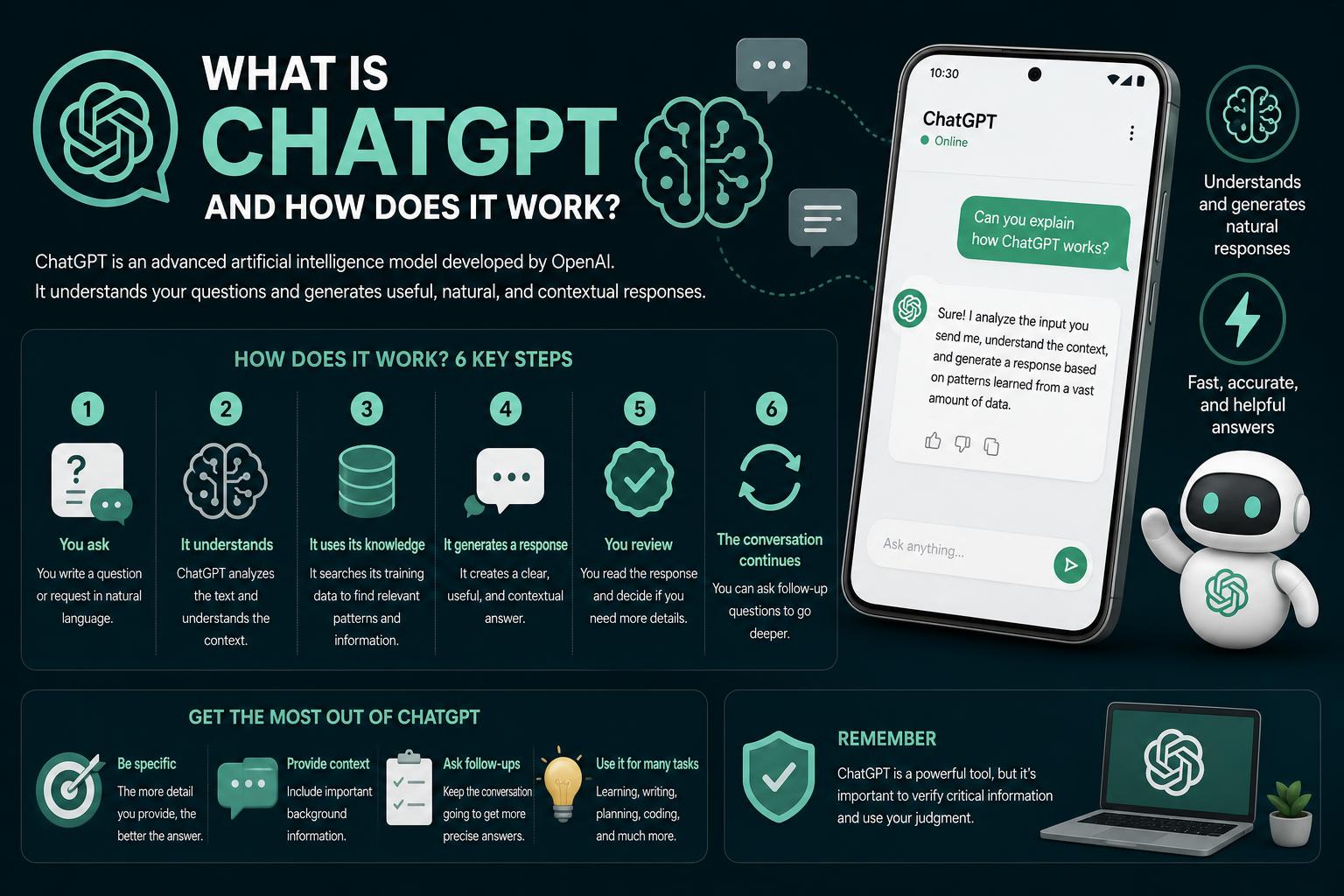
- ChatGPT is a versatile AI language model using transformer architecture, enabling advanced conversation, creativity, and workflow automation.
- It learns through large-scale unsupervised pre-training, refined with supervised and reinforcement learning from human feedback, leading to context-aware responses.
- The platform powers practical use cases across business, education, marketing, and technical support, while presenting risks and ethical challenges that require user awareness.
The emergence of generative AI has transformed not just the way we communicate, but also the landscape of work, creativity, and productivity. One major driver behind this transformation is ChatGPT, a model developed by OpenAI that has effortlessly bridged the gap between humans and machines. While the capabilities of this language model often feel magical, the mechanisms powering ChatGPT are grounded in deep learning, sophisticated architectures, and immense datasets. If you’re curious about what ChatGPT is, how it works, and how it fits into modern workflows, this article is your deep-dive guide.
Understanding how ChatGPT operates—and the many ways it’s used—opens new possibilities for individuals and organizations alike. Whether you’re a business professional, developer, student, marketer, or simply someone intrigued by AI, chances are you’ve seen ChatGPT mentioned everywhere. But generic headlines can be confusing or shallow. In this resource, we break down the technology, practical uses, features, limitations, and future implications of ChatGPT, translating technical concepts into clear, natural language you can apply today. Let’s get started on this extensive tour of ChatGPT’s role in today’s world.
What Is Retrieval-Augmented Generation (RAG) in Artificial Intelligence: Complete Guide and Examples
Defining ChatGPT: What Exactly Is It?
ChatGPT is much more than a chatbot—it’s a powerful, general-purpose artificial intelligence platform designed to engage in natural human dialogue, generate creative and technical text, solve problems, and automate tasks across various domains. Developed by OpenAI, ChatGPT is based on the Generative Pre-trained Transformer (GPT) family of models. The core innovation here is the Transformer architecture—a neural network that excels at analyzing and generating language (and, in recent iterations, images and audio, too).
The name “ChatGPT” stands for “Chat Generative Pre-trained Transformer.” Unlike basic rule-based bots that can only provide responses from a script, ChatGPT understands context, adapts to conversational flow, and draws from knowledge gleaned across billions of text samples. In its more advanced forms, ChatGPT processes images, audio, and multi-step instructions, making it far more versatile than most conversational AI tools.
Key highlights of modern ChatGPT include:
- Contextual understanding: It keeps track of a conversation, adapts tone and answers based on prior exchanges.
- Multimodal inputs: Images, audio, and text are processed together, allowing seamless multi-format interaction.
- Agent harness: Beyond chat, it can automate workflows, execute complex actions across multiple applications, and handle chained tasks.
- Extensibility: It integrates via APIs, plugins, and custom tools, making it adaptable to business systems and creative projects.
The technology is built to mimic—and sometimes exceed—the conversational abilities we associate with intelligent human interactions.
What is No-Code? The Complete Guide to Visual Application Development
Diving Into How ChatGPT Works: From Data to Dialogue
The mechanisms that enable ChatGPT to deliver such impressive results can seem mysterious, but let’s peel back the layers and explain each major component.
1. Training Large Language Models: The Foundation
ChatGPT was created by pre-training a massive neural network on enormous datasets that include web pages, books, articles, code, forum posts, wikis, and much more. For instance, GPT-3, a predecessor, was trained on over 45TB of text data, drawing from the entirety of Wikipedia and countless other sources. Modern models use even more diverse, multimodal data—including images and audio.
This pre-training process is mostly “unsupervised”: the AI model reads vast amounts of unlabelled text and learns language structure, grammar, patterns, and general world knowledge by prediction—essentially guessing the next word(s) given a partial sequence and adjusting itself based on how well it performs.
Key points about pre-training:
- No specific outputs are paired with the inputs: The model learns by identifying general patterns and relationships within the data, rather than memorizing specific answers.
- The process builds intuition about language itself, making the AI able to adapt across various topics even if it hasn’t seen a particular question before.
Alongside unsupervised learning, ChatGPT incorporates supervised fine-tuning and reinforcement learning from human feedback (RLHF) to improve model responses and behaviors further.
2. The Transformer Architecture: ChatGPT’s Neural Engine
At the heart of ChatGPT lies the Transformer architecture, a game-changing neural network design that processes language using “self-attention” mechanisms. Transformers aren’t bound by the sequential structure of older models like RNNs. Instead, they scan all parts of a sequence at once, weighing the importance of every word or token in relation to others—making it easier to grasp long-term dependencies in language and generate coherent, in-context answers.
Here’s how the Transformer works in simple terms:
- Tokenization: Input text is broken down into “tokens”—small units of meaning, like words, syllables, or even characters.
- Self-Attention: The model analyzes how each token relates to every other token in the input, identifying patterns and context.
- Encoding and decoding: The model encodes the input into internal representations, then decodes these into output tokens that form a response.
This parallel processing is why Transformer models like ChatGPT can handle long texts quickly and with greater coherence.
3. Fine-Tuning With Supervised and Reinforcement Learning
While the bulk of ChatGPT’s “knowledge” comes from unsupervised pre-training, its ability to provide sensible, helpful, and appropriate answers is refined through supervised and reinforcement learning layers. During supervised learning, the model is trained on pairs of inputs and desired outputs, such as questions and ideal answers curated by human experts.
The most impactful fine-tuning method is RLHF (Reinforcement Learning from Human Feedback):
- Step 1: Trainers present the model with examples of good and bad responses to various prompts.
- Step 2: These outputs are then ranked, creating a “reward model” that encourages the AI to favor more helpful, truthful, and safe answers.
- Step 3: The system learns to optimize its responses for human approval, gradually reducing the risk of bias or offensive content.
This process is a feedback loop—user ratings and corrections after deployment further refine the behavior of ChatGPT models in the wild.
4. Tokenization and Context Windows
ChatGPT’s input and output are managed at the token level, with each token representing a chunk of text (on average, four characters or so). Modern GPT models can process millions of tokens within a single conversational context, enabling long and detailed interactions—though they must still prioritize which information to keep active in memory if conversations run very long.
Output is generated by predicting the most likely next token at each step, balancing accuracy with a controlled dose of randomness for variety in responses.
5. Multimodality and Expanded Abilities
Recent iterations of ChatGPT (e.g., GPT-4 and beyond) go further, integrating text, images, and audio as input and output formats. This “multimodal” capability lets the model analyze, create, or edit photos, transcribe and process speech, and handle instructions that span different media. As a user, you can submit a screenshot, dictate instructions, or hand off a file—all in the same conversation thread.
6. Extending ChatGPT: APIs, Integrations, and Workflows
ChatGPT can be accessed through a web interface, but its true power is unlocked when used as an API in your own applications or via integration with workflow automation platforms like Zapier.
Key extensibility features include:
- Desktop and mobile apps: offer chat, voice, and even developer interfaces like Codex.
- Memory and customization: allows remembering preferences, project context, and keeping information between sessions if authorized.
- Plugins and connectors: facilitate direct action on emails, databases, spreadsheets, and more, as part of a workflow.
Integrating ChatGPT into existing systems allows automating repetitive tasks, providing instant support, summarizing documents, analyzing data, and more, without leaving the usual environment.
What is No-Code? The Complete Guide to Visual Application Development
Core Features of ChatGPT
ChatGPT’s feature set is what makes it so attractive for personal and professional use.
- Human-like conversation: produces text that sounds natural in multiple languages and adjusts style or tone as needed.
- Text synthesis: can instantly generate articles, reports, stories, advertising copy, and creative ideas.
- Multi-turn context: remembers conversation history, enabling coherent responses and follow-up questions.
- Prompt comprehension: can ask for clarification if the input is vague, ensuring better results.
- Style modulation: generates texts with adjustable levels of formality, voices, or emotional tones.
- Programming and debugging: creates, explains, and reviews code, offering suggestions, fixes, and edge case detection.
- Text summarization: distills long documents or explains complicated concepts simply.
- Keyword and intent analysis: useful for marketing, allows efficiently generating, grouping, and categorizing keywords.
- Multimodal capabilities: processes images or audio in addition to text for advanced use cases.
- Extensibility via API: powers third-party applications, automation, and various integrations with a simple interface.
All these features are designed to boost productivity and creativity in real-world scenarios, not just answer trivial questions.
What Is Perplexity AI? Everything You Need to Know
Known Limitations and Challenges of ChatGPT
No technology is perfect, and ChatGPT has some important limitations that users should keep in mind.
- Lack of real comprehension: although it mimics reasoning, ChatGPT does not “understand” meanings; it relies on statistical patterns rather than conceptual understanding.
- Can produce errors: generates convincing but inaccurate or nonsensical answers, especially on complicated or infrequent technical questions.
- Outdated data: its “knowledge” is limited up to its last training update, although some versions can search the web.
- Mechanical response: sometimes repeats phrases or structures responses repetitively, lacking common sense or subtlety in certain cases.
- Risk of biases: can reproduce prejudices present in training data, including stereotypes and unintentional offenses.
- Privacy risks: entered data could be stored and reviewed, so care must be taken with sensitive information.
- Service availability: high demand can cause capacity issues and limited access during peak hours.
Being aware of these limitations is crucial when using ChatGPT for research, consulting, or business automation.
ChatGPT Usage: Free vs Paid Tiers
Many people wonder if using ChatGPT involves costs. The basic entry is usually free, but advanced features, priority access, and higher-performance models are subscription-based. The free version has limits, such as speed and response restrictions, while paid plans offer greater reliability, access to the latest models, and in some cases, API credits.
Consult the documentation and privacy policies to choose the option that best fits your needs, especially if you handle sensitive data or require regulatory compliance.
[relacionado url=”https://www.ikkaro.net/what-is-opencode/”]
Ethical Considerations: Opportunities and Risks
The growth of ChatGPT has sparked debates on AI ethics, including plagiarism, bias, privacy, and job displacement.
Plagiarism and Cheating
Due to its ability to generate human-sounding content, there is a risk that people may present AI-created work as their own, especially in academic and professional fields. Institutions must rethink originality, encourage transparency, and promote the responsible use of AI as a tool, not a shortcut.
Biases and Representation
Models reflect biases from their training data. If these contain stereotypes or unfair ideas, the output can be biased. Developers work to reduce these risks with balanced datasets, anti-bias reinforcement learning, and greater transparency to build trust.
Job Displacement and Human Contact
AI can replace routine jobs related to text and simple reasoning, affecting industries. However, many experts see a transition toward “AI-powered” roles, where humans use models like ChatGPT to boost creativity, gain insights faster, and focus on strategic tasks.
Privacy Considerations
The storage and analysis of user data, especially in improvement processes, poses privacy risks. It is recommended to be careful with sensitive information and for companies to establish strict data management and regulatory compliance protocols when integrating ChatGPT into their workflows.
[relacionado url=”https://www.ikkaro.net/what-is-software-defined-vehicles-sdvs/”]
Alternatives to ChatGPT: Other Language Models
As AI models evolve, alternatives emerge that address different needs or ethical concerns, such as M1-Project, which emphasizes privacy and bias reduction, or models from tech giants like Google (Gemini), Meta (LLaMA), and Anthropic (Claude).
Choosing the right platform depends on what you are looking for: To reduce bias and increase transparency, options like M1-Project are preferable. For mature APIs, OpenAI and Google lead. Evaluate based on your sector, integration, and risk profile.
What Are AI Agents? A Complete Guide to Intelligent Agents in 2025
Real-Life Examples: ChatGPT in Action
Some prominent examples show how ChatGPT transitions from a demo to an essential tool across different sectors:
- IBM: Uses GPT to process data, manage knowledge, and automate processes.
- Klarna: Implemented assistants to support operations and reduce resolution times.
- Morgan Stanley: Uses GPT for instant access to research, compliance, and client support.
- Duolingo: “Duolingo Max” powers language practice and feedback on the platform.
- Coca-Cola: Use of generative AI in co-creation campaigns with consumers.
These cases demonstrate that ChatGPT is not just an innovation, but a strategic component in multiple industries.
Technical Deep Dive: From Tokens to Outputs
For developers and technical enthusiasts, understanding ChatGPT in its architectural aspects helps optimize its implementation.
Token Management and Context Windows
All text, image, and audio are converted into tokens—small units of meaning. The model reasons over millions of parameters, relating tokens to one another. The “context” is the set of tokens it can consider at once; this is key if very extensive dialogues are desired.
Self-Attention and Parameter Scaling
The “self-attention” mechanism allows the model to focus on important words, regardless of their position, leading to precise and coherent understanding and generation.
Temperature Settings and Output Diversity
APIs allow adjusting the “temperature,” influencing creativity and variability in responses. A high temperature generates more creative ideas, while a low temperature yields more conservative and predictable answers. This makes it possible to tailor the output according to need.
Practical FAQs
Below we address some frequently asked questions about ChatGPT:
- How does it differ from traditional chatbots? Older ones use rules and scripts; ChatGPT generates real-time responses, adapting to context.
- Does it have real comprehension? Actually, it only predicts words statistically, it does not conceptualize meaning.
- Can it make mistakes? Without a doubt, it is always recommended to verify results in critical applications.
- What is RLHF? It is a process where humans rate responses, helping the model learn preferences.
- How does multimodality work? Images, audio, and text are processed together using tokens and similar networks.
Future Developments: What Lies Ahead for ChatGPT
The path for ChatGPT includes continuous improvements in precision, bias reduction, privacy, multimodality, and support for real-life integration. Greater autonomy in complex tasks, expanded memory, on-device processing, and safer behaviors are anticipated, guided by regulations and the community.
The constant evolution of ChatGPT is transforming the way we communicate, work, and create. Its growing adoption and AI literacy will allow maximizing its value, always being aware of its limitations and risks in the fast-paced world of generative artificial intelligence.