
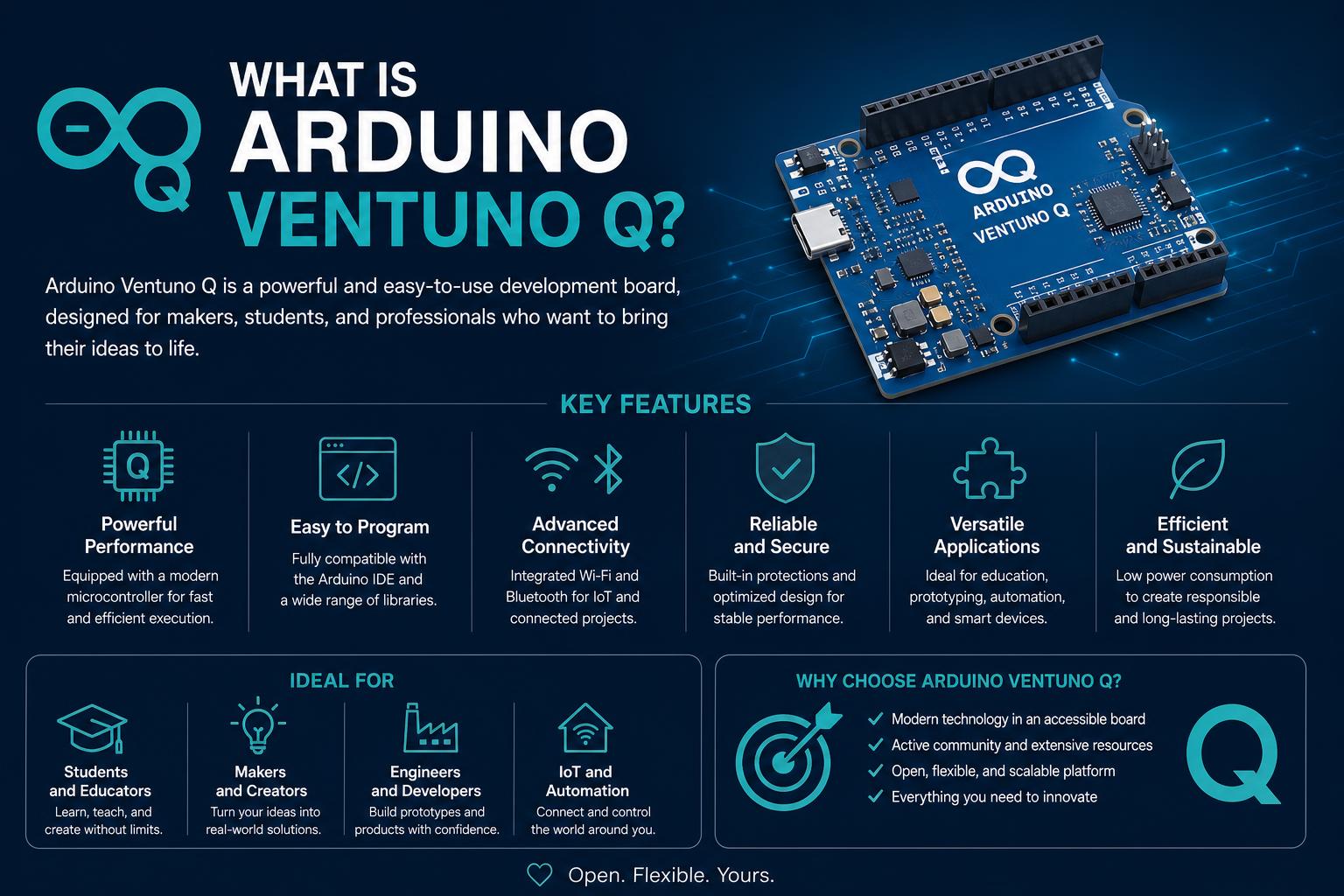
- The VENTUNO Q combines a powerful AI processor and real-time microcontroller for unrivaled edge computing.
- It supports advanced AI models, local inference, and robust industrial interfaces, all in one board.
- App Lab and flexible Linux/Zephyr development environments accelerate prototyping and deployment.
The rise of edge AI, robotics, and intelligent devices has created a demand for compact but powerful hardware solutions capable of running advanced models directly at the point of data collection. The Arduino VENTUNO Q stands out as the latest evolution of the Arduino platform, uniquely engineered to bring high-performance AI and real-time control to developers, engineers, and makers worldwide, all on a single board. While Arduino has long been synonymous with easy-to-use microcontrollers for prototyping, the VENTUNO Q redefines what’s possible at the intersection of embedded systems and artificial intelligence.
With its dual-brain architecture combining a sophisticated AI processor and a dedicated real-time microcontroller, the VENTUNO Q introduces a new era: intelligent devices that can sense, process, and act independently at the edge, without relying on the cloud. This article will take you on a comprehensive journey through its features, applications, and the wide array of opportunities it unlocks for innovation in robotics, computer vision, and industrial automation.
Introducing VENTUNO Q: The Next Generation Edge AI Computer
Arduino VENTUNO Q is an advanced edge AI board designed for next-level AI, robotics, and computer vision tasks right out of the box. At its core, it’s all about merging immense AI processing capabilities with precise, real-time machine control on a single, highly integrated PCB.
The VENTUNO Q is built around a powerful Qualcomm Dragonwing™ IQ-8275 SoC, featuring a dedicated Neural Processing Unit (NPU), Central Processing Unit (CPU), and Graphics Processing Unit (GPU). Alongside this AI powerhouse is an STM32H5 microcontroller, forming a ‘dual-brain’ system. These two processing units communicate seamlessly through an efficient RPC (Remote Procedure Call) bridge—eliminating delays and cutting down the complexities that typically come with multi-device setups.
With 16 GB LPDDR5 RAM and 64 GB industrial-grade eMMC storage, the VENTUNO Q has both the memory and the storage capacity to handle advanced AI models—from large language models (LLMs) to real-time computer vision and sensor fusion applications.
Why Does the Dual-Brain Architecture Matter?
Traditional embedded AI systems often force developers to choose between raw computing power and real-time responsiveness. The magic of VENTUNO Q lies in its dual-brain approach, bringing both worlds together:
- The AI Brain: The Qualcomm IQ-8275 runs Linux (with Ubuntu pre-installed), empowering you to execute neural networks, language models, and high-bandwidth data processing using the NPU’s 40 TOPS (trillion operations per second) of AI acceleration. This makes it possible to deploy models for image recognition, voice control, sensor fusion, and more—directly on the device, with no cloud latency.
- The Action Brain: The STM32H5 real-time microcontroller brings low-latency, deterministic control over actuators, CAN-FD motor controllers, PWM, GPIO, and industrial protocols. It runs Zephyr RTOS with the Arduino Core, ensuring sub-millisecond response times for safety-critical and robotics use cases.
This combination means VENTUNO Q is both ‘smart’ and ‘fast’—it can analyze complex sensor data, make decisions using modern AI, and control machinery with surgical precision, all in real time.
A Deep Dive into Arduino AI Assistants: Smarter Coding with AI for Makers and Innovators
Key Specifications and Features
Let’s break down the VENTUNO Q’s main hardware features so you can see why it’s considered Arduino’s most capable board to date:
- Processor: Qualcomm Dragonwing IQ-8275 SoC featuring NPU, CPU, and GPU cores.
- Microcontroller: STM32H5 series for real-time I/O and fast motor/actuator control.
- AI Performance: 40 TOPS dedicated to on-device AI for neural networks, machine vision, speech, and autonomous control.
- Memory: 16 GB high-speed LPDDR5 RAM for large AI models and high-resolution computer vision.
- Storage: 64 GB industrial-grade eMMC, expandable with an M.2 NVMe Gen.4 slot for robust data storage and OS updates.
- Networking: Tri-band Wi-Fi 6 (2.4/5/6 GHz), Bluetooth 5.3, and 2.5Gb Ethernet ensure high-speed connectivity for edge and IoT applications.
- USB: USB-C for fast data/device connections, plus dual USB-A 3.0 ports for peripherals and storage expansion.
- Multiple Camera Inputs: Three MIPI-CSI connectors for stereo vision, 360° awareness, and multi-angle inspection in robotics and automation.
- Advanced Display Outputs: MIPI-DSI, HDMI, and USB-C DisplayPort support a variety of screens, projectors, and interactive panels for human-machine interfaces.
- Industrial I/O: CAN-FD, PWM, and deterministic GPIOs for integration with professional motor controllers and industrial networks.
The board’s toughness and expandable design make it ideal for demanding environments and scalable projects—moving seamlessly from prototype to production.
Out-of-the-Box Software Power: Linux, Zephyr RTOS, and App Lab
One of the things that make VENTUNO Q truly developer-friendly is its flexible software ecosystem. For the AI brain, Ubuntu Linux comes pre-loaded (Debian coming soon), providing a familiar and open development environment. Tools like Docker and the apt package manager are available right from the start, so teams can use their preferred workflows and IDEs—including VS Code or native Linux tools—without being boxed into proprietary software.
The Action Brain runs Zephyr Real-Time Operating System (RTOS) with full Arduino Core support, ensuring lightning-fast response for low-level control, motor actuation, and sensor handling. This means you can write classic Arduino sketches, build Python scripts, or run containerized AI models—all managed and orchestrated from a unified platform—the Arduino App Lab.
What is Arduino IoT Cloud HUB? The Ultimate Guide for Modern IoT Projects
Develop Smarter and Faster with Arduino App Lab
Arduino App Lab is designed as a cross-platform development environment that bridges the gap between embedded programming, Linux development, and edge AI. Pre-installed on VENTUNO Q, App Lab enables users to:
- Write and manage Arduino sketches and Python scripts in one place, making it easy to combine low-level hardware control with high-level AI decision-making.
- Seamlessly deploy containerized AI models for inference, testing, and application updates.
- Import, train, and optimize custom AI models using Edge Impulse Studio or upload GGUF-format models directly from Hugging Face or Qualcomm AI Hub for instant deployment and testing.
- Access a growing library of plug-and-play Apps and Bricks—self-contained examples and modules that accelerate development, such as pre-built vision, audio, and detection features.
Arduino App Lab: The Definitive Guide for Developers, Educators, and Makers
AI Model Support and Integration
The VENTUNO Q’s AI brain gives you freedom when it comes to model choice and deployment. Its NPU supports an extensive range of pre-optimized AI models, enabling advanced intelligence and perception tasks directly on the board. These include:
- Qwen Series: On-device large language models (LLM) for natural language processing without cloud dependency.
- Qwen VLM: Fusion models for OCR, scene description, and image captioning, combining vision and language understanding.
- Melo TTS & Piper TTS: Speech synthesis for natural voice interaction and responses.
- Whisper ASR: Local automatic speech recognition for device voice control and accessibility.
- YOLOX: High-speed object detection—track people, vehicles, or other items in real-time across visual feeds.
- MediaPipe: Gesture and movement recognition—ideal for touchless interfaces and robotics hand/pose control.
- PoseNet: Body pose tracking for fitness, safety, or entertainment applications.
If you have custom models, you can upload them through the llama.cpp Brick in App Lab or train new models with Edge Impulse Studio, taking advantage of the NPU’s hardware acceleration for fast and efficient deployments, without the need for costly recompilations or framework migrations.
Hardware Expansion, Connectivity, and Industrial Design
Designed with scalability and real-world deployment in mind, VENTUNO Q comes with industrial features you’d expect in far more expensive systems.
- Robust M.2 NVMe Gen.4 slot lets you expand storage as project needs grow.
- Triple MIPI-CSI camera support allows for advanced stereo depth sensing, object tracking from multiple angles, and even 360° perception for robotics and surveillance.
- Multiple connectivity options—ranging from Wi-Fi 6, Bluetooth 5.3, to high-speed 2.5Gb Ethernet—ensure seamless integration with edge networks, industrial automation, and IoT solutions.
- Industrial I/O options (CAN-FD, PWM, deterministic GPIOs) pave the way for robust integration into manufacturing, autonomous vehicles, and professional robotics ecosystems.
The board’s ruggedness and expandable design make it ideal for demanding environments and scalable projects, enabling a smooth transition from prototype to production.
Applications: Where Can You Use Arduino VENTUNO Q?
The true versatility of the VENTUNO Q becomes clear when looking at its wide range of applications. Thanks to its real-time control and AI power, you can use it for:
- Autonomous robots and drones that need fast perception, decision-making, and precise motion control for tasks such as pick-and-place, navigation, Visual SLAM (Simultaneous Localization and Mapping), and more.
- Industrial automation, predictive maintenance, and process monitoring—moving into applications where data is processed locally to obtain faster insights, without relying on the cloud or waiting for network latency.
- Quality control and inspection—using real-time computer vision models to detect defects on production lines or packaging systems.
- Smart cities and connected home devices—enabling traffic analysis, public safety automation, and environmental monitoring that responds instantly to its surroundings.
- Educational platforms for advanced computer vision, embedded AI, and generative intelligence—giving students and researchers a hands-on path to understanding AI and robotics development.
Its dual nature as both a powerful edge AI inference engine and a deterministic real-time controller is unmatched in this price range and form factor.
From Prototype to Production: Scalability and Long-Term Support
One of the recurring challenges with innovative hardware is transitioning from a successful prototype to a deployment-ready product. VENTUNO Q is specifically designed to bridge that gap. When your prototype or proof of concept is ready to scale, the same Dragonwing IQ8 architecture will be available as a System-on-Module (SoM) certified by partner vendors.
This means that the software stack, AI models, and application logic developed on VENTUNO Q can migrate seamlessly to production hardware, avoiding costly reconfiguration or rewrites. For companies and developers, this reduces time to market and the technical risks associated with scaling.
Community, Documentation, and Support
The Arduino ecosystem is known for its extensive documentation, active community, and open-source philosophy. With VENTUNO Q, you get support through:
- Official documentation that helps you get started, troubleshoot issues, and build advanced projects.
- The Arduino forum, where beginners and experts alike exchange ideas, solve problems, and collaborate.
- Professional support through customer service channels and warranty services for greater peace of mind with your hardware investment.
For more information, to get involved, or to troubleshoot issues, check the official VENTUNO Q documentation and the Arduino store page.
Ordering and Availability
The official launch date for VENTUNO Q is August 25, 2026. You can place orders directly or through authorized distributors such as RS Online. The starter package includes the board, the power supply, and a high-quality USB-C cable.
All of this reflects Arduino’s new direction following its acquisition by Qualcomm in late 2025. Following the UNO Q, the VENTUNO Q highlights a renewed commitment to bringing cutting-edge technology to its open-source community, combining professional-grade power with ease of use.
As advanced technology becomes more deeply integrated into our devices and industrial machines, devices such as Arduino VENTUNO Q will be at the forefront—empowering engineers, researchers, and anyone interested in pushing the boundaries of intelligent, real-time, connected devices.