
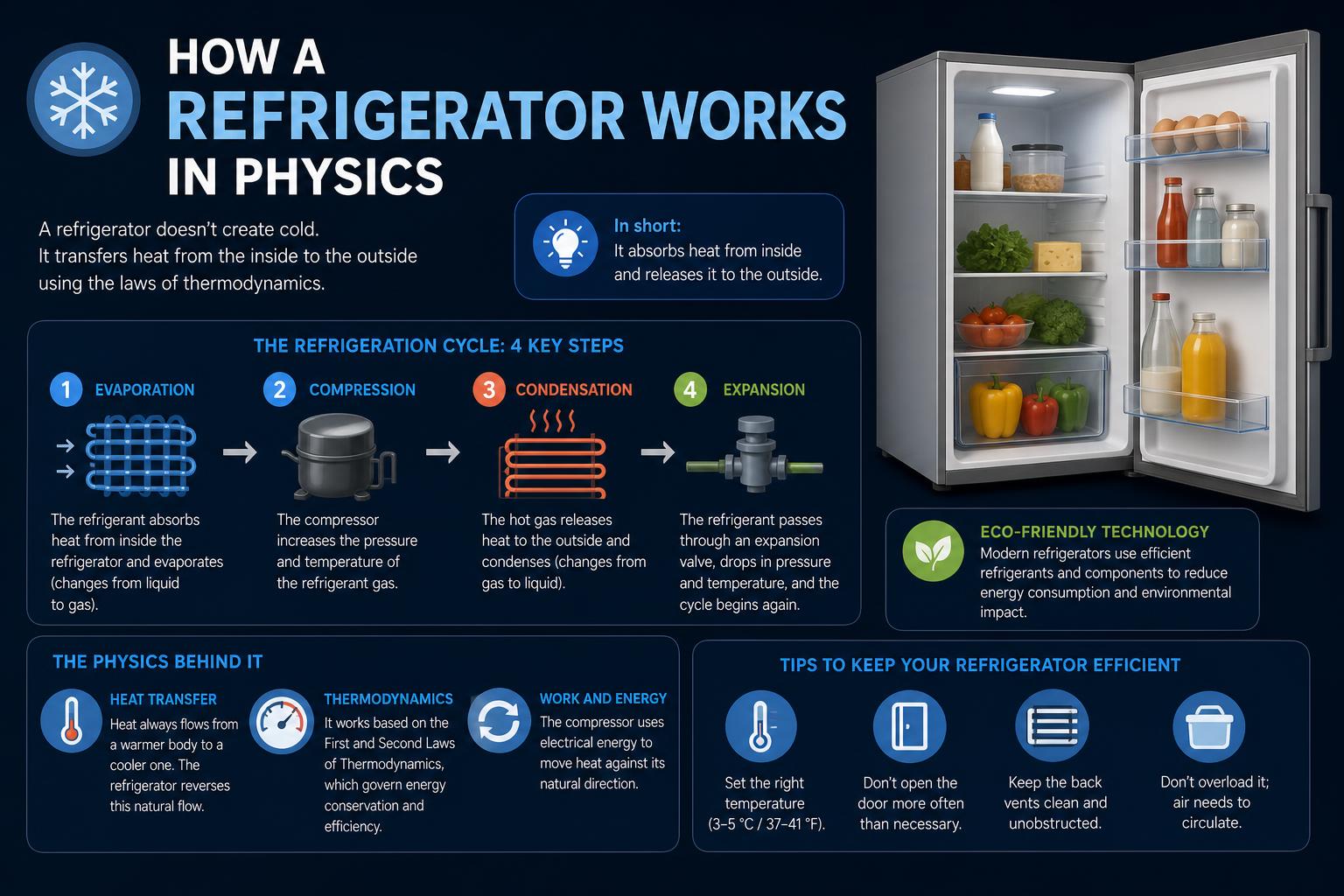
- Refrigerators move heat from inside to outside using the vapor-compression cycle.
- Key components include the compressor, evaporator, condenser, and expansion valve.
- Modern fridges are highly efficient, using safe refrigerants and innovative technology.
Ever wondered what’s really happening inside your refrigerator to keep your leftovers cool and your drinks chilly, especially on scorching summer days? You might use your fridge every day, but the science that makes it work is a fascinating blend of thermodynamics, clever engineering, and materials science. Dive in, and you’ll find out that behind those closed doors is a miniature physics lab, pulling off high-level tricks that even physicists once believed impossible without deep knowledge and innovation.
Understanding how a refrigerator works is not just a fun curiosity—it’s a way to observe the laws of physics at play in your everyday life. If you’ve ever wondered why you can’t cool down your room by simply leaving the fridge door open, or what magical process pumps heat out of a cold box into a warmer kitchen, the answers lie in physics. Let’s break it all down in an easy, chatty way and explore the real science humming behind your fridge door.
Why Refrigeration Is Such a Big Deal in Modern Life
Refrigeration has revolutionized how we store and preserve food, fight off dangerous bacteria, and generally make hot summers bearable. It’s easy to take for granted, but consider a world without air conditioning or fridges—especially when the mercury hits 37°C (that’s 98.6°F, or the temperature of the human body). As heat waves hit hard in many parts of the world, we’re reminded just how essential these devices are. Refrigeration isn’t just about convenience; it’s vital for public health, food distribution, and daily comfort.
The Core Principles: Thermodynamics at Work
Any conversation about how refrigerators work has to start with a quick physics refresher: the laws of thermodynamics. These are a set of principles that govern energy and heat transfer in our universe. Your fridge operates right at this cutting edge of physical law!
First Law: Conservation of Energy
This law tells us that energy can never be created or destroyed—only transferred or transformed. In the context of refrigeration, all the energy moving around inside your fridge and into your kitchen is accounted for, even if it changes form from heat to work or vice versa.
Second Law: Heat Flows from Hot to Cold… Unless You Do Work
Here’s where things get interesting. Heat, by itself, will always move from a hotter place to a colder one—never the other way around. So, if you leave a mug of hot tea on the counter, it cools off as the room steals its heat. Put a cold can of soda out, and it warms up to room temperature. What makes your fridge special is that it makes heat flow from a cold inside (your food) to a warmer outside (your kitchen), seemingly breaking this law. But it doesn’t! The catch is, it has to use energy—work—to make this happen. That’s why your refrigerator needs electricity.
Breaking Down the Refrigerator Cycle
Now, let’s peek under the hood. The typical refrigerator in your home uses a cycle called the vapor-compression cycle to keep its insides cool. This cycle is an elegant process orchestrated by a handful of components, each doing their part to move heat out and cold in.
The Main Components (The Dream Team)
- Evaporator: This clever component absorbs heat from inside the fridge, cooling your food.
- Compressor: Acts like the heart of the whole system—it squeezes the refrigerant (working fluid), raising its pressure and temperature.
- Condenser: Once the refrigerant is compressed and hot, the condenser helps it dump heat into your kitchen air and cools it back down into a liquid.
- Expansion Valve: This smart valve suddenly lowers the pressure of the liquid refrigerant, setting up the conditions for it to absorb heat once again in the evaporator.
How the Refrigerator Circuit Works
Think of your fridge as a giant heat-moving assembly line. Here’s how the journey goes:
- Compression: The refrigerant gas, cold and low-pressure, is drawn into the compressor. The compressor squeezes it, making it hot and high-pressure (like a bike pump warming up as you pump air).
- Condensation: This hot, high-pressure gas travels through the condenser coils (the metal pipes usually on the back or under your fridge). As it cools off, it releases its heat to the kitchen air and turns into a liquid.
- Expansion: The now-cooled, high-pressure refrigerant liquid is forced through the expansion valve—a tiny opening. Here, it suddenly drops in pressure, and a portion of it evaporates, cooling sharply as it does. This is the Joule-Thomson effect in action!
- Evaporation: The cold refrigerant travels through the evaporator coils inside the fridge. As it passes by, it sucks up heat from the food and air inside, turning back into a low-pressure gas and starting the cycle over.
This continuous cycle is what creates the cold environment in your refrigerator, drawing heat away from your groceries and sending it out into your kitchen.
The Role of the Refrigerant
The refrigerated magic wouldn’t be possible without a special working fluid called a refrigerant. Refrigerants are substances that change easily from gas to liquid and back, absorbing and releasing heat as they go. Historically, substances like ammonia, sulfur dioxide, or CFCs—like Freon—were used. Modern fridges use safer, ozone-friendly refrigerants due to environmental regulations like the Montreal Protocol.
Environmental Impact of Refrigerants
Refrigerants made refrigeration accessible and safe, but they also contributed to the destruction of the ozone layer. CFCs such as Freon were efficient but environmentally harmful. The international community responded with the Montreal Protocol, phasing out harmful chemicals in favor of new, eco-friendly alternatives. Refrigeration companies have since innovated with more sustainable refrigerants that maintain efficiency while protecting the atmosphere.
Deeper Dive: The Physics Behind Compression and Expansion
So, why all this business of squeezing and expanding gases? Physics gives us the answer! When you compress a gas, you pack the molecules closer together, forcing them to move faster—the temperature goes up. When you let them expand (suddenly, through the expansion valve), the molecules spread out, slow down, and the temperature drops. That’s how the fridge gets cold from ‘nothing’—it’s simply clever manipulation of pressure, temperature, and state changes.
The Joule-Thomson Effect
Here’s a fun fact: Even if there’s no heat transfer from outside, gases will cool down as they expand rapidly through a small throttle. This is due to the Joule-Thomson (or Joule-Kelvin) effect, which relies on molecular attraction forces. This effect, along with smart engineering tweaks, allows refrigerators to reach temperatures far below freezing.
Why Does Your Kitchen Get Warmer?
A crucial, often overlooked detail is that the refrigerator isn’t a source of cold—it’s a mover of heat. Every joule of heat energy your fridge removes from inside gets dumped back into your kitchen, plus a little extra from the work done by the motor. That’s why leaving your refrigerator door open doesn’t cool your kitchen—it actually warms it up overall by the amount of electrical energy used in the process. The reason is simple: energy is conserved, and some is converted into waste heat outside the fridge.
Heat Pumps, Air Conditioners, and Reversible Magic
Refrigerators and air conditioners are twins—heat pumps that move warmth from one place to another. Many modern HVAC systems are reversible, meaning they can either cool your room by moving heat out, or heat it by moving heat in. In both cases, these systems rely on the same principles discussed above: compression, expansion, evaporation, and condensation using a refrigerant.
Alternative Refrigeration Technologies
While the vapor-compression cycle dominates, alternatives exist for specific purposes. One elegant example is the thermoelectric, or Peltier effect refrigerator. Here, instead of relying on fluids and moving parts, an electric current passes through the junction of two different materials, creating a temperature difference by quantum mechanical effects—one side cools down while the other heats up. These fridges are compact and reliable, although not nearly as energy-efficient as vapor-compression systems, and are often seen in travel coolers and compact devices.
The Refrigerator’s Efficiency: Coefficient of Performance
Like any machine, fridges can be more or less efficient, depending on design, materials, and user behavior. The key metric is the coefficient of performance (COP). This number tells you how much heat the fridge can move compared to how much work (electricity) it uses. In numbers:
The higher this ratio, the better! Modern units are impressively energy-savvy, using insulation, improved heat exchanger designs, and more efficient compressors to keep food cold while sipping electricity.
How Has Refrigerator Efficiency Improved?
Fridges have become dramatically more efficient over the years. Back in 1972, a typical American fridge would burn through 1800 kWh each year, while today’s models often use less than 500 kWh annually. These savings come from better insulation, smarter compressors, improved condenser and evaporator coils, and tighter system design. Better for your wallet and for the planet!
The Refrigerator’s Cycle: Step-by-Step in Detail
Let’s walk through a single round trip for the refrigerant in an average fridge, integrating everything we’ve discussed:
- Evaporator absorbs heat: Refrigerant, now a cold, low-pressure liquid, runs through coils inside the fridge. As it evaporates to gas, it absorbs heat from inside, cooling your food.
- Compressor gets to work: The compressor sucks in the cold, gaseous refrigerant and squeezes it, increasing its pressure and temperature. This is where the “work” (electricity) is put in.
- Condenser releases heat: The now-hot, high-pressure gas is piped through the condenser coils outside the fridge, where it transfers its heat to the air, condensing into a liquid.
- Expansion valve sets up cooling again: The high-pressure refrigerant liquid shoots through the expansion valve, dropping in pressure and temperature, and the cycle repeats.
The magic of this cycle is that it can continue indefinitely, provided there’s electricity to keep the compressor running and heat can be released outside the fridge.
FAQs and Common Refrigerator Myths
- “Why does the compressor make the refrigerant hotter, just to cool down later?” Compressing the refrigerant is essential to raise its temperature above that of the surrounding room, so it can efficiently release heat outside your fridge. Without this step, heat could not be expelled easily.
- “Isn’t leaving the door open a way to cool the kitchen?” Quite the opposite—it increases the room’s temperature because the total heat expelled (food’s heat plus compressor’s work) is greater than the cooling achieved.
- “What about the silent, compact fridges—how do they work?” Some use the Peltier effect (thermoelectric cooling), which has no moving parts but is currently less efficient than vapor-compression cycles.
Modern Features and Innovations
The basic science hasn’t changed since domestic fridges first appeared, but technological improvements have made modern refrigerators quieter, more reliable, and hyper-efficient. Smart sensors regulate temperature, custom zones keep different foods at just the right climate, and some units now even connect to your Wi-Fi! But every fridge, whether basic or advanced, ultimately relies on the same physics that governed those first Café Indesit or GE models.
In short, your everyday refrigerator is a daily demonstration of scientific principles in action, blending the genius of thermodynamics, environmental engineering, and a dash of quantum phenomena. Whenever you enjoy a cool drink or reach for leftovers that stayed perfectly fresh, you’re experiencing the power of physics—and a long legacy of human invention and ingenuity.