
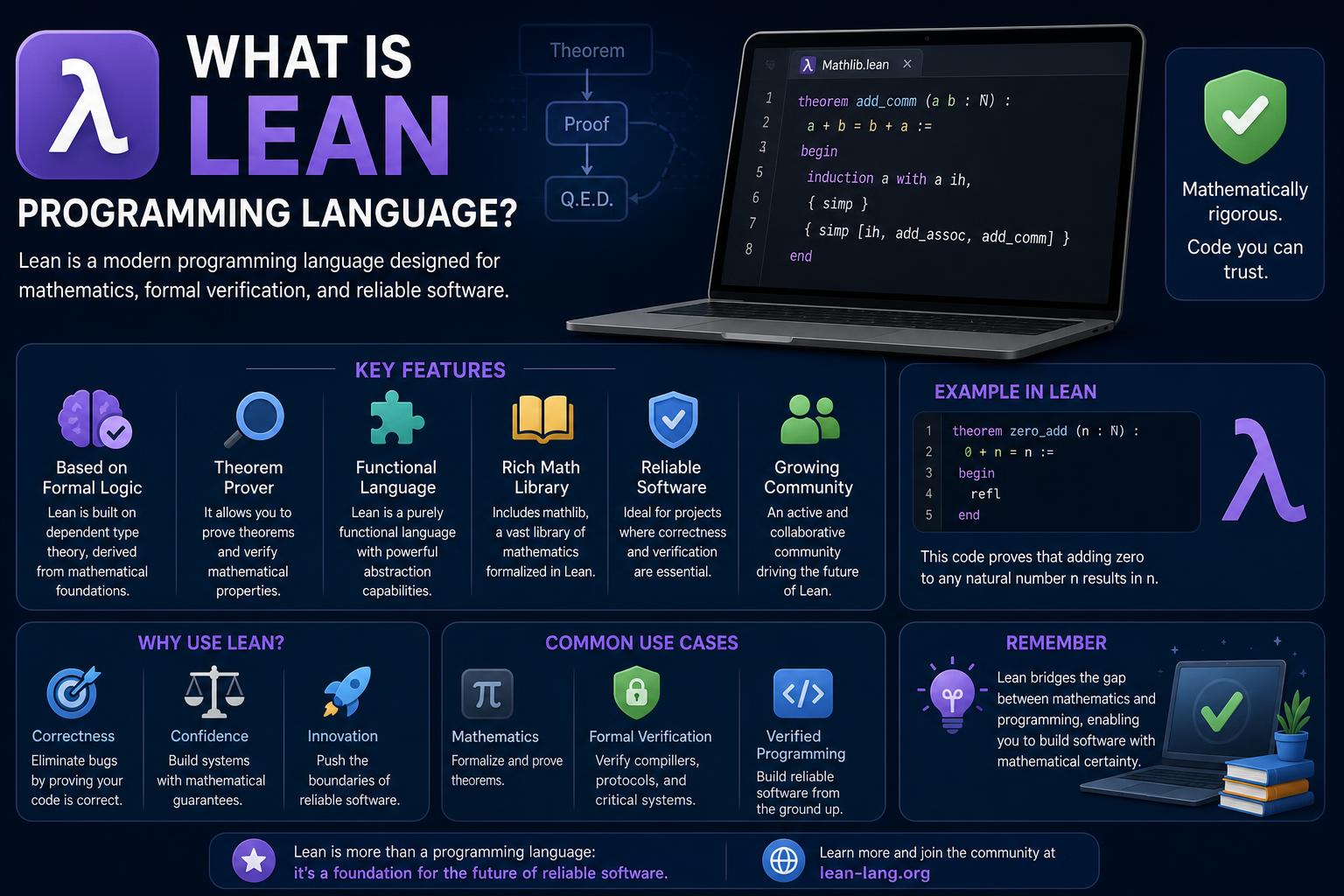
- Lean seamlessly blends functional programming with interactive theorem proving, providing a robust platform for both mathematicians and programmers.
- The Lean ecosystem supports cutting-edge formal verification, education, AI-assisted mathematics, and hardware/software certification through its thriving community and extensive libraries.
- Lean’s extensibility, open-source model, and focus on machine-checkable proofs revolutionize collaboration, democratize mathematics, and foster innovation across academia and industry.
The Lean programming language has been quietly revolutionizing the intersection of mathematics, computer science, and software development. If you have heard of formal methods, proof assistants, or how AI is rewriting the rules on mathematical rigor, chances are Lean’s name has come up. But what exactly is Lean? How does it stand out from other languages, and why are mathematicians, engineers, and even tech giants like Microsoft and Amazon so interested in it?
This comprehensive guide reveals everything you need to know about Lean, from its academic origins to its fundamental role in the formalization of mathematics, software verification, and shaping the future of interactive theorem proving. We will explore Lean’s philosophy, its technical structure, practical uses, vibrant community, and even its contributions to the world of AI. Whether you are a programming language enthusiast, a mathematics professional, or simply curious about the next big technological innovation, you are in the right place.
What Is Lean? The Essentials
Lean is a functional programming language and an advanced interactive theorem prover, blending code with mathematical proofs in a seamless environment. Initially developed by Microsoft Research in 2013, Lean aimed to bridge the gap between automated and interactive theorem provers—making it easier for users to construct, check, and maintain both programs and rigorous proofs.
The core of Lean lies in dependent type theory, a logical foundation that unites programs, data, and proofs. In Lean, types are powerful enough to specify properties about programs and even contain other programs. This lets Lean act as both a general-purpose programming language and a precision tool for formal mathematics.
Lean’s design philosophy centers around:
- Rigorous correctness. Proofs and programs are machine-checkable, so you’re not just taking someone’s word—they are verified by Lean’s trusted kernel.
- Expressive, readable syntax. Lean code can closely resemble textbook mathematics, using Unicode and custom notation.
- Extensibility and self-hosting. The language is extensible—users can create domain-specific extensions and even access Lean’s internal structures. Ever since Lean 4, much of the system is written in Lean itself.
- Community-driven open-source evolution. Development is now supported by the Lean Focused Research Organization (FRO), a nonprofit dedicated to advancing both the engine and its ecosystem.
Brief History and Evolution of Lean
From its roots at Microsoft Research to its latest versions, Lean has championed user-focused innovation.
- 2013: Leonardo de Moura (Microsoft Research) launches Lean to address challenges in formalizing mathematics.
- Lean 1 and 2: Early experimental versions, introducing support for homotopy type theory and new research directions.
- Lean 3 (2017): Stability arrives. Most notable features are implemented in C++; Lean becomes more widely adopted in mathematics communities.
- Lean 4 (2021—present): A complete reimplementation. Now written mainly in Lean rather than C++, Lean 4 brings better typeclass synthesis, macro systems, and efficient native code generation. The result? A faster, more flexible language and proof assistant capable of sophisticated automation and powerful user extensions.
- The Lean FRO: In 2023, de Moura and Sebastian Ullrich founded the Lean-FRO to support decentralized, community-driven innovation. The group aims to scale the language and enhance proof automation.
- Recognition: In 2025, Lean’s core creators received the ACM SIGPLAN Programming Languages Software Award for their significant impact on mathematics, verification, and AI.
Philosophy: Lean as a Bridge between Math and Programming
Lean blurs the traditional line between programming and proving. By making programs and mathematical proofs coexist within the same environment, users can define mathematical objects (like numbers, sets, and functions), write proofs about their properties, and implement algorithms—all using a single, unified language.
This duality underpins Lean’s four main use-cases:
- Formal mathematics. Lean has become a hub for digitizing mathematical theorems, definitions, and proofs at all levels. Whether you’re formalizing undergraduate algebra or cutting-edge research, Lean’s syntax and libraries make it natural.
- Software and hardware verification. The ability to model and prove properties about programs is highly valuable in critical industries. Lean enables precise reasoning about everything from cryptography to biomedical devices, aerospace software, and more.
- AI for math and code synthesis. With Lean’s machine-checkable proofs, researchers can create environments where AI builds and checks mathematics—paving the way for self-correcting AI systems.
- Education. Lean’s interactive environment gives students hands-on experience in mathematical reasoning, providing instant feedback and gamified learning (e.g., the Natural Number Game).
Technical Deep Dive: Lean’s Underlying Logic and Language Features
At its heart, Lean uses dependent type theory—where types themselves can depend on values and vice versa. This theoretical approach, known as the calculus of inductive constructions (an idea first popularized by the proof assistant Coq, now known as Rocq), offers a solid foundation for rich mathematical expression and complex software systems.
Main technical aspects of Lean:
- Strict, pure functional programming. Lean is pure: functions have no side effects unless explicitly stated in their type signatures, promoting maintainable code and mathematical clarity.
- First-class functions and types. Functions can be passed around as values, and types can be computed by programs—allowing highly abstract, reusable code.
- Advanced type features. Dependent types, type classes, inductive types, and polymorphism all enable expressing a wide range of mathematical and computational concepts cleanly. For example, you can define natural numbers, lists, or even axioms as types within Lean.
- Unicode and notation. Lean code can use Unicode symbols like α, β, →, and statements like ∃ (there exists), ∀ (for all), etc.—giving it a look and feel close to textbook mathematics. Custom notations can be established using macros, so domain-specific languages (DSLs) can be built directly in Lean.
- Automation and tactics. Proofs in Lean can be developed both by writing terms directly (term mode) or interactively via tactics—specialized commands that help construct or automate proofs step by step. Tactics like
induction,simp(simplification),omega(arithmetical reasoning), andgrind(SMT-inspired automation) are available out of the box and can be extended by users. - Efficient execution. Lean 4 introduced an efficient compiler that produces C code, enabling high-speed execution and supporting demanding automation tasks.
- Open, extensible architecture. Since much of Lean itself is written in Lean, it’s easy for advanced users to override key parts, redefine behaviors, and create new extensions.
Core Libraries and Ecosystem
Lean doesn’t live in isolation; it comes with a fast-growing ecosystem of libraries and tools.
- Standard Library (Std): Packs data structures, concurrency primitives, and a variety of utilities for general-purpose development. Comparable to standard libraries in other functional languages.
- Mathlib (mathlib): The flagship community-driven library seeks to formalize the entirety of pure mathematics at (and beyond) undergraduate level. As of May 2025, mathlib had over 210,000 formalized theorems and 100,000 definitions and continues to grow through contributions from hundreds of mathematicians worldwide.
- Batteries: A supplementary library expanding on Std, adding extra data structures and programming conveniences.
- CSLib: Targets theoretical computer science with formalizations of various computational concepts.
- SciLean: Focuses on scientific computing, bringing mathematical modeling and numerical computing within Lean’s verification framework.
- PhysLib: Launched to digitize and formalize physics, inspired by the success of mathlib in mathematics.
Working with Lean: Tooling and Editor Support
Lean’s adoption is propelled by modern development tools that offer an interactive experience for both code and proofs. The language integrates seamlessly with major code editors like Visual Studio Code, Emacs, and Neovim. Through the Lean language server protocol and editor plugins, you get:
- InfoView: A real-time, interactive panel that displays the current proof state, hypotheses, and goals as you step through your code or proofs.
- Unicode LaTeX Shortcuts: Type symbols using familiar LaTeX-like sequences, such as
\alphafor α or\impliesfor ⇒, making it easy for mathematicians to hop in. - Playgrounds and Interactive Tutorials: The Natural Number Game lets beginners learn Lean’s basics in a playful way, while advanced interactive books integrate directly with editors for real-time feedback.
Learning Lean: Resources for All Levels
Getting started with Lean is less daunting than it might seem! There’s a wealth of documentation, textbooks, tutorials, and even games to nurture a growing community of learners:
- Lean Learn Portal: Gateway to recommended reading, tutorials, and entry points.
- The interactive Natural Number Game: An ideal starting point for those new to programming, proof-assistants, or mathematics.
- Mathematics in Lean: A modern textbook that guides users through Lean by having them formalize key concepts from number theory, algebra, calculus, and beyond, with paired Lean files and exercises.
- Functional Programming in Lean: For programmers, this comprehensive resource introduces the Lean language and functional programming principles, assuming no prior experience with Haskell or OCaml.
- Buzzard’s Lean Tutorial: A hands-on tour blending theory and real Lean code samples, perfect for intermediate users who want to get their hands dirty.
- Community discussions and help: The Lean Zulip chat group offers a supportive, round-the-clock expert community where newcomers and veterans exchange tips, troubleshoot, and collaborate.
Real-World Impact: Notable Lean Applications and Projects
Lean isn’t just a playground for theoreticians—it’s redefining modern research and industrial practice:
Formalizing Mathematics at Scale
Mathlib sets the pace in massive, collaborative formalization: More than 1.5 million lines of formalized mathematics, with undergraduate and advanced research topics, regularly updated by over 300 contributors from diverse backgrounds. Esteemed mathematicians such as Peter Scholze and Terence Tao use Lean to check new theorems, and major journals now cite Lean-formalized proofs.
Industrial Use: Verification by Amazon and Beyond
Lean powers formal verification for critical software and hardware at Amazon Web Services (AWS), among others. Examples:
- Cedar: An open-source policy language and evaluation engine. Lean is used to develop executable models of the Cedar runtime, enabling rigorous correctness proofs for its authorization engine and static analysis.
- LNSym: Symbolic simulation tool for cryptographic machine code, leveraging Lean to model ARM instruction semantics and reason about cryptographic protocols formally and efficiently.
- SampCert: Library of formally verified algorithms for differential privacy, underpinned by Lean’s Mathlib for precise mathematical properties needed in privacy-preserving data analysis.
- AILean: A cutting-edge collaboration between AWS and the Technology Innovation Institute explores the intersection of large language models (LLMs) and formal mathematics, using Lean both as a dataset and a reasoning engine.
Artificial Intelligence Meets Lean: Proofs and Automation
Lean is a testbed for AI-driven mathematics and code synthesis:
- OpenAI and Meta AI have trained AI models to generate and check proofs in Lean for high-school-level olympiad mathematics. Meta’s model is even available for public use.
- DeepMind’s AlphaProof reached the performance level of a silver medalist in the International Mathematical Olympiad, proving the viability of AI in Lean-based proof search.
- Anthropic’s Prove2Me, in 2026, coordinated agents that built a machine-checked Lean formalization of Fermat’s Last Theorem—an endeavor comprised of approximately 13 million lines of Lean code.
- Harmonic and LeanDojo: Startups and research projects use Lean both to guarantee mathematically sound outputs from LLMs and to automate tedious proof steps, leveraging Lean’s introspective capabilities and trusted kernel.
Lean’s Community: Decentralized Innovation and Open Science
Lean’s growth is unique for a technical language—it thrives off a fiercely open, decentralized culture:
- The Lean FRO supports foundational development, resource allocation, and community outreach. Think of it as the Rust Foundation for Lean.
- Convergent Research and philanthropic partners have invested in making Lean sustainable and independent of any single institution, a move lauded across academia and tech.
- Diversity and inclusion are explicit goals: From school children to seasoned researchers, Lean’s documentation and educational tracks aim to make mathematics and programming accessible for all.
- Formalized libraries like mathlib and PhysLib are open for community participation and constantly updated with new proofs, definitions, and tutorials.
The Lean Workflow: Code, Proofs, and the Trusted Kernel
The Lean workflow is all about harnessing precision—every definition, proof, or algorithm you write is machine-checked for accuracy.
- Define your types and functions. Whether it’s a mathematical structure or an executable algorithm, all live in Lean’s environment.
- State and prove properties. For every definition, you can (and should) formulate and prove theorems stating its key features.
- Write proofs using tactics or terms. Develop proofs interactively or in a more direct, explicit style.
- Compile and execute. Lean compiles programs efficiently—thanks to the C backend in Lean 4—and executes proofs as ensured computations.
- Export and audit. All formal artifacts can be exported and independently checked—so trust is never bottlenecked on any single person or institution.
Outreach and Education: Lean in the Classroom and Beyond
Lean isn’t just for researchers and engineers—it’s rapidly entering educational curricula:
- University courses at leading institutions (Imperial College London, TU Munich, Carnegie Mellon, etc.) integrate Lean into undergraduate and graduate math and computer science programs.
- Textbooks and interactive courseware (such as “Mathematics in Lean” and “Functional Programming in Lean”) walk learners step-by-step through formalization, logic, and programming.
- Gamelike tutorials (notably the Natural Number Game) provide accessible, low-pressure introductions to Lean for students of all levels.
- Community documentation and online events: Regular workshops, hackathons, and conference keynotes (e.g., the International Conference on Computer Aided Verification) spread awareness and mastery.
Industrial Tools and Lean Integration
Lean has a modern toolchain, supporting scalable workflows for both individual and enterprise users.
- elan: Manages multiple Lean toolchains in a manner similar to Rust’s
rustup—keep your environment seamlessly up to date. - lake: Handles Lean packages, dependencies, and builds, providing reproducible, organized development much like
cargofor Rust orGradlefor other ecosystems. - Advanced plugins and integration: Connect Lean with editors like VS Code and Emacs, get type information and error messages live, and use profiling/debugging tools directly within your IDE.
- Verso: Lean-native documentation authoring system, which enables writing docs in alternative concrete syntaxes that mirror Markdown or HTML. This allows for user-friendly documentation tightly integrated with code.
Lean for Metaprogramming and Proof Automation
Power users and developers can leverage Lean’s metaprogramming interface to create custom proof tactics, automation frameworks, and even proof-generating AI tools.
- Monadic API: Exposes much of Lean’s core operations, so you can script complicated automation or even write new proof search algorithms within Lean itself.
- Custom Tactics: Advanced users can develop and share their own proof strategies and automation, making Lean a platform for meta-level research.
- Resolution and SMT solvers: Integration with approaches for theory proving that enable handling complex mathematical domains efficiently.
- Application in bug finding: AI bug-hunters have even found rare loopholes in Lean’s core, helping make it more secure and trustworthy.
Impact Beyond Mathematics: From Physics to Law
While mathematics has been Lean’s first love, the language’s approach is equally transformative elsewhere:
- Physics: With the emergence of PhysLib, there is now a formidable effort to digitize and formalize physics with the same depth and precision as mathematics. Major institutions and influential researchers are pushing for a “million lines of physics” project, aiming for breakthroughs in theoretical physics and rigorous computation.
- Law and civics: Computational law researchers are exploring the use of Lean for formalizing statutes, contracts, and procedures, providing guarantees on logical consistency and fairness.
- Education and outreach: From K-12 to postgraduate research, Lean resources cater to a wide learning spectrum, democratizing access to high-level mathematics and programming skills.
Lean’s Role in Collaborative Open Science
Perhaps Lean’s most lasting contribution is the transformation of research into a truly open, auditable, and collaborative process. With its trusted kernel and exportable proofs, anyone in the world can check, build upon, and extend mathematical and algorithmic results—no matter where they originate. This culture encourages the entire field to move away from closed, difficult-to-verify results towards communal, machine-checkable libraries of mathematics and science.
The standards set by Lean have already influenced how mathematicians, developers, and AI researchers work together globally. Users can rely on Lean as both a source of trustworthy results and a platform for on-the-fly innovation.
Its integration of rigorous logic, extensible programming, a decentralized community, and broad applicability makes Lean much more than just a proof assistant: it is becoming the bridge to verifiable knowledge, the future of education, and collaborative exploration at the intersection of computer science and mathematics. If you want to explore, contribute, or simply experiment with a new way of thinking about code and proofs, dive into Lean and discover how it is changing the game.