
- Rotary actuators create precise rotational motion through electric, hydraulic, or pneumatic means, with design variants like rack-and-pinion, vane, worm, and planetary gear systems.
- Selection depends on required torque, motion range, duty cycle, and environment; correct calculations and installation are essential for longevity and performance.
- Rotary actuators are critical in automation, process control, robotics, vehicles, aerospace, and even home automation, with innovations enhancing efficiency and smart functionality.
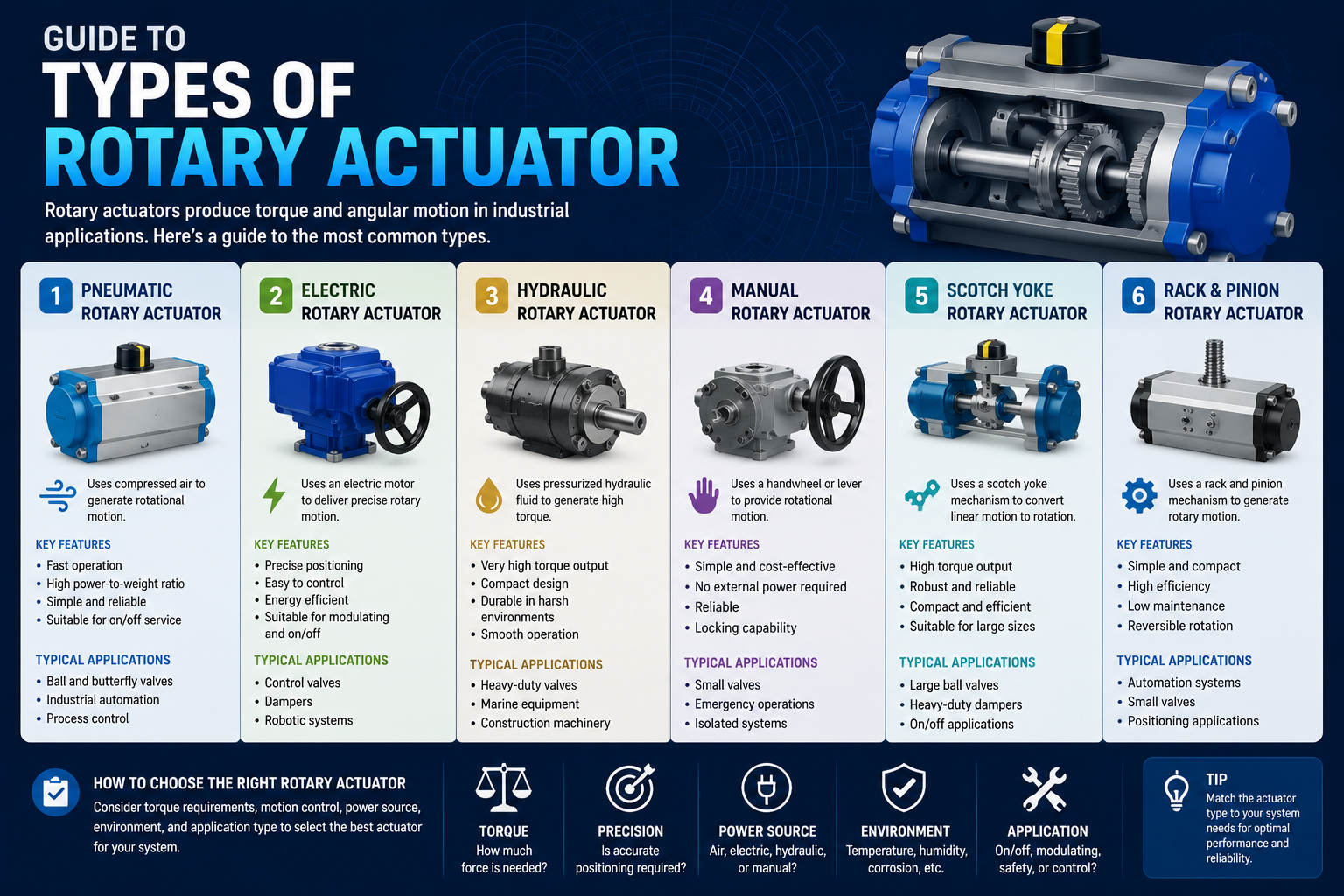
Rotary actuators are at the heart of countless machines, devices, and automation solutions that drive the modern world. Every time a robotic arm pivots, a gate swings open at the touch of a button, or a precision medical device adjusts itself, there’s a good chance a rotary actuator is making it all possible. Yet, despite their ubiquity, many engineers, designers, and even seasoned professionals are often surprised by how deep the topic runs once they begin to delve into all the different types, mechanisms, and application scenarios. If you’re looking to move beyond the basics and truly understand how rotary actuators work and how to choose the right one, you’re in the right place.
This article brings together exhaustive insights from technical guides, peer-reviewed resources, and industry experience. We’ll go beyond the simple definitions, integrating core concepts, exploring all major mechanical designs, and connecting technical facts to real-world examples. Whether you’re optimizing motion control for heavy industry, fine-tuning a smart home device, or just fascinated by the engineering that moves our world, you’ll find answers to every question about rotary actuators, from operating principles and torque calculations to practical maintenance and selection criteria.
Understanding the Fundamentals of Rotary Actuators
At their core, rotary actuators are devices designed to produce controlled rotational motion—that is, they make something spin, swing, or turn within a precise range. But unlike a traditional motor that might turn something indefinitely, actuators usually operate within a set arc and often provide both the motive force and precise control over the movement. The basic idea: they transform energy (electrical, hydraulic, pneumatic, or even vacuum pressure) into torque at an output shaft, giving engineers a flexible and compact way to control angular motion.
There are three primary energy sources used to power rotary actuators:
- Electric Actuators – Use electrical energy, often combined with gearboxes to deliver torque.
- Hydraulic Actuators – Harness the non-compressible nature of hydraulic fluid for powerful, precise movement.
- Pneumatic Actuators – Use compressed air (or other gases) to actuate rotary motion, usually where rapid, repetitive, or explosion-safe environments are needed.
What sets actuators apart from motors is their range of motion. While motors can spin endlessly in theory, actuators are typically engineered to turn just a certain amount—a quarter turn (90°), half turn (180°), three-quarter turn (270°), or even multi-turn but limited, providing control and safety mechanisms right in their design. This makes them perfect for automated valves, damper controls, robotic arm joints, and endless other jobs where precision control of angular position or torque is required.
Main Types of Rotary Actuators Explained
The classification of rotary actuators is rooted in both their energy source and mechanical design. Understanding these categories is vital for selecting, specifying, and troubleshooting actuators in real-world projects. Let’s break down the major types found throughout engineering and automation today:
1. Gear Motor-Based Rotary Actuators
Gear motors are the most common electric rotary actuators in automation, robotics, and consumer applications. At their simplest, they combine a high-speed electric motor with a built-in gear reduction system. This pairing is a game-changer:
- High-speed, low-torque rotation from the electric motor gets reduced to lower speed but much higher torque at the output shaft, capable of moving real-world loads efficiently. Typical reduction ratios might be 50:1, 100:1, or even higher.
- Integrated gearboxes come in different flavors—worm gear (self-locking and compact, but lower efficiency), planetary gear (high torque density, exceptional efficiency, but no self-locking), and spur gear (cost-effective, but often noisier).
Electric rotary gear motors shine in applications needing precise programming, easy reversibility, and microcontroller or PLC-based control. They’re found in conveyor diverters, home automation (like TV lifts and smart window systems), robot arms, and many industrial tasks.
2. Hydraulic Rotary Actuators
Hydraulic actuators use incompressible fluid to produce some of the most powerful and compact rotary motion available. They’re the go-to choice when brute force is required, such as in heavy construction equipment, industrial valves under high pressure, or aviation flight controls. Their key features are:
- Extremely high torque output relative to size, thanks to the high energy density of hydraulic systems.
- Excellent performance in harsh environments with heavy load resistance (think crude oil valves, pipeline gates, cranes, marine applications, and chemical machinery).
- Hydraulic systems require pumps, reservoirs, and plumbing, making them more complex than electric actuators, but they are practically unbeatable for maximum rotational force in small footprints.
3. Pneumatic Rotary Actuators
Pneumatic actuators employ compressed air to create rotary motion. These are favored for:
- Speed and repetition—pneumatics can cycle very quickly, ideal for pick-and-place robots, machine indexing, and rapid automation.
- Simplicity and safety in explosive or hazardous environments where electric sparks are unsafe.
- Common designs include rack-and-pinion and rotary vane mechanisms.
4. Specialized and Emerging Types
Some applications require unique characteristics. Emerging options include:
- Memory wire rotary actuators: Use temperature-sensitive wire (like Nitinol) that contracts when heated, creating rotary torque for lightweight and miniature systems.
- Vacuum actuators: Although rare, some historical systems (like early vehicle windshield wipers) used manifold vacuum to drive rotary motion.
Mechanical Design Variations: How Rotary Actuators Generate Motion
Within each energy category, the internal mechanism determines how linear or pressure-based input transforms into rotation. Let’s unpack the three primary mechanisms:
Rack-and-Pinion Rotary Actuators
This classic mechanism transforms linear force into rotation. A toothed bar (“rack”) is driven linearly—by air, fluid, or mechanical means—and meshes with a round gear (“pinion”) attached to the output shaft. As the rack moves, the pinion rotates. Notable characteristics:
- Very direct, rigid coupling—ideal for precise positioning and high repeatability.
- Rotation limits typically range from 90°, 180°, up to 270°, covering quarter to three-quarter turns.
- Can be built for pneumatic or hydraulic power, offering application flexibility. Integration is straightforward, with compact versions available for tight spaces.
Rotary Vane Actuators
Vane actuators use a shaft with one or more vanes inside a sealed cavity. When pressurized fluid or air is introduced, it pushes on the vanes, turning the shaft through its arc. These actuators:
- Offer smooth, consistent rotary output with adjustable angles (from 30° up to 270°).
- Are used in pneumatic and hydraulic applications, suitable for damper control, robotics, and oscillating systems.
- Sealing issues can occur (especially in older designs), but modern technology has minimized leaks.
Worm Gear and Planetary Gear Actuators
Electrically driven mechanisms include:
- Worm Gear: Use a screw-like threaded worm meshing with a spur gear, providing high reduction ratios in a compact form, with self-locking capabilities. They operate quietly but with lower efficiency (40–60%) due to sliding friction.
- Planetary Gear: Consist of a central sun gear, planet gears, and a ring gear, offering high efficiency (over 90%) and greater torque density. They’re ideal for precision robotics but don’t self-lock, often requiring brakes for holding position.
Scotch Yoke and Other Limited Rotation Actuators
The Scotch yoke mechanism converts linear piston motion into rotation. Commonly used in valve automation, these actuators deliver maximum torque at start and end of motion, suitable for quarter-turn operations like shutoff valves and robotics limbs.
Operation Principles: How Rotary Actuators Work
The fundamental principle is that all rotary actuators convert input energy into controlled angular movement and torque.
- Input Energy: Electric, hydraulic, pneumatic, or thermal expansion (memory wire).
- Mechanical Conversion: Internal mechanisms—racks & pinions, vanes, worms, gears—convert input into rotational output.
- Range of Motion: Designed for a specific angular span, limited by mechanical stops or digitally programmed. This ensures safe, repeatable, and predictable movement, unlike motors alone.
The key is achieving the required torque, speed, and precision for your application. Attention to detail is essential!
Torque and Force: The Science Behind Rotary Actuator Output
Understanding how shaft torque translates into usable load force is crucial:
- Torque (T) is the twisting force at the shaft, measured in Nm or ft-lb.
- Linear Force (F) at the point of contact depends on torque and lever arm length.
- The core formula: T = F × D, with D being the distance from the rotation center to the load.
- Doubling the lever arm length reduces the force at the load, maintaining torque but trading force for distance.
Implications:
- Heavy gates and valves use short, robust arms for maximum force over limited arcs.
- Applications with wide swings, like robotic arms, use longer levers to increase sweep, accepting lower force.
- Calculate the needed torque based on real force requirements to avoid undersizing or oversizing. Using a safety margin of 1.5–2X is recommended.
Always remember that datasheet torque ratings are meaningful only when coupled with realistic load and lever arm calculations.
Comparing Rotary Actuators vs. Electric Motors
Why choose a rotary actuator over a motor? What’s the difference? Both can spin, but:
- Motors provide continuous, unlimited rotation—ideal for fans, pumps, and non-positioned applications.
- Rotary actuators deliver precise, limited arc motion with built-in position control and high holding torque, suited for robotic joints and automated valves.
- Electric motors often need external sensors, gearboxes, or brakes to match the control capabilities of actuators.
- Actuators are generally easier to control in terms of position and torque, while motors excel at continuous spinning tasks.
Industry Applications: Where Rotary Actuators Make a Difference
The use of rotary actuators spans multiple industries—anywhere precise control of rotation is needed. Here are some key examples:
Process Control and Industrial Automation
In factories, rotary actuators are everywhere. Typical applications include:
- Robotic joints for positioning and manipulation.
- Valve operation in plumbing, gas, or chemical plants, requiring fast, accurate, and safe movement within set angles.
- Material handling: conveyor diverters, turntables, and machine tool changers.
Automotive and Marine Systems
Vehicles rely on rotary actuators for multiple functions, such as:
- Electronic throttle control: precisely adjusting airflow.
- Windshield wipers: powering moveable blades resilient under tough conditions.
- Trim tabs, steering, and anchor windlasses: demanding durability in water and vibration.
Medical and Healthcare Equipment
Medical devices require reliable, quiet, and accurate movement. Actuators are crucial for:
- MRI tables: smooth, precise adjustments.
- Surgical tables: safe tilt and height control.
- Adjustable furniture and rehab devices: ensuring patient comfort and safety.
Aerospace and Defense
Extreme conditions necessitate robust design in aerospace and defense, such as:
- Control surfaces (ailerons, slides, flaps): depend on reliable movement under temperature and vibration extremes.
- Space systems: pivoting solar panels and antennas in vacuum and radiation-rich environments.
Home and Residential Automation
Smart homes benefit from rotary actuators in:
- Automated gates and doors.
- Smart window shades and blinds.
- Furniture automation, like TV lifts or adjustable beds.
Linear vs. Rotary Actuators: When to Use Each
Deciding between linear and rotary actuators influences your system’s geometry. Consider:
- Linear actuators: move loads straight; best for lifting, sliding, or extending applications.
- Rotary actuators: excel when motion follows an arc — gates, robotics, or valve control.
If your motion involves turning, pivoting, or swinging, start with a rotary actuator to keep design simple. Otherwise, linear is preferred for direct, straightforward movement.
Selection Criteria: How to Specify the Right Rotary Actuator
Choosing properly involves assessing:
- Torque needs: both to move and hold—include safety margins (50–100%).
- Angular range: accuracy in degrees — pick an actuator designed for that span.
- Duty cycle: continuous or intermittent operation—higher duty cycles require robust construction.
- Speed and positioning: precision, feedback requirements, and control complexity.
- Power supply compatibility: electrical, hydraulic, or pneumatic sources.
- Environmental ratings: resistance to dust, water, chemicals; match IP rating accordingly.
- Mounting considerations: attachment, alignment, and load support.
Installation Best Practices: Getting the Most From Your Rotary Actuator
Proper installation ensures longevity and performance. Recommendations include:
- Rigid mounts: to resist forces without flexing.
- Precise alignment: shafts aligned with driven components to avoid unnecessary wear.
- Flexible couplings or joints: to accommodate minor misalignments.
- Managing inertia: keep mass close to the shaft to reduce shocks during start and stop.
- Thermal management: ensure airflow or cooling to prevent overheating during operation.
Maintenance, Troubleshooting, and Longevity
A well-maintained rotary actuator offers extended lifespan. Tips include:
- Regular inspections: Check for corrosion, loose hardware, or contamination.
- Lubrication: Follow manufacturer guidelines—sealed units require less, while others may need periodic greasing.
- Listen and observe: Unusual sounds or vibrations signal potential issues.
- Monitor temperature: Overheating indicates overload or ventilation problems.
- Early issue detection: Small signs often predict bigger failures if ignored.
Testing and Commissioning: Proving Your Rotary Actuator In-Service
Validate performance under real conditions through:
- Full cycle testing with actual load: Measure torque at various points, especially start/end.
- Static hold verification: Confirm self-locking capabilities by power-off testing.
- Stress testing: Repeated cycles to observe heat, vibration, and wear behavior.
- Backlash checks: Ensure minimal looseness after cycles.
- Mount stability: Confirm brackets and fixtures remain firm under operation.
Real-World Examples and Case Studies
Applying the right actuator solves practical challenges:
- Industrial Gate Operators: Worm gear actuators provide maximum holding force and safety during power loss.
- Robotic Arms: Planetary gear electric actuators achieve precise multi-axis movement with feedback systems.
- Pipeline Valves: Hydraulic rack-and-pinion or Scotch yoke actuators generate necessary force under tough conditions.
- Smart Home TV Lifts: Compact worm gear actuators support heavy panels discreetly.
- Medical Imaging Tables: MRI-safe electric actuators ensure reliable, quiet adjustments.
Frequently Asked Questions (FAQ)
What is the difference between a rotary actuator and electric motor?
An electric motor offers continuous, unlimited rotation—ideal for fans or pumps. A rotary actuator provides limited, programmed motion with built-in control and holding force, perfect for valves or robotics.
Which rotary actuator is best for high holding force applications?
Worm gear actuators are self-locking, making them suitable when holding position without power, especially for vertical loads.
How should I choose between pneumatic, hydraulic, and electric actuators?
- Electric: Precise, programmable, easy integration, clean environments.
- Hydraulic: High power, robust performance outdoors or in high-force needs.
- Pneumatic: Fast cycling, lower forces, suitable for hazardous or explosive environments.
Are rotary actuators suitable for harsh or wet environments?
Yes, by selecting actuators with appropriate IP ratings. For outdoor or marine use, ratings like IP65-IP67 are standard; for wash-down or pharma, IP69K is recommended.
What is a DC gear motor in this context?
A DC gear motor combines an electric motor with a gear reducer. It provides high torque at low RPM, with programmable control, common in precision motion applications.
Innovations and Future Trends in Rotary Actuation
The industry is evolving with new materials, smarter electronics, and increased integration. Notable trends include:
- Smart actuators: IoT-connected, self-diagnosing, and predictive maintenance capabilities.
- Miniaturization: More compact designs for robotics, wearables, and medical devices.
- Energy efficiency: Using planetary, brushless motors, and sealing advancements to reduce heat and power consumption.
- Sustainable manufacturing: Longer lifespan, recyclable components, and green lubricants, especially for sensitive industries.