
- Vibe coding enables software creation using plain language through AI assistants, lowering barriers for non-coders and speeding up innovation.
- Platforms like Replit, GitHub Copilot, and Google's Gemini Labs tools support idea-to-app workflows where human feedback guides AI-generated code.
- The approach has sparked debate due to concerns about code quality, security, maintainability, and its wide impact on open-source communities and developer roles.
- Vibe coding is best used for rapid prototyping, personal projects, and early-stage ideas; expert oversight is still essential for production-quality, sensitive, or large-scale software.
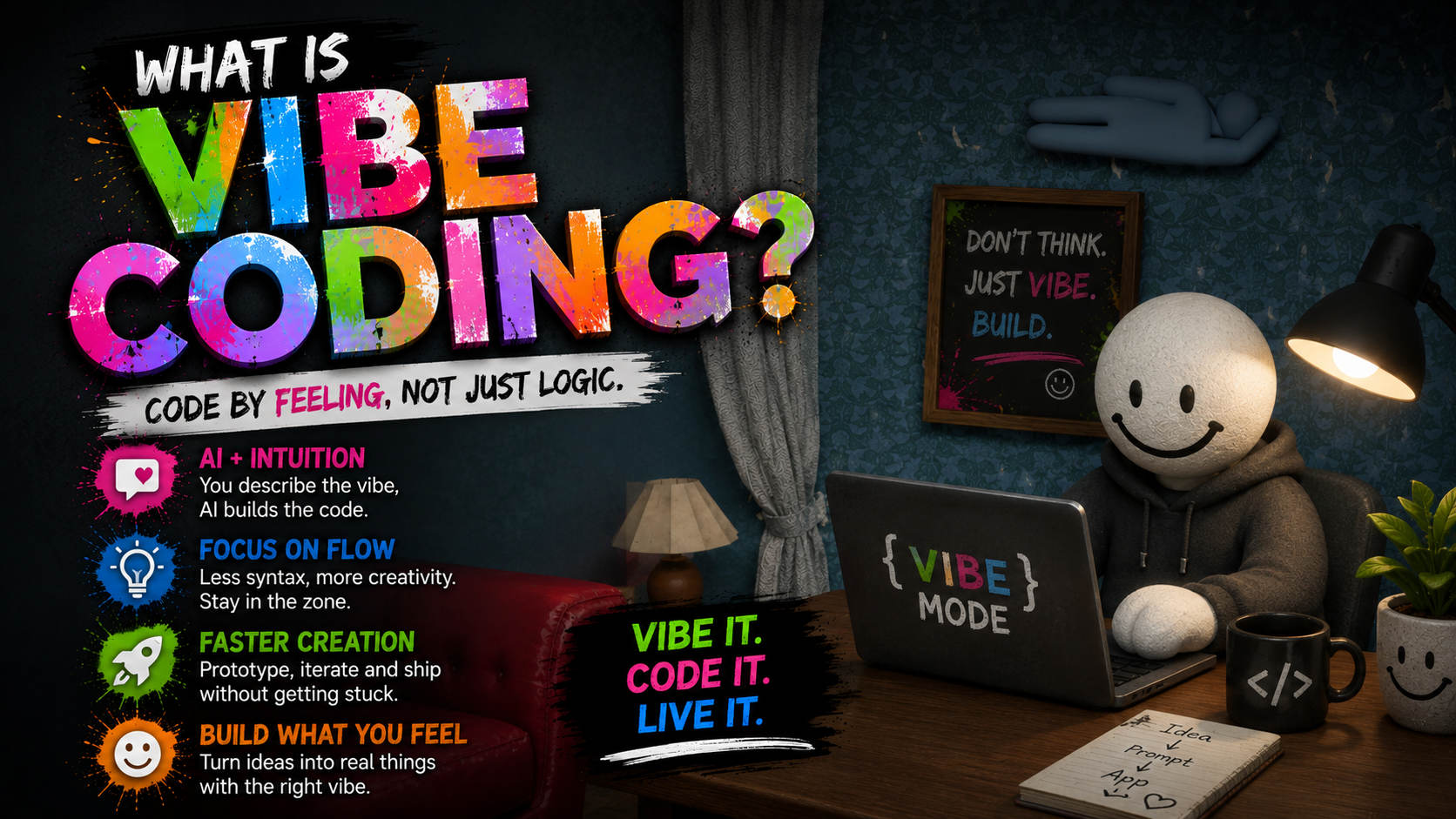
Vibe coding is rapidly transforming the landscape of software creation, unlocking software development to an entirely new audience. Whether you’re a coder burnt out by endless lines of syntax, a product designer eager to jump from idea to prototype, or a newcomer with zero technical background but loads of creativity, the emergence of vibe coding promises both excitement and heated debate. But what exactly does this viral term mean, how does it work, and what’s the real story behind the buzz?
This article breaks down vibe coding from every angle: from its conceptual roots and how it works in practice, to its opportunities, real-world applications, toughest criticisms, and the trajectory it’s charting for the future of how we build software.
What Is Vibe Coding? Where Did It Come From?
Vibe coding reimagines coding as a collaborative dance between human intention and artificial intelligence, rather than a solo navigation through endless syntax, frameworks, and debugging sessions. The driving idea is simple yet revolutionary: you no longer have to laboriously write code line-by-line in a traditional language. With vibe coding, you express what you want in plain English (or another human language), and a large language model (LLM) or AI-powered agent translates your intent into real, working code.
Andrej Karpathy, a leading voice in AI and programming, popularized the term in 2025 with a social media post: “There’s a new kind of coding I call ‘vibe coding’, where you fully give in to the vibes, embrace exponentials, and forget that the code even exists.” This radical reframing means creative leaders, designers, entrepreneurs, and hobbyists can now conjure apps and scripts without needing to decode the mysteries of JavaScript, Python, or React.
How Does Vibe Coding Work?
The vibe coding workflow centers on describing your goal, context, and preferences to an AI tool, which then generates a functioning codebase or application prototype to match your vision. While approaches and platforms vary, the vibe coding process generally involves:
- Choosing an AI coding assistant: Leading platforms include Replit, GitHub Copilot, Cursor, bolt.new, and IBM’s tools. These go beyond text autocompletion, offering multi-file reasoning, debugging, deploying, memory of previous commands, and more.
- Describing your intent, context, requirements, and design preferences: Instead of giving strict, technical prompts, you can state your goal in plain language. For example, “Build a minimalist habit-tracking app with React on the front-end and Node.js for the backend, supporting user authentication and daily progress graphs.”
- AI generates and assembles your app: The AI tool writes code to fulfill your requirements. In advanced platforms, it can also set up environments, databases, and even deploy the app online.
- Iterative guidance and feedback: You test the generated app, review features, and provide feedback—also in natural language. The agent reworks, improves, or expands the app as needed.
This paradigm can be entirely non-technical or hybrid, enabling both novices and experienced developers to offload repetitive coding, accelerate prototyping, or even manage full-fledged projects with minimal manual programming input.
Why Is Vibe Coding Gaining Traction Now?
The boom in vibe coding coincides with several key technological and market trends:
- Exponential AI progress: The capabilities of LLMs double roughly every seven months, with the power to generate, refactor, and manage complex codebases increasing sharply.
- Acute developer shortages: 82% of businesses surveyed report a lack of available development talent, while project backlogs continue to climb—fueling demand for low-barrier app creation tools.
- Rise of platformized AI development: Mainstream platforms (like Replit and Google’s Gemini Labs tools) now support natural language-to-app workflows that abstract away deployment, storage, and even live collaboration.
This means that anyone with an idea—not just trained engineers—can turn concepts into real software, accelerating innovation and reducing the cost of experimenting or launching a business.
Popular Vibe Coding Tools and Platforms
Numerous products and ecosystems have emerged around the vibe coding mindset, each offering different features or catering to specific audiences:
- Replit: It offers an all-in-one, browser-based development environment. Its Agent can take a plain-English description and configure databases, interfaces, and deployments, allowing users to launch apps without writing code.
- GitHub Copilot: Initially focused on code completion for experienced developers, it is now evolving toward task-driven, natural-language development.
- Google Labs: Stitch, Canvas, Jules, and Gemini: These tools are designed to prototype interfaces and iteratively add production-ready code, merging creative design with engineering workflows.
- Cursor and Bolt.new: Popular among developers looking for a more guided or collaborative coding experience.
- IBM Vibe Coding Offerings: Focused on enterprise code generation and deployment, with greater context and control.
The Vibe Coding Experience: Beyond the Hype
Although vibe coding is celebrated for empowering non-programmers, it is also highly useful for experienced engineers looking to avoid tedious configurations, refactor legacy code, or explore new features. This is how the process typically unfolds:
- From idea to app—the traditional path: Traditionally, turning a concept into a functional application required learning complex technical skills or hiring professional developers—costing thousands and taking weeks or months. Vibe coding reverses this process: you express your vision in text, and the AI-powered assistant produces a functional prototype or MVP within minutes or hours.
- Non-technical empowerment: Instead of obsessing over frameworks or syntax errors, users spend their time refining requirements, improving the user experience, and creatively solving problems—allowing them to direct application development like managers or creatives rather than programmers.
- Hybrid and production use: Many professionals start with vibe coding to sketch out a project or prototype and then collaborate with traditional developers or use advanced agents, such as Jules, to refine, deploy, or scale their creations.
Key Tips for Effective Vibe Coding
Maximizing the benefits of vibe coding requires understanding both its potential and its limitations. Experts and guides recommend:
- Be specific in your requests: The more clearly you define what you want—features, style, and frameworks—the more closely the generated app will match your expectations. Avoid vague instructions.
- Break down your goals: Instead of overwhelming the agent with extensive requirements, address them one at a time and provide specific instructions.
- Use checkpoints and version control: Save milestones regularly to avoid losing progress or overwriting stable versions, making debugging easier.
- Actively interact with your AI assistant: Ask how to solve problems or which technology stack to use. Use its answers to improve your understanding and identify issues early.
Opportunities and Benefits Unlocked by Vibe Coding
The adoption of vibe coding opens up a world of opportunities in technology and beyond:
- Unprecedented accessibility: Virtually anyone can build functional applications without prior knowledge.
- Faster prototyping: Research indicates that teams using low-code and no-code tools—closely related to vibe coding—launch applications up to 5.8 times faster.
- Democratized innovation: Non-traditional creators, including educators, small-business owners, and hobbyists, can now participate in digital creation, reducing the friction between ideas and real products.
- New learning opportunities: Many users report that experimenting with vibe coding agents develops their technical intuition and helps them understand programming concepts in a practical way.
- Interdisciplinary work: Vibe coding platforms facilitate collaboration between designers, product owners, and engineers from ideation through deployment, reflecting more realistic workflows.
Real-World Use Cases: Apps, Prototypes, and More
Vibe coding is already making an impact across different industries, supporting everything from quick projects to more ambitious ventures. Real-world examples include:
- Prototyping custom tools: Journalists and non-technical users have created small “tools for one,” apps for tracking habits, managing tasks, or experimenting with unique interfaces.
- Startup acceleration: According to Y Combinator, 25% of startups in its Winter 2025 batch had codebases that were at least 95% AI-generated—drastically reducing launch time and cost.
- Open-source experimentation: Figures such as Linus Torvalds have also used AI agents to quickly create visualizers and utilities, expressing goals instead of manually programming every component.
- Major technology companies, including IBM and Google Labs, are incorporating vibe coding workflows into internal innovation, hackathons, and rapid feature prototyping.
Limitations, Criticism, and Controversies Surrounding Vibe Coding
As promising as it may be, vibe coding faces persistent criticism and challenges:
Lack of Code Understanding and Accountability
One of the main criticisms is that some users rely on AI-generated code without fully understanding its logic, which can lead to bugs, vulnerabilities, and maintenance difficulties. As expert Simon Willison noted: “If an LLM wrote every line of your code, but you reviewed it, tested it, and understood it, that’s not vibe coding… it’s using an AI typing assistant.”
Quality and Security Risks
Documented cases and studies have highlighted risks in the quality and security of AI-generated code:
- CodeRabbit found that AI co-written code had up to 1.7 times more major issues—including logic errors, incorrect configurations, and vulnerabilities—than human-written code.
- A Swedish platform, “Lovable,” revealed that 170 out of 1,645 vibe-coded web apps had critical security flaws that exposed personal data.
- Errors such as the accidental deletion of databases by a Replit agent illustrate the unpredictability and risks of blindly trusting AI workflows.
Technical Debt and Maintenance Difficulties
As more code is generated without rigorous review, the risk of long-term technical debt increases: studies show that metrics such as refactoring rates and code duplication worsen in pipelines that use AI tools.
The Open-Source Community Debate Over “Vibe Coding Kills”
The open-source community is reacting negatively to indiscriminately AI-generated pull requests and bug reports—sometimes described as an “Eternal September.” Maintainers warn of floods of low-quality code and security reports, leading some projects to withdraw bug bounties or restrict access.
Academic research warns: “Vibe coding increases productivity by lowering costs, but it also reduces user engagement and OSS quality, negatively affecting social welfare.”
Complexity, Debugging, and Productivity Trade-Offs
Although useful for simple apps, it currently struggles with complex projects, poorly documented libraries, or security-critical code. Studies show that experienced developers may spend 19% more time on mature tasks, contrary to expectations of time savings.
Broader Social and Economic Concerns
Not all industry leaders trust the hype, and figures such as Andrew Ng warn that the term can be misleading, suggesting that an approach based solely on “following the vibes” ignores the need for rigorous engineering in production environments.
When—and When Not—to Use Vibe Coding
Vibe coding is ideal for:
- Rapid prototyping
- Visualizing and testing early-stage ideas
- Learning, teaching, and experimentation
- Custom apps or “software for one”
Caution should be exercised when using it for:
- Production software with critical quality, privacy, or security requirements
- Open-source projects where quality and maintainability are essential
How to Get Started with Vibe Coding
For creative and curious users, getting started with vibe coding is more accessible than ever:
- Start with a prompt: Use tools such as Google Gemini or Replit to experiment with how they interpret your ideas.
- Refine your descriptions: Interact with the agent, adjusting your requirements and learning throughout the process.
- Try different platforms: Google Labs’ Canvas and Stitch are ideal for visual prototyping, while Replit offers complete development and deployment.
- Seek community support: Take advantage of collaboration features, forums, and guides to solve problems and exchange ideas.
What Makes Vibe Coding Platforms Different
What distinguishes a genuine vibe coding experience from simple AI code generation?
- End-to-end, natural-language workflows: The most effective platforms handle every step, from environment configuration to cloud deployment, without requiring technical jargon.
- Integrated debugging and learning tools: Live previews, inline feedback, and step-by-step guides make it easier to understand the logic and improve results.
- Collaboration and scalability: Multiplayer features, real-time threads, and assisted updates allow users to co-create seamlessly.
- Hosting and scalability: Tools such as Replit support one-click launches and automatic resource allocation.
The Future of Vibe Coding
Vibe coding is still evolving, and while it may not completely replace professional developers on large or critical projects in the near future, the barriers it breaks down are immense. The next wave could introduce more sophisticated agents, better quality controls, and deeper integrations across enterprise, design, and education.
Ultimately, vibe coding is changing the question from “How do I build it?” to “What should I build?”—amplifying human creativity and making development more enjoyable and accessible, like brainstorming on a whiteboard.