
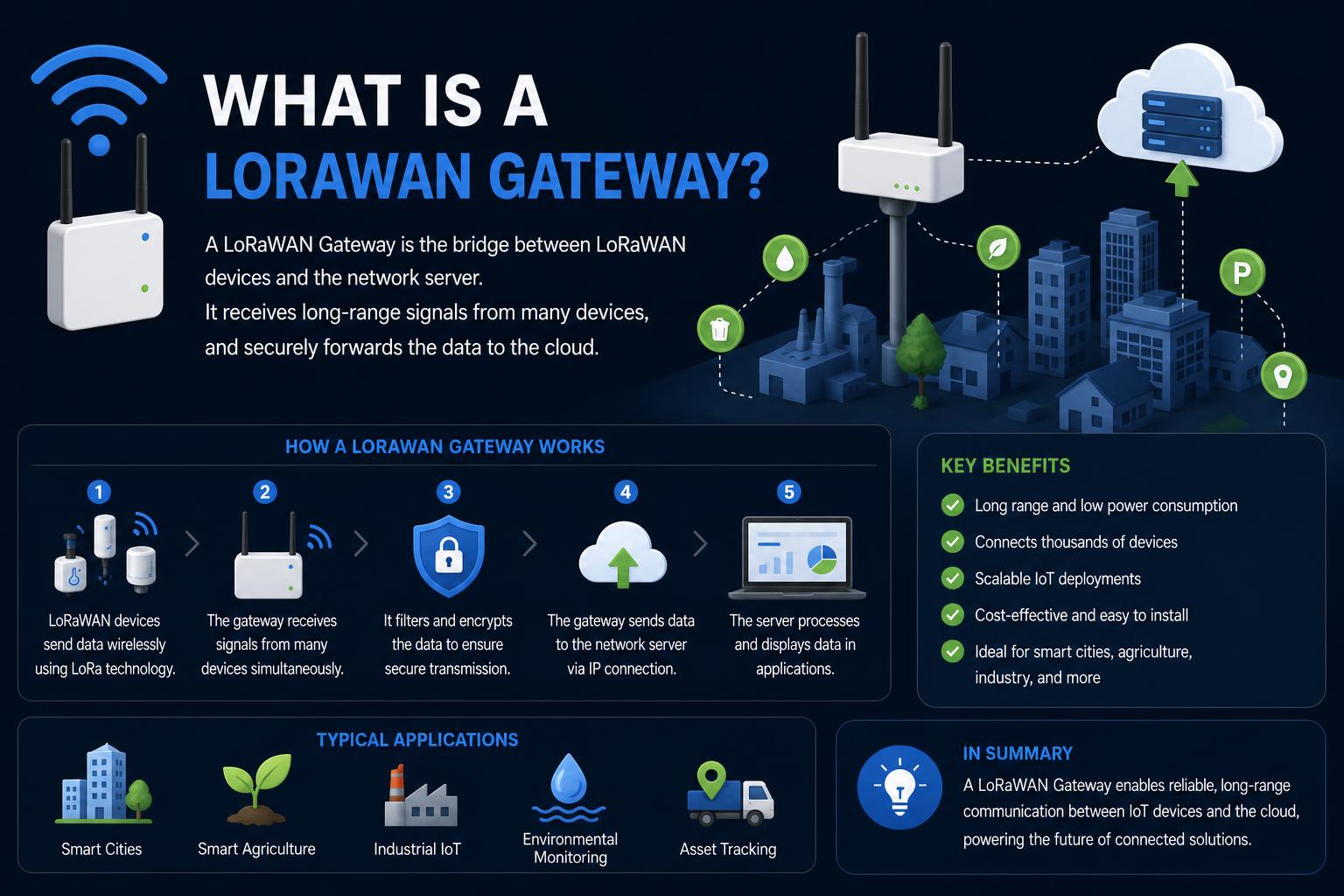
- LoRaWAN gateways are the essential bridge connecting low-power IoT devices to network servers, ensuring coverage, reliability, and scalability for modern IoT deployments.
- The architecture and components of LoRaWAN gateways (host system, concentrator, antennas, backhaul connectivity) are diverse and must be chosen based on environment, device density, and project scale.
- Deployment, management, and security aspects are vital: right location, frequency plan, remote maintenance, and robust authentication/encryption measures greatly influence successful IoT outcomes.
IoT is changing our lives, connecting everything from farms and factories to entire cities. But while the vision of smart devices talking over vast distances sounds great, there’s a lot going on behind the scenes to make it happen. If you’re poking around in the world of IoT networks or have ever heard terms like ‘LoRa’, ‘LoRaWAN’, or wondered how thousands of tiny sensors can all send their data miles away and actually get it back safely—this article is for you.
Let’s decode the real backbone of these networks: the LoRaWAN gateway. You’ll see this term pop up again and again whenever someone discusses connecting IoT endpoints over long distances, with ultra-low power consumption and broad coverage. What is Lorawan gateway? What makes a gateway so special? Why is it the linchpin of large-scale IoT deployments? And if you’re thinking of building, buying, or managing a LoRaWAN network, what upsides, gotchas, and best practices should you know? Get ready—we’re diving deep into all things LoRaWAN gateway, pulling together the super-useful knowledge from industry leaders and technical standards.
What is a Gateway in IoT?
In networking, a gateway is a bridge between two different networks or protocols. Think of it as a universal translator: information comes in one language (protocol) from a set of devices, the gateway translates and repackages that info, and sends it where it needs to go—often over completely different types of networks. In a classic Internet setup, your home router acts as a gateway connecting your devices to the internet. But when it comes to IoT and LoRaWAN, the role of the gateway is even more critical.
The reason is clear: IoT devices like sensors and actuators scattered across wide areas don’t talk ‘Internet’ directly. They speak specialized, often proprietary radio languages designed to be super-efficient and energy-saving. Without a gateway, their data would stay locked in a local bubble.
Unpacking LoRa and LoRaWAN: The Foundation
LoRa stands for Long Range. This proprietary wireless modulation technique, based on Chirped Spread Spectrum (CSS), allows data to travel vast distances—even several kilometers—using very low power. It’s built to be robust against interference, making it ideal for devices spread throughout cities, rural areas, or challenging industrial sites.
The technology’s magic is in its ‘spreading factors,’ which can be adjusted to trade data rate for distance—hence smart meters, agriculture sensors, or parking detectors lasting for years on a battery while sending updates miles away.
LoRaWAN (LoRa Wide Area Network) is the open protocol that rides on top of LoRa. Developed and updated by the LoRa Alliance, it takes care of network structure, device authentication, encryption, roaming, and secure message exchange—bringing order and interoperability to any LoRa-powered project.
What Exactly is a LoRaWAN Gateway?
A LoRaWAN gateway is the digital bridge between the sea of LoRa-enabled IoT devices (often called nodes or end-devices) and the logical brain of the system, the network server. Without this bridge, your field of sensors would be as useful as a room full of people speaking a language nobody nearby understands.
The LoRaWAN gateway receives radio signals from all the LoRa devices in its vicinity. It then prepares, aggregates, and reforms this data into a format suitable for Internet transport—sending it upstream via Ethernet, Wi-Fi, or cellular (4G/5G) to the network server, which does the heavy lifting of packet decoding, device authentication, downlink commands, and linking with application servers where real actions happen.
Gateways can also send information back to devices—issuing network updates, configuration commands, or simple acknowledgments. Unlike mesh-based protocols, LoRaWAN features a star-of-stars topology—every end-device talks directly to the gateway(s), never to each other. This keeps energy use minimal and makes scaling much easier.
LoRaWAN Gateway Architecture: Let’s Break It Down
A typical LoRaWAN gateway isn’t just a point of radio contact—it’s a carefully architected collection of subsystems, each with a distinct role:
- RF Front End (Antennas and Modem): The physical interface, consisting of robust antennas and a radio module or concentrator, receives the RF signals from the IoT field. These can pick up multiple signals simultaneously—sometimes across several channels and frequencies.
- Baseband Processor (Host System): Here’s where the real number crunching happens. The host system contains a CPU/MCU, memory, and operating software to manage incoming packets, filter noise, aggregate simultaneous signals, and drive downstream network logic.
- Backhaul Interface: The link from your gateway to the rest of the world—most often via Ethernet, Wi-Fi, or cellular. The reliability, speed, and redundancy of this link determine how quickly and securely your IoT data gets from field to cloud.
- Power Options: Depending on use case, the gateway might run off mains electricity, battery backup, Power over Ethernet (PoE), or even solar panels—especially important for remote or outdoor deployments.
Quality gateways wrap these elements in an enclosure appropriate to their environment: small, easy-to-mount plastic cases for indoor units, or rugged, weatherproof (IP67-rated) housings for outdoor units battling the elements.
Role and Importance: Why LoRaWAN Gateways Matter So Much
No gateway, no LoRaWAN network. The gateway is the star point in the LoRaWAN ‘star topology’, directly communicating with all end-nodes and relaying their messages to the network server. The server, in turn, directs information to the ultimate destination—application layers such as dashboards, data analytics, or control systems.
Important: Gateways not only extend range—sometimes up to 10-15km in rural areas—they also allow hundreds or thousands of devices to join the network. This makes LoRaWAN ideal for massive, distributed, battery-powered deployments such as smart agriculture, city infrastructure monitoring, logistics, industrial automation, and building management systems.
Key LoRaWAN Gateway Components and Their Functions
Host System
This is the processing core of the gateway. It runs the software stack that receives radio packets (uplink) and prepares downlink responses. Performance here matters—a capable host enables advanced analytics, low latency, packet filtering, and power efficiency.
LoRa Concentrator
LoRaWAN gateways are distinct because of their multi-channel concentrator functionality. Unlike basic transceivers, concentrators can process multiple frequencies and spreading factors at once—crucial for large-scale deployments with lots of device traffic.
Antennas
Antennas dictate coverage. Omnidirectional antennas provide broad but relatively shallow coverage, perfect for city zones or wide-open fields. The right antenna height and placement avoid obstacles, interference, and signal dead zones.
Backhaul Connectivity
Without a stable backhaul, your gateway is an island. Most professional-grade gateways offer redundant options: Ethernet, Wi-Fi, and cellular. Selecting the right mix ensures your data reliably reaches the network server in every scenario, including failover and outage recovery.
Power and Environmental Protection
Gateways come in indoor and outdoor versions. Outdoor models are ruggedized—think heavy-duty cases, waterproofing, wide temperature tolerance, sometimes solar or battery backup. Indoor models trade ruggedness for ease of use, quick install, and integration into office environments with lower device density.
How Do LoRaWAN Gateways Work?
The LoRaWAN communication pipeline works in distinct steps:
- IoT devices (end-nodes) transmit data using LoRa modulation on pre-configured frequencies and spreading factors.
- Gateways in range receive these packets—often several at once with different time-frequency characteristics.
- The gateway’s concentrator and host process the data, filter duplicates, and forward (‘uplink’) it via backhaul to the network server.
- The network server (LoRaWAN Network Server – LNS) authenticates, decrypts, manages device sessions, and forwards data to an application server.
- To send commands or messages back, the process reverses (‘downlink’)—from the application server through the LNS, out to the relevant gateway, and on to the end device.
This architecture is robust: a network can have multiple gateways overlapping coverage, making connections redundant and reliable, and supporting mobile devices or harsh environments. Gateways don’t establish direct-to-device addresses—all routing or intelligence sits with the server, ensuring security, scalability, and easier management.
LoRaWAN Frequency Plans: Why Compliance and Region Matter
One of the key complexities in deploying LoRaWAN is frequency planning. LoRaWAN operates in unlicensed radio bands (ISM—Industrial, Scientific, and Medical bands), but these frequencies differ by country:
- EU868: Commonly used in Europe (863–870 MHz)
- US915: North America (902–928 MHz)
- CN470: China (470–510 MHz)
- Others: AS923, KR920, IN865, etc.
You MUST match the frequency plan between your gateway and all deployed devices. If the frequencies don’t align, devices simply won’t “see” the gateway, and no data will ever move between them. Always comply with LoRa Alliance and national regulations when selecting and deploying gear.
Types of LoRaWAN Gateways: One Size Doesn’t Fit All
Indoor vs Outdoor Gateways
- Indoor Gateways: Compact, easy to install, suitable for offices, homes, or industrial interiors. Typically, they cover about 500 meters and support up to 500 devices, perfect for low/medium density use.
- Outdoor Gateways: Built to withstand wind, rain, sun, and dust. These units, often in IP67-rated housings, can stretch coverage to 10km or more in line-of-sight locations and may connect upwards of 2,000 devices per cluster. Their strong antennas and rugged build make them ideal for farms, city rooftops, or factory yards.
Single-Channel vs Multi-Channel Gateways
- Single-Channel (Low-Cost/Test) Gateways: Cheaper and suited for proof-of-concept or low-traffic scenarios, but not recommended for production deployments—the inability to listen to multiple frequencies simultaneously severely limits scalability and reliability.
- Multi-Channel Gateways: Capable of listening for device activity across many channels and spreading factors at all times. This is essential for real-world, dense deployments with heavy sensor traffic across a broad area, and for compliance with LoRaWAN standards on bi-directional communication.
Classes of LoRaWAN Devices: Class A, B, and C Explained
How much time your devices spend ‘listening’ versus ‘sleeping’ greatly affects power, responsiveness, and use case.
- Class A: All certified LoRaWAN devices support this. After an uplink transmission, they briefly open a window for downlink commands, then shut off the radio. This keeps batteries living longest and is ideal for sensors that ‘check in’ occasionally.
- Class B: Adds scheduled ‘ping’ slots, so devices can listen for downlink regularly, but at a cost of slightly higher energy use. This fits devices needing more frequent interaction.
- Class C: Keeps the radio on and ready to receive almost constantly (except when transmitting), giving the most real-time performance—best for actuators/controls in factory or critical settings, but at a significant drain to battery life (hence often mains powered).
Functions and Benefits of LoRaWAN Gateways
Why do organizations choose LoRaWAN gateways for IoT rollouts?
- Long-Range Communication: Nowhere else does low-power wireless go this far, this efficiently.
- Energy Efficiency: Battery-powered sensors can last years, reducing maintenance and costs.
- Massive Scalability: One gateway can serve hundreds or thousands of devices—ideal for smart cities, industrial sites, or agriculture.
- Flexible Deployment: Mix and match indoor, outdoor, and solar-powered units to fit infrastructure and coverage needs—streetlights, mountaintops, tunnels, and everywhere in between.
- Security: LoRaWAN employs strong AES-128 encryption, device authentication, and per-packet integrity checking, making it tough for bad actors to intercept or spoof devices.
Gateway Deployment: Best Practices and Real-World Considerations
Deploying for Coverage and Scalability
Placement and density of gateways directly determine network performance. If you’re aiming for maximum range (rural farming, pipeline monitoring), leverage high, unobstructed locations (tower tops, tall buildings). Avoid obstacles—trees, walls, hills—that sap radio strength. Always factor in local RF noise and legal band limits.
Urban or high-density setups (fabrics, campuses) may require overlapping coverage with multiple gateways to ensure total availability and minimize ‘dead spots’. Studies and performance testing using tools like Node-RED confirm: adding gateways increases overall reliability, success rate, and real-time responsiveness. And with proper frequency channel planning, dense deployments won’t interfere with themselves—a key driver for industrial and city usage.
Installation Tips
- Mount gateways high and clear of obstructions.
- Configure the correct frequency plan for your region and devices.
- Register your gateway with your preferred network server (Chirpstack, Loriot, The Things Network, or private cloud solutions).
- Connect power and backhaul (Ethernet, Wi-Fi, LTE/4G, or whatever your deployment requires).
- Link, reconnect, and register devices—check signal quality and performance with built-in dashboard/monitoring tools.
Frequent monitoring and tuning (via the gateway’s web interface or a remote management platform) help maintain peak network health and spot issues before they become outages.
Maintenance, Upgrades, and Network Health
Most modern gateways support remote firmware upgrades, protocol changes, and cloud-based monitoring. This minimizes the need for onsite visits—crucial for widely distributed networks. Also, by tracking metrics such as packet reception ratio (PRR), RSSI, and SNR, you can troubleshoot low performance or spot environmental interference before service is affected.
Security and Network Management
Security is baked into the LoRaWAN protocol stack but the gateway itself must be kept secure—physically (outdoor enclosures, tamper protection) and digitally (firewalls, strong passwords, encrypted backhaul connections). Regularly update firmware to patch vulnerabilities and keep up with the latest standards.
Key Metrics and Performance Numbers for LoRaWAN Gateways
- Range: Outdoor gateways typically reach 2–15 kilometers in open country, 500 meters to 5 kilometers in cities. Indoor units may vary widely depending on building structure.
- Device Capacity: A single multi-channel gateway can easily support 500–2,000 end-devices concurrently—scale is determined by backhaul, radio density, spreading factor usage, and environmental factors.
- Data Rates: These are low by design (to maximize range and battery): perfect for sensor data, not designed for video or bulk file transfer. Expect a few kbps per channel under typical loads.
- Packet Reception Ratio (PRR): Higher with more gateways and good placement. Studies show PRR increases by up to 16.6% when moving from one to four gateways.
- Energy and Maintenance: Optimized algorithms and adaptive data rates (ADR) can lower energy use by up to 12%, while boosting network life by as much as 14% for large-scale deployments.
Deployment Examples of LoRaWAN Gateways
Agriculture: Netafim leverages LoRaWAN gateways to track soil moisture, optimize irrigation, and reduce water usage across vast fields.
Cities: The Things Network uses LoRaWAN for public air quality and water quality monitoring, enabling large-scale environmental data collection with minimal infrastructure cost.
Industrial: KORE’s KORA platform employs gateways on cranes and gas tanks for real-time status monitoring and preventive maintenance, enhancing safety and operational efficiency.
Utilities and Asset Tracking: Gateways are used by utility companies to monitor remote tanks and energy meters, and for vehicle tracking in large fleets—showcasing LoRaWAN’s versatility across verticals.
Essential Questions and Buying Criteria: Finding Your Perfect Gateway
- Coverage: Does the device support required frequency bands for your region and project?
- Scalability: Is the unit easily upgradeable—does it support adding more devices or frequency bands later?
- Backhaul Flexibility: Are there multiple options (Ethernet, Wi-Fi, cellular, PoE) for reliable connectivity?
- Power Sources: Can it be powered by grid, PoE, or solar for your chosen site?
- Security: What encryption and access control mechanisms does it support?
- Remote Management: Is there a dashboard/interface for remote management/monitoring and firmware updates?
- Compatibility: Will it work with your chosen network server and existing infrastructure?
- Environmental Rating: Is it rated for the temperature, dust, and moisture of your intended location?
- Cost and ROI: Consider both Capital Expenses (CAPEX) and Operational Expenses (OPEX)—the cheapest unit isn’t always the best value over years of operation.
- Support and Documentation: Does the vendor provide thorough guides, troubleshooting, and fast technical support?
The definitive guide to Windows IoT: Editions, features, and Real-World Impact
Frequently Asked Questions on LoRaWAN Gateways
How many devices can connect to one LoRaWAN gateway?
One multi-channel LoRaWAN gateway can easily connect hundreds to thousands of devices. Practical limits depend on spreading factor use (devices further away often need longer airtime), packet intervals, and local RF conditions. Network simulation and field trials help determine your real-world capacity.
What is the typical range of a LoRaWAN gateway?
Range varies from 2–15 kilometers in rural or unobstructed conditions, to 500 meters–5 kilometers in built-up cities. Placement and antenna selection are huge factors—always aim for higher ground and minimal physical blocks.
Do LoRaWAN gateways require an internet connection?
Yes. The gateway must transmit received packets to a LoRaWAN Network Server (LNS), which is typically located in the cloud or, less commonly, on a private LAN. Multiple backhaul options ensure reliability even in remote areas.
Are LoRaWAN gateways routers?
No—ordinary routers do IP data packet routing. LoRaWAN gateways operate at a lower layer, relaying LoRa radio messages to the server (and vice versa) but not conducting general IP routing internally. Some advanced models do offer basic network management (device-level routing, internal VPNs, etc), but this is not their main function.
How is security handled?
LoRaWAN provides for AES-128 encryption of all over-the-air traffic, device mutual authentication, network session keys, and end-to-end integrity checks. Still, you must secure the gateway’s management interface and backhaul connection; always keep firmware up to date for the best protection.
What’s better: Indoor or Outdoor gateway?
Depends on application. Indoor gateways are cheaper and faster to install; they suit home automation or single-building projects. Outdoor gateways provide wider range, greater resilience, and higher device capacity—best for public, industrial, or rural deployments where ruggedness and uptime are vital.
Field-Proven Tips for Gateway Success
- Always size your network for future growth. Over-estimate device count, coverage, and channel use—IoT projects often expand rapidly after seeing early benefits.
- Regularly monitor and maintain your gateways. Automated monitoring platforms let you catch performance drops, bandwidth congestion, or looming hardware failures before users notice.
- Never overlook frequency compliance. Non-compliant deployments risk fines, legal trouble, and interoperability headaches. Stay up to date with the LoRa Alliance’s recommendations for your country.
- Mix public and private networks if needed. Some projects benefit from public LoRaWAN coverage (low upfront costs) but gain privacy, security, or latency by supplementing with private gateways.
- Invest according to your network’s criticality. The lowest-cost gateway may backfire: it can become your single biggest point of failure if it’s unreliable or poorly supported.
LoRaWAN gateways are the silent but crucial backbone of the IoT revolution. They empower vast, distributed, energy-efficient sensor networks across sectors from agriculture to urban infrastructure, industrial automation, and beyond. Selecting and maintaining the appropriate gateway, placed correctly and managed proactively, can unlock a new era of real-time information and control—reliably, securely, y a escala.
A Comprehensive Guide to IoT Devices: How They Work, Where They’re Used, and Trends