
- DC motor controllers enable precise, efficient, and safe operation of motors by managing speed, direction, and torque.
- Modern controllers use techniques like PWM control, feedback loops, and H-bridge circuits to deliver adaptable and responsive performance.
- Choosing the right controller requires careful consideration of voltage, current, application needs, and integration options.
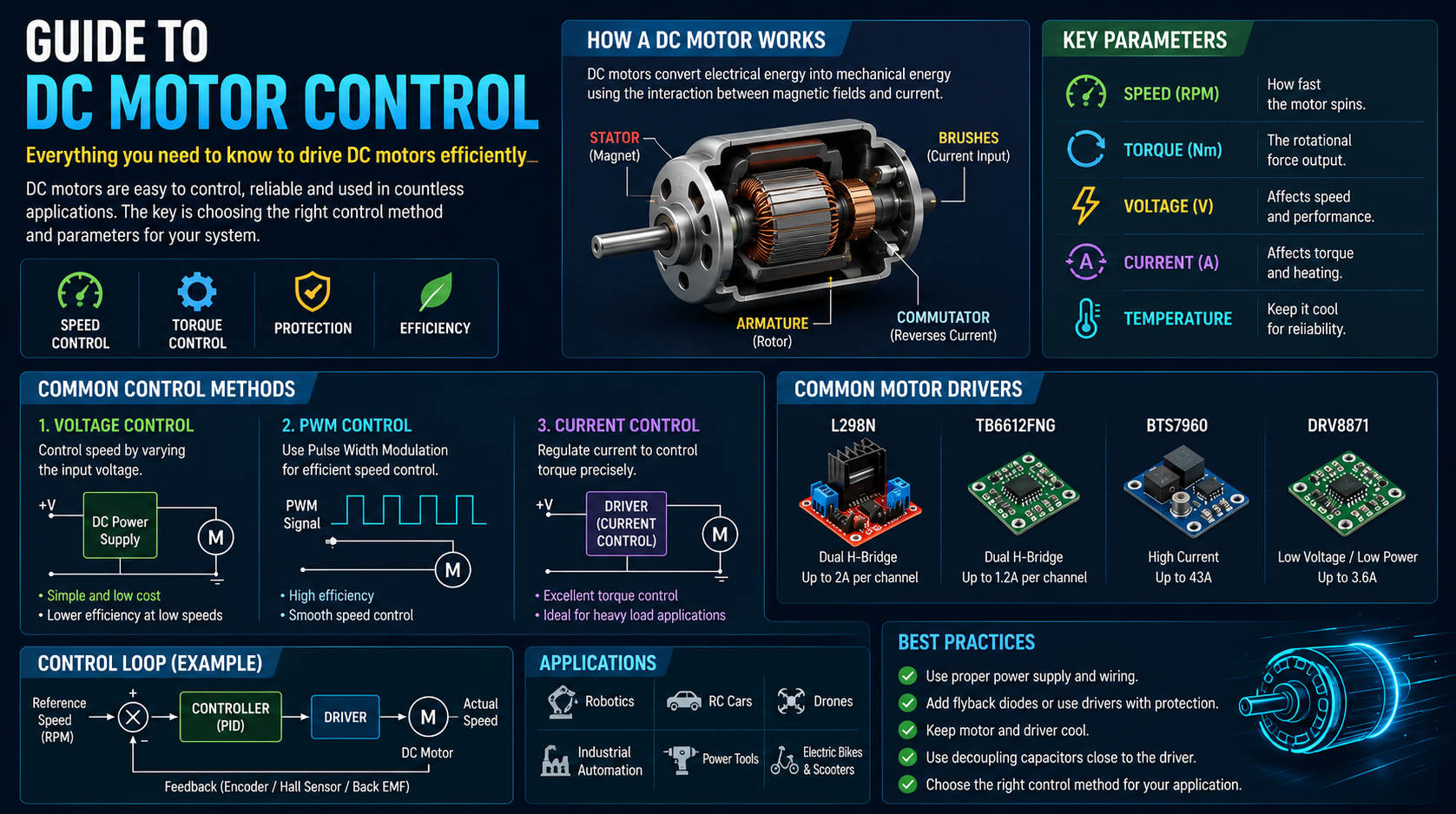
If you’ve ever wondered what makes your electric gadgets, robots, or even vehicles move in such a controlled and precise way, the answer likely lies in something called DC motor control. The magic of transforming direct current electricity into motion we can harness is everywhere, from tiny electronics to massive industrial equipment. Yet, how exactly do these systems keep things running smoothly, change speeds on command, prevent breakdowns, or even reverse direction at the push of a button? Let’s roll up our sleeves and dive deep into the surprisingly fascinating world of DC motor controllers.
Living in a world powered by electronics, understanding DC motor control techniques doesn’t just satisfy your curiosity—it also opens a gateway to innovation. As industries push for smarter automation and hobbyists create ever-more creative robotics, knowing the ins and outs of how these controllers work gives builders and engineers a massive advantage. So, let’s unpack everything there is to know about DC motor controllers, the science behind their operation, the technology that supports them, and the real-world considerations that make all the difference when choosing or building your own system.
What is a DC Motor Controller?
A DC motor controller is an electronic device designed to manage the operation of a direct current motor by regulating its speed, direction, and torque. Whether in your home appliances, industrial tools, cars, or advanced robotics, these controllers serve as the brains managing the brawn. By adjusting the amount of voltage and current sent to the DC motor and sometimes handling complex feedback loops, controllers ensure that motors not only spin but perform gracefully and safely, matching the goals of whatever machine they’re powering.
Why not just connect a motor directly to a power source? You could, but you’d be missing out on control, longevity, and, often, the safety of the system. Directly connecting a DC motor to a battery or supply means you’ll only get full speed in one direction, but real-world applications demand much more: starting and stopping at will, reversing, speeding up, slowing down, and even protecting against overloads and faults. This is where controllers shine, as they bring intelligence, efficiency, and reliability into the equation.
Key Functions and Features of DC Motor Controllers
Here’s what quality DC motor controllers bring to the table:
- Precise Speed Control: They can adjust how fast the motor spins, perfect for projects from model cars to conveyor belts.
- Directional Reversing: Many controllers make it possible to conveniently flip motor direction, enabling movement forward or backward with the flip of a switch or the press of a button.
- Torque Management: For applications where pulling power matters, some controllers can regulate torque to deliver consistent performance under variable loads.
- Protection Features: Overload, overcurrent, thermal shutdown, and more—these safety mechanisms keep both the motor and entire system protected from common faults.
- Integration Options: Modern controllers support a variety of communication protocols, allowing for remote control or even integration with microcontrollers and automation platforms.
Types of DC Motors and Why Their Control Matters
Not all DC motors are made equal. The way a controller interacts with a motor depends largely on its internal construction. Here are the major types:
Brushed DC Motors (BDC)
Brushed DC motors are the classic choice: these have a stator (with either windings or permanent magnets) and an armature (rotor) with windings, all connected via commutator and brushes. Their big advantages are simplicity and the ability to run directly off a DC power supply. However, because the brushes are mechanical, they wear over time, generate sparks, and produce electromagnetic interference (EMI).
Brushed DC motors are still very common in consumer electronics, robotics, and low-power industrial setups. Their basic design and affordable nature keep them relevant, and with the right controller, you get fairly precise speed and direction control. For a deeper dive into their operation, check out this expert thread on Reddit’s in-depth explainer.
Brushless DC Motors (BLDC)
Brushless DC motors replace the literal brushes and commutator with an electronic commutator. Inside, there’s a rotor with permanent magnets and a stator with windings. These are called ‘brushless’, but the magic lies in that the commutation (switching current to keep the motor spinning) is managed by an external or built-in drive circuit, which actively controls which winding is energized at each moment.
How does this help? BLDC motors offer higher efficiency, lower maintenance, quieter operation, and longer lifespan than their brushed counterparts. They require a more sophisticated controller and extra wiring, but are preferred in industrial applications, electric vehicles, and HVAC systems. For detailed guides on BLDC control, see sources like ASPINA and Phidgets.
Stepper Motors
Choose stepper motors when you need precise position control. These brushless motors move in discrete steps rather than continuous rotation. A stepper controller sends current in pulses, causing the motor to rotate one increment at a time, which is ideal for robotics, 3D printers, and CNC machines where exact positioning and holding are required.
Servo Motors
Servo motors typically use DC motors combined with feedback systems. They can automatically reach and maintain a target position or speed. The controller receives data from encoders or sensors and adjusts output accordingly, resulting in precise and repeatable motion.
Core Principles of DC Motor Control
Controlling a motor isn’t just about making it spin; it’s about doing so how you want, when you want, and safely. Here are the fundamental concepts:
Speed Control: Turning Voltage into Motion
The key rule: The speed of a DC motor depends on the voltage applied. Increasing voltage boosts speed, reducing it slows the motor. But as load increases, speed drops unless the controller compensates.
PWM (Pulse-width Modulation) has transformed speed management. Instead of linear voltage adjustments—wasting energy and generating heat—PWM rapidly switches power ON and OFF. The duty cycle (percentage of time ON vs. OFF) determines the average voltage delivered, enabling efficient, precise speed control. Almost all modern controllers use PWM for optimal performance.
Using Feedback Devices: Encoders and Sensors
Precise control often requires feedback—encoders are electromechanical devices that provide rotational information in pulses. They enable closed-loop control for stable speed and precise positioning. Some controllers, like , incorporate encoder connectivity, simplifying automation and enhancing safety.
Control Techniques: How to Achieve Your Desired Performance
Voltage Control
Initial controllers used resistive elements or linear regulators to vary voltage, but this was inefficient, wasting energy as heat. Now, this method is mainly for low-power applications.
PWM Control
Today, PWM is dominant. By rapidly switching a transistor or MOSFET on and off at high frequency and adjusting the duty cycle, the average voltage and power delivered is precisely controlled, with less heat and higher efficiency. It’s standard in robotics, RC vehicles, and dynamic speed adjustments.
Current Limiting and Braking
To protect the motor and electronics, controllers often include current limiting. Many also feature motor brakes: shorting motor terminals briefly after disconnecting power to stop rotation quickly and safely. This is crucial in robotics and vehicles where uncontrolled spin-down isn’t acceptable.
Essential Control Circuitry: H-Bridge and Beyond
The H-bridge remains a staple for direction control. Four switches (MOSFETs or transistors), arranged in an H configuration, enable bidirectional control and braking via dynamic braking. Chips like the L298 are common for small projects, while high-power systems may use IGBTs or even GaN transistors for better efficiency. For practical insights into various designs, see the discussion on .
[relacionado url=”https://www.ikkaro.net/guide-to-driving-a-dc-motor/”]
Using Feedback Devices: Encoders and Sensors
Precise control often requires feedback—encoders are electromechanical devices that provide rotational information in pulses. They enable closed-loop control for stable speed and precise positioning. Some controllers, like , incorporate encoder connectivity, simplifying automation and enhancing safety.
[relacionado url=”https://www.ikkaro.net/stepper-motor-control/”]
DIY or Buy: Building vs. Purchasing a DC Motor Controller
If you’re deciding between DIY and commercial solutions, consider:
- Integrated ICs: Simplify design for low-power, low-voltage applications but watch for obsolescence.
- Discrete Components: Offer customization and high-end control at the cost of increased complexity and development time. Match your design to voltage, current, speed, and feedback needs.
Guides and community projects like the Easy DC Motor Controller can provide practical tips for building your own system.
Common Pitfalls and Real-World Considerations
Engineers often encounter challenges in motor controller design. Some common issues include:
- Component Ratings: Ensure switches and drivers can handle expected voltages and currents to prevent damage.
- Dead Time in H-Bridge Operation: Proper timing prevents short circuits; neglecting this can blow fuses or damage components.
- PWM Frequency: Too low causes heat; too high may overload components or generate EMI.
- Electromagnetic Interference: Switching creates EMI; good PCB layout and filtering mitigate this problem.
- Microcontroller Limits: Feedback signals at high frequency require capable hardware or additional processing units like FPGAs.
Motor Controllers vs Motor Drivers: What’s the Difference?
It’s a common confusion, but the distinction is:
- Motor Driver: Focuses on power amplification—converts control signals into current. Lacks complex control logic.
- Motor Controller: Combines power amplification with control algorithms, feedback handling, and safety features—often microcontroller or FPGA-based for advanced control and communication.
This comprehensive approach allows for smarter, more adaptable motor management, crucial in modern automation.
How to Choose the Right DC Motor Controller
Picking the best controller depends on:
- Voltage and Current Ratings: Compatibility with motor specifications and power supply.
- Control Requirements: Need for simple on/off, variable speed, torque control, or feedback integration.
- Communication Protocols: Compatibility with microcontrollers or PLCs—look for UART, SPI, I2C, CAN, etc.
- Operating Environment: Consider temperature, dust, moisture, and vibration requirements for durability.
- Budget: Balance feature needs with cost, support, and availability of replacement parts.
Distributors like American Control Electronics and Arshon Technology offer extensive options.
Applications: Where DC Motor Controllers Make a Difference
DC motor controllers are integral to many fields, including:
- Robotics and Automation: Conveyor belts, factory robots, 3D printers rely on precise, programmable movement.
- Consumer Electronics and Toys: RC cars, drones, household fans benefit from responsive control.
- Automotive Systems: Adjustable seats, electric power steering, and EV motors depend on reliable control.
- Industrial Machinery: Pumps, CNC machines, winders operated with high torque and delicate handling capabilities.
- Medical Devices: Equipment like insulin pumps or prosthetics depend on precise, safe movement control.
Real-World Projects and Success Stories
Practical examples demonstrate the versatility of modern DC motor controllers:
- Autonomous Robotic Mower: Using PWM-controlled brushed motors for agile, obstacle-aware movement with reliable stopping and reversing, detailed on .
- Factory Automation: Customizable controllers from companies like enhance productivity with features like PID, torque regulation, and braking.
- Educational and Open Source Projects: Platforms such as and enable hobbyists and students to build feedback-enabled robotics easily.
Future Trends in DC Motor Controlling Tech
Looking ahead, expect innovations such as:
- Greater Integration: Combining features like built-in encoders and IoT connectivity on smaller boards.
- Enhanced Efficiency: Using GaN transistors and advanced power management for faster switching and longer-lasting systems.
- Intelligent Feedback: Incorporation of machine learning to enable predictive maintenance and adaptive responses.
- Universal Compatibility: Controllers capable of managing various motor types and communication standards for simplified integration.
DC motor controllers continue to evolve, powering innovation across industries—from robotics and automotive to industrial automation—and their mastery remains essential for engineers and hobbyists alike. Choosing the right control strategies and keeping abreast of new developments ensures your projects benefit from the latest in reliability, efficiency, and sophistication.