
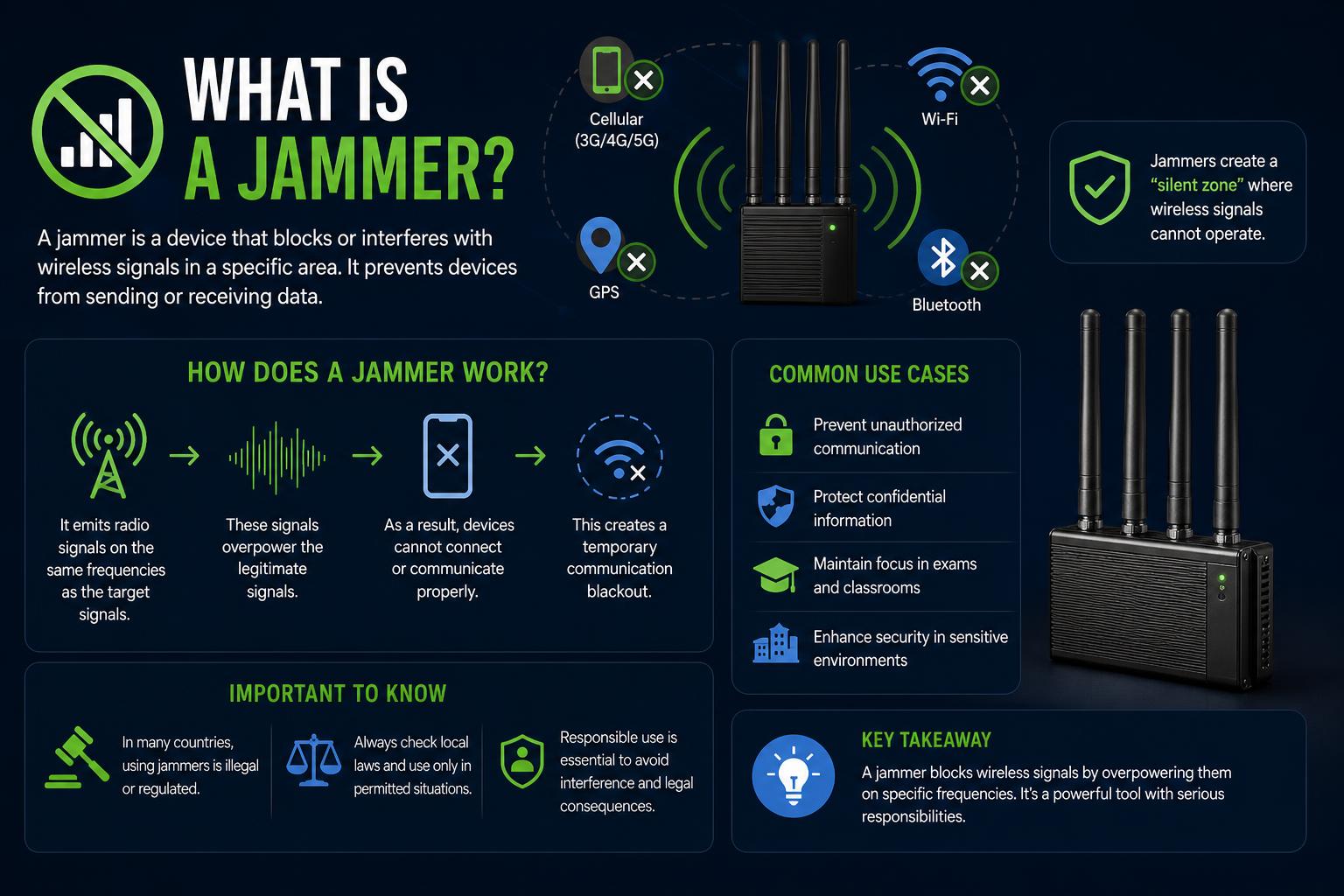
- Jammers disrupt wireless communications by emitting interference on target frequencies.
- Multiple jamming methods exist, including noise, sweep, and repeater techniques.
- Strict global laws limit jammer usage, with severe penalties for violations.
Electronic jamming is a topic that’s surrounded by curiosity, given its critical applications and the legal controversy it stirs worldwide. If you’ve ever wondered why your phone suddenly drops off the map in certain places or how some security protocols work, you’re about to dive deep into the world of jammers. Let’s shed light—without interference—on what these devices do, how they function, and why they matter so much in today’s wireless, always-connected environment.
Signal jammers have their roots in military use, but found their way into various public and private applications, sometimes in controversial or outright illegal ways. Understanding jammers helps us appreciate why they’re tightly regulated in most of the world, and what consequences their misuse brings. Whether you’re in tech, security, or just a curious mind, this guide delivers a nuanced look at jammers without getting too technical—so, let’s break the silence.
What Exactly Is a Jammer?
A jammer is a device designed to disrupt, block, or degrade wireless communications between devices. Typically, jammers work by injecting noise or malicious signals onto the same frequencies that legitimate devices use, thereby overwhelming the intended signal and rendering communication impossible or unreliable. The simplest analogy: imagine someone shouting loudly at a crowded room, drowning out any attempt at conversation.
Initially, jammers were developed with military and law enforcement operations in mind. Strategic objectives included thwarting remote detonation devices, neutralizing surveillance operations, and controlling information in high-risk scenarios. Over time, the technology has been adapted for (and unfortunately misused in) environments ranging from classrooms and cinemas to transportation hubs and prison systems.
How Do Jammers Work?
Jammers emit signals that are tailored to interfere with specific frequencies used by target devices—such as cell phones, GPS units, WiFi routers, or radios. The attacking signal usually has a much higher power level than the legitimate communication, causing devices in range to lose connectivity, reliability, or both. There’s a spectrum of jamming sophistication, from basic static noise (which might block only a single frequency) to complex, adaptive devices capable of targeting multiple or changing channels on the fly.
- Denial-of-Service Approach: Most jammers use a denial-of-service (DoS) method. By broadcasting powerful interference on the same frequency, they make it impossible for legitimate devices to send or receive data or voice signals.
- Jamming Variants by Device Type: The jammer’s effectiveness, range, and subtlety depend on its build, power, antenna, and the wireless protocol being targeted.
Main Types of Jammers and Jamming Methods
Jammers can be sorted based on their construction, target, and approach to disrupting signals. Below, we’ll break down the most significant categories and explain the core methods behind how they operate.
Noise-Based Jamming Techniques
- Spot Jamming: Here, the jammer focuses its entire power output on a single frequency. It’s effective against devices that remain on one frequency but is weak against those that can hop channels.
- Barrage Jamming: Rather than focusing on one frequency, barrage jammers spread their power across several frequencies at once, ensuring broader coverage, but the jamming effect is weaker on each individual channel.
- Sweep Jamming: The full power is shifted rapidly across frequencies. This allows the jammer to hit multiple bands in quick succession so that any channel is affected for short intervals but not simultaneously across all channels.
Repeater Technique (Digital Radio Frequency Memory, DRFM)
This approach is more advanced, capturing legitimate signals, altering or re-transmitting them, and confusing receivers or radars. DRFM jamming tricks the radar or receiver into seeing false targets or incorrect distances, a tactic used especially in military applications.
Varieties of Wireless Jammers
There’s a broad array of jammer types, each tailored to a purpose and a level of sophistication. Here are the main classes found in the field:
- Deceptive Jammers: These transmit continuous signals masquerading as legitimate communication. Devices ‘think’ communication is happening when, in reality, the network is deadlocked until the jammer is turned off. Simple yet effective for lingering interference.
- Reactive Jammers: Also called CTS jammers, these only transmit interfering signals when they detect a legitimate request (e.g., an RTS or Ready To Send signal). Highly efficient since they only jam when necessary and save power.
- Pulse-Noised Jammers: A special form of Manpack Jammer, these can hop channels and attack multiple frequencies in bursts, conserving energy and maximizing impact.
- Channel-Hopping Jammers: These override channel-selection algorithms (like CSMA in the MAC layer) to jump around the frequency spectrum. Staying invisible in discovery mode, they strike unpredictably as per a programmed sequence.
- Proactive Jammers: These unleash random bits onto a frequency, regardless of any actual communications, effectively disabling all devices on that channel. Subtypes include constant, deceptive, and random jammers.
- Function-Specific Jammers: Designed for a particular goal, these can switch between being proactive or reactive and customize their jamming style for efficiency or maximum disruption.
- Follow-On Jammers: These scan all channels, striking each one briefly to force devices to keep searching for clean frequencies. Power-efficient, they continually pursue transmitters that try to escape jamming.
Legal Status: Where Are Jammers Allowed or Prohibited?
Because of the risk to public safety and the potential for widespread disruption, most countries strictly control or prohibit civilian use and manufacturing of jamming devices. Here’s a rundown of where you’ll find the tightest rules and some exceptions:
- United States: The FCC forbids the sale, marketing, use, or advertisement of jammers without explicit federal approval. Offenders face fines, equipment seizure, and even jail time. The FCC’s jammer enforcement division pursues violations vigorously.
- European Union: Under the Directive 1999/5/EC, jamming devices are illegal except for strictly defined exceptions (typically for law enforcement or secure environments).
- Australia, Canada, UK, and Most Other Nations: It’s against the law to operate, own, or manufacture jammers unless you’re a registered government agency or specially licensed. There are some exceptions for prison or military uses, under supervision.
- India: Restricted to the military, law enforcement, or for perimeter-specific uses with prior permission.
- Russia and Some Select Countries: Technically legal, but generally confined to secure locations or schools. Regulations are often changing.
- Brazil, Malaysia, South Africa, and Other Regions: Generally illegal with strict penalties for private use or unauthorized possession, though some push for allowing installation in prisons.
Punishments can range from stiff fines—often in the hundreds of thousands of dollars—to years of imprisonment and permanent seizure of devices. The reasoning is simple: jammers put emergency communications, law enforcement operations, transport networks, and regular daily communications at risk.
Common Uses for Jammers (and the Arguments For and Against)
While illegal in most places, there are persistent pushes for legalizing or allowing jammers in very specific settings:
- Military: Protecting units in the field from remote detonation or enemy surveillance.
- Law Enforcement: Controlling prison communications to prevent contraband use of cell phones.
- Public Spaces: Some argue for their use in libraries, theaters, classrooms, or religious venues to enforce etiquette—though this is almost universally banned due to public safety.
However, the core risk is the indiscriminate nature of jammers: they block not just annoying or illicit transmissions but also critical communications—emergency calls, police radio, or essential business signals. That’s why, outside of government-controlled environments, the law nearly always comes down hard on unauthorized use.
Jammers vs. Signal Boosters and Defenses
One frequent question is whether a signal booster (amplifier) can overcome a jammer’s blocking effect. Unfortunately, the answer is generally no. Boosters depend on an outside signal—they cannot create one from nothing. If a jammer obliterates or corrupts the frequency, boosters have nothing to amplify. In fact, jammers block signal boosters just as efficiently as they do phones and radios.
Conversely, commercial boosters are not effective defensive weapons against jamming. Even the best commercial boosters can’t overcome active and targeted jamming interference.
How Can You Detect If a Jammer Is Active?
The most common sign is a sudden and unexplained drop in service—calls won’t connect, data stops flowing, even signal bars disappear. While numerous smartphone apps claim to detect jammers, these are generally unreliable and require a baseline signal, which you probably won’t have if you’re being jammed. Without specialized, often military-grade equipment, it’s almost impossible for the average user to confirm the presence of a jammer.
If you suspect illegal jamming activity, your best recourse is to move locations and contact authorities. Federal agencies, like the FCC in the US, recommend filing formal complaints so they can investigate and take action.
Is It Possible to Circumvent a Jammer?
By design, jammers are tough to defeat—but not always infallible. If you’re technically proficient, you might try to switch your device to a different frequency, although high-end jammers can often track and adapt. Physical relocation is usually the quickest fix, since most jamming devices only have a range of about 30 feet (give or take, depending on the device’s power and antenna design). However, the safest method is to remove yourself from the affected area. Attempts to locate and deactivate a jammer are generally discouraged unless you have the legal authority or technical expertise to do so safely. Some jammers can be small and inconspicuous—looking like walkie-talkies, cell phones, or WiFi routers, making field detection challenging for non-professionals.
Who Manufactures and Sells Jammers?
Despite their illegality in most jurisdictions, a brisk online market exists—mainly in the form of shady third-party sites, restricted-access forums, or individuals selling through word of mouth. Manufacturing is typically centered in countries with loose regulations or inconsistent enforcement. Law-abiding vendors (such as companies focused on legal signal boosting, like Wilson Amplifiers) steer clear of jammers, instead offering solutions to enhance, not block, connectivity. Always check a vendor’s compliance policies before even inquiring about jamming technology, and remember: Legal consequences for buying, selling, or using unauthorized jammers can be severe.
What Should You Do If You Encounter a Jammer?
If you find yourself in a suspected jamming zone, first try moving to a new location. In most cases, stepping outside the jammer’s limited effective range will restore communications. If the problem persists, and particularly if it suggests criminal intent (such as signal loss in a sensitive venue), alert law enforcement or your country’s communications authority promptly. For persistent, legitimate interference issues, consult an authorized expert—never attempt enforcement or deactivation tactics unless you have the appropriate skills and clear legal backing.
Whether you’re working in a high-security field, building network resilience, or just a tech enthusiast, understanding how jammers work—and why they’re so stringently controlled worldwide—equips you to recognize, respond to, and avoid their disruptive effects. Staying informed about the legal landscape and the current risks around signal jamming is essential as wireless technology becomes ever more embedded in our critical infrastructure and everyday communication.