
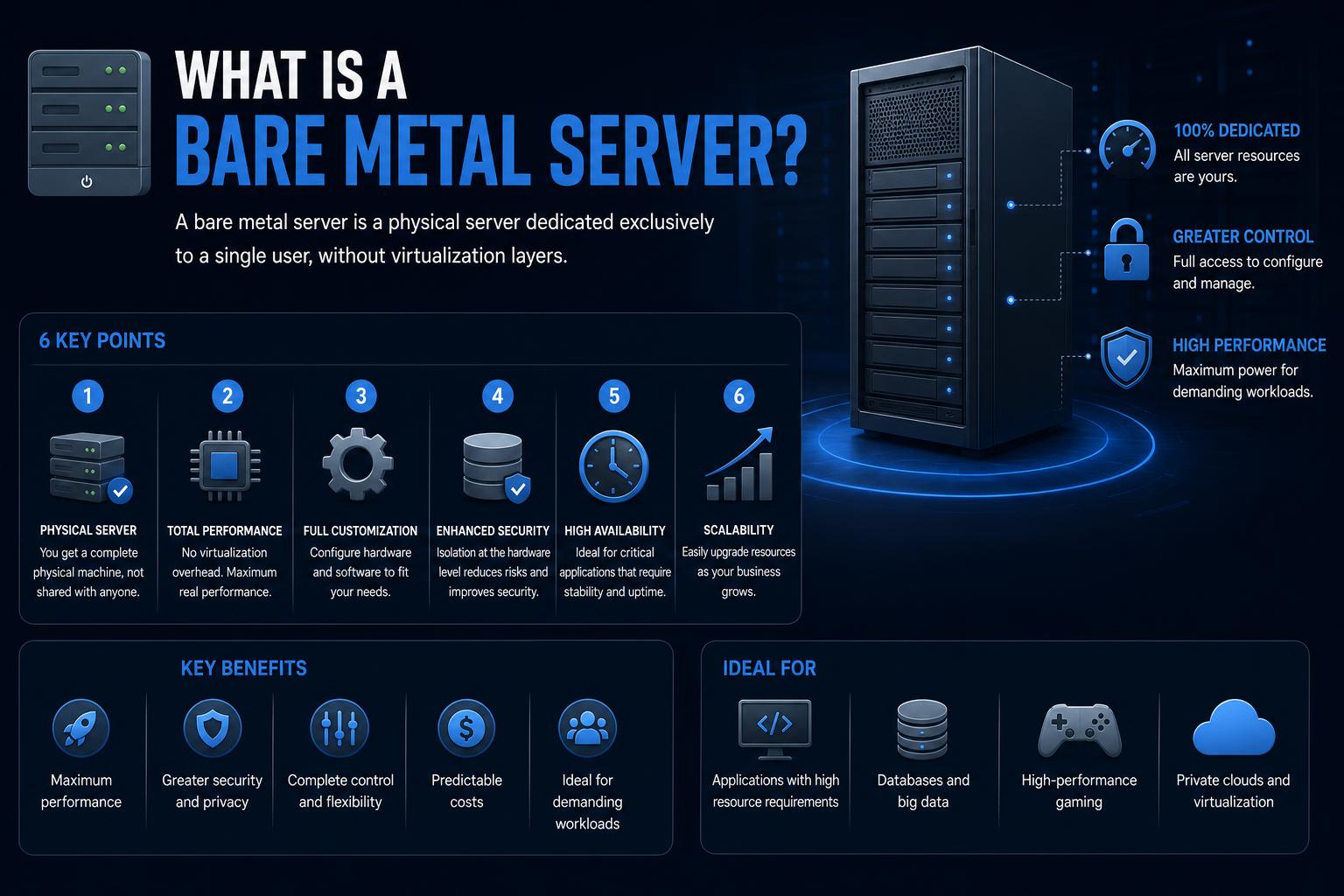
- Bare metal servers deliver dedicated, non-virtualized hardware for unmatched performance and security.
- Modern BMaaS platforms automate provisioning, lifecycle management, and network isolation for scalable, cloud-native operations.
- They are the preferred choice for high-compliance, high-performance, and low-latency workloads across industries.
In today’s cloud-centric world, the concept of bare metal servers is making a notable comeback, especially among industries demanding high performance, security, and complete infrastructure control. While advances in virtualization and multi-tenant cloud architectures have delivered remarkable flexibility, they sometimes fall short when the stakes involve strict compliance, high-frequency workloads, or the absolute need for guaranteed resources.
Let’s dig deep into what bare metal servers really are, why they’ve regained the spotlight, their real-world benefits, when you should consider them, and how they fit into the modern cloud ecosystem. You’ll also discover not just how they work, but why businesses of all scales — from emerging startups to established enterprises — are increasingly turning to bare metal solutions for critical workloads.
What Exactly is a Bare Metal Server?
A bare metal server, at its core, is a physical machine dedicated exclusively to a single tenant, with no virtualization or sharing across users. Unlike virtualized environments where resources are split by a hypervisor, with isolated virtual machines running for multiple clients on one physical host, a bare metal server hands over every ounce of compute, memory, and storage directly to you. This makes bare metal ideal for users needing direct, unmitigated access and superior performance.
Bare Metal vs. Dedicated Servers: Clearing Up the Confusion
It’s common to see ‘bare metal’ and ‘dedicated server’ used interchangeably, but there are subtle yet important differences worth noting. Historically, dedicated servers offered isolated hardware environments but came with longer provisioning times, fixed-term contracts, and sometimes dated technology. The rise of bare metal server offerings was a response to these limitations, merging the exclusiveness of dedicated hardware with the on-demand, scalable, and flexible nature of modern cloud services. Today, many bare metal servers can be provisioned in minutes, billed by the hour, and offer top-shelf hardware options, including configurations tailored for high-end computation (such as advanced GPUs and SSDs).
Bare Metal in the Cloud: The Modern Shift
The intersection of bare metal servers and the cloud has given rise to the term ‘bare metal cloud’ and services such as ‘Bare Metal as a Service’ (BMaaS). Providers like OpenMetal and IBM Cloud offer solutions where users can instantly rent fully dedicated servers, enjoying on-demand deployment and cloud-native management tools—without sharing infrastructure with other tenants. This approach brings together the flexibility of cloud provisioning with the security and consistency of physical, non-shared machines.
How Are Bare Metal Servers Provisioned and Managed?
Modern bare metal provisioning makes server setup and lifecycle management far simpler, thanks to sophisticated automation tools used by providers and enterprises alike. OpenStack Ironic and Canonical MaaS are popular open-source solutions that orchestrate the deployment, management, and reallocation of physical hardware at scale, often through APIs and infrastructure-as-code workflows. This enables rapid scaling, customization, and even network reconfiguration to suit complex architectures without manual intervention. Commercial options like MetalSoft and RackN DigitalRebar deliver turn-key BMaaS management for larger data centers and enterprises.
Key Benefits of Bare Metal Servers
- Maximum Performance: Virtualization introduces a performance overhead, but with bare metal, all compute cycles, memory, and storage bandwidth are allocated directly to your applications. Industries such as high-frequency trading, media streaming, and real-time analytics often report 30-50% performance gains over comparable virtual environments.
- Elimination of ‘Noisy Neighbors’: With full single tenancy, there is no risk of resource contention with other users — a common issue in public multi-tenant clouds that can hurt application predictability.
- Custom Hardware Flexibility: Bare metal servers can be ordered with a wide array of hardware, including top-end CPUs, RAM, local disks, and even specialized GPU setups for AI, machine learning, and scientific workloads (see OVHCloud’s explainers for more on GPU-driven use cases).
- Enhanced Security: The lack of a virtualization layer and absence of shared infrastructure significantly reduce the attack surface, increasing compliance and lowering vulnerability to threats like Spectre and Meltdown that can compromise systems through shared hardware.
- High Control and Full Customization: Tenants have root-level access, the ability to run custom operating systems, hypervisors, or even interact with hardware directly, which is ideal for testing, R&D, and regulated workloads.
- Predictable Costs: Especially in pay-as-you-go or hourly billing models, you pay for exactly what you use with no hidden resource contention or surprise charges from neighboring workloads overstaying their welcome.
Use Cases: Where Bare Metal Shines
- High-Performance Computing (HPC): Scientific research, video rendering, and simulation workloads benefit from direct, dedicated access to every core and byte of memory.
- Financial Services: Low-latency trades and high-frequency operations require predictability and security only achievable in a non-shared environment.
- AI and GPU-Intensive Applications: Advanced GPUs deliver exponential speedups for parallel processing — essential for training deep learning models, big data analytics, and medical diagnostics (see OVHCloud for GPU configuration benefits).
- Media Streaming and Content Delivery: Consistent, high throughput is key for platforms serving large user bases without jitter or buffering, which is tough to guarantee on heavy, multi-tenant infrastructure.
- Healthcare and Regulated Environments: Strict data isolation requirements (such as HIPAA or GDPR) often can’t accept any form of shared infrastructure, making dedicated bare metal imperative.
- Development and Testing: Removing external noise ensures accurate results during R&D, especially when evaluating new software or high-stakes workloads.
Bare Metal as a Service (BMaaS): Features and Providers
BMaaS combines the power, security, and exclusivity of physical servers with the agility and scalability of cloud provisioning. Customers can create, scale, and tear down complex bare metal environments on-demand — ideal for projects with variable workloads or those wanting to avoid long hardware leases.
Key players providing BMaaS include Equinix Metal, Rackspace, DataBank, OpenMetal, and OVHCloud. Open-source platforms enabling this model include OpenStack Ironic, Canonical MaaS, Tinkerbell, and xCAT. These tools automate server provisioning, lifecycle management, network segmentation, and strengthen security between tenants by default — bridging the gap between classic hardware administration and next-gen cloud orchestration.
Bare Metal Cloud vs. Virtualized Cloud Solutions
Let’s break down the biggest contrasts between pure bare metal and the typical virtualized public cloud:
- Isolation: Bare metal avoids all multi-tenancy risk, as the server belongs to just one client at any time. Virtual machines rely on software-level separation, which can be compromised by new security threats or resource spikes from other tenants.
- Performance: Direct access to hardware means more predictable, sometimes much higher, application performance. Virtualized clouds, even with the best schedulers, often hit performance ceilings due to shared CPU, memory, and I/O bandwidth.
- Flexibility and Customization: You design the environment — from the operating system choice, all the way down to BIOS settings. With VMs, you’re often bound to predefined templates and limited by the cloud vendor’s stack.
- Billing Models: Bare metal cloud vendors increasingly offer hourly or monthly billing, making it easier to scale up or down as needs change and reducing over-provisioning risks.
Lifecycle Management & Automation with BMaaS Software
The complexity of managing hundreds or thousands of bare metal servers has been greatly reduced in recent years. BMaaS management platforms abstract and automate routine work — such as server onboarding, network segmentation, storage management, and resource redeployment. Tools like MetalSoft (commercial) and RackN Digital Rebar allow even large, distributed environments to be managed as easily as virtualized clusters. This provides the benefits of automation while retaining the raw power and security of physical servers.
Many of these BMaaS platforms integrate with container orchestration solutions like Kubernetes — enabling seamless autoscaling of workloads across both physical and virtual host pools, with dynamic resource composition (choosing right-sized hardware for specific tasks).
Composable Infrastructure and Bare Metal
Composable disaggregated infrastructure is an emerging trend related to bare metal. It aims to let IT teams “compose” ephemeral compute units from a pool of hardware resources — matching RAM, storage, and CPUs as needed for any specific workload. BMaaS sometimes overlaps with this concept, especially when external block storage such as iSCSI is used, allowing for flexible node sizing and rapid hardware replacement in case of failure.
Bare Metal in Edge Computing and Low-Latency Deployments
As edge computing becomes more prominent in applications like connected vehicles, augmented reality, mixed reality, and telerobotics, the need for low-latency bare metal clouds is increasing. Bare metal provisioning, automation software, and orchestration tooling allow providers to dynamically automate many mini data centers at the edge, all while delivering minimal latency for end users.
Security Considerations
One of the most significant benefits highlighted consistently across providers is advanced security. Separation at the hardware layer nullifies hypervisor escape risks and isolates customers at the network and physical level—making bare metal servers the go-to option for businesses needing the highest data protection or dealing with sensitive compliance rules. With automation comes additional benefits, such as automatic data wiping and segmentation, ensuring each tenant starts with a clean slate and no risk of data leakage from previous customers.
Typical Lifecycle of a Bare Metal Server
- Provisioning: Select hardware configuration and operating system. Providers (or internal automation tools) image the bare metal with your chosen software stack, applying any custom firmware or BIOS settings as needed.
- Operation: Applications run directly on hardware, with performance analytics, security monitoring, and scaling operations handled by your IT team or the BMaaS provider.
- Decommissioning: At the end of use, automation tools clean and reset the hardware, removing all data (often with certified wiping processes) before returning it to a resource pool for the next tenant.
Examples of Popular BMaaS Software
- OpenStack Ironic (Open source)
- Canonical MaaS (Open source)
- MetalSoft (Commercial)
- RackN Digital Rebar (Commercial)
- Tinkerbell (Open source)
- xCAT (Open source)
- RackHD (Open source)
- Cobbler (Open source)
- Foreman (Open source)
Major Companies Offering BMaaS
Ultimately, bare metal server solutions offer an attractive option for organizations and developers looking to maximize control, power, and security in service delivery models, whether in on-premises or cloud environments. Whether building a next-generation AI engine, delivering real-time services, or simply escaping the unpredictability of shared hardware, modern bare metal solutions combine the best of dedicated hardware with the convenience and automation of the cloud.