
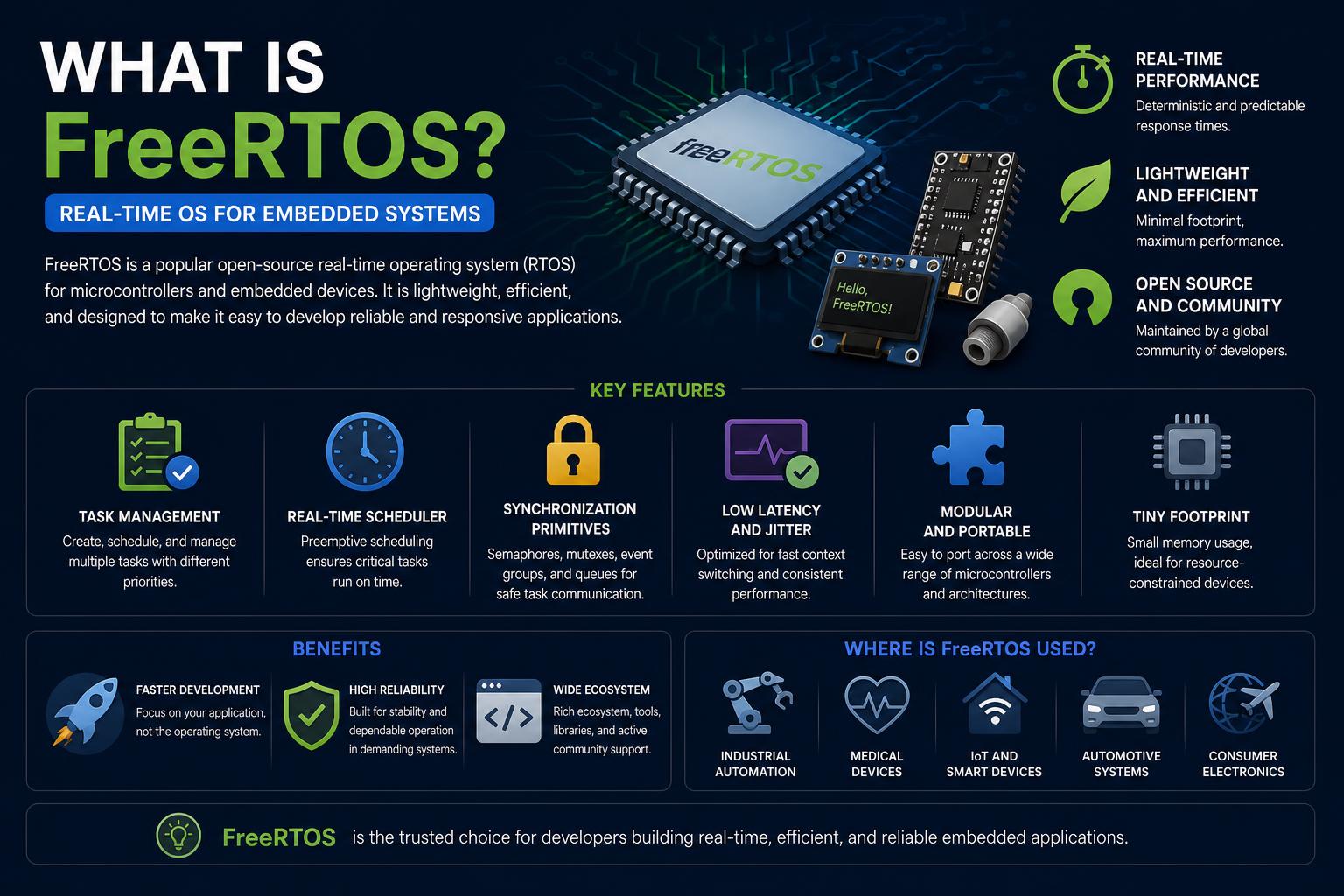
- FreeRTOS stands out as a lightweight, open-source real-time operating system (RTOS) tailored for embedded devices and microcontrollers.
- Its design prioritizes reliability, simplicity, and flexibility, supporting a wide array of architectures and industries.
- Developed over more than 15 years with major chip manufacturers, FreeRTOS is backed by extensive documentation and robust community support.
When it comes to making microcontrollers and embedded devices smarter, more responsive, and reliable, FreeRTOS often leads the conversation. This powerful and adaptable real-time operating system (RTOS) has become the go-to choice for engineers and developers seeking to squeeze maximum performance out of their hardware, from hobbyists tinkering in a garage to professionals building groundbreaking commercial products.
If you’ve ever wondered what makes FreeRTOS so highly regarded in the embedded systems world, you’re certainly not alone. Its combination of broad hardware support, a proven track record, and community-driven development has led to millions of downloads and countless real-world applications. In this article, you’ll discover exactly what FreeRTOS is, how it works, why it matters, and what sets it apart from other RTOS options out there.
Understanding FreeRTOS: A Real-Time Microkernel for Embedded Devices
At its core, FreeRTOS is a lightweight, open-source real-time operating system kernel designed specifically for microcontrollers and small microprocessors. Distributed under the permissive MIT license, FreeRTOS offers a compact, fast, and reliable kernel that can be used freely for both commercial and personal projects. Its minimal footprint makes it ideal for even the most resource-constrained environments.
FreeRTOS provides key features such as multitasking, task prioritization, scheduling, and inter-task communication — all with a focus on deterministic, real-time behavior. “Real-time” here means tasks and processes can be managed to respond within predictable time constraints, which is critical for many embedded systems, from automotive control units to IoT sensors. With FreeRTOS, you have granular control over how and when your application responds to events, making it suitable for everything from simple gadgets to complex, safety-critical devices.
History and Stewardship: From Richard Barry to AWS
The story of FreeRTOS begins in 2003, when it was created by Richard Barry and initially managed by Real Time Engineers Ltd. Over time, the project grew rapidly, with contributions and adoption by companies worldwide. In 2017, FreeRTOS entered a new era when stewardship of the project was passed to Amazon Web Services (AWS). Richard Barry continues to lead the project’s technical direction as part of the AWS team, ensuring both the kernel and the community continue to thrive.
This partnership with AWS has expanded FreeRTOS’s capabilities, especially in the realms of connectivity, security, and cloud integration, while maintaining its open ethos and accessibility for everyone. The codebase now benefits from corporate stewardship, regular security reviews, and an even broader ecosystem of contributors and hardware partners.
Why Choose FreeRTOS for Embedded Systems?
FreeRTOS’s popularity isn’t by coincidence — it delivers a unique balance of size, performance, and flexibility. Here are some reasons why it stands out as a leading RTOS in the embedded space:
- Compact and Fast: FreeRTOS has a small memory footprint and is optimized for low overhead and high speed, making it suitable for devices with tight RAM and CPU constraints.
- Broad Hardware Support: It’s been ported to more than 40 microcontroller architectures spanning ARM (Cortex-M, Cortex-A), Atmel AVR, Espressif (ESP32, ESP8266), RISC-V, MicroBlaze, Nios II, and many more. Find the full list on the official FreeRTOS website.
- Open Source with a Business-Friendly License: The MIT license gives you freedom to use, modify, and distribute FreeRTOS without legal headaches, even in closed-source commercial products.
- Reliability and Maturity: Over 15 years of active development and millions of deployments have made FreeRTOS a trusted kernel in both hobbyist and industrial-grade applications.
- Community and Documentation: Access to robust documentation, books, and an active community makes learning and adopting FreeRTOS far easier for newcomers and professionals alike.
Inside FreeRTOS: Features, Design, and Implementation
Let’s take a closer look at what FreeRTOS brings to the table:
- Multitasking and Scheduling: FreeRTOS enables multiple tasks (threads) to run concurrently, each with its own stack. The kernel uses a scheduler to decide which task should run based on priority and round-robin time-slicing.
- Task Priorities: Each task can be assigned a priority, ensuring that critical work gets CPU time to meet real-time constraints.
- Preemptive and Cooperative Multitasking: FreeRTOS offers the flexibility to configure the scheduler as either preemptive (higher-priority tasks interrupt lower-priority tasks) or cooperative (tasks yield control voluntarily).
- Synchronization Mechanisms: The kernel provides mutexes, semaphores, and software timers for safe communication and resource sharing between tasks, which are fundamental for building robust applications.
- Memory Management Schemes: FreeRTOS supports both static and dynamic memory allocation, offering five different schemes ranging from ‘allocate only’ to more complex schemes that support memory coalescence and thread-safe allocations. This allows you to tune memory usage for your specific device’s needs.
- Tickless Idle Mode: For ultra-low power applications, FreeRTOS can operate in tickless mode, minimizing processor wakeups and extending battery life in portable devices.
- Coroutines: These are lightweight tasks with limited stack usage, which are suitable for applications where conserving memory is paramount.
While FreeRTOS isn’t meant to replace a full-fledged operating system like Linux or Windows—lacking advanced features like device drivers and user accounts—its focus on simplicity and efficiency means it’s ideally suited for dedicated embedded applications. In many ways, FreeRTOS can be thought of as a threaded library, giving you just enough structure to build reliable and maintainable firmware without the bloat.
Development Workflow: Getting Started With FreeRTOS
One of FreeRTOS’s strengths is its accessibility and clear onboarding process. The code is developed in plain C (with minimal assembly for context switching), making it portable and easy to understand. Here’s a broad overview of the typical workflow to get started:
- Download the FreeRTOS Kernel: Visit the to grab the latest source code and Long Term Support (LTS) releases. These packages are regularly updated by AWS and the community.
- Select a Qualified Hardware Platform: FreeRTOS provides ready-to-use demos, sample applications, and BSPs (Board Support Packages) for a vast range of “qualified” hardware. You can check the full list of supported hardware and qualified devices on the and the AWS Partner Device Catalog.
- Access Extensive Documentation: The official documentation includes a user guide, porting guide, and qualification guide, all available for free. Contribution to the documentation is encouraged, and the docs are published under Creative Commons for maximum accessibility at FreeRTOS Docs GitHub.
- Join the Community and Contribute: As an open-source project, FreeRTOS welcomes contributions and issue reporting on its GitHub repository, helping to improve and expand its ecosystem.
Advanced Libraries: Connectivity, Security & OTA Updates
Modern embedded applications often require functionalities beyond the kernel itself. That’s why FreeRTOS provides a growing set of additional libraries that address:
- Connectivity: Libraries to connect securely and reliably to the cloud or other devices.
- Security: Implementing secure communication and storage is made easier with integrated security features.
- Over-the-Air (OTA) Updates: Ensuring devices can remain up-to-date and secure throughout their lifecycle.
These libraries are especially valuable for IoT applications, enabling seamless integration with AWS IoT and other cloud solutions.
Community and Book Resources
Beyond the code itself, FreeRTOS is supported by a wealth of resources:
- Books and Reference Manuals: Access in-depth books and guides that walk you through everything from basic RTOS theory to advanced kernel configuration and debugging.
- Online Tutorials and Demos: The FreeRTOS project site hosts a wide variety of demonstration projects for supported MCU families, helping you accelerate your learning curve.
- Active Forums and Issue Trackers: Although some forums like Reddit provide lively discussions and community feedback, the primary resources are still the main FreeRTOS site, GitHub, and documentation portals.
Industry Use Cases for FreeRTOS
With its broad feature set, FreeRTOS is used in almost every industry where embedded or real-time systems are deployed. Some common use cases include:
- Automotive: FreeRTOS helps simplify the development of automotive widgets, controllers, and infotainment systems requiring quick real-time responsiveness.
- IoT Devices: From smart home gadgets to industrial sensors, FreeRTOS is often the backbone for reliable, connected devices.
- Industrial Control: Machinery and robotics rely on FreeRTOS to ensure operation sequences happen right on schedule, every time.
- Consumer Electronics: Wearables, gaming hardware, and more leverage its scheduling and power-saving features to maximize battery life and performance.
Developers often debate when to use FreeRTOS versus “bare metal” programming or lighter approaches like hardware ISRs and timers. While FreeRTOS introduces some complexity (such as dynamic memory management and multithreading challenges), it dramatically enhances maintainability, scalability, and real-time responsiveness—especially in projects that grow beyond a handful of timed loops or require multitasking sophistication.
Potential Downsides and Developer Perspectives
No tool is perfect, and FreeRTOS is no exception. Feedback from the developer community highlights several challenges to consider:
- Increased Complexity: Introducing an RTOS means more moving parts compared to bare-metal approaches, and requires disciplined software design.
- Memory Constraints: Each task requires its own stack, which can increase RAM demands unexpectedly—an important consideration on small MCUs.
- Dynamic Allocation Pitfalls: Although flexible, dynamic memory allocation may pose risks in tightly limited environments; developers must carefully manage heap configurations.
- Debugging can be trickier: Multithreaded problems, preemption, and task switching can complicate debugging, especially if real-time bugs or RTOS “black magic” preemption catches debuggers off guard.
- Not Always Needed: For very small or highly deterministic applications, sometimes simpler approaches—like hardware timers, ISRs, and superloops—might be preferable.
Despite these caveats, FreeRTOS often makes complex systems manageable, opening the door for more sophisticated applications and long-term maintainability.
Related Projects: Derivatives & Commercial Variants
The FreeRTOS kernel has spawned several important derivatives to address safety and commercial needs:
- SAFERTOS: Developed in parallel with FreeRTOS, SAFERTOS is tailored for safety-critical systems, built to meet stringent certification requirements (IEC 61508 SIL3). Though similar in API and algorithms, it follows a rigorous development lifecycle and can reside in ROM for certification compliance. More info: SAFERTOS.
- OPENRTOS: Provides a commercially licensed version of FreeRTOS, supported by Wittenstein High Integrity Systems. This allows companies to secure commercial terms outside the MIT license if needed. See details on the OPENRTOS website.
- Amazon FreeRTOS (deprecated): AWS has provided a specialized version focused on IoT cloud integration, though core development has unified under standard FreeRTOS releases.
Exploring Supported Architectures and MCUs
FreeRTOS’s astounding adaptability is evident in its extensive hardware support. Platforms include:
- ARM: ARM7, ARM9, Cortex-M3/M4/M7/M23/M33/A/R4
- Atmel AVR, AVR32, SAM series
- Cortus APS1, APS3, APS5, FPS6, FPS8
- Espressif (ESP32, ESP8266)
- MicroBlaze, Nios II, IBM PowerPC
- RISC-V (including SHAKTI and PULP variants)
- Renesas (H8/S, RX, SuperH, V850, RL78)
- Microchip PIC (18, 24, 32), dsPIC, SAM
- STMicroelectronics (STM32, STR7)
- Texas Instruments (MSP430, TMS570, C2000), and many others
Ready-made demo apps and port files massively accelerate getting started on these MCUs, and documentation is available for each port.
Support, Documentation, and Community Contributions
Enjoying the benefits of FreeRTOS is not a solo journey — the project provides:
- Dedicated Community: From forums to GitHub, support is always within reach.
- Extensive Documentation: Whether you need a beginner’s overview or a detailed kernel deep dive, guides are maintained and openly available.
- Contribution Opportunities: Both code and documentation are open for contributions, reflecting a collaborative spirit that fuels fast innovation and knowledge-sharing.
Where to Download and How to Get Started
FreeRTOS is truly open-access. To get a feel for the kernel or start a production project, here’s what you need to do:
- or clone from .
- Explore supported MCUs and qualified hardware on the .
- Join the ongoing conversation and development by following project updates, contributing issues, or submitting documentation enhancements.
As you can see, FreeRTOS isn’t just a kernel, but a launching pad for innovative embedded development across every sector. With open access, thorough documentation, rich community support, and continuous improvement, it empowers both new and experienced developers to architect reliable, maintainable, and future-proof systems. Whether you’re building a one-off experiment or a globally shipped IoT device, mastering FreeRTOS gives you the tools and support to bring your vision to life with confidence.
[relacionado url=”https://www.ikkaro.net/what-is-simulink/”]