
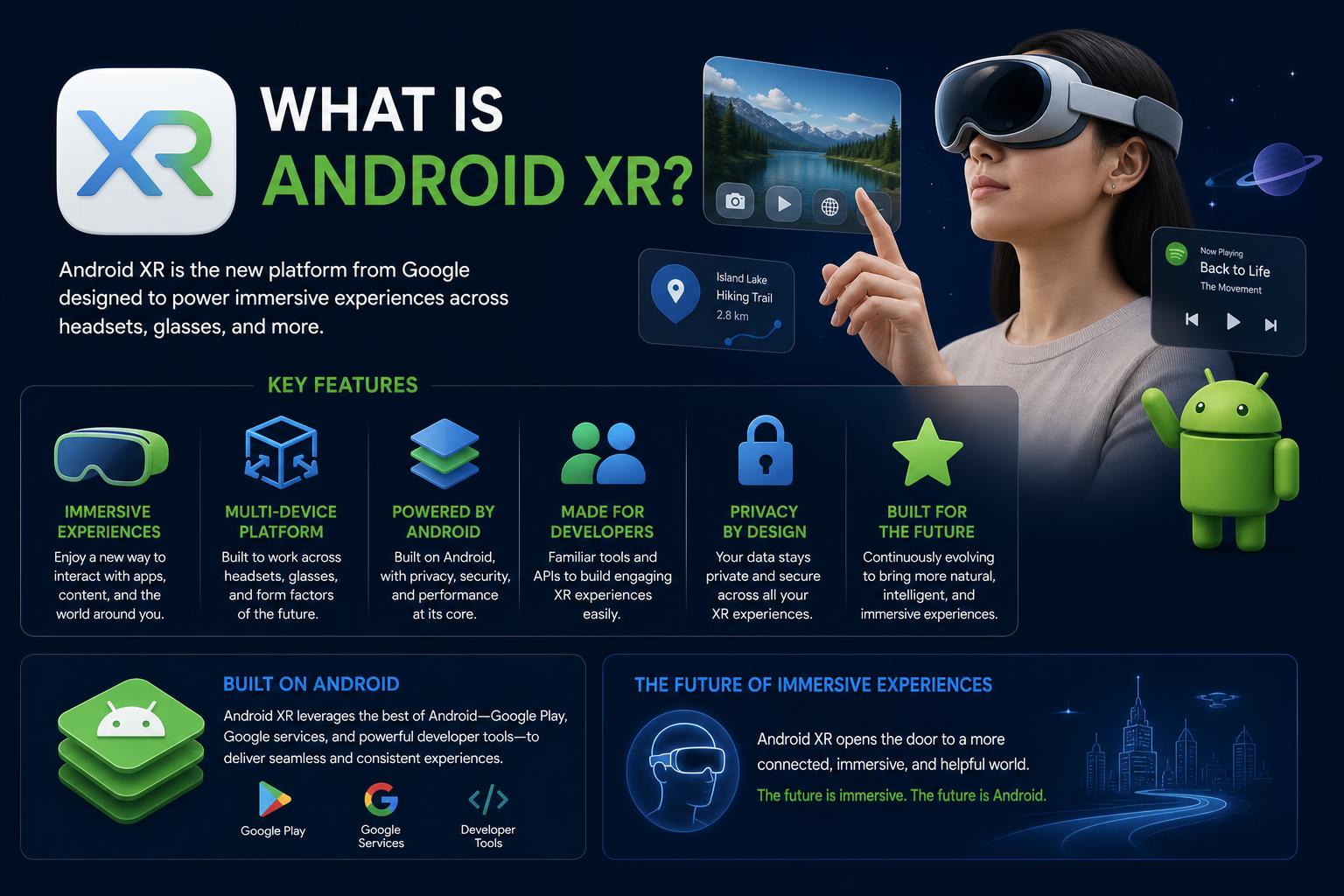
- Android XR is Google's expansive new open platform for immersive experiences, integrating AR, VR, and powerful AI.
- It supports a diverse hardware ecosystem: from flagship headsets like Galaxy XR to lightweight smartglasses and everyday audio wearables.
- Gemini AI is deeply embedded in the platform, powering context-aware assistance, gesture control, and seamless interaction with apps in XR environments.
Android XR (Extended Reality) represents a new chapter in Google’s long and winding journey through the worlds of augmented reality (AR), virtual reality (VR), and mixed reality (MR). In an era where immersive experiences are becoming part of everyday life, Android XR aims to seamlessly bridge the digital and physical using advanced AI, open standards, and highly portable hardware. With the upcoming wave of smart glasses and headsets, Android XR sets out to redefine how we interact with technology, apps, and even the very environment around us.
For anyone curious about what Android XR is, how it grew out of Google’s previous AR/VR projects, and what makes it stand out from the competition, this article explores everything from the technology’s background and hardware to software features, user experiences, and future potential in the rapidly evolving extended reality space. Regardless of whether you’re a developer, a tech enthusiast, or just XR-curious, prepare to be immersed in a world where smart devices, spatial computing, and powerful AI combine to create possibilities we could barely imagine a few years ago.
Understanding Android XR: The Evolution of Google’s Immersive Technology
Android XR emerges as Google’s boldest move yet to establish a robust, AI-driven platform dedicated to extended reality experiences. The system is designed to work across a spectrum of devices—including standalone headsets and lightweight glasses—delivering both immersive virtual environments and digital overlays that enhance real-world perception.
But the roots of Android XR go back much further than its 2024/2025 launch. Google’s early ventures into smartglasses began over a decade earlier with Google Glass in 2013. Despite the initial hype, Glass faced criticism over privacy and practicality, leading Google to refocus on enterprise use before eventually discontinuing its mass-market ambitions.
Google didn’t leave the AR/VR race, though. The company repeatedly explored new directions—acquiring hardware startups like North (known for innovative smartglasses), investing in R&D for AR devices, and launching platforms like Daydream and Cardboard (which targeted smartphone-powered VR experiences). Yet, despite flashes of progress, no single product transformed the everyday tech landscape until the vision for Android XR began to take shape.
The Road to Android XR: From Project Iris to XR-Ready Hardware
Much of Google’s renewed focus on XR intensified in the early 2020s, driven by industry competition and the realization that powerful, always-with-you immersive devices were on the horizon. Internally, Google launched initiatives like Project Iris (an ambitious AR headset project led by Clay Bavor), followed by acquisitions such as Raxium (a microLED display startup) to strengthen its hardware expertise.
The rapid rise of competitors like Apple’s Vision Pro, Meta’s Quest platform, and Samsung’s own XR devices put pressure on Google to accelerate development and prioritize openness and AI integration. By 2023-2024, following internal reorganizations and strategic partnerships (including close collaboration with Samsung and Qualcomm), Android XR was positioned as an open alternative to Apple’s closed ecosystem, aiming to empower a broad ecosystem of manufacturers and developers.
By December 2024, Android XR was officially unveiled as a new operating system within Google’s platform lineup, promising full-scale support for both VR and AR hardware, all deeply integrated with Google’s Gemini AI and the robust services of the Play Store.
What is Android XR Exactly?
Android XR is more than just another flavor of Android—it’s a dedicated operating system and platform tailored specifically for immersive devices, including headsets, smartglasses, and mixed reality products. The platform enables both fully immersive virtual experiences (like VR gaming and media consumption) and contextual AR overlays (that blend digital content with the physical world through smartglasses).
Core Features of Android XR:
- Integration with Gemini AI assistant—powering natural language interactions, real-time information retrieval, and proactive digital assistance, all within immersive environments.
- Rich support for Play Store apps—millions of Android apps, from productivity to streaming media and games, become available in new XR formats or through reimagined interfaces.
- Compatibility with industry standards—such as OpenXR, WebXR, and Unity—ensuring developers can bring existing and new immersive content to the platform easily.
- Flexible user input—from voice commands and gesture control (thanks to integrated cameras and spatial sensors) to eye tracking and touchpad-based navigation.
- Modular hardware support—for everything from lightweight, everyday audio-only glasses to dual-screen spatial computing smartglasses and full VR headsets.
Android XR Hardware: Headsets, Glasses, and Controllers
The first wave of Android XR devices showcases a diverse ecosystem of hardware, all aiming to maximize comfort, mobility, and immersive potential.
Galaxy XR: The Flagship Headset
Samsung’s Galaxy XR, arriving in 2025, serves as the inaugural showcase for Android XR as a full-fledged headset platform. It offers users what can be described as an ‘infinite screen’, blending total immersion with the ability to remain present in the physical environment. You can easily switch between a virtual universe (for apps, games, and entertainment) and real-world awareness, all managed by hands, eyes, or voice.
The Galaxy XR features deep integration with Gemini AI, letting users call up information, control apps, or perform tasks just with natural language—essentially having a virtual assistant always by your side, aware of what you’re seeing or doing. This device emphasizes openness: with Play Store access, users can enjoy Google’s reimagined apps (Maps, Photos, YouTube, Google TV, Chrome, and Meet) as well as millions of existing mobile and tablet apps, all optimized for the new reality.
Xreal Aura: Glasses for the Everyday
For those who find full headsets cumbersome, the Xreal Aura smartglasses—which also run Android XR—offer a lighter, more discreet alternative. The hardware consists of a pair of dual-screen glasses connected via USB-C to a compact, phone-sized controller. Onboard controls live on the glasses’ arms, while built-in cameras enable advanced gesture recognition and spatial awareness.
Early experiences with the Aura suggest a genuine leap forward: users can enjoy immersive interactions, pin apps in a 3D space, use hand gestures for input, and talk to Gemini for help or information—without being cut off from the real world. You can use the glasses as an external display for a laptop or console, while Gemini can analyze and interact with whatever you’re seeing, making these smartglasses both a productivity tool and a window into context-aware spatial computing.
Other Smartglasses and Everyday Options
Android XR isn’t just about high-end hardware—Google’s vision includes a range of form factors, such as simple audio-only glasses for on-the-go assistance and communication. These everyday wearables prioritize battery life, discretion, and convenient access to Gemini voice features, catering to users who want digital help without any visible display.
Gemini AI: The Heart of Android XR
One of the most exciting and distinctive aspects of Android XR lies in its tight integration with Gemini, Google’s generative AI platform. Gemini powers everything from context-aware assistance and conversational controls to natural language search and on-device intelligence.
Examples of Gemini in action on Android XR devices:
- Indications and directions: Instantly receive step-by-step navigation in your field of view, without needing your phone in hand.
- Live translation: Get real-time translation of conversations or signs, with spoken or visual feedback.
- Message summaries: Gemini can summarize your latest messages and notifications, making sure you stay on top of your communications while staying heads-up.
- Circle to Search in the real world: Use gaze or hand gestures to identify and get more information about objects around you—just ‘circle’ what you want to know more about, and Gemini provides answers.
- Task automation: Launch apps, move windows in XR space, switch contexts, or control compatible smart devices with simple voice commands.
- Real-world object recognition: Scan items around you to retrieve details, such as chemical components, historical facts, or shopping information—turning your glasses into a portable, always-on encyclopedia.
All of this is designed to make Android XR feel like an intuitive, natural extension of your senses, with Gemini acting as a proactive assistant that understands context, visual cues, and your intentions.
How Android XR Differs from the Competition
While Apple’s visionOS (which powers Vision Pro) and Meta’s Horizon OS are also making big moves in the XR market, Android XR carves out a unique niche with several key advantages:
- Open ecosystem: Rather than enforcing a ‘walled garden’, Android XR supports a variety of hardware partners (like Samsung, Google, Xreal, and potentially Sony), integrating with standard development tools and protocols.
- Immediate app support: With Play Store access, users and developers benefit from a massive, established catalog of apps, drastically reducing the friction seen when launching a new platform.
- Developer friendliness: Tools like Unity, OpenXR, and WebXR mean it’s easier for studios to bring new and existing content (games, immersive apps, utilities) to the XR ecosystem.
- Gemini as a core component: Rather than treating AI as an added feature, Gemini’s brain power is deeply baked into the platform—offering a sci-fi-like experience, reminiscent of pop culture AI assistants like Marvel’s J.A.R.V.I.S.
This flexible approach is intended to drive rapid innovation, reach a larger audience, and inspire creative XR solutions not just for gaming and entertainment but for productivity, education, and everyday life.
Experiencing Android XR: Control, Interaction, and Everyday Use
Interaction on Android XR is designed to be as natural as possible, whether you’re using a headset or a lightweight pair of glasses. Here’s how users interact with the system:
- Gesture input: Smartglasses use onboard cameras to recognize hand gestures—such as pinching, dragging, or pointing in the air—enabling app navigation, text typing, and window management with minimal physical touch.
- Touchpad controllers: For precision, many XR devices (such as Xreal Aura) offer compact controllers with touch-sensitive surfaces, letting you swipe and select just as you would on a mobile screen.
- Voice and conversational AI: Tapping a button on the glasses or headset invokes Gemini, which can launch apps, search, summarize content, move windows, and more—all through spoken language.
- Eye tracking and gaze detection: Advanced hardware can monitor where you look, providing additional seamless options for highlighting and selecting digital content.
One impressive trick: the smooth handoff between digital immersion and awareness of the physical world. Some devices include lenses or systems that automatically darken or lighten depending on your gaze, helping you stay engaged in an app or quickly refocus on the people or objects around you. This dual focus minimizes the disconnect so common with traditional VR headsets and supports day-to-day wear.
Use Cases: Beyond Entertainment
Android XR isn’t limited to gaming or passive entertainment—though it certainly excels there. The ecosystem is gearing up to support a wildly diverse range of applications:
- Cinema and media streaming: Affordable Android XR headsets in development (possibly by Sony and others) could make ‘virtual movie theaters’ a daily reality, supporting services like Netflix, Disney+, Google TV, and more—straight out of the box, thanks to direct Play Store access.
- Immersive productivity: Apps like Google Maps have been reimagined for XR, allowing users to ‘walk through’ 3D cityscapes, enter Street View in full immersion, or drop pins in the real world. Google Meet, Chrome, YouTube, and Photos now support XR-specific experiences and spatial interactions.
- Education and creative tools: Companies like Adobe are bringing new creative workflows to XR, while science and learning experiences (like seeing molecular structures or planet models in your living room) are made possible via augmented overlays.
- Health and wellness: Meditation and relaxation apps like Calm, immersive fitness sessions, and sports viewing through XR-optimized interfaces broaden the use cases far beyond play.
- Cross-device interaction: Some hardware allows the smartglasses to function as ultra-portable external displays for laptops, consoles, or Android devices—with everything you see available for Gemini’s assistance and analysis.
The Android XR platform thus stands out as both a playground for entertainment and a toolkit for real-life problem-solving, context-aware learning, and creative work.
Developer Ecosystem: Building for Android XR
Developers interested in the XR ecosystem will find Android XR a particularly attractive platform because of its commitment to open standards and toolsets. The operating system supports:
- OpenXR and WebXR: These protocols make it easier to develop, port, and deploy immersive experiences across a range of hardware with minimal friction.
- Unity and Unreal Engine: Popular game engines are supported, accelerating the creation of visually rich XR apps and games by leveraging tools that studios already know and love.
- Play Store integration: Developers can distribute and monetize their XR apps alongside mobile and tablet offerings, with cross-compatibility where appropriate.
- Expanded access to Google’s AI stack: Gemini integration means apps can leverage advanced AI features for personalization, proactive suggestions, natural language understanding, and automation.
This approach dramatically speeds up the XR content pipeline, ensuring that users will have access to a constantly growing ecosystem of immersive tools, entertainment, and everyday apps.
Open Platform vs. Closed Gardens: Android XR’s Competitive Edge
Unlike some competing XR solutions, Android XR places major emphasis on openness and interoperability. Google and its partners hope that by minimizing walled gardens, the platform will attract not only hardware manufacturers (like Samsung, Xreal, Sony and others) but also a wider range of developers and content creators who crave flexibility.
This philosophy stands in contrast to Apple’s approach with visionOS and the Vision Pro—which, although powerful, enforces strict ecosystems and tight control over third-party apps and hardware. With Android XR, users and developers alike are invited to help shape the extended reality future, driving faster adoption and innovation.
The Future: What’s Next for Android XR?
Looking ahead, Android XR seems poised to spur an explosion of new hardware and software. Telegrams from industry insiders suggest major brands (such as Sony) are considering affordable $100 XR headsets, potentially making XR experiences as mainstream as smartphones. Existing services are being adapted for spatial reality, and future updates from Google are expected to further reduce battery consumption and hardware bulk, opening the door to all-day, always-on wearable computing.
The role of Gemini AI is only set to increase. As generative AI becomes more capable at understanding context and user intentions, XR devices may fulfill the sci-fi promise of an ‘intelligent agent’ that augments memory, improves safety, enhances navigation, supports creativity, and helps manage every aspect of daily life.
Industry partnerships are central to this dream. Collaborations with Samsung, Qualcomm, and others will ensure that both the software and hardware around Android XR continue to improve. And as new versions of the Play Store, Google apps, and external services launch with XR-optimized experiences, users can expect richer entertainment, greater convenience, and unprecedented ways to interact with technology and their surroundings.
Android XR is setting the stage for an era where immersive technology, open collaboration, and intelligent assistance are fundamentally entwined. Whether you’re looking to stream movies in a new way, boost your productivity, explore new creative workflows, or simply interact seamlessly with AI and the environment, Android XR is rapidly becoming the platform to watch.