
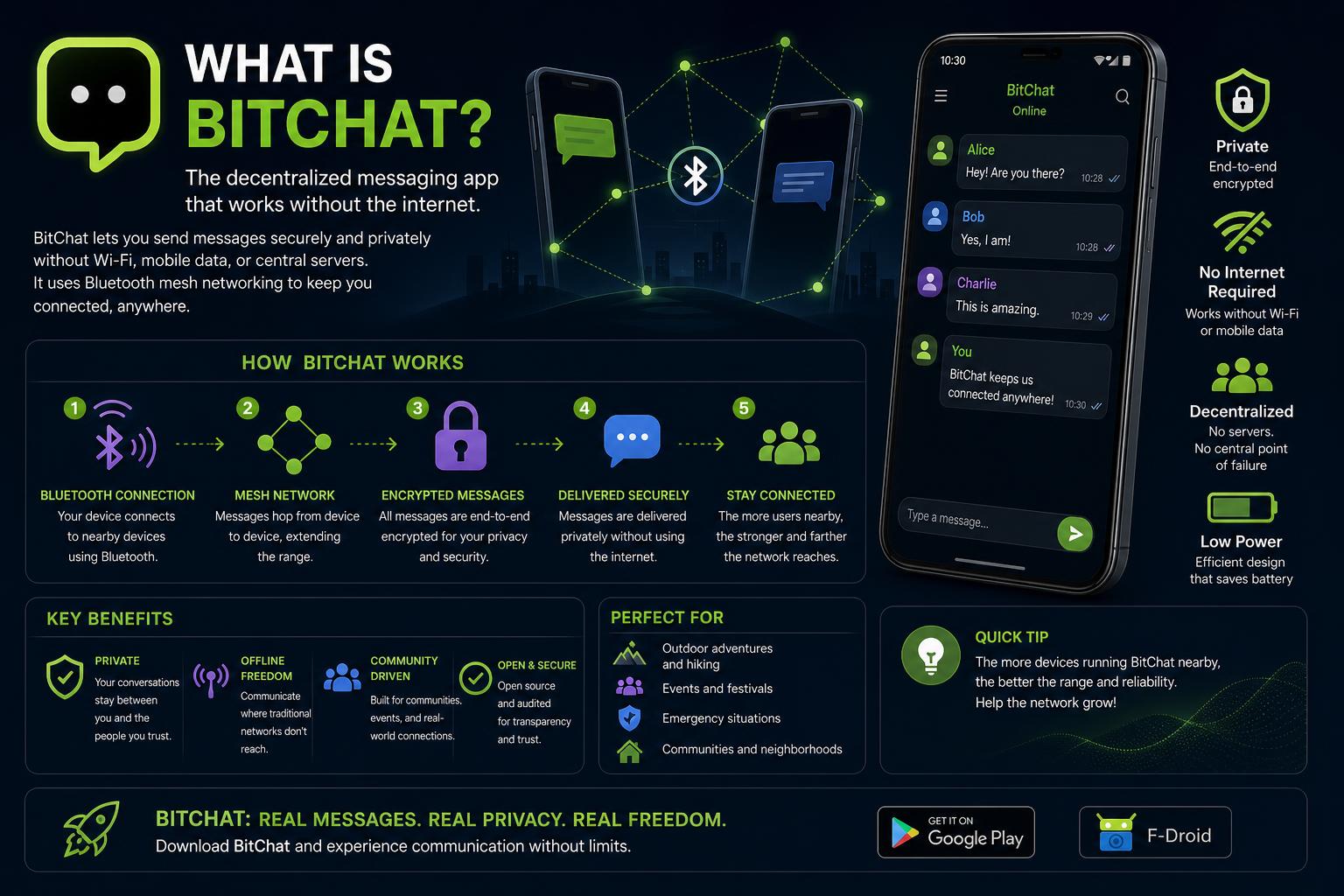
- BitChat enables communication without internet, using Bluetooth mesh networks.
- Messages are end-to-end encrypted, with no accounts or central servers involved.
- The app is open-source, privacy-focused, and adapted for both local and global use.
Instant messaging has long been dominated by big names like WhatsApp, Signal, and Telegram – but a new challenger, BitChat, has started generating real buzz for its unique approach to private, offline communication. If you’ve heard about this new app or caught glimpses of headlines referencing its role in global events and protests, you’re probably wondering what all the fuss is about. Let’s break down what BitChat really is, how it’s redefining messaging, and why it’s shaking up the landscape of secure, decentralized communication tools.
Backed by Twitter co-founder Jack Dorsey and a passionate open-source developer community, BitChat emerges at the intersection of privacy, resilience, and connectivity. It’s not just another WhatsApp rival boasting end-to-end encryption – BitChat is designed from the ground up to function even when the internet is unavailable or restricted, leveraging Bluetooth mesh networking and modern protocols to keep people connected, no matter the obstacles. But there’s much more to the story than just ‘texting without the internet.’
What Exactly Is BitChat?
BitChat is a peer-to-peer (P2P) encrypted messaging application that allows users to send messages over Bluetooth mesh networks – no central servers, SIM cards, or Wi-Fi required. Conceived by Doris Lima and developed by Jack Dorsey, Taksh Kothari, Calle, and Block, Inc., BitChat represents a new generation of messenger focused on decentralization, censorship resistance, and infrastructure independence.
The basic idea is simple but powerful: BitChat connects nearby devices directly using Bluetooth Low Energy (BLE), enabling text exchanges to hop between multiple users even when cellular or Wi-Fi networks are down or intentionally blocked. Each device acts as both a client and a relay node, so messages can leapfrog from phone to phone, potentially covering surprising distances when many users are nearby.
But BitChat isn’t only about Bluetooth; it also supports the internet-driven Nostr protocol when connectivity exists, unlocking global reach and expanding communication far beyond the local mesh. This hybrid model ensures that whether you’re at a crowded festival, caught in a natural disaster, experiencing an internet outage, or simply want maximum privacy, BitChat adapts to your needs.
How Does BitChat Work?
Traditional messaging services depend on centralized servers that can be monitored, compromised, or turned off at a moment’s notice. BitChat flips that model on its head. There’s no need to register with a phone number, email, or any ID – just install the app from the App Store or Google Play (or install the APK directly), and you’re in.
- Bluetooth mesh networking: This technology allows your device to form an ad-hoc network with others in range, automatically discovering and relaying texts between users. Messages hop through as many phones as necessary to reach their destination.
- Global communication with Nostr: If the internet is available, BitChat can use the decentralized Nostr protocol to link users worldwide and enable location-based channels – these allow micro-communities to emerge within cities, neighborhoods, or even global interest groups.
No registration, phone numbers, or tracking: BitChat does not ask for or store your personal data, making it inherently privacy-friendly. There’s no server logging your messages, contacts, or activity.
Instead of the usual contact list tied to your address book, users appear in your BitChat interface dynamically as they come into mesh range or join your current location channel. When you launch the app, you’ll see a number representing how many peers are currently connected to your mesh. Tap it to view or privately message specific users. Think IRC-style group chats with a twist – everything is ephemeral and local, unless you connect with Nostr online.
Key Features That Make BitChat Unique
- Offline messaging without infrastructure: Communicate even during internet disruptions, natural disasters, or in remote regions.
- Ad-hoc channels for communities: Join mesh or location-based chats with anyone nearby, or leave notes at a physical spot for others to find.
- No accounts, no passwords: Just open and start chatting securely.
- Open-source code: All software is available for public review on GitHub (for iOS/macOS) and Android, encouraging transparency and collaboration.
- Cross-platform support: BitChat runs on iOS 16+, macOS 13+, and Android 8+ devices, all with compatible protocols.
How Is BitChat Being Used?
The timing of BitChat’s release – and its privacy-oriented, decentralized structure – turned it into much more than a hobby project. In 2025 and 2026, BitChat saw mass adoption by protestors and activists in various countries, particularly where authorities limited internet access to control dissent. Notably, BitChat became a communication lifeline during:
- Protests in Madagascar and Nepal: Tens of thousands downloaded the app in days to circumvent network shutdowns and stay connected on the ground.
- Widespread blackouts in Uganda and Iran: When mobile data and Wi-Fi were cut by authorities, BitChat’s Bluetooth mesh kept lines of communication open locally.
- Music festivals and large events: Even far from political unrest, users find BitChat handy for private, local exchange in busy, congested areas where network coverage might be overwhelmed.
BitChat’s design specifically defends against censorship, surveillance, and communication breakdowns caused by centralized outages. By distributing the relay of messages across all users’ phones, there’s no ‘off switch’ or single point of failure for authorities or hackers to target. The network grows in power with each new participant, making BitChat an especially resilient grassroots tool for digital self-defense and real-world utility alike.
Messaging Experience: What’s It Like to Use BitChat?
BitChat favors simplicity and minimalism over fancy extras. The app launches straight into the main chat – no onboarding, no phone number verification, and no tedious setup screens. When others are present in your mesh network, you can post group messages visible to everyone, or tap a name to open private conversations.
The interface is basic but practical:
- Connected users sidebar: Tap the number on your main screen to open a dynamic list of peers currently in range.
- Private messages and group chat: You can send direct texts or broadcast to the group (everyone on the mesh sees it).
- Fun micro-interactions: ‘Hug’ or ‘slap’ another user – these are lighthearted nods to classic chatroom culture and show up as chat events, rather than serving any real function.
- Transparency: When someone takes a screenshot, everyone in the group is notified – ideal for privacy-conscious conversations.
There’s no media sharing (yet), stickers, or elaborate emoji packs; BitChat is about robust, no-frills connectivity when it matters most.
Technical Deep Dive: How BitChat Secures Your Messages
Privacy and security are recurring themes, and BitChat takes them seriously – but with some caveats. The entire codebase is open-source, so developers and security researchers can inspect it for issues or suggest improvements. To protect message contents, BitChat uses the Noise Protocol Framework for end-to-end encryption, meaning only you and your intended recipient(s) can read what’s exchanged.
Security Highlights:
- End-to-end encryption by default – All direct messages, whether relayed by Bluetooth or Nostr, are shielded from prying eyes.
- No login data or centralized databases to compromise – Even a network breach or device loss doesn’t risk your wider contact list.
- Panic mode – Triple-tap the app logo to wipe all local messages and identifiers, great for sensitive situations.
- Password-protected channels – Restrict access to group chats by sharing a key with trusted peers only.
However, the developers (including Dorsey himself) repeatedly warn: BitChat is under active development and has not had a formal, third-party security audit. Notably, after launch, a researcher pointed out potential authentication weaknesses, prompting a rapid response and the integration of the Noise protocol. Until rigorous external review is complete, the team explicitly advises against relying on BitChat for mission-critical security needs, like transmitting highly sensitive data. Use it for resilience and convenience, but with an understanding of the possible risks while its security is maturing.
Comparing BitChat to Other Decentralized Messengers
BitChat enters a space already populated by decentralized, privacy-first messengers like Briar, FireChat, and Bridgefy. However, it stands apart due to its combination of Bluetooth mesh, optional Nostr online integration, and a reputation boost from its high-profile backers.
- Briar: Focuses heavily on Tor routing and P2P architecture, targeting activists and journalists under threat.
- FireChat / Bridgefy: Earlier Bluetooth mesh solutions, widely used in Hong Kong protests, but not as actively maintained or as open in their codebase.
- BitChat: Hybrid mesh + internet, modern encryption, rapid open-source development, and a surge in real-world deployments worldwide.
If you’re interested in this area, BitChat’s strong compatibility across mobile platforms, continued updates, and adaptation to unfolding global events make it a rising favorite among decentralized messenger options.
Getting Started with BitChat
BitChat is available for download on multiple platforms:
- iOS / macOS: Install from the App Store. Source and builds on GitHub.
- Android: Find it on Google Play or grab APKs from GitHub directly for cases where censorship blocks app stores.
There’s no sign-up – just install and open. You’ll see live mesh participants or, if you enable Nostr, can join location-based global channels. To stay current or compile from source, follow the open-source repositories linked above.
For more detailed, technical documentation, check the official whitepaper.
BitChat in the News and Censorship Attempts
BitChat’s popularity and impact have led to both acclaim and controversy. The app’s role in anti-censorship movements attracted attention from digital rights groups and governments alike. In India, after a notable surge during the 2026 Jantar Mantar protests, authorities issued takedown orders against the app, removing it from local app stores and attempting to force code repository shutdowns via legal threats. The main argument? BitChat made it nearly impossible for internet blocks to stifle protestor coordination.
Despite these moves, the open-source nature of BitChat means it can still be installed and distributed without central oversight. Developers responded by adding offline APK sharing, enabling installation via Wi-Fi hotspots or Android’s Nearby Share even without app stores. This cat-and-mouse dynamic highlights the unique resilience and adaptability of decentralized technology in the face of real-world pressure.
Practical Tips and Limitations
BitChat is designed for security and resilience, but it’s not flawless and won’t replace fully featured chat apps for everyone. Here are a few things to keep in mind:
- Limited user base and range: Mesh-only communication requires multiple users nearby – in sparsely populated areas or small groups, the network may be limited.
- No multimedia attachments: Currently, BitChat focuses on text messages only – don’t expect photos, videos, or file sharing (yet).
- Battery impact: Bluetooth mesh can consume extra power, particularly in dense or busy environments.
- Security: Open-source and encrypted, but not yet fully audited. Exercise appropriate caution with highly confidential information.
Despite those limitations, the tradeoff is a robust, extensible foundation that prioritizes freedom from centralized control and keeps communication flowing under pressure.
The Future of BitChat
BitChat represents a growing movement toward decentralized communication, privacy empowerment, and resistance to censorship and surveillance. Leveraging open protocols and active community development, BitChat is evolving rapidly and could soon offer expanded features as adoption continues to spread in both emergency situations and everyday scenarios worldwide.
For anyone concerned about privacy, resilience, or simply looking for a modern yet simple chat solution that can survive the harshest network conditions, BitChat’s official site is the place to start. The app’s unique mesh networking and hybrid approach have already proven themselves in dramatic, real-world cases – and as more people adopt it, its power will only continue to grow.
BitChat is proof that when communities need secure, independent ways to communicate, open-source innovations will rise to the challenge. Whether you’re preparing for the next blackout, staying in touch at your local festival, or joining a global encrypted movement, this app offers a new set of tools built for both today’s realities and tomorrow’s possibilities.