
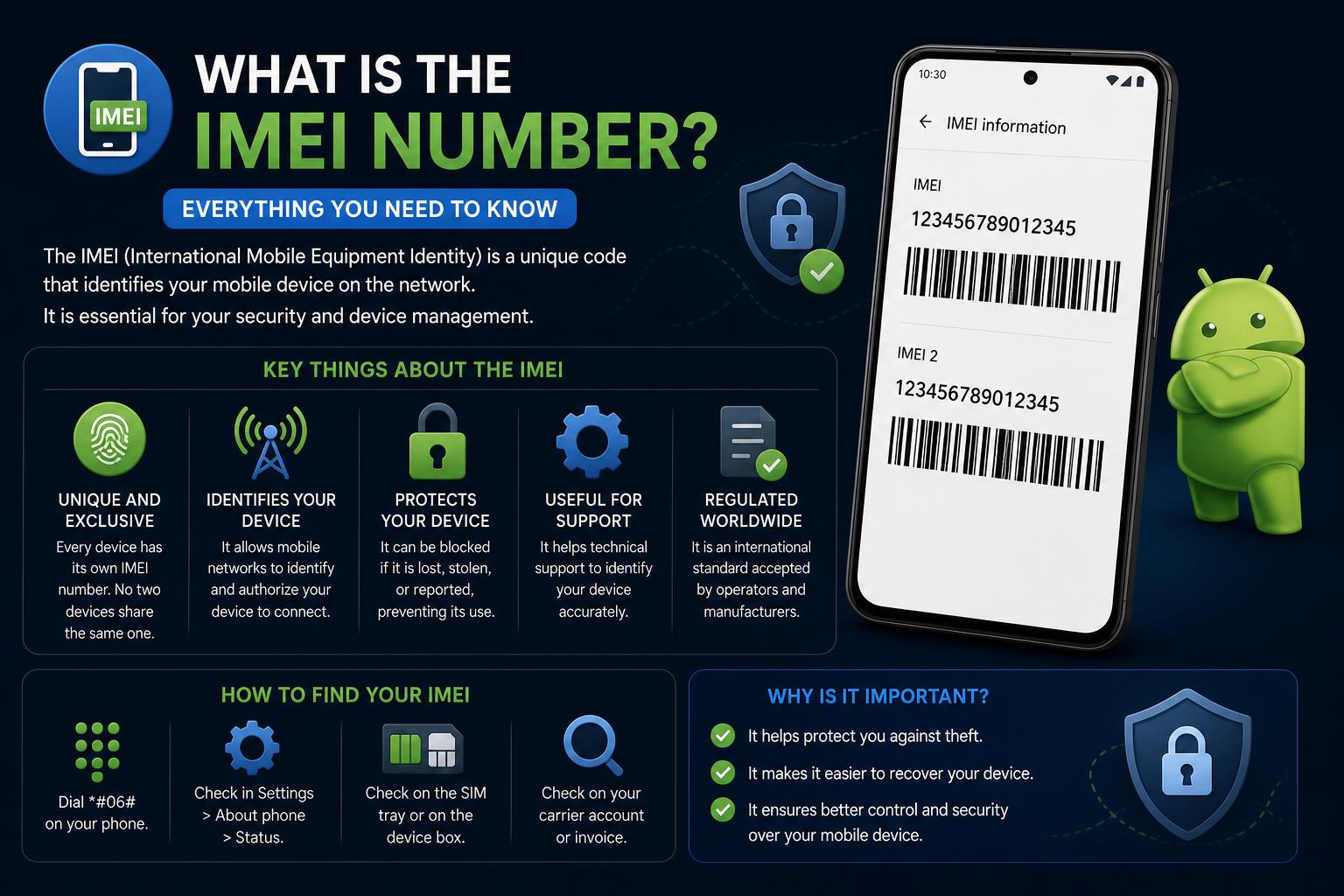
- The IMEI is a unique 15-digit code essential for identifying mobile devices globally.
- It is crucial for security, theft prevention, and network compatibility checks.
- IMEI numbers are different from SIM/card identifiers like IMSI and ICCID.
If you’ve ever needed to unlock your mobile device, buy a used phone, or report a lost or stolen device, you’ve probably stumbled on a mysterious number called the IMEI. But what exactly is this string of digits, and why does everyone from your cellular carrier to global law enforcement agencies care so much about it? The IMEI, or International Mobile Equipment Identity, is the universal fingerprint for mobile devices. It’s much more than just another code; it’s your phone’s passport to the global cellular network and a critical piece of the mobile security puzzle.
In this in-depth guide, we’ll break down everything you need to know about IMEI numbers. We’ll explain what they are, how they work, their structure, why they matter for device security and global policing, the difference between IMEI and other similar codes, and walk you through how to locate your own IMEI using several no-nonsense methods. Whether you’re a tech enthusiast, managing a fleet of IoT devices, or a regular smartphone user trying to keep your device safe, this article has you covered!
What is an IMEI Number?
The International Mobile Equipment Identity—better known as IMEI—is a 15-digit (sometimes 16-digit) unique code assigned to every mobile device that connects to a cellular network. Think of it like your phone’s fingerprint: no two devices have the same IMEI, making it a global tool for identification and validation.
While you might have heard about other codes linked to your mobile device, such as the IMSI (International Mobile Subscriber Identity) or ICCID (Integrated Circuit Card Identifier), those identify the SIM card or subscriber profile. The IMEI specifically tracks the hardware itself, regardless of the SIM. This distinction is crucial, especially when a device changes hands, switches networks, or is lost or stolen.
[relacionado url=”https://www.ikkaro.net/what-is-android-device-manager/”]
Why is the IMEI Number So Important?
IMEI numbers are used by:
- Mobile network operators: to validate, track, and disable devices when necessary.
- Device manufacturers: for support, device recalls, or troubleshooting specific models.
- Law enforcement: to track and recover stolen devices or investigate criminal cases.
- Consumers: to ensure used devices haven’t been blacklisted, are carrier compatible, or to report lost phones.
If a phone’s IMEI is added to a blocklist (more on that later), that device can be rejected by networks worldwide, making it essentially unusable no matter how many new SIM cards get inserted. That’s why the IMEI is such a powerful anti-theft tool, and why it’s protected by law in many regions.
IMEI Number Structure: What Those Digits Mean
On first glance, an IMEI looks like a random string of numbers, but each section of your IMEI number reveals information about your device.
- Standard IMEI: 15 decimal digits containing a Type Allocation Code (TAC), serial number, and a check digit.
- IMEISV: A variation carrying 16 digits, including a Software Version Number (SVN) at the end.
The usual IMEI format is AA-BBBBBB-CCCCCC-D, where:
- AA-BBBBBB: Type Allocation Code (TAC). The first 8 digits specify the device type/model and point to the approval group (the first two digits identify the Regulatory Body).
- CCCCCC: Device-specific serial number.
- D: A check digit used for error-detection, validated via the Luhn algorithm.
Decoding IMEI – Example
Let’s take a sample IMEI: 49-015420-323751-8
- The TAC is 49-015420 – identifies the manufacturer and model.
- The serial number is 323751 – unique to this physical unit.
- The check digit is 8, calculated so the whole number passes the Luhn error-check.
Older IMEIs (before 2003) included a Final Assembly Code (FAC), indicating manufacturing site, but this was phased out as the TAC became 8 digits long.
[relacionado url=”https://www.ikkaro.net/how-to-find-your-android-phone/”]
IMEI, IMSI, and ICCID: What’s the Difference?
This trio of codes often confuses people because they all play a role in mobile connectivity. Here’s a simple way to keep them straight:
- IMEI: Identifies the physical device (your smartphone/tablet’s unique fingerprint).
- IMSI: Identifies the subscriber (the profile on your SIM card that determines your phone number and carrier subscription).
- ICCID: Identifies the SIM card itself (printed on the plastic card or chip inside your phone).
So, swap your SIM card and your IMEI stays the same. Swap your device, and your IMSI and ICCID could move to new hardware. Each has its place in the mobile ecosystem, ensuring proper identification and security at every layer.
What is an IMEI Number Used For?
The versatility of the IMEI number is why it’s embedded in so many aspects of mobile device management:
- Device Verification: Carriers and manufacturers use IMEI numbers to verify a device’s authenticity and warranty status.
- Locking or Blocking Devices: If a phone is lost or stolen, reporting its IMEI to a carrier can ensure the device is blacklisted and cannot be used on networks that share blacklist data.
- Global Theft Deterrence: With IMEI blocklisting, stolen phones can be rendered useless internationally, making theft less profitable for criminals.
- Police Investigations: Authorities can use IMEI numbers to track missing devices or even associate devices to suspects in criminal investigations. There have been impactful cases, such as the use of IMEI data to identify perpetrators in international crimes.
- Network Compatibility Checks: Before switching carriers, users can verify that their IMEI is compatible with the network of interest, helping avoid connectivity issues and understanding how to fix mobile network availability errors.
- Warranty and Support Inquiries: Providing your IMEI helps manufacturers troubleshoot issues, process warranty claims, or recall devices when needed.
IMEI Numbers and Anti-Theft Practices
IMEI blocklisting forms a critical front line defense against mobile phone theft. When a device is blacklisted, it’s rejected by carriers that participate in shared blocklist databases—most notably, the Central Equipment Identity Register (CEIR), used by many global operators. Once placed on this blocklist, a phone simply won’t make or receive calls, no matter what SIM is placed inside.
Diversely, some countries also use allowlists instead—here, your IMEI must be registered and cleared before the device can access national networks. This system is common in places like Chile, Turkey, and several other countries that wish to strictly control device imports and usage.
The process of blocklisting or allowlisting IMEIs aims to:
- Deter theft by nullifying the value of stolen devices.
- Let consumers verify devices before purchasing secondhand phones.
- Give carriers and authorities tools to control network access and track devices for lawful purposes.
Note: While IMEI blocklisting is effective, it does have limitations. Skilled criminals may attempt to reprogram IMEIs, though this is illegal in many countries and increasingly challenging due to improved hardware protections. Also, blocklisting is only as effective as the network of cooperating carriers—international smuggling is still a risk in regions without robust blacklist sharing.
IMEI Lookup Services and Public Resources
Consumers are not left in the dark. Many carriers and websites offer public IMEI lookup services, letting users enter the device’s 15-digit IMEI to:
- Check if it’s reported lost or stolen.
- Confirm network compatibility (for example, to see if a used phone will work with your carrier).
- Verify warranty status or carrier lock state.
- Identify the phone model and specifications from the Type Allocation Code.
Examples of official lookup resources include the GSMA’s database or carrier-operated tools like Stolen Phone Checker.
[relacionado url=”https://www.ikkaro.net/how-to-fix-the-mobile-network-not-available-error/”]
How to Find Your IMEI Number
You might need your IMEI number to unlock your device, report it as stolen, or check for compatibility. Luckily, there are several reliable methods for finding it:
- Dial *#06# on your device keypad. On nearly all mobile phones, entering this code into the dialer displays your IMEI directly on the screen, no muss, no fuss.
- Check your phone’s settings. Head to Settings > About (Phone/Device). Most smartphones list the IMEI here, often under “Status” or a similar heading.
- Look at your device’s packaging. The original box your phone came in often includes a sticker with the IMEI printed and sometimes with a scannable barcode.
- Physical inspection. Some devices print the IMEI on the back (rare these days), under the battery, or even on the SIM card tray. Pop out the SIM tray and check for a string of 15 digits.
- Carrier account portal. Once registered, some carriers let you view your IMEI on your account page for easy reference.
For IoT deployments and enterprises managing fleets of devices, it’s also possible to track IMEIs centrally via device management platforms. This simplifies the process of inventory tracking, troubleshooting, and compliance for large numbers of devices across a network.
IMEI in the Wild: Real-World Applications and Legal Impact
Beyond day-to-day operations, IMEI numbers play a behind-the-scenes role in global policing, telecommunication regulation, and border management. Here are a few real-world uses and legal frameworks:
- Legal Protection Against Reprogramming: In the UK, for instance, it’s a criminal offense to alter an IMEI or to possess equipment that could do so. The U.S. has attempted similar legislation (broader adoption is spreading globally).
- Device Tracking and Lawful Intercept: Intelligence and law enforcement agencies can use IMEI tracking technologies to zero in on a device’s physical location—even associating phones with suspects (such as in the investigation of high-profile crimes).
- National Regulation: Countries such as Australia, Chile, Turkey, and others have pioneered IMEI registration as a requirement for network access—making it nearly impossible to use unregistered or stolen devices on local carriers. Australia, for example, offers a consumer lookup service for blocked IMEIs.
- International Blocklist Databases: The Central Equipment Identity Register (CEIR) allows for global cooperation. If a phone is reported lost or stolen in one CEIR-participating country, it is often barred elsewhere as well.
- Allowlist Practices: Some regions, instead of simply barring bad IMEIs, require active registration and approval before a device is allowed on their network. This ensures every device is tracked and monitored.
IMEI Number Security and Limitations
While the system is robust and has proven effective in hampering phone theft worldwide, it’s not foolproof. IMEI numbers can sometimes be changed by skilled users with illicit tools, or their efficacy can be limited if the device is smuggled into a jurisdiction with no database participation. It’s important to remember that the IMEI:
- Is an identifier for the physical device—not the user or SIM.
- Cannot be easily reset or changed through normal use, making it reliable for manufacturers and carriers.
- Should not be shared publicly, as it can be exploited in rare scams (such as reporting your phone stolen while it’s in your possession).
In many countries, removing a device from a blocklist may be possible with proof of ownership and a password set at the time of reporting, but local laws vary.
The Luhn Algorithm: The Math Behind Your IMEI
Wondering how that final digit in your IMEI isn’t just a random number? The check digit is calculated using the Luhn algorithm, a simple checksum formula that helps catch input errors—useful for blocking accidental data-entry mistakes and ensuring database consistency.
- Double every other digit, starting from the right (ignore the check digit for this calculation).
- Add together all the resulting digits (if you get a number above nine from the doubling, add its digits – e.g., 14 becomes 1 + 4).
- Add the check digit, and if the total is divisible by 10, it’s a valid IMEI.
This basic algorithm doesn’t encrypt anything, but it’s a global standard for all IMEI and many credit card numbers.
IMEI and IoT: Mass Device Management
With the rise of IoT (Internet of Things), many organizations now manage thousands of mobile-enabled devices. Tracking IMEIs ensures that only approved, secure devices access the network. IoT management platforms, such as those offered by KORE Wireless, allow enterprises to monitor, provision, and troubleshoot devices at scale, helping prevent unnecessary costs, fix connectivity issues in real time, and maintain security across fleets of sensors, meters, and more.
IMEI on Satellite Devices
You might think IMEIs are just for terrestrial cell phones, but global satellite networks like Iridium, Thuraya, and BGAN use IMEI numbers, too. On certain devices, the IMEI is the sole device identifier, critical for activation and troubleshooting—even though these devices might not even use SIM cards in the traditional sense.
Practical Tips for Consumers
- Before buying a used phone, always check the IMEI on an official database to ensure it’s not blacklisted or reported stolen.
- If you lose your device, immediately report its IMEI to your carrier and local police to maximize your chances of blocking it on national and international networks.
- For travelers or those buying imported phones, double-check your IMEI is compatible with local networks, especially in countries with strict allowlist policies.
- Never share your IMEI publicly or post it online — if your device is compromised, a malicious party could try to exploit or fraudulently block/claim your phone.
The humble IMEI number quietly underpins the security, usability, and management of every mobile device in the world. Whether you’re troubleshooting a connectivity issue, combating mobile theft, or syncing hundreds of IoT sensors, understanding and managing your IMEI is critical. From international crime investigations to your neighborhood device swap, this little string of digits is what keeps the mobile world spinning safely and reliably. Next time you check your phone’s settings, you’ll know the story behind those 15 unique digits.