
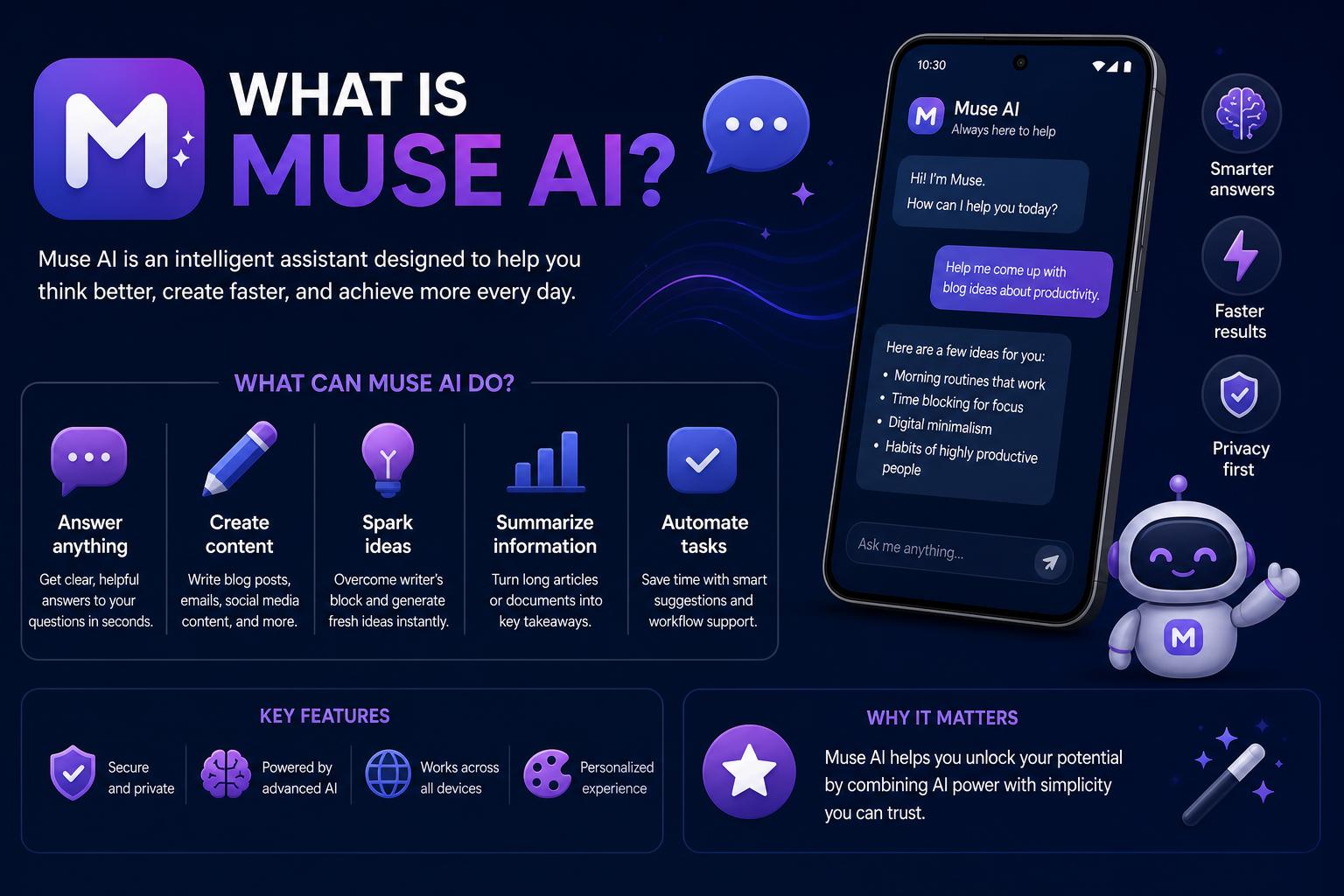
- Muse AI is Meta’s proactive, agentic personal AI assistant, capable of completing real tasks for users.
- Features include advanced image and soon video generation, multi-reference composition, and self-refinement via reinforcement learning.
- Built-in privacy controls such as Content Seal watermarking ensure transparency and user oversight for all AI-generated content.
Muse AI has quickly risen to prominence as one of the most talked-about innovations in the artificial intelligence space, mainly due to its high-profile launch by Meta and its promise of revolutionizing how people interact with technology. As artificial intelligence becomes more deeply woven into our daily lives, understanding what sets Muse AI apart from other digital assistants and generative tools becomes essential for anyone curious about the future of AI-powered personal agents.
But what exactly is Muse AI, and why is it creating such a buzz? In this comprehensive guide, you’ll discover the key features, underlying technology, real-world capabilities, and privacy considerations surrounding this game-changing platform. Drawing from leading sources and first-hand reports, we’ll break down everything you need to know about Muse AI—the world’s first truly personal AI agent designed for everyone. Whether you’re a technology enthusiast, a casual user, or an industry professional, this article will equip you with a clear and nuanced understanding of Muse AI’s unique proposition, limitations, and future direction.
What is Muse AI?
Muse AI is billed as the world’s first personal AI agent meant to be universally accessible and useful. Developed by Meta, Muse is not just another chatbot or question-answering service. Instead, it is a proactive, task-completing virtual agent that can carry out real-world actions on behalf of users—far beyond merely responding to queries or generating text and images.
According to Meta’s official announcement (2026), the vision for Muse is to create an AI that manages, organizes, and actively helps users accomplish daily tasks. This means that, unlike traditional AI assistants, Muse is designed to actually ‘get things done’ for you—from booking travel and sending emails to shopping online and filling out web forms. The system is built with user oversight in mind, requiring explicit approval before confirming purchases or financial transactions, thus prioritizing user control and safety.
Key Features and Capabilities of Muse AI
The standout aspect of Muse AI is its ability to act as an agent, not just as an information source. This agentic quality is showcased most vividly in its image and video generation modules, as well as in its personal assistant functionalities.
Muse Image: Next-Gen Image Generation
Muse Image is one of the most innovative parts of the Muse platform. Unlike many standard prompt-to-image AI models, Muse Image operates as an agent: it can invoke supporting tools, perform searches for context, and even write code to improve the accuracy of its outputs. It doesn’t just blindly generate images; it works iteratively to polish and refine its creations through a process called self-refinement.
- Self-Refinement: Every time Muse Image generates an output, it ‘reflects’ on its own work. If a detail looks off—say, an object is misaligned, or a person is missing a crucial feature—Muse Image will identify these issues and make targeted edits, or even restart the image generation process entirely if necessary. This kind of introspective improvement was not manually programmed but emerged naturally as the AI learned to maximize its reward through reinforcement learning. As Muse Image refined its results, the quality increased, leading to higher evaluations.
- Multi-Reference Image Composition: Muse Image supports complex compositions by allowing users to provide multiple reference images alongside textual prompts. For example, a prompt could interleave descriptions with several photos—people, specific clothing, particular styles, or unique environments. Muse Image skillfully combines these elements, yielding outputs that are not just visually striking but also contextually accurate.
Muse Video: Early Steps Toward AI Video Creation
Alongside Muse Image, Meta has previewed an upcoming tool: Muse Video. While still in the early stages, this video generation tool is designed to maintain high fidelity, prompt adherence, and temporal consistency—meaning the generated footage not only looks good frame-by-frame but also flows naturally from scene to scene.
Current development efforts focus on improving audio-video synchronization and making fast motion in videos appear physically realistic—challenges that most current AI video creators still grapple with. The release of Muse Video is eagerly awaited by creators, filmmakers, and brands looking to leverage generative AI in multimedia production.
Content Seal: Invisible AI Watermarking
In a world where distinguishing AI-generated media becomes ever more challenging, Content Seal is Muse AI’s technological answer. This system embeds an invisible watermark into all images (and soon, videos) generated by Muse. The watermark is:
- Invisible and Robust: Content Seal remains intact even if the image is cropped, compressed, resized, or screenshotted.
- Provenance Tool: Users—and eventually, the broader public—can use a detection tool to verify whether a photo originates from Muse AI. It’s an initial step toward combating misinformation and maintaining content integrity, especially as AI-generated visuals become more lifelike.
Muse Spark is tightly integrated with Muse Image and other agentic models developed by Meta. Think of Muse Spark as the ‘planner’ or orchestrator—it helps the various AI models communicate with each other, share specialized tools, and jointly plan for complex tasks in media generation. This collaborative foundation is what allows Muse AI to handle multipart prompts smoothly—such as generating a slideshow with consistent styling across all images, or coordinating the look of both image and video assets for a single project.
Muse AI as a Personal Agent
The true differentiator for Muse AI is its ability to act proactively on the user’s behalf. It’s not just about providing answers or making suggestions: Muse AI can actually perform actions on your behalf with appropriate user confirmation. Highlighted examples include:
- Booking Travel: Muse AI understands itinerary criteria, searches for the best options, and can reserve tickets or accommodations. The process concludes only with a user’s explicit go-ahead.
- Sending Emails and Filling Forms: The AI is capable of drafting and sending professional emails or filling out bureaucratic forms online—tasks notorious for being time-consuming in both personal and professional contexts.
- Online Shopping and Approvals: Whether shopping for everyday items or making larger purchases, Muse AI can manage the end-to-end process, once again requiring user approval before any transactions are completed.
This agency-centered design means Muse AI isn’t just a passive advisor but a genuine participant in users’ digital lives, optimizando for conveniencia y control.
How Muse AI Learns: Reinforcement and Emergent Behaviors
What sets Muse AI’s underlying models apart from other generative AIs is the way they learn and adapt over time. Self-refinement and agency were not hardcoded into Muse Image or Spark. Instead, these qualities ’emerged’ organically through training with reinforcement learning (RL)—a process in which the AI receives feedback based on its results, gradually improving with each iteration.
This design philosophy means Muse AI can discover new strategies and refine its ‘thought processes’ to produce better outcomes—even strategies the original developers might not have anticipated. It’s a glimpse into how powerful modern AI systems are becoming: not only following instructions but actively optimizing their paths toward a goal.
Privacy, Transparency, and User Control
With increasing capabilities come important questions around safety, privacy, and transparency. Muse AI has built-in checks to ensure that users remain in full control of their digital agent. For instance:
- Explicit Approvals: No financial transaction, purchase, or sensitive task is executed without the user signing off, preventing accidental or undesired actions.
- Content Watermarking (Content Seal): Every AI-generated image is tagged invisibly for provenance, helping users and third parties understand the origins of media and combat potential misuse.
In addition, Meta is actively developing public-facing tools for verifying AI-generated content, which will be vital as generative technologies continue to mature. Transparency around when and how Muse AI is involved helps build trust in this new generation of digital agents.
Limitations and Where Muse AI is Headed
While Muse AI is groundbreaking, it is not without its current limitations. Some features remain in preview or are under ongoing development, particularly in multimedia generation and physical realism in video. Synchronization issues, especially with audio and rapid motion in generated content, are common pain points that the Muse team openly acknowledges and is working to address.
On the agentic front, Muse AI’s responsibilities are deliberately scoped with robust guardrails to protect users’ interests and prevent overreach or misuse. As capabilities expand, maintaining this balance between empowerment and security will be critical.
How Does Muse AI Compare To Other AI Agents?
Muse AI distinguishes itself from competitors in several ways:
- Action Capability: Where most AI assistants aim to inform and advise, Muse AI is built to execute tasks, taking a more active role in users’ lives.
- Integration with the Meta Ecosystem: Connected to Meta’s vast network of tools, platforms, and knowledge graphs, Muse AI can act with a deep contextual understanding and access resources beyond those of standalone virtual assistants.
- Self-Improvement via RL: Muse is ahead of many AI agents in learning from experience and self-optimizing its output across media and personal tasks.
This evolution signals a shift from reactive digital helpers to proactive digital teammates—an AI that not only supports but actively participates in your day-to-day routines.
Reception and Real-World Use Cases
The launch of Muse AI has prompted a range of reactions. Early hands-on impressions from tech outlets like The Verge highlight both the promise and the uncanny potential of such powerful agentic AI. Some reviewers are fascinated by the blend of initiative, capability, and self-correcting intelligence, while others express concern over the broader implications for privacy and digital autonomy.
Meanwhile, industry analysis—such as Forbes’ reporting via social platforms—emphasizes the practical benefits: task completion, digital organization, and the potential to streamline both business and personal workflows. With a planned rollout beginning in the United States and massive investments in development, Muse AI is poised to become a cornerstone of Meta’s future-facing tech ecosystem.
Future Prospects: Continual Evolution
As of 2026, Muse AI remains under active development. Meta’s capital investment signals a long-term commitment to advancing the capabilities, security, and transparency of its personal AI agent. With features like Content Seal watermarking expanding to video, enhanced agentic planning (Muse Spark), and ongoing improvements in creative tools, Muse AI will likely serve as the template for next-generation digital assistants and creator tools.
For users, creators, and businesses, this means exciting opportunities but also the need for vigilance — understanding both the advantages and the responsibilities that come with integrating agentic AI into everyday tasks.
Muse AI represents a significant advancement in personal digital assistance, combining creativity, autonomy, and task completion within a strong framework of user control and transparency. As it continues to mature, Muse promises to transform not only our interaction with technology but also the expectations we have regarding the AI agents that help us navigate the digital world. For the latest information and access to its features, visit the official Muse AI website.
Flywheel Explained: Mechanics, Applications, and the Flywheel Effect