
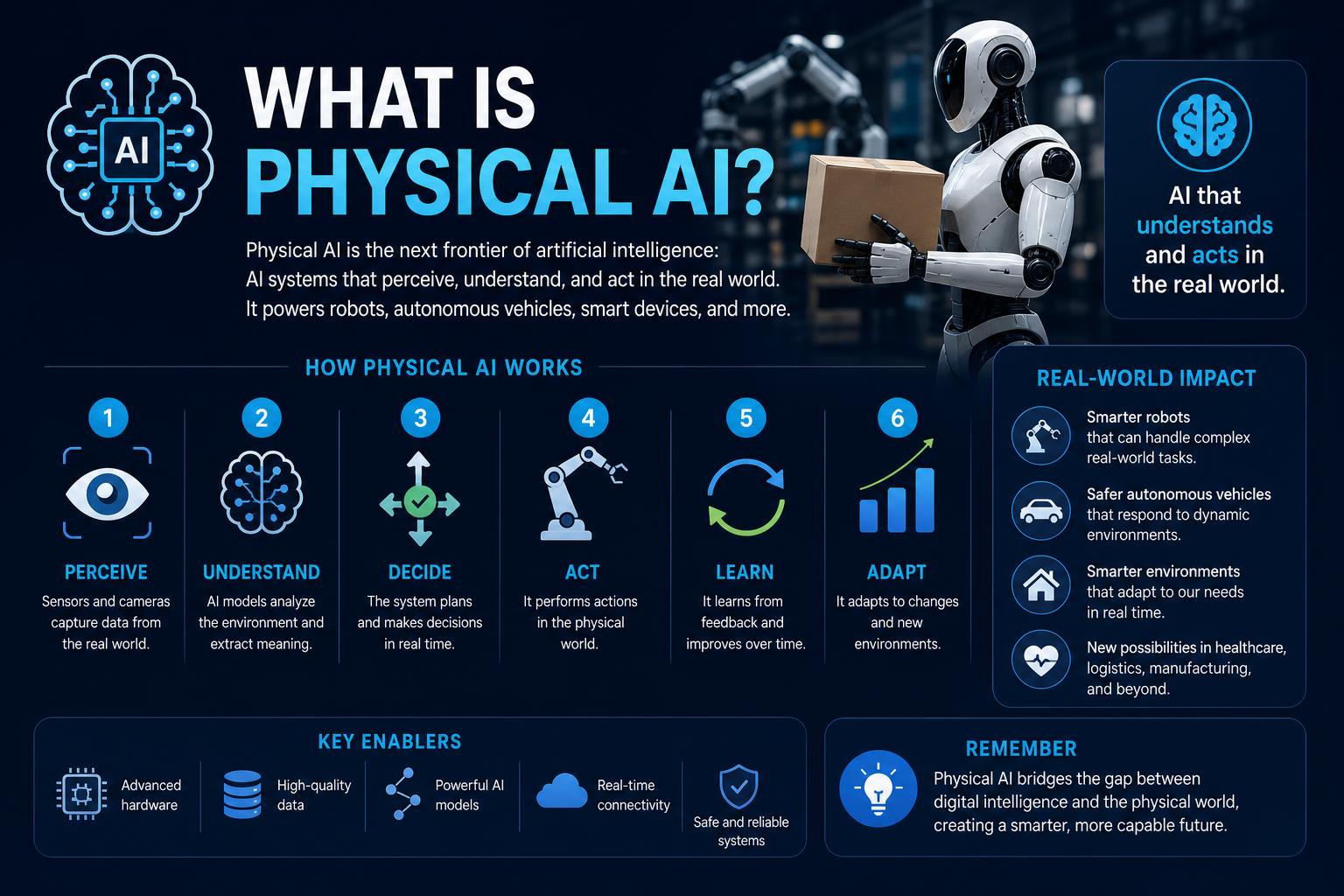
- Physical AI integrates sensors, advanced AI, and actuators to enable machines to perceive, reason, and act in real environments, bridging the gap between digital intelligence and real-world action.
- Modern foundation models and multimodal sensor fusion technologies underpin Physical AI platforms, enabling adaptable, self-learning systems for manufacturing, healthcare, logistics, and more.
- The rise of Physical AI brings unparalleled benefits in automation, safety, precision, and efficiency, but also faces significant challenges in data quality, hardware reliability, ethical alignment, and trust.
Physical AI has rapidly emerged as one of the most influential advancements in artificial intelligence, capturing the interest of industries, researchers, and technology enthusiasts worldwide. While much of AI’s past hype involved algorithms humming along quietly on our computers or in the cloud, the latest breakthroughs are all about bringing intelligence out into the world—the ‘physical’ part of AI. If you’ve ever wondered how robots, self-driving cars, smart drones, or industrial machines are learning not just to think but to perceive, decide, and act in the real world, you’re in the right place. Imagine stepping into a warehouse where robots weave around people, adjusting routes to avoid obstacles, picking and sorting items with precision, or a smart city where sensors and AI collaborate to make daily life safer and more efficient. In this extensive explainer, we’ll peel back the layers of Physical AI: its underlying technology, practical applications, real-world challenges, key industry players, and why its impact stretches far beyond just robotics. Let’s dive in and see how artificial intelligence is stepping, rolling, and even flying off our screens into real environments.
Understanding Physical AI: Expanding Beyond Digital AI
Physical AI refers to artificial intelligence systems that directly perceive, reason about, and act upon the real, physical environment—typically through a combination of sensors, AI models, and physical actuators like motors, grippers, or wheels. In essence, it’s AI that doesn’t just analyze data on screen or in the cloud; it turns that intelligence into tangible actions in the world around us. Most of the popular AI models, from language models like ChatGPT to data-mining algorithms running in background processes, operate solely in the digital domain. They process and produce bits, not bolts. In contrast, Physical AI embodies intelligence through robots, machines, and even smart infrastructure, using sensor data as its ‘eyes’ and ‘ears’ before making decisions about how to act. This means everything from picking up and moving objects, adjusting machine operations in factories, steering autonomous vehicles, monitoring patient vital signs via wearable robots, or optimizing resources in energy grids or agriculture—all without needing constant human guidance.
The Core Components: What Powers Physical AI?
At the heart of every Physical AI system are four crucial building blocks:
- Sensors: These are the hardware components that allow a system to sense the physical world—cameras for vision, microphones for hearing, LiDAR/radar for distance, IMUs for motion, and every imaginable detector for temperature, pressure, proximity, and more. The system’s ability to interpret what’s happening around it starts here.
- AI Processing Units: This is the system’s ‘brain’, typically powered by specialist chips like NVIDIA Jetson modules, GPUs for handling vast data streams in real-time, or other edge computing devices. These enable the system to process massive volumes of raw sensor data and make split-second decisions.
- Mechanical Hardware & Actuators: This is where AI gets its muscle—motors, wheels, robotic arms, grippers, exoskeletons, drones, and other mechanical interfaces that turn decisions into physical action. This is what lets robots pick up, move, or interact with the physical world.
- AI Models & Control Algorithms: The software brainpower, ranging from traditional rule-based automation to advanced machine learning, computer vision, and control systems (often using Robot Operating System (ROS)) that allow robots and machines to adapt, learn, and act autonomously based on real-time data.
A truly intelligent physical system seamlessly integrates these components to observe, interpret, decide, and execute—mirroring the ‘sense-think-act’ cycle of biological beings.
Defining Features: What Sets Physical AI Apart?
- Embodiment: Unlike digital AI, physical intelligence requires a body. Whether it’s a humanoid robot, a flexible robotic arm on an assembly line, an autonomous vehicle, or a smart drone, physical AI must operate with real world constraints—gravity, friction, and everyday hazards.
- Perception in Multimodal Environments: Instead of a single data source, these systems fuse signals from multiple sensor types—vision, sound, vibration, temperature—to build a comprehensive understanding of their current environment.
- Adaptive Decision-Making: Physical AI can’t rely on rigid, pre-programmed responses; it must adapt its behavior dynamically as situations shift, learning continuously from new data and situations.
- Action and Autonomy: The final step isn’t an output on screen—it’s a physical action, often requiring fine control, precise movement, and coordination with humans or other machines.
Physical AI is not simply smarter robotics, nor is it limited to robots. Its reach extends to any intersection between machines, sensors, and intelligent decision-making: warehouse automation, autonomous vehicles, healthcare exoskeletons, smart infrastructure, and even smart homes.
How Physical AI Works: The Sense-Think-Act Loop
The typical workflow for a Physical AI system can be summarized in a recurring loop:
- Sensing: Hardware sensors gather huge amounts of real-time data about the surrounding environment—3D maps from LiDAR, images from cameras, motion from accelerometers, and so forth.
- Perception: All the sensory data is processed to detect and understand objects, conditions, or patterns—Is someone in the robot’s path? What’s the temperature? Has a machine part moved out of alignment?
- Reasoning & Planning: Using learned or pre-trained AI models (sometimes called ‘foundation models’), the system decides optimal actions: Should it stop, reroute, pick up an object? What sequence of movements is safest and most efficient?
- Action: The decision is executed through motors, actuators, or other mechanical hardware—altering the system’s state in the real world, such as adjusting speed, grasping a package, or sounding an alert.
- Feedback & Learning: Systems gather the results of their actions (positive or negative outcomes) and continuously refine their responses, sometimes employing reinforcement learning or self-supervised learning techniques.
This loop is continuous and real-time, enabling machines to operate in fast-changing, unpredictable environments. For example, a warehouse robot uses its camera and LiDAR to map out its surroundings, spots a human stepping into its path, calculates a new route within milliseconds, and navigates around the obstacle—all without human intervention.
Core Technologies Driving Physical AI
Bringing intelligence into the physical world demands cutting-edge advances across several technological frontiers:
Robotic Systems
Robots in manufacturing, agriculture, delivery, and healthcare have long been a proving ground for AI. Where old robots followed fixed routines, new systems—like Boston Dynamics’ Atlas or Amazon’s warehouse bots—employ vision, tactile sensors, and domain-specific AI models to handle variable, complex environments.
Advanced Sensors & Computer Vision
Using multimodal sensor arrays, modern physical AI platforms gather diverse data: cameras for vision, microphones for sound, LiDAR for depth, accelerometers and gyroscopes for motion and orientation, even temperature and vibration for industrial monitoring. Platforms like NVIDIA Omniverse fuse these data streams into rich digital ‘twins’ of real environments, enabling AI to understand, simulate, and interact effectively.
Foundation Models & Universal Sensor Languages
The newest breakthrough is the arrival of model architectures capable of learning generalized, transferable physical behaviors. NVIDIA Cosmos is a foundation model trained on vast, multimodal datasets, allowing robots and machines to reason about their environment even in new, never-before-seen situations—a crucial advance known as zero-shot prediction. Vision-language-action (VLA) models, such as NVIDIA’s Isaac GR00T or Google’s DeepMind RT-1, are designed to interpret not only what is seen but also what should be done, fusing visual, language, and physical reasoning for complex tasks.
Simulation Environments & Synthetic Data
Imitating the unpredictable physical world in a digital environment is vital for training, validation, and safety. Platforms like and CARLA AV Simulator let developers create ‘digital twins’ of environments, generate vast amounts of synthetic data, and stress-test AI systems under all possible scenarios before real-world deployment.
Edge Computing & Real-Time Inference
To avoid dangerous latency in real-world decision making, Physical AI systems run inference locally—on GPUs, edge devices (e.g., NVIDIA Jetson), or even embedded microcontrollers. This means intelligence is deployed directly on the device, allowing real-time responses even in situations where network reliability can’t be guaranteed.
Physical AI vs. Traditional AI, Robotics, and Generative AI
Is Physical AI just robotics? That’s a common misconception. While robotics certainly benefits greatly from modern physical AI, not all robotics systems qualify as ‘intelligent’. Many industrial robots, for example, simply follow a fixed script day-in day-out, unable to react to environmental changes. Traditional Machine Learning solutions, by contrast, are generally designed for narrow, well-defined digital tasks—like classifying emails or recommending products. They require exhaustive manual feature engineering and do not generalize well across different physical environments or sensor types. Physical AI leverages foundation models and sensor fusion, letting a warehouse robot, for example, understand not just what it ‘sees’ but also how to act on it—navigating around people, adjusting for changes, and improving over time. Generative AI is about creating new digital content—text, images, code. Its power lies in digital creativity. Physical AI is about tangible action. Generative models might help train or simulate physical AI agents, but direct physical interaction, adaptation, and control remain outside the realm of mere data generation.
Key Players and Industry Initiatives
- NVIDIA: Besides their GPUs and AI chips, NVIDIA leads with its Cosmos foundation model, Isaac GR00T VLA model, Omniverse simulation suite, and the Jetson line for edge deployment. They’re blazing a trail in integrating AI with real-world robotics and industrial systems.
- IBM: IBM explores how simulated environments can train, validate, and deploy autonomous mobile robots in real world contexts, emphasizing incremental adaptation and safety.
- ArchetypeAI: Their Newton model and physical AI platform empower developers to build, manage, and deploy agents for continuous monitoring, verification, and safety in sectors from manufacturing to healthcare, running both in the cloud and at the edge.
- Encord: Encord’s annotation and data management tools help overcome the major bottleneck in physical AI—preparing large, accurately labeled, multimodal training datasets to fuel robust models.
- Universities and Research Labs: Initiatives like Northeastern University’s Physical AI Research Initiative (PAIR) contribute sophisticated frameworks uniting perception, reasoning, and physical learning, drawing on global efforts in both hardware and AI algorithm development.
For more information about these projects, visit their official websites through the links provided.
Real-World Applications: Where is Physical AI Making an Impact?
Manufacturing & Warehousing
Physical AI powers the next generation of manufacturing—from fully autonomous assembly lines to collaborative robots (‘cobots’) that safely and intuitively work side-by-side with people. Modern factories use hundreds of robots that constantly adapt to variable parts on the line, identify defects, or reroute in real-time if a process step is missed. Inventory management, package sorting, and logistics operations are becoming highly automated, thanks to AI-powered agents that verify every step of complex workflows and optimize production processes for safety, efficiency, and flexibility.
Healthcare & Medical Robotics
From surgical assistance robots capable of minute, human-level precision to hospital automation bots that deliver medications, supplies, or even monitor patient status, physical AI is revolutionizing healthcare. Exoskeletons and rehabilitation devices now adapt in real-time to patient needs, using feedback from sensors to guide movement, restore mobility, and even predict health complications before they become critical.
Transportation: Self-Driving Vehicles, Drones, and Smart Mobility
Self-driving cars are perhaps the poster-children for physical AI: constantly interpreting layered sensor data (Lidar, radar, GPS, cameras), they reason about the unpredictable road environment, predict the motion of pedestrians, and take real-time action to steer, accelerate, or brake. Smart drones and autonomous delivery robots are already in action, navigating unpredictable terrain to deliver goods in urban and rural environments alike.
Agriculture
Autonomous tractors and AI-enabled harvesters monitor crop growth, health, and soil quality—optimizing planting, weeding, and harvesting while using resources (water, fertilizers, pesticides) with far greater precision. Drones survey large plots of land, using AI to assess conditions, detect diseases, and even forecast future yield at a level impossible through manual observation.
Construction, Energy, and Heavy Industry
AI-augmented excavators, cranes, and industrial vehicles independently perform tasks like digging, material placement, logistics, or dangerous inspections in mines and construction sites. In energy production, smart monitoring agents detect faults or inefficiencies before they escalate, preventing costly downtime or safety risks in everything from power plants to oil rigs.
Smart Cities and Infrastructure
Urban safety and efficiency get a boost from Physical AI agents that analyze traffic, adjust signals in real time, monitor compliance on construction sites, automate building controls, or even fuse environmental sensor data to improve pedestrian and commuter experiences.
Benefits of Physical AI: Why Does It Matter?
- Automation of Complex, Variable Tasks: Unlike traditional automation limited to repetitive, rigid tasks, Physical AI enables machines to handle jobs with messy, unpredictable environments—unlocking true flexibility and freeing humans for higher-level work.
- Efficiency and Productivity: By constantly monitoring, detecting anomalies early, and adjusting to maximize uptime and quality, AI-driven systems reduce waste, downtime, and manual oversight, optimizing operations across industries.
- Safety and Risk Reduction: Machines can take on hazardous tasks in dangerous locations (e.g., inspecting reactors, surveying disaster zones, mining, cleaning toxic spills), while physical AI agents continually monitor human safety on worksites—shutting down equipment, issuing alerts, or taking corrective action proactively.
- Precision and Quality: Physical AI achieves levels of precision and consistency difficult to match by even the most skilled humans, whether assembling microscopic components in electronics or performing minimally invasive surgery.
- Continuous Learning: These systems aren’t static—they learn from their environment, improving over time with new data and real-world feedback, enabling a virtuous cycle of refinement and adaptation.
Challenges and Limitations of Physical AI
Data and Model Challenges
High-quality, multimodal data is vital for building accurate, trustworthy AI systems that can generalize across real-world scenarios. Unfortunately, gathering and annotating those datasets is costly, time-consuming, and may require domain-specific expertise. Synthetic data helps, but real-world variation is hard to fully simulate.
Hardware, Energy, and Edge Constraints
Physical AI models often require significant on-device computation—balancing power, heat, form factor, and ruggedness especially in mobile robots or compact devices. Integrating new algorithms into legacy industrial hardware or aging infrastructure adds complexity and cost.
Sensor Limitations and Environmental Sensitivity
Even the best sensors are vulnerable to noise, failure, and harsh real-world conditions—dust, poor lighting, vibration, extreme temperatures. Physical AI systems must continually recalibrate, fuse data to compensate for errors, and compensate for real-world unpredictability.
Safety, Ethics, and Trust
Physical AI systems have direct, sometimes profound effects on the real world—and people’s lives. A self-driving car or hospital robot must avoid causing harm, engender public trust, and navigate a growing field of regulation and ethical requirements. Ensuring that these machines are ‘aligned’ with human intentions, values, safety, and privacy is an ongoing technical and societal challenge.
Adaptation and Generalization
Pre-trained models might work in one environment, then fail as situations change—a common issue when factory layouts shift, parts change, or a robot is moved to a new sector. Zero-shot generalization and self-supervised adaptation remain technical frontiers as the world continues to evolve faster than any static dataset.
Future Trends: Where is Physical AI Headed?
The Rise of Humanoid and General-Purpose Robots
Thanks to advances in VLA models and hardware, robots are leaving behind predefined routines. Humanoid platforms, like those showcased at recent CES events, are being designed to function in human environments—walking, using tools, and performing support jobs in homes, hospitals, and factories. Physical AI’s intelligence layers allow these machines to adapt, collaborate with people, and tackle a wide range of tasks previously considered science fiction.
Autonomous Factories and Industry 4.0
The next generation of factories is built not around inflexible machines, but around intelligent, adaptive systems that coordinate logistics, adjust production lines on the fly, simulate changes before implementing them, and respond dynamically to operational disruptions or surges in demand. Platforms like ArchetypeAI’s Newton are already delivering solutions for process monitoring, verification, and industrial safety without requiring complex integration or cloud dependencies.
Smart Infrastructure and Cities
From dynamic traffic systems to real-time environmental monitoring, Physical AI will play a cornerstone role in making urban spaces safer, healthier, and more efficient. Public safety agents, smart building controls, and connected logistics platforms are converging as sensor and AI deployment scales across thousands of endpoints.
Synergy with Generative AI and Large Multimodal Models
As generative AI advances, it’s increasingly being used to simulate environments, generate training data, and help design or validate physical AI agents—closing the feedback loop between digital creativity and real-world deployment. Expect tighter integration between language models, simulation engines, and physical systems.
Common Questions About Physical AI
What exactly is Physical AI, in lay terms?
Physical AI is simply AI that makes decisions and acts in the real world, not just on a computer screen. It relies on sensors to detect its surroundings and actuators or robots to perform tasks—everything from driving, assembling, inspecting, to interacting with people and objects in physical environments.
Is Physical AI the same as robotics?
Not quite: robotics is about mechanical platforms that can move or manipulate objects, while Physical AI is about the intelligence that makes that possible—seeing, understanding, adapting, and acting in real time rather than blindly repeating programmed routines.
How does Physical AI differ from Embodied AI?
Embodied AI focuses on developing intelligence through physical interaction, emphasizing learning at the intersection of perception and movement, often mimicking the way humans learn about the world. Physical AI is instead about executing specific practical tasks in real environments, combining perception, learning, and action for tangible outcomes.
What are current examples of Physical AI systems?
- Self-driving cars using advanced perception and planning to navigate urban roads.
- Smart factory robots that verify tasks, detect quality issues, and automatically adjust workflows in manufacturing plants.
- Healthcare robots delivering supplies or guiding patient rehabilitation, using real-time sensor feedback and machine learning to tailor their actions.
- Autonomous drones for agricultural crop analysis or targeted spraying.
- Public safety systems fusing video and environmental sensor feeds to monitor hazards and act on them in real time.
Which industries are adopting Physical AI most rapidly?
Manufacturing, logistics, healthcare, agriculture, construction, energy, and urban infrastructure lead the charge, but any sector where real-world data must be interpreted, understood, and acted on in real time will increasingly rely on physical AI solutions.
What’s holding back Physical AI today?
The major bottlenecks include lack of high-quality, annotated multimodal data for training foundational models, hardware constraints (especially for edge and small-form-factor devices), sensor reliability issues, adaptation to new environments, integration with legacy/industrial systems, and ensuring safety, trustworthiness, and ethical compliance.
What companies and platforms are noteworthy in Physical AI?
- NVIDIA for their Cosmos and GR00T models, Omniverse simulation suite, and Jetson edge hardware.
- IBM for industrial physical AI research, simulation tools, and applied robotics platforms.
- ArchetypeAI for Newton foundation model and full-stack agent deployment infrastructure.
- Encord for high-quality annotation, curation, and management of multimodal training data.
- Universities including Northeastern and their PAIR initiative, contributing frameworks and open research.
Will Physical AI replace or complement human workers?
The answer is nuanced: Physical AI is primarily focused on automating tasks that are repetitive, dangerous, or require high precision, complementing human workers by freeing them from tedious or hazardous jobs and enabling higher-value contributions. There are implications for labor markets, skills, and workplace safety, and ongoing dialogue is essential as the technology matures. Physical AI is the natural evolution of artificial intelligence as it grows capable of directly interacting with, learning from, and improving our physical world—not merely digitizing data, but transforming industries, safety, and daily life across the globe. As technology advances, intelligent machines are set to become true partners in solving humanity’s most challenging problems and opportunities in the real world, not just behind a screen.
What Is Retrieval-Augmented Generation (RAG) in Artificial Intelligence: Complete Guide and Examples