
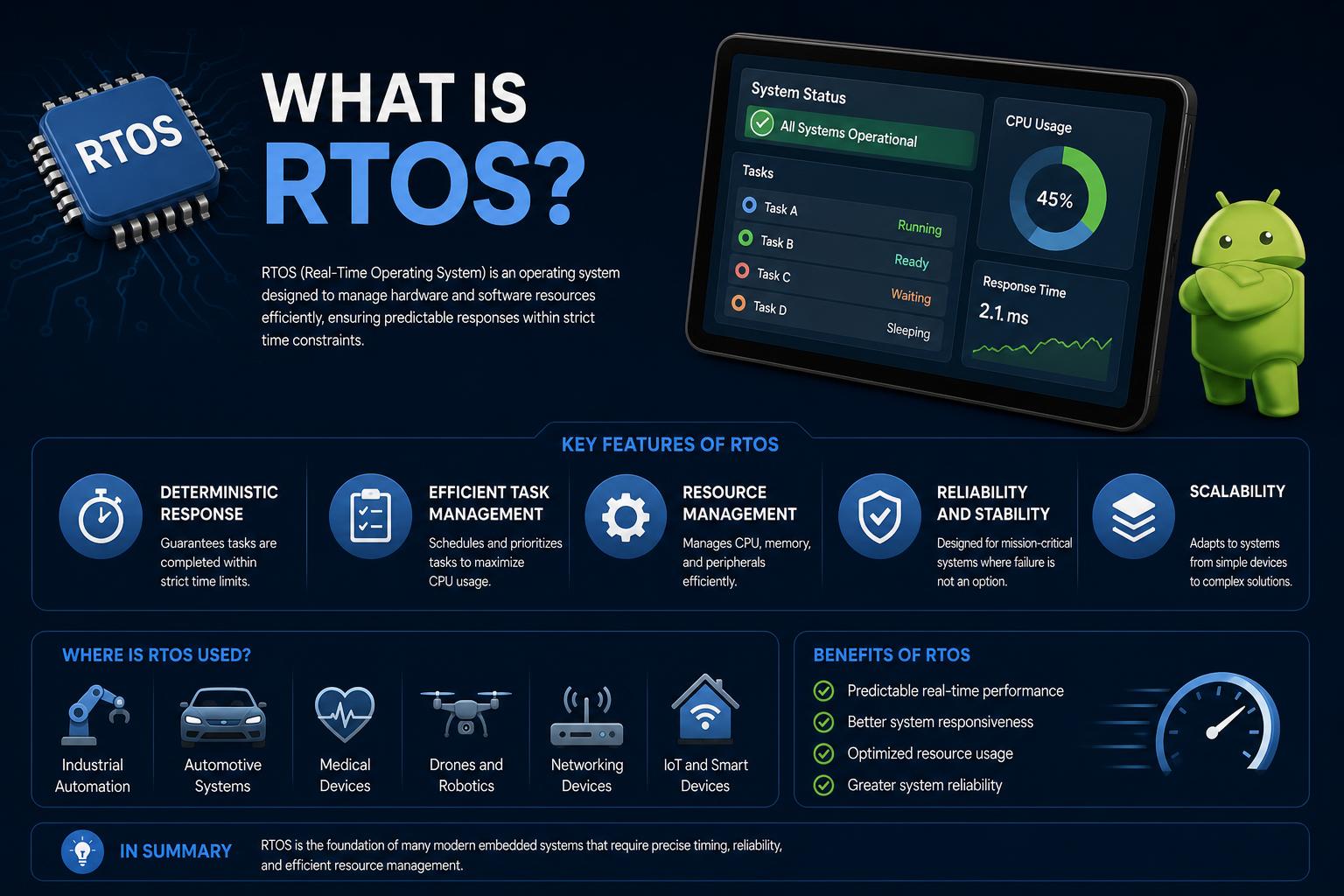
- A real-time operating system (RTOS) guarantees time-sensitive tasks are completed within strict deadlines, making it fundamental for safety-critical and performance-sensitive applications.
- RTOS differs from general-purpose OS through deterministic scheduling, minimal latency, and sophisticated resource management to consistently meet timing constraints.
- There are three primary RTOS types: hard, firm, and soft real-time systems, each catering to different levels of timing criticality across industries such as aerospace, medicine, and multimedia.
When we talk about computing systems that just can’t afford to be late, Real-Time Operating Systems—popularly known as RTOS—are the superheroes behind the scenes. Whether it’s a medical implant precisely pacing a heartbeat, a robotic arm assembling electronics, or your car’s anti-lock brakes reacting in milliseconds, RTOS ensures perfection in timing, reliability, and performance. While most folks are familiar with big names like Windows or Linux, these general-purpose operating systems aren’t designed for environments where every microsecond can matter. Enter RTOS, a purpose-built solution that prioritizes immediate, predictable responses in critical scenarios.
But what really sets RTOS apart? How do its design principles differ from everyday OS like Windows, and where are these systems used? In this detailed guide, we’ll unravel the architecture, key features, scheduling mechanisms, memory management strategies, and use cases that make real-time operating systems the backbone of modern embedded and safety-critical applications. By the end, you’ll have a full understanding of how RTOS works under the hood and why it’s such an indispensable piece of technology in high-stakes environments.
What Exactly is an RTOS?
A Real-Time Operating System (RTOS) is a specialized operating system engineered to handle tasks that must be performed within well-defined time constraints, ensuring timely and predictable responses to external events. While general-purpose operating systems (GPOS) like Windows, macOS, or mainstream Linux prioritize multitasking and user interaction, RTOS is relentlessly focused on precision timing and deterministic execution. In real-world terms, determinism means that the time required for processing is not just fast but, more crucially, predictable.
The main objective of an RTOS is guaranteeing that all high-priority or safety-critical jobs are completed within their deadlines, no matter what other processes are running in the system. Any failure to meet these deadlines can lead to anything from minor quality degradation (as in video streaming) to catastrophic outcomes (as in airplane control or pacemakers).
Key Principles and Characteristics of RTOS
The unique requirements of an RTOS hinge on two critical ideas: predictability and minimal latency. Let’s unpack a few essential characteristics that set RTOS apart from traditional operating systems:
- Deterministic Response: Deadlines are non-negotiable. The time between an event and the system’s response must be guaranteed within strict bounds.
- Minimal Jitter: Consistency in timing is critical. Jitter (the variability in response time) is minimized or eliminated to ensure reliability.
- Preemptive Scheduling: High-priority tasks can interrupt low-priority ones at any moment, allowing the most critical jobs to run as soon as required.
- Efficient Interrupt Handling: Interrupt Service Routines (ISRs) are lean and prioritized, enabling near-instant reactions to external events such as sensor input or hardware faults.
- Resource Management: Memory, CPU, and peripherals are allocated and managed to avoid unpredictable bottlenecks—static or fixed-sized allocations are frequently used to eliminate runtime surprises.
These principles form the bedrock for industries where consequences for late or missed tasks can range from annoying lags to life-threatening failures.
RTOS vs. General-Purpose Operating Systems (GPOS)
The differences between RTOS and GPOS aren’t just about speed—they’re fundamentally philosophical and architectural.
- Scheduling: GPOS usually implement fair, resource-optimizing algorithms aimed at maximizing throughput and user experience. RTOS prioritizes strict, deadline-bound execution using deterministic, priority-driven scheduling (like fixed-priority preemptive or earliest-deadline-first).
- Interrupt Latency: GPOS may disable interrupts for convenience or efficiency, potentially delaying time-critical tasks. In contrast, RTOS are designed with minimal interrupt masking or critical sections, ensuring low and predictable latencies.
- Multitasking: GPOS allow a mix of tasks with no timing guarantees; real-time tasks get no assurance of prompt scheduling. RTOS guarantees that high-priority (real-time) jobs can preempt others, securing their required CPU time under any load.
- Resource Sharing: GPOS focus on overall system optimization across diverse use cases. RTOS avoid dynamic changes during runtime that could disrupt predictability; they often use static resource assignments and simple communication protocols like mutexes and message passing between tasks.
The upshot? If your world collapses when a process is a millisecond late, you need RTOS. Otherwise, a GPOS suffices for everything from office tools to gaming platforms.
Evolution and History of Real-Time Operating Systems
The need for time-sensitive computing has existed as long as we’ve needed machines to interact with physical, safety-critical systems. RTOS development began in the 1960s and 1970s, spurred by military, aerospace, and industrial control demands where traditional OS failed to deliver predictable, fast responses. Early innovations included:
- Preemptive Scheduling Algorithms: Prioritizing time-critical jobs ahead of lower-priority ones.
- Improved Interrupt Handling: Ensuring immediate response to external events.
By the 1980s and 1990s, commercial options like VxWorks and QNX became industry standards, powering everything from telecom to automotive systems. Standardization efforts (like POSIX real-time extensions) unified design practices, further boosting adoption.
The 2000s saw RTOS powering the explosion in Internet of Things (IoT) and embedded devices. Lightweight, open-source variants like FreeRTOS and Zephyr gained popularity, offering flexible kernels for resource-constrained systems. With the continued rise of AI, adaptive systems, and critical infrastructure, RTOS continues to evolve by integrating with machine learning and advanced scheduling strategies.
The RTOS market is projected to grow from $6.41 billion in 2025 to $12.21 billion by 2034 at a compound annual growth rate of over 7%. As industries increasingly prioritize reliability and speed, the role of RTOS will only become more prominent.
How Does RTOS Work? Components and Architecture
The internal workings of an RTOS revolve around a set of interlocking components engineered for deterministic performance. Here’s a breakdown:
1. Scheduler
The heart of any RTOS is its scheduler, responsible for determining which task runs next, when, and for how long. RTOS schedulers use various strategies:
- Fixed-Priority Preemptive Scheduling: Each task is permanently assigned a priority. The scheduler always runs the ready task with the highest priority, preempting lower-priority tasks as necessary.
- Round-Robin Scheduling: Tasks at the same priority take turns using the processor, ensuring fairness but not strict timing.
- Earliest Deadline First (EDF): Tasks are ranked by their impending deadlines, with those closest to the finish line jumping to the front.
RTOS distinguishes between three primary states for each task: Running (executing on CPU), Ready (waiting to run), and Blocked (waiting for some event like I/O or a message).
2. Interrupt Handling
Quick, predictable responses to interrupts are mission-critical. Interrupt Service Routines (ISRs) are designed to be as short as possible, often doing nothing more than signaling another task via a semaphore, flag, or message. The heavy lifting (processing sensor data, reading hardware, etc.) is deferred to less time-sensitive code.
RTOSs often employ unified or segmented architectures to avoid database corruption and maintain quick response:
- Unified: Disables interrupts during catalog updates, increasing latency but simplifying safety.
- Segmented: Delegates OS-related work to a separate handler, which operates at a higher priority than any thread but lower than ISRs, preserving predictable latency even under high interrupt rates.
3. Memory Management
RTOS handles memory with an iron fist—there’s no room for unpredictable allocation delays, leaks, or fragmentation. Strategies include:
- Static Allocation: All required memory is reserved upfront at compile-time, ensuring no surprises while running.
- Fixed-Size Blocks: For embedded devices, memory is divided into chunks of a predictable size, eliminating search overhead.
- Heap Management: If dynamic allocation is needed, RTOS uses deterministic algorithms like first-fit or best-fit, often paired with garbage collection or explicit deallocation to keep memory tight and predictable.
Dynamic memory is generally discouraged (or done with extreme caution) because fragmentation or indeterminate search times can introduce deadly delay.
4. Task Communication and Synchronization
Multiple tasks often share data and hardware, presenting a risk for race conditions, resource starvation, and deadlocks if not managed properly. RTOS provides robust tools for safe multithreading, including:
- Mutexes: Allow only one task to access a shared resource at a time, with potential pitfalls like priority inversion (when a low-priority task holds a mutex needed by a higher-priority task). Priority inheritance protocols are often implemented to fix this.
- Message Queues and Semaphores: Tasks communicate and exchange data predictably. Message passing ensures that only one managing task touches a particular resource, often reducing the complexity and risk of deadlocks.
- Interrupt Disabling or Critical Sections: When a resource must be protected from all access, the system can temporarily block all interrupts, but only for very short, bounded operations.
5. Fast Dispatch Latency
Dispatch latency—the time to switch from one task to another—must be minimized for real-time guarantees. RTOS achieves this by carefully optimizing context switch routines and ensuring scheduler decisions are made in just a handful of instructions.
6. Hardware Abstraction and Device Drivers
RTOS often ship with highly optimized hardware abstraction layers (HAL) and a collection of device drivers. This makes it easier to port applications across hardware platforms, from simple microcontrollers to high-powered multicore chips. For example, Zephyr offers advanced device driver abstraction, letting developers focus on application logic rather than low-level bits and bytes.
7. Symmetric Multiprocessing (SMP) Support
The rise of multicore embedded processors means many RTOSes now support SMP, balancing tasks across available cores for maximum throughput and reliability. SMP enables parallel execution of independent tasks, dynamic load balancing, and even hot-swapping of tasks for fault tolerance.
8. Function Libraries
Real-time function libraries offer developers reusable, efficient modules for common tasks like task management, memory, synchronization, and device I/O. This reduces development effort and maximizes reliability across diverse applications.
Types of Real-Time Operating Systems
RTOS can be divided into three broad types, determined by how strictly they enforce task deadlines. It’s important to choose the right category for your application to strike the right balance between reliability and flexibility.
Hard Real-Time Systems
Here, missing a deadline is a total deal-breaker. If a critical task is late, the system is considered failed—period. Examples include:
- Flight control systems
- Pacemakers and medical implants
- Robotic arms in precision manufacturing
- Industrial plant emergency shutdown controllers
Hard RTOS use advanced preemptive scheduling, deadline monitoring, and mechanisms for priority inversion avoidance to guarantee that critical jobs always complete in time.
Firm Real-Time Systems
In firm real-time systems, deadlines really matter—but missing one doesn’t cause instant disaster, just major inconvenience or wasted results. Examples might include:
- Multimedia apps with strict, but not critical, timing
- Some banking and transaction systems
- Industrial automation with tolerance for minor hiccups
Most tasks require on-time execution, but the system can tolerate the occasional missed deadline if it doesn’t pose safety or mission-critical risk.
Soft Real-Time Systems
Soft RTOS focus on responsiveness, but deadlines are more like best-effort targets. Delays might reduce performance or user experience, but the system keeps running. Key examples:
- Streaming audio and video
- Interactive games
- Communications networks
Soft RTOS still use fast scheduling and interrupt handling, but are more forgiving when the system is overloaded or resources are scarce.
Common RTOS Scheduling Algorithms
The scheduler is the brain of an RTOS and uses different algorithms depending on the required level of determinism and hardware complexity.
- Fixed-Priority: The classic model; each task is permanently assigned a priority. This can be made preemptive (higher priorities always run first) or non-preemptive (tasks must yield).
- Round-Robin: Each ready task in the same priority group takes a turn for a fixed time slice. This is simple, fair, and great when no task is more urgent than others.
- Earliest Deadline First (EDF): Priorities shift dynamically—whichever task has the closest deadline gets CPU first. Adaptable, but requires constant recalculation.
- Rate-Monotonic: Useful for periodic tasks, with faster (higher frequency) tasks assigned higher priorities. It’s mathematically proven for certain workloads.
- Critical Section Preemptive & Deferred Preemption: Helps avoid deadlocks and conflicts by granting higher-priority tasks direct entry to critical execution sections or deferring preemption.
Schedulers can be implemented with various queue arrangements and critical section minimization to make context switches nearly instantaneous.
Intertask Communication and Resource Sharing
Multitasking inevitably leads to the need for tasks to cooperate or compete for resources. RTOS provide several robust techniques for safe, predictable resource sharing:
1. Interrupt Masking
By temporarily disabling interrupts, a task can guarantee exclusive access to resources for a few instructions. This is only safe for extremely short, non-blocking critical sections. Embedded systems often use this to protect I/O registers or flag variables.
2. Mutexes (Mutual Exclusion Locks)
Mutexes are central to multithreaded safety, allowing a task to lock access to a resource and forcing others to queue until it’s done. Downsides include potential for deadlocks (where two or more tasks wait forever) and priority inversion. Priority inheritance protocols (where a low-priority task temporarily inherits a higher priority) are commonly used to fix this.
3. Messaging and Semaphores
Message passing avoids the need for shared resource locking entirely—one task owns the resource and others must send requests through controlled queues or mailboxes. This architectural choice generally avoids deadlocks and is easier to debug.
RTOS Applications: Where is RTOS Essential?
The guarantee of timely, reliable execution makes RTOS crucial in many fields. If the timing of a job is essential, expect to find RTOS under the hood.
1. Aerospace and Defense
Missile guidance systems, radar control, flight data monitoring, satellite communications, and air traffic management all require split-second accuracy, total reliability, and strong fault tolerance. Systems like VxWorks and QNX are common due to their hard real-time capabilities.
2. Automotive Systems
Modern cars depend on RTOS for engine control, anti-lock braking, airbag deployment, infotainment, and advanced driver assistance (ADAS). Here, hundreds of sensors and controllers must communicate and act instantly—no delays allowed.
3. Medical Devices
From implanted pacemakers to bedside monitors and robotic surgical tools, medical applications demand absolute reliability and timing accuracy. RTOS such as FreeRTOS are often used because of their proven track record and lightweight footprint.
4. Industrial Automation and Robotics
Factory equipment, robots on assembly lines, conveyor systems, and supervisory control all need immediate, guaranteed responses to sensor inputs and process control signals. Predictability and efficient resource sharing are must-haves to avoid catastrophic downtime or waste.
5. Multimedia and Communications
Streaming video, live audio, telephony, and conferencing apps all require real-time transport protocols synchronized across networks and devices. Smoothing out jitter is the secret to consistent media experiences.
6. Finance and Transaction Processing
Modern trading platforms and transaction systems use RTOS to manage huge numbers of data feeds and trades in milliseconds, ensuring fair, error-free markets and up-to-date financial data. Fast scheduling and robust fault tolerance ensure high system availability and security.
7. Consumer IoT Devices
Wearables, smart appliances, and home automation devices leverage RTOS like FreeRTOS and Zephyr for efficiency, low power usage, and rapid response to user input or sensor data.
Popular RTOS Platforms
Several RTOS implementations are used widely across industries, ranging from tiny kernels for microcontrollers to robust solutions for mission-critical applications.
- FreeRTOS: Open-source, lightweight, and highly portable, ideal for microcontrollers and embedded applications. Strong developer community and commercial support.
- QNX Neutrino: Microkernel RTOS with POSIX compatibility, famous for automotive, industrial, and telecom use. Renowned reliability and security.
- VxWorks: One of the most trusted commercial RTOS, used in aerospace, telecom, and high-performance systems. Deterministic, feature-rich, and with extensive hardware support.
- embOS: Known for a tiny footprint and fast context switching, makes it suitable for embedded and low-power devices. Offers wide hardware compatibility and mature APIs.
- Zephyr: An open-source project supported by the Linux Foundation, aimed at IoT and small-footprint devices with advanced driver and connectivity support.
- Integrity (Green Hills Software): Security-focused RTOS with strong separation kernel technology, offering high reliability, safety certifications, and proven in mission- and safety-critical systems.
Pros and Cons of Real-Time Operating Systems
RTOS provides many advantages over traditional operating systems, but there are trade-offs every engineer must consider.
Advantages
- Guarantees Timely Completion: Every critical task is assured a deadline-bound execution.
- Predictability: RTOS avoids variability, ensuring reliable, consistent behavior.
- Efficient Resource Utilization: Optimal use of CPU, memory, and peripherals for maximum performance.
- Memory Safety: By discouraging or controlling dynamic allocation, issues like memory leaks and unpredictable fragmentation are minimized.
- Fast Task Switching: Minimal task shift latency means resources and tasks are always available when needed.
- Applicational Focus: RTOS design favors running applications over those queued, putting priority where it counts.
- Embedded System Integration: Because of small program sizes, RTOS effortlessly powers transport, appliances, and lightweight IoT deployments.
Disadvantages
- Limited Multitasking: Most RTOS handle a relatively small number of simultaneous tasks, focusing effort on those that must not fail.
- Resource Intensity: High-performance RTOS can require expensive, specialized, and well-maintained hardware.
- Algorithmic Complexity: Scheduling routines, safe synchronization protocols, and priority inheritance can be tricky to design and debug.
- Device Driver Requirements: RTOS often demand bespoke drivers and precise interrupt handling for optimal operation.
- Minimal Switching Philosophy: Many real-time systems deliberately minimize the number of context switches to avoid unpredictable overhead, at the cost of system flexibility.
- Learning Curve: Developers must deeply understand multitasking, race conditions, and low-level memory to fully leverage RTOS safely.
Notable Issues in Real-Time Task Coordination
Two major challenges in RTOS development are managing priority inversion and avoiding deadlock:
- Priority Inversion: When a high-priority task is blocked by a lower-priority task holding a needed resource. If a third, medium-priority task monopolizes the CPU, the high-priority job can be delayed indefinitely. Most RTOS employ priority inheritance to mitigate this.
- Deadlock: When tasks wait on each other’s resources in a cyclic dependency, resulting in permanent program freeze. Deadlock avoidance involves careful system design, often by ordering mutex acquisitions or using timeout mechanisms.
RTOS Hardware Support and Portability
RTOS can run on a wide spectrum of hardware, from 8-bit microcontrollers with scarce memory to powerful multicore processors in servers or networking gear. Most popular RTOS are highly portable, providing Board Support Packages (BSPs), abstraction layers, and extensive libraries for rapid development.
This flexibility means the same codebase can scale up or down, and new hardware features (e.g., custom I/O, security modules) are easily integrated via standardized APIs.
Current Trends and Future of RTOS
As technology keeps evolving, so do the demands on real-time systems. The integration of AI and ML into RTOS enables next-level predictive behaviors in industrial automation, autonomous vehicles, and medical diagnostics. Adaptive scheduling, dynamic workload balancing, cloud integration, and high-assurance security features are all hot topics. Open-source RTOS with modular kernels continue to lower barriers for hobbyists and startups alike.
Cybersecurity is also paramount—modern RTOS include isolation, encryption, and certified security profiles in response to new threats, especially as embedded devices become interconnected in vast critical infrastructure networks.
Real-Time Operating Systems are the linchpins of systems where timing is everything—delivering reliable, consistent, and fail-safe execution in the moments when it matters most. The marriage of deterministic scheduling, quick response, and robust multitasking makes RTOS indispensable in domains ranging from industrial robots to medical lifesavers and next-gen vehicles. As our connected world grows even more dependent on time-critical applications, understanding how RTOS functions becomes vital for engineers, developers, and anyone intrigued by what makes modern digital infrastructure tick.