
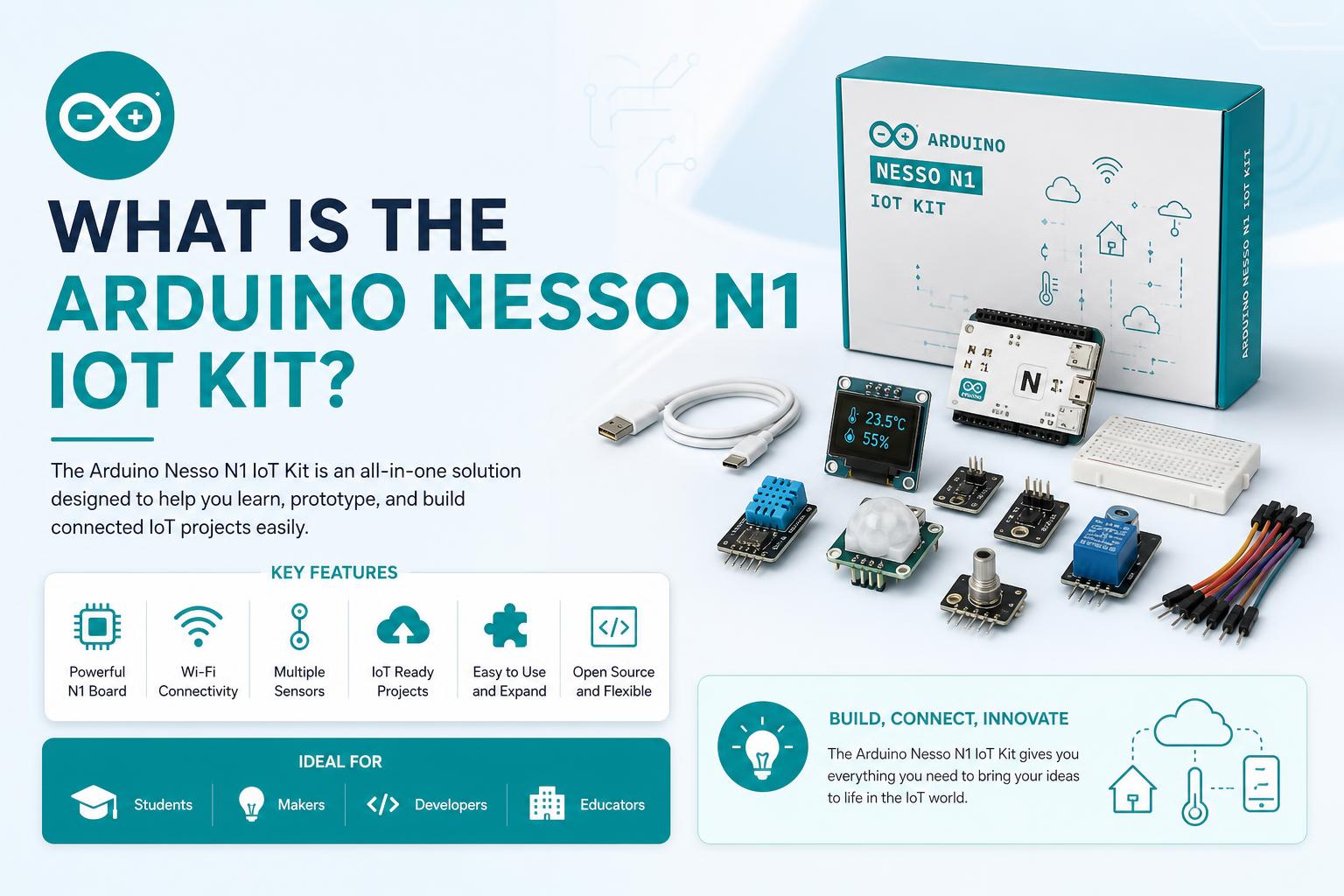
- The Arduino Nesso N1 combines Wi-Fi 6, BLE, Thread/Zigbee, and LoRa connectivity in one ready-to-use kit.
- It features a powerful ESP32-C6 RISC-V microcontroller, touchscreen, battery, sensors, and robust security.
- Pre-assembled, developer-friendly, and instantly expandable for a variety of projects—prototyping or deployment.
- Supported by major development environments (Arduino IDE, MicroPython, Zephyr) and seamless Arduino Cloud integration.
The world of IoT is evolving at an extraordinary pace, with an ever-increasing demand for accessible, compact, and powerful development kits that can keep up. Among the latest innovations catching the attention of makers and professionals alike is the Arduino Nesso N1 IoT Kit. If you’ve been searching for a new multi-protocol, all-in-one device to power your next connected project, you probably noticed buzz around the Arduino Nesso N1—but you may still be figuring out what sets it apart, how it works, and whether it’s the right fit for your needs. You’re in the right place.
Let’s dive into what makes the Arduino Nesso N1 unique, unpack its technical features, explore its development ecosystem, and reveal why this kit is already generating excitement across hobbyist and professional communities. Whether you’re a home automation enthusiast, embedded developer, or someone trying to bridge the gap between rapid prototyping and scalable IoT solutions, the Nesso N1 might just transform your workflow.
What is the Arduino Nesso N1?
The Arduino Nesso N1 is a compact IoT development kit combining power, connectivity, and flexibility. Jointly designed by Arduino and M5Stack, the Nesso N1 is quite literally packed with features to accelerate the process—from ideation to prototyping and deployment—of any IoT-enabled device or application. At its core, the Nesso N1 leverages the Espressif ESP32-C6, a RISC-V-based microcontroller, and surrounds it with a rich set of sensors, display elements, and multi-protocol wireless support.
But it’s not just about hardware—this kit is also designed for seamless integration into the wider Arduino software ecosystem, including compatibility with popular platforms like Arduino IDE, MicroPython, and UIFlow. All of this comes in a pre-assembled, palm-sized enclosure built for on-the-go prototyping and ready deployment. If you’re tired of losing time on mechanical assembly or wrestling with basic connectivity layers, this device was made for you.
Key Features and Hardware Overview
At the heart of the Arduino Nesso N1 beats the Espressif ESP32-C6 microcontroller, offering an impressive mix of performance and low power usage. This SoC integrates a single-core 32-bit RISC-V processor (up to 160 MHz), with a secondary ultra-low-power core for efficiency-critical tasks. The ESP32-C6 brings in features like:
- 2.4 GHz Wi-Fi 6 (802.11ax)
- Bluetooth LE 5.3
- IEEE 802.15.4 (Thread and Zigbee)
- LoRa connectivity (sub-GHz)
- Hardware-assisted security (AES, SHA, ECC, secure boot, flash encryption)
- Rich digital and analog interfaces (UART, SPI, I2C, I2S, PWM, ADC, CAN, etc.)
In practical terms, the Nesso N1 supports a wide range of communication protocols, making it ideal for connected environments that might range from legacy IR hardware to BLE, Wi-Fi, or LoRa networks. Beyond wireless connectivity, the board’s physical features include:
- 1.14-inch color TFT display
- Programmable buttons
- Bosch BMI270 6-axis IMU sensor (motion and orientation detection)
- Semtech SX1262 LoRa transceiver
- IR transmitter for controlling classic electronic devices
- RGB LED and buzzer for dynamic user feedback
- 250 mAh rechargeable LiPo battery with level indicator
- Grove and Qwiic connectors for plug-and-play expansion
- USB-C for programming, power, and native USB-to-Serial/JTAG functions
Unlike other conventional development boards, the Nesso N1 comes fully assembled in a rugged enclosure, eliminating the need for extra design work or complicated wiring. This makes it ready for immediate prototyping, while also being well suited for portable or field scenarios. The connectors allow for quick experimentation: just plug in compatible sensors or accessories and get started.
Deep Dive into Connectivity: Wi-Fi, Bluetooth, Thread, Zigbee, and LoRa
One of the Nesso N1’s main strengths is its support for multiple protocols—all in a single device. By integrating Wi-Fi 6 (802.11ax), Bluetooth 5.3 LE, IEEE 802.15.4 (for the Thread and Zigbee application stack), and LoRa (850-960 MHz), the Nesso N1 can communicate in almost any environment, from smart homes to industrial or rural networks.
- Wi-Fi 6 offers higher speed, better efficiency in congested environments, and improved power management—essential for IoT deployments.
- Bluetooth 5.3 LE favors low-energy, proximity-based connections, ideal for wearables or home sensors.
- Thread and Zigbee add interoperable mesh networks, enabling future integrations with home IoT and compatibility with the Matter standard.
- LoRa enables long-range, low-power communication, perfect for agriculture, remote monitoring, or industrial applications.
This ability to support all these protocols—plus IR for traditional appliances—means you can develop all kinds of connected projects on a single platform. Whether it’s a Wi-Fi hub for a smart home, Thread-based automation, or remote sensors over LoRa, the Nesso N1 is built to deliver it.
What Makes the Nesso N1 Stand Out
In a crowded market, the Nesso N1 mainly sets itself apart through quick setup, high performance, and flexible software support.
1. Ready to use, ready to deploy
No extra assembly required—the Nesso N1 comes pre-assembled, tested, and ready to use. The compact enclosure isn’t just aesthetic, it’s also rugged, with the battery and display already built in. The board comes pre-programmed and is visible in Arduino IDE (with supported versions of the ESP32 core), making it easy to get started in minutes.
2. Highly interactive and expandable platform
The combination of touchscreen, buttons, sensors, and connectors allows for rich interactions and real-time feedback, which is key during weeks of prototyping or development. Unlike other boards that require soldering or wiring to test ideas, the Nesso N1 encourages rapid experimentation. Plug-and-play expandability gives access to numerous sensors and actuators without hassle.
3. Smooth integration with major development environments
Whether you prefer Arduino, MicroPython, or UIFlow, the Nesso N1 adapts easily. It also syncs seamlessly with Arduino Cloud for remote management, monitoring, and data visualization—turning the hardware into a complete IoT experience.
Detailed Technical Specifications
Want a deeper look? Here are the essential features, compiled from official documentation and real-world testing:
- Microcontroller: Espressif ESP32-C6 (32-bit RISC-V @ 160 MHz)
- Memory/Storage: 16 MB NOR Flash, 512 kB SRAM
- Display: 1.14” color TFT LCD, touch-enabled
- Controls: Programmable buttons and touchscreen
- Sensors: Bosch BMI270 6-axis IMU, internal temperature sensor
- Connectivity: Wi-Fi 6, Bluetooth 5.3 LE, Thread, Zigbee, LoRa (SX1262)
- Power: 250 mAh LiPo battery with charge indicator
- I/O Interfaces: 30x GPIO (QFN40) or 22x GPIO (QFN32), 2x UART, SPI, I2C, I2S, CAN, ADC, PWM, among others
- Visual/Audio feedback: RGB LED, piezoelectric buzzer
- Expansion: Grove, Qwiic, USB-C
- IR transmitter: Built in for controlling older devices
- Enclosure: Pre-assembled rugged plastic with built-in antenna
Security and Reliability
The Nesso N1 doesn’t just connect—it also protects your data and devices. The ESP32-C6 supports secure boot, flash encryption, random number generation, and hardware cryptography modules like AES, ECC, HMAC, SHA, and RSA. These features ensure integrity, privacy, and secure firmware updates for your IoT deployments.
Power Management and Low-Power Operation
Modern IoT devices need to run efficiently on battery or without a wired power connection. The ESP32-C6 and its supporting circuitry offer four power modes: Active, Modem-sleep, Light-sleep, and Deep-sleep. This lets you balance performance and power consumption, perfect for field sensors or portable controllers.
With its 250 mAh LiPo battery, the Nesso N1 is suited for most development work and light deployments right out of the box. Battery-level monitoring and automatic charging simplify power management during testing, making it easier to integrate into real-world scenarios.
Programming, Debugging, and Workflow
The Nesso N1 is fully developer-friendly, supporting Arduino IDE, MicroPython, and UIFlow. Thanks to its USB-C connector, you can flash, debug, and manage the board with a single cable, with no need for extra adapters for serial or JTAG.
- Flashing and debugging: Native support on updated ESP32 platforms in Arduino IDE (from version 3.3.3) and openOCD support for advanced debugging.
- Zephyr OS compatibility: The Nesso N1 integrates the Zephyr operating system, enabling flashing, debugging, and thread analysis via GDB for more complex projects.
- Fast development cycles: The board supports “skip-flash” and “diff” options, speeding up test cycles and easing continuous integration for larger teams.
Expandability and Modular Design
The plug-and-play philosophy extends to its expansion system. Thanks to Grove and Qwiic connectors, you can add a variety of sensors, displays, relays, and more, with no soldering or wiring required. It’s also compatible with Arduino Modulino modules and M5Stack sensor hats, letting you build complex prototypes or distributed connected solutions with minimal effort.
Ideal Applications for the Arduino Nesso N1
Its feature set makes it adaptable to almost any current IoT project. Some standout applications include:
- Smart home control: Works as an automation hub, connected to Matter/Thread devices, replacing an IR remote control or powering custom dashboards.
- Industrial and remote monitoring: Uses LoRa and BLE for field sensors, environmental monitoring, and asset tracking in applications where range and low power are key.
- Educational use: The friendly display, battery, and open environment make it perfect for classrooms, workshops, and fast-paced learning settings.
- Edge gateways: With multiple protocols and rugged hardware, it can act as a bridge between devices and the cloud, including local visualization and decision-making.
Whatever the scenario, the Nesso N1 connects a wide range of technologies and removes the main obstacles in prototyping.
Comparison with Other IoT Kits
Many dev boards offer connectivity, but few deliver this level of out-of-the-box ease of use. Most require external modules for advanced radio protocols like LoRa or Thread, or lack the robust integration and protection offered here. On top of that, cloud compatibility, battery management, user interface, and built-in debugging options mean you don’t have to juggle multiple boards or accessories across different phases of the project.
How to Get Started and Availability
The Nesso N1 is currently available in the official Arduino Store and is expected to be widely adopted by the community soon. Early users note that if you have the latest version of the ESP32 package in Arduino IDE (3.3.3 or newer), the board shows up listed and ready to use, making setup easier. Reviews indicate that regulatory certifications such as FCC are already in place, allowing for general distribution.
Free samples and early-adopter promotions are likely to show up through forums and communities, but in general, the board is purchased directly or through Arduino partners. New documentation and reviews are appearing quickly, so keep an eye on the Arduino and M5Stack communities for feedback and evolving use cases.
Frequently Asked Questions and Community Perspectives
The Nesso N1 is generating a lot of interest, with users discussing everything from release timing to technical details. Some details, like the main clock speed, have raised questions, but most agree that its single-core processor at 160 MHz offers plenty of performance for most applications. In addition, the maturity of the ecosystem and the underlying technology lend confidence for large-scale deployments, combining innovation with reliability.
The name “Nesso” carries an Italian touch, referencing a village in northern Italy and, symbolically, the role of connecting all your devices and networks.
Documentation and Additional Resources
Want to dig even deeper? The official datasheet (TPX00227), the ESP32-C6 hardware documentation, and the Zephyr overview (Zephyr Docs) provide the technical detail needed for advanced projects. Platforms like Hackster.io and Arduino community forums also offer practical tips, support, and examples.
The Arduino Nesso N1 simplifies the process from hardware connectivity all the way to integration with remote dashboards, putting it at the forefront of building accessible, reliable connected solutions for developers of every skill level.