
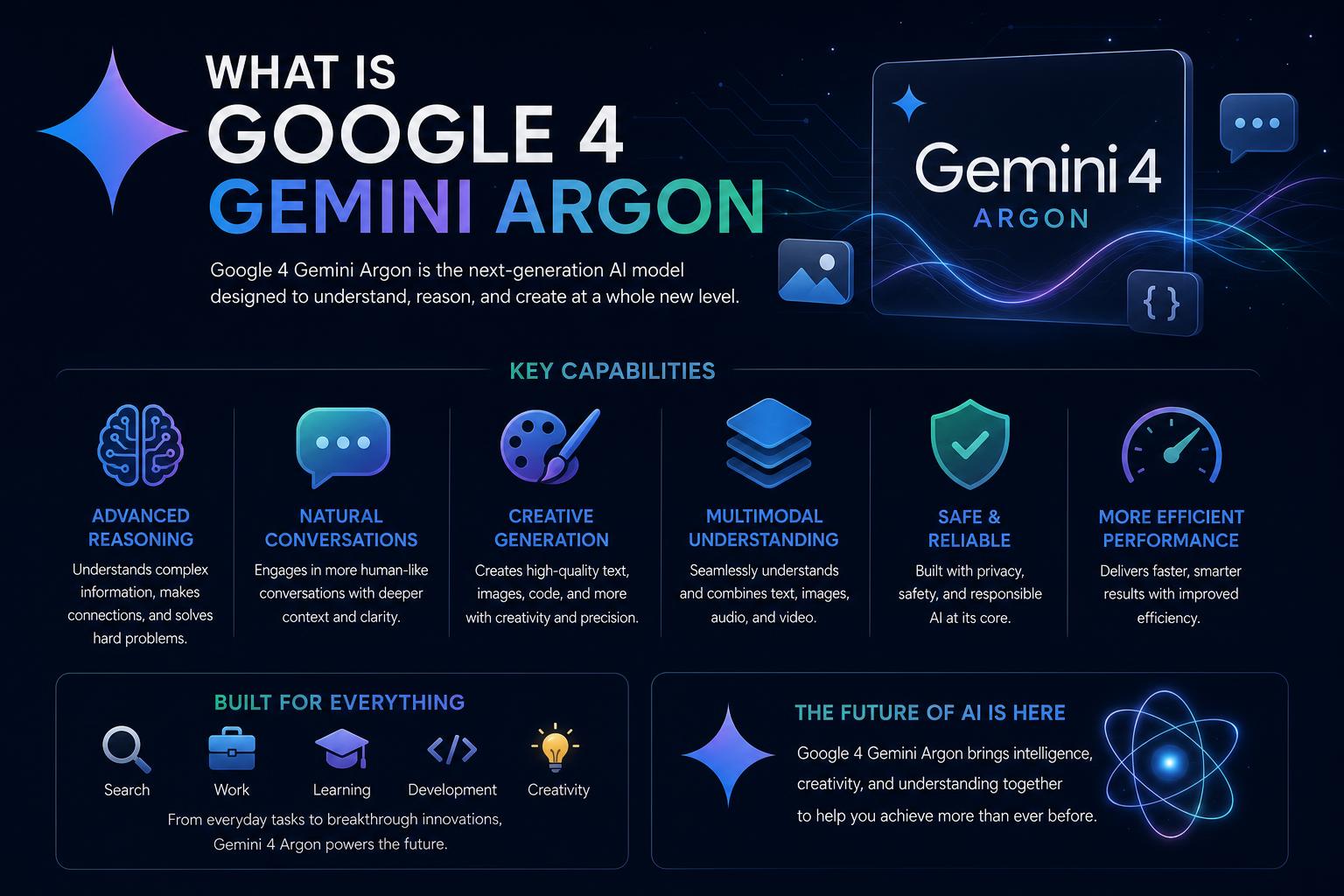
- Google Gemini 4 Argon leads in multimodal, long-context enterprise AI performance.
- It's trusted for advanced software engineering, finance, legal, and security tasks.
- Argon sets new benchmarks in robotics and real-world, agentic automation workflows.
In a world where artificial intelligence evolves at breakneck speed, knowing the latest breakthroughs isn’t just helpful—it’s essential. There’s a new player that’s caught the tech world’s collective eye: Google Gemini 4 Argon. This model isn’t just an incremental upgrade; it’s a serious leap forward in what enterprise AI can do, spanning everything from complex coding assists to powering autonomous robots. If you’re trying to wrap your head around what sets Gemini 4 Argon apart or wondering if it’s the right solution for your business or research, this deep dive is made for you.
Let’s explore what differentiates Gemini 4 Argon from earlier models, how it’s changing workflows for engineers, corporate teams, and even robotics developers, and what you need to know before considering adopting or integrating this cutting-edge technology. We’ll weave together details from both Google’s own documentation and perspectives from early users and industry analysts, so by the end of this article, you’ll have a panoramic understanding of Gemini 4 Argon’s value and its practical impact.
What is Gemini 4 Argon?
Gemini 4 Argon represents the latest evolution in Google’s family of large language models, specifically engineered to tackle complex, multi-step tasks across a variety of domains. It’s not just about answering simple prompts or generating generic content anymore—the model is crafted to take on coding, reasoning, multimedia analysis, and workflow automation for highly specialized professional fields.
Launched publicly in October 2026, Gemini 4 Argon was first introduced to the world on Google’s official blog. Its enterprise roots are clear: Argon isn’t a consumer chatbot, but rather an agent powering everything from software development and legal research to financial modeling and advanced robotics. It boasts unprecedented capabilities in multi-step reasoning, massive context handling, and even visual and spatial understanding, making it Google’s most advanced model designed for practical application in high-stakes, regulated industries.
Core Capabilities and Innovations
Multi-Modality and Enterprise-Grade Workflows
At its heart, Gemini 4 Argon is built for multimodal input and output—meaning it gracefully handles not just text, but also tables, charts, images, and even video. Its most distinctive strength is the way it can take sprawling, unstructured data (think: a PDF pack of scanned contracts mixed with spreadsheets and graphs), digest the lot, and produce clear, structured, and source-grounded output. That’s a big deal in finance, law, engineering, and operations where the realities of messy, real-world documentation often stymie less robust AI models.
The model uses a shared, gigantic token window—reportedly up to 1,048,576 tokens—let’s put that in perspective: you could analyze entire codebases, lengthy transactional documents, or hours-long video transcripts in a single prompt. This allows it to keep context and memory over very long, multi-step tasks, a breakthrough for true enterprise-grade automation.
[relacionado url=”https://www.ikkaro.net/what-is-googlebook-laptops/”]
Outstanding Performance Across Benchmarks
Google hasn’t held back in benchmarking Gemini 4 Argon against real-world industry challenges:
- DeepSWE v1.1: Argon leads the field at 77.9%, the highest score for software engineering models tested on extended, production-grade code tasks.
- Vals Index: Argon is top-ranked in an economic impact benchmark that covers the U.S. GDP’s most data-driven sectors: finance, coding, legal, and tax functions.
- AutomationBench by Zapier: Scoring 51.3%, it takes first place in executing core business functions end-to-end, from HR onboarding to customer service resolutions.
- LVBench: In tasks demanding long video comprehension, Argon boasts an exceptional 91.7%—a sign of its prowess with visual-semantic data and multimedia understanding.
- Embodied Reasoning (ERQA): For robotics and spatial cognition, Argon posted 87%—way ahead of most contemporary frontier models.
- CWE-Bench v1: When put to the test for cybersecurity, it ties for first place with an ability to remediate 68% of key security vulnerabilities, showing value not just for dev teams, but also for InfoSec and compliance.
- Gray Swan Indirect Prompt Injection: The model led here too, countering prompt-injection attacks with a success rate as low as 0.7%—critical for enterprise users worried about AI safety and data leaks.
Real-World Use Cases: How Enterprises Use Argon
Software Engineering & Development
For the engineering teams at Google (and now for select enterprise partners), Gemini 4 Argon is more than just another coding assistant. It’s been deployed for everyday debugging, massive codebase refactoring, and even redesigns of key algorithmic frameworks. In practical terms, Google’s own Chrome team used Argon to help restructure the mammoth Chromium project—40 million lines of code—cutting timelines from months to mere weeks.
Argon’s unique ability to maintain context over lengthy tasks enables agentic development: it tracks progress, manages multi-file or multi-service changes simultaneously, and proposes improvements autonomously when integrated with CI/CD pipelines and automated test suites. For instance, the open-source Agent Development Kit (ADK) now features optimizations discovered by Argon, which have slashed in-memory session prep time by 40% and improved cold imports by 21%.
Finance, Legal, and Regulated Domains
Precision and traceability are crucial in domains like accounting, law, and banking. Argon shines here—handling multi-step ledger reconciliations, extracting verified citations in legal analysis, and generating audit-traceable financial reports. It’s been a game-changer for teams running heavy compliance or high-stakes data extraction, outperforming previous models such as Gemini 3.1 Pro by significant margins in legal research and M&A analysis.
Early adopters like Harvey, ServiceNow, Figma, and others report that Argon’s citation fidelity and accuracy in processing long documents or regulatory filings are not just improved—they’re now at a professional standard required by regulated industries. This means reliable, repeatable answers, not just plausible-sounding text generation.
Accelerating Product Development
Rapid prototyping and shipping of complex products are recurring demands from modern product teams. With Argon, organizations are seeing a fundamental shift: large, ambitious projects—such as building 3D gaming engines or orchestrating factory logistics—have benefitted from the AI’s ability to break down objectives, coordinate multi-stage progress, and update large sets of files synchronously.
As Figma’s design leadership described, Argon helps turn ambitious, multi-step ideas into impressive prototypes, reducing friction from ideation to implementation. Google’s AlphaEvolve agent uses Argon to optimize everything from game code to chip layouts, reflecting its core strength: bridging traditional development, mathematical optimization, and agentic reasoning in a single toolset.
Security, Trust, and Defensive AI
Security is a first-class priority—not just for offensive research, but for enterprise-grade, defensive operations. Argon is designed with cyber mitigations that block exploitation and pentesting by default, but it fully supports defensive use cases such as finding and remediating vulnerabilities before deployment. The official cloud release notes reference tools like CodeMender, which leverage Argon to deliver end-to-end, autonomous security auditing over massive codebases.
For the select few in critical infrastructure or government, Google offers Argon’s most unmitigated (guardrail-free) version through the Fairwind Program. This ensures that only trusted defenders have full access to Argon’s advanced cyber capabilities, fostering broader collaboration on defense and safety in the AI arms race.
Breakthroughs in Robotics: From Video to Reality
One of the most headline-grabbing advances is Argon’s role in robotics. Unlike most language models, which struggle with 3D reasoning or physical world tasks, Argon enables autonomous robotics progress at scale. The model combines visual-semantic reasoning with physical intuition and automatic code generation.
For example, Google shared a demonstration where Argon learned a completely new physical skill—playing cornhole—simply by observing a human in a raw video. Argon mapped the scene, modeled body joint trajectories, and even generated working simulation code, which was then tested on the Apptronik Apollo humanoid robot. The robot, after only a few hours of “video-to-sim-to-real” training, successfully replicated the task—a process that would otherwise take robotics teams weeks of manual modeling and code writing.
This opens the door to a paradigm where millions of everyday videos become reusable training grounds for physical AI, compressing time-to-market and enabling rapid iteration in robotics, logistics, manufacturing, and even healthcare automation.
How to Access, Integrate, or Use Gemini 4 Argon
API, Pricing, and Developer Tools
Argon is available through the Gemini Developer API and Google AI Studio—though you won’t find it in free or basic tiers. Notably, access to Argon is part of Google’s enterprise offerings and its AI Ultra subscriptions within platforms like Antigravity (for both desktop and command-line interfaces).
Pricing starts competitively at $2 per million input tokens and $10 per million output tokens until the initial promotional window expires (after which rates double). This means early enterprise or developer adopters can experiment at low cost, but should plan for higher operational expenses once the introductory period ends.
Developers should be aware Argon’s API supports up to 65,536 synchronous thinking and output tokens by default, with “long decode” options for more extensive needs. There are guides for development, product integration, and security auditing, making it accessible for both fast prototyping and scaled deployments. Google Ultra and Enterprise subscribers enjoy additional support and access, whereas advanced defensive access (with no cyber guardrails) is strictly limited under the Fairwind initiative.
Business and Research Use in Practice
Many companies and research groups report remarkable improvements in real-world applications:
- Software teams are now able to hand off entire migration or optimization projects to Argon and receive ready-to-ship deliverables.
- Legal and finance teams highlight the model’s reliability in extracting key citations, drafting filings, and automating compliance paperwork.
- Companies like ServiceNow and AI Lab note a boost in customer service automation and security analytics, with accuracy and precision previously unattainable by older generations.
- Design and product groups, as in Figma’s case, use Argon to swiftly transform ambitious ideas into actionable prototypes.
Customer feedback emphasizes that Argon’s ability to synthesize vast amounts of unstructured data into actionable outputs is one of its most valuable features, enabling organizations to overcome previous limitations and manage complex, regulated workloads more efficiently.
AI Safety and Compliance
As concerns about AI safety grow, Google has taken proactive steps to address these issues. For Gemini 4 Argon, the model underwent the White House’s voluntary review process and has been stress-tested for safety frameworks, especially those required by enterprise and government partners. While the public lacks direct insight into these processes, Google’s commitment to compliance helps position Argon as a trustworthy enterprise solution.
How to Fully Disable Gemini AI in Google Chrome: The Complete Guide