
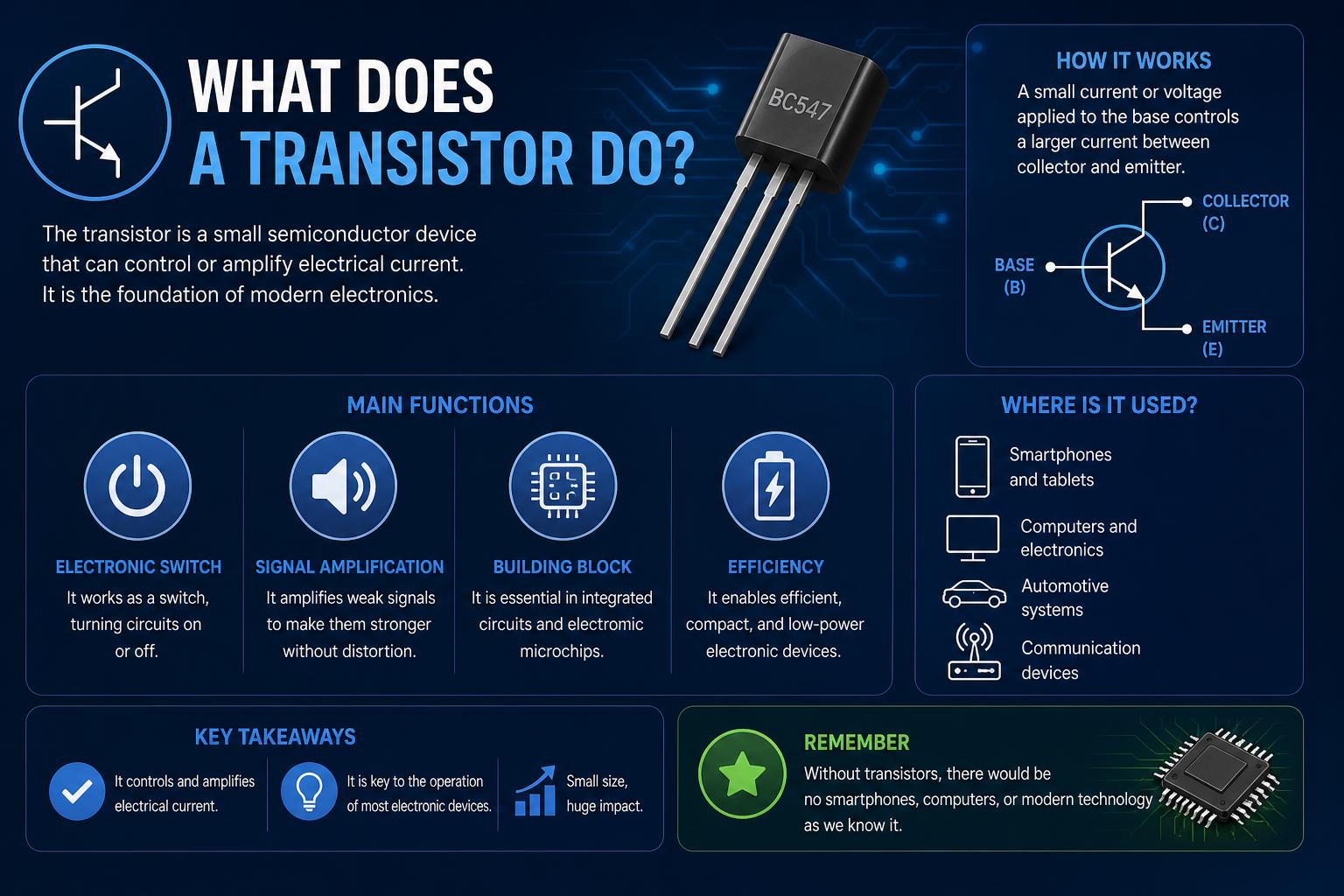
- Transistors function as both amplifiers and switches, enabling control over electrical signals in virtually all modern electronics.
- Bipolar Junction Transistors (BJTs) and Field Effect Transistors (FETs) each operate on unique principles, suited for tasks ranging from analog signal amplification to high-speed digital switching.
- The correct selection and implementation of transistor types, along with attention to biasing and thermal management, underpin the reliability and efficiency of electronic circuits.
Understanding the humble transistor is like finding the secret ingredient behind just about every electronic device you’ve ever used. Whether you’re browsing on your smartphone, cranking up your favorite tune on an amplifier, or reading this very article on a laptop, the transistor sits quietly at the heart of it all, working its magic. But what exactly does a transistor do? Is it just an electrical switch, or is there more to this tiny powerhouse? Let’s embark on a deep dive into transistors—exploring their function, underlying physics, numerous types, and their transformative impact on modern technology.
We’ll break things down from the elementary workings of transistors up through their advanced circuit applications, highlighting their star roles in amplification, switching, computation, power regulation, and more. Get ready for a comprehensive look, laced with practical examples, technical context, and hands-on circuit wisdom—all packaged in a conversational way. Whether you’re an electronics beginner or an experienced tinkerer, you’ll find insight, context, and new appreciation for these semiconductor all-stars.
The Transistor: What It Is and Why It Matters
At its core, a transistor is a solid-state semiconductor device used to amplify or switch electrical signals and power. Quite simply, when you need a small electrical signal to control a bigger one, or you want to flip current on and off at will, a transistor is your best friend. It’s no exaggeration to say that the invention of the transistor marked a seismic shift in electronics, enabling modern computers, phones, audio systems, and all manner of digital and analog devices.
What makes transistors unique is how they use the special properties of semiconductors—chiefly silicon—doped with impurities to control the flow of current. By carefully designing these regions inside the device and arranging electrical terminals just so, a transistor can take a tiny voltage or current at one terminal and use it to modulate a much larger current between two other terminals. That’s the heart of both amplification and electronic switching, and why transistors replaced their chunky, fragile predecessors: vacuum tubes.
Quick Historical Context: From Vacuum Tubes to Solid-State Revolution
- The first era of electronics—radios, early computers—depended on vacuum tubes, which were large, power-hungry, brittle, and unreliable.
- In 1947, the first working transistor (a point-contact transistor) was created by John Bardeen, Walter Brattain, and William Shockley at Bell Labs. It was radically smaller, used much less power, produced less heat, and was vastly more reliable than vacuum tubes.
- Throughout the 1950s and 1960s, researchers learned to fabricate multiple transistors side-by-side on the same chip, giving birth to the integrated circuit—a steppingstone to the microchip and the foundation of the digital age.
- Today, chips in computers and phones pack billions of transistors, while discrete transistors power amplifiers, switches, regulators, and other components.
How Does a Transistor Work?
Let’s make this as clear as possible: the purpose of a transistor is to control the flow of electrical current. It does this by exploiting the physics of semiconductors and the special ways that electrons and “holes” (think of holes as the absence of an electron) move through doped regions of materials like silicon. Depending on the type and configuration, applying a small input—the base or gate—can cause a much larger current to pass between two other terminals (collector and emitter in BJTs, drain and source in FETs).
Amplification
Say you’ve got a weak electrical signal—from a microphone, for example—and you want it strong enough to drive a speaker. This is where a transistor shines as an amplifier. The input is applied to a control terminal (base/gate), and a small current or voltage here lets a much larger current flow between the other two terminals. The result? Your input waveform gets stronger—the same shape, just a lot bigger—and can do real work, like moving a loudspeaker.
Switching
Transistors are also essential in digital logic and power control, acting as fast, reliable switches. Here’s what happens: a control signal turns the transistor fully on (current flows freely) or fully off (current is blocked). This is the basis of digital logic (ones and zeros, or “high” and “low”), memory storage, and computer computation. Flip-flop circuits, logic gates (AND, OR, NOT, NAND, NOR, XOR…)—these are all built from networks of transistors wired as electronic switches.
Complete Guide to GPIO: Function, Architecture, and Real-World Uses
Transistor Structure: The Three-Terminal Magic
All standard transistors have three terminals. Their labels and roles depend on the type of transistor:
- Bipolar Junction Transistor (BJT): Emitter, Base, Collector.
- Field-Effect Transistor (FET): Source, Gate, Drain.
The magic of the transistor lies in how a signal at one terminal (Base or Gate) therefore controls a much bigger flow between the other two. In a BJT, you control current with current. In a FET, it’s voltage that does the controlling.
The Bipolar Junction Transistor (BJT) Up Close
- Emitter: Injects charge carriers into the base (electrons for NPN, holes for PNP).
- Base: Thin region in the middle. Small base current controls a much larger collector current.
- Collector: Collects carriers from the emitter that make it through the base.
In an NPN transistor, applying a small base current (by making the base-emitter voltage about 0.6 to 0.7 V for silicon types) allows a larger collector current to flow. In active mode, the base-emitter junction is forward-biased (current flows), while the base-collector junction is reverse-biased (blocks current, except for what’s injected by the base). Nearly all the emitter current flows into the collector, with only a tiny bit leaking out the base. This ratio is called the “beta” (current gain), and it can be hundreds in modern devices.
The Field-Effect Transistor (FET) & MOSFET Mystique
- Gate: Acts as a voltage-controlled “valve” for current flowing from Source to Drain.
- Source: Where current enters (for N-channel) or leaves (for P-channel).
- Drain: Where current exits (for N-channel) or enters (for P-channel).
Applying a voltage to the Gate creates an electric field in the channel between Source and Drain. That field attracts or repels carriers, forming a conductive channel (current flows) or depleting it (current stops). Unlike the BJT, almost no current is drawn by the Gate—just a few nanoamps or less. That’s why FETs have sky-high input impedance!
Understanding PN Junctions in Transistors
Transistors ride on the back of PN junctions—the boundary between P-type (rich with “holes”) and N-type (rich with electrons) semiconductor regions. Here’s what happens in a junction:
- Forward Bias: Hook the P side positive and N side negative—current flows as carriers cross the junction.
- Reverse Bias: Hook it up backwards—carriers are pushed away from the junction and only a tiny leakage current (from minority carriers) gets through.
Inside a BJT, the base-emitter junction is forward-biased (so carriers can flow from emitter into base), while the base-collector junction is reverse-biased. Most emitters pass through the thin base into the collector, creating the transistor’s gain.
With FETs, the gate creates a field that modulates the channel—think of it like a garden hose where the gate voltage turns the spigot, opening or closing the channel to current.
Types of Transistors and How They Differ
Modern electronics would be lost without the two main families of transistors—BJTs (current-controlled) and FETs (voltage-controlled)—each with sub-types and specialties.
Bipolar Junction Transistors (BJTs): NPN and PNP
BJTs use both electrons and holes (hence “bipolar”) to carry current. Two flavor stacks:
- NPN: (N)Emitter–(P)Base–(N)Collector. Most popular due to fast electron mobility.
- PNP: (P)Emitter–(N)Base–(P)Collector. Same principle, but the flow and voltages are inverted.
In NPN types, a positive base voltage lets electrons surge from emitter to collector; for PNP, a negative base voltage lets holes flow from emitter to collector. Devices usually have beta (current gain) ranging from a few tens for power types into several hundreds for small-signal transistors. BJTs are ideal for low-noise, linear amplification (used in audio or sensors) and are common in analog circuits or high-current applications.
Field Effect Transistors (FETs): MOSFETs and JFETs
Unlike BJTs, FETs rely on voltage at the Gate to control current, not a steady current at the input. The two main types:
- JFET (Junction FET): Simpler structure, controlled by reverse-biasing a PN junction at the Gate. Current flows from Source to Drain unless the Gate voltage “pinches” the channel, excellent for low-noise, analog front-ends.
- MOSFET (Metal-Oxide-Semiconductor FET): Dominant in electronics. The Gate is isolated by a thin oxide layer; applying voltage across it creates an electric field that shapes a conducting channel. N-channel and P-channel variants are common. CMOS technology—combining N and P devices—is fundamental for microprocessors, memory, and logic.
MOSFETs provide fast switching, very low on-resistance, and can be miniaturized extensively, making them essential for modern digital devices and power electronics.
Further Variations
As you explore datasheets, you’ll find a variety of specialized transistors:
- IGBT (Insulated Gate Bipolar Transistor): Merges MOSFET-like gate control with BJT-like high-current capacity; used in motor drives and inverters.
- Darlington Transistor: Cascaded BJTs for extremely high current gain.
- Phototransistor: Sensitive to light, used in optical sensors.
- Power MOSFET: Designed for handling high voltage and current in power circuits.
- High-electron-mobility transistors (HEMT), MESFETs, Organic FETs: Variants for high-speed, high-frequency, or specialized applications.
Parameters and Datasheet Specs: What to Watch
Selecting the right transistor relies heavily on understanding key datasheet parameters. Here are some essential ones to consider:
- VBE (Base-Emitter Voltage): About 0.6–0.7 V for silicon BJTs to turn on.
- VGS(th) (Gate-Source Threshold Voltage): The gate voltage at which the MOSFET just begins to conduct; indicates switching threshold.
- hFE or Beta (Current gain): Ratio of collector current to base current in BJTs.
- RDS(on): On-resistance of MOSFET when fully activated; lower values improve efficiency.
- Maximum ratings: Include collector or drain current, voltages, and power dissipation.
- Thermal limits: Power dissipation and junction temperature constraints require proper cooling.
- Switching characteristics: Transition frequency, rise/fall times, and delay determine high-speed performance.
Real-World Circuits: Transistors in Action
Let’s see how these theoretical principles come alive in practical circuits to control and amplify signals.
Transistor Switching Example (NPN BJT)
- The microcontroller provides a small base current via a resistor; emitter connected to ground.
- When activated, the transistor saturates—collector voltage drops, completing the load circuit.
- Disengaging the base drive turns the transistor off, stopping current flow.
- Including a flyback diode across inductive loads protects against voltage spikes during switching.
Transistor Switching Example (N-channel MOSFET)
- The load connects to the supply voltage; drain connected to load, source to ground.
- The gate receives a voltage signal through a resistor, with a pull-down to prevent accidental turn-on.
- Applying a positive voltage turns the transistor on, current flows; removing it turns it off.
- Use diodes in inductive loads to protect against back-EMF.
Basic Amplifier Example (BJT Common Emitter)
- The input voltage is coupled via a capacitor into the base, biased with a divider.
- The collector is biased with a resistor connected to the supply.
- Proper biasing puts the transistor in its linear region; input swings produce amplified output signals at the collector.
- An emitter resistor improves stability and minimizes distortion.
Transistor in Level-Shifting
To interface different logic voltage levels, a transistor-based level shifter can translate signals from 3.3V to 5V or vice versa—protecting sensitive components and ensuring signal integrity. You can learn more about control and driving techniques of transistors in circuits like how to drive a DC motor.
Key Roles in Analog, Digital, and Power Electronics
Transistors in Digital Logic
Most digital systems rely on an enormous number of transistors functioning as switches within logic gates. Their low static power consumption in CMOS technology enables dense integration in microprocessors and memory chips, supporting the incredible computing power of modern electronics.
Transistors in Analog Circuits
Amplification remains a core function. Transistors serve in microphones, audio amplifiers, and operational amplifiers, boosting weak signals into usable voltages for processing or output.
Transistors in Power Circuits
- Switching regulators efficiently convert voltages—buck converters, boost circuits, inverting supplies.
- LED drivers and motor controllers depend on power MOSFETs and IGBTs to handle high currents.
- Inverters for solar and backup power rely on high-current, high-voltage transistors.
Transistors in Interface Circuits and Level Shifters
- Critical for multi-voltage systems, ensuring compatible logic levels.
- Protect downstream electronics against voltage spikes and noise.
Transistors also perform roles in oscillators, RF front-ends, sensing, and high-speed digital communication—an essential component in nearly every electronic system.
Deep Dive: Important Transistor Parameters in Circuit Design
Designing reliable circuits requires understanding and matching transistor specifications to your application’s demands:
- Base-Emitter Voltage (BJT): Usually around 0.6–0.7 V; critical for biasing.
- Threshold Voltage (MOSFET): The gate voltage needed to begin conduction; impacts switching behavior.
- Input/Output impedance: BJTs have certain characteristics; FETs, especially MOSFETs, offer very high input impedance, advantageous in many designs.
- Power ratings and thermal limits: Proper heatsinking and thermal management prevent failure.
- Switching performance: Higher transition frequencies improve high-speed operation but may increase EMI, so balance is required.
How Transistor Selection Shapes Circuit Performance
The choice between BJT, MOSFET, or other types depends on application requirements like voltage, current, speed, and linearity. BJTs are favored for linear, low-noise amplification; MOSFETs excel in high-speed switching and power management. Always consult datasheets, operating curves, and specifications to select the best device for your project.
Transistor Applications: More Than Just On/Off
From audio amplifiers to RF transmitters, from microprocessors to motor controllers, transistors form the backbone of modern electronics. Their ability to switch and amplify with high efficiency has enabled the digital revolution and continues to drive innovation across countless fields.
Safety, Protection, and Design Guidelines
- Overvoltage protection: Use diodes and snubbers to prevent voltage spikes damaging transistors.
- Current limiting: Always include base or gate resistors to prevent excessive current.
- Static protection: Handle MOSFETs with anti-static measures due to thin gate oxides.
- Thermal management: Adequate heatsinking and airflow extend device lifespan.
Transistors as the Building Block of Modern Electronics
From materials science to circuit design, the transistor remains the fundamental building block in electronics. Its evolution continues to shape our technological landscape, powering everything from smartphones to supercomputers.
If you’re interested in hands-on experimentation, try building simple circuits that switch, amplify, or level-shift signals—nothing beats learning by doing. As semiconductor technologies evolve, the potential for new applications and unprecedented miniaturization keeps expanding the horizon of what’s possible.
Key Takeaways: The Transistor’s Essential Role
- Transistors are versatile, three-terminal semiconductor devices that function as the core elements of amplification and switching in nearly all electronics.
- They come in multiple types—BJT, MOSFET, JFET, IGBT, and more—each optimized for specific voltage, current, speed, and linearity needs.
- Understanding the details—from materials and structure to biasing and protection—is critical for successful circuit design and reliability.
- The relentless evolution of transistor technology empowers ever-smaller, faster, and more efficient integrated circuits, forever shaping the landscape of digital and analog innovation.
Next time you activate a device, keep in mind that the tiny transistor inside is tirelessly amplifying, switching, and managing the flow of electrons, enabling the modern electronic world to function seamlessly.
UART Explained: What It Is, How It Works, and Why It Matters