
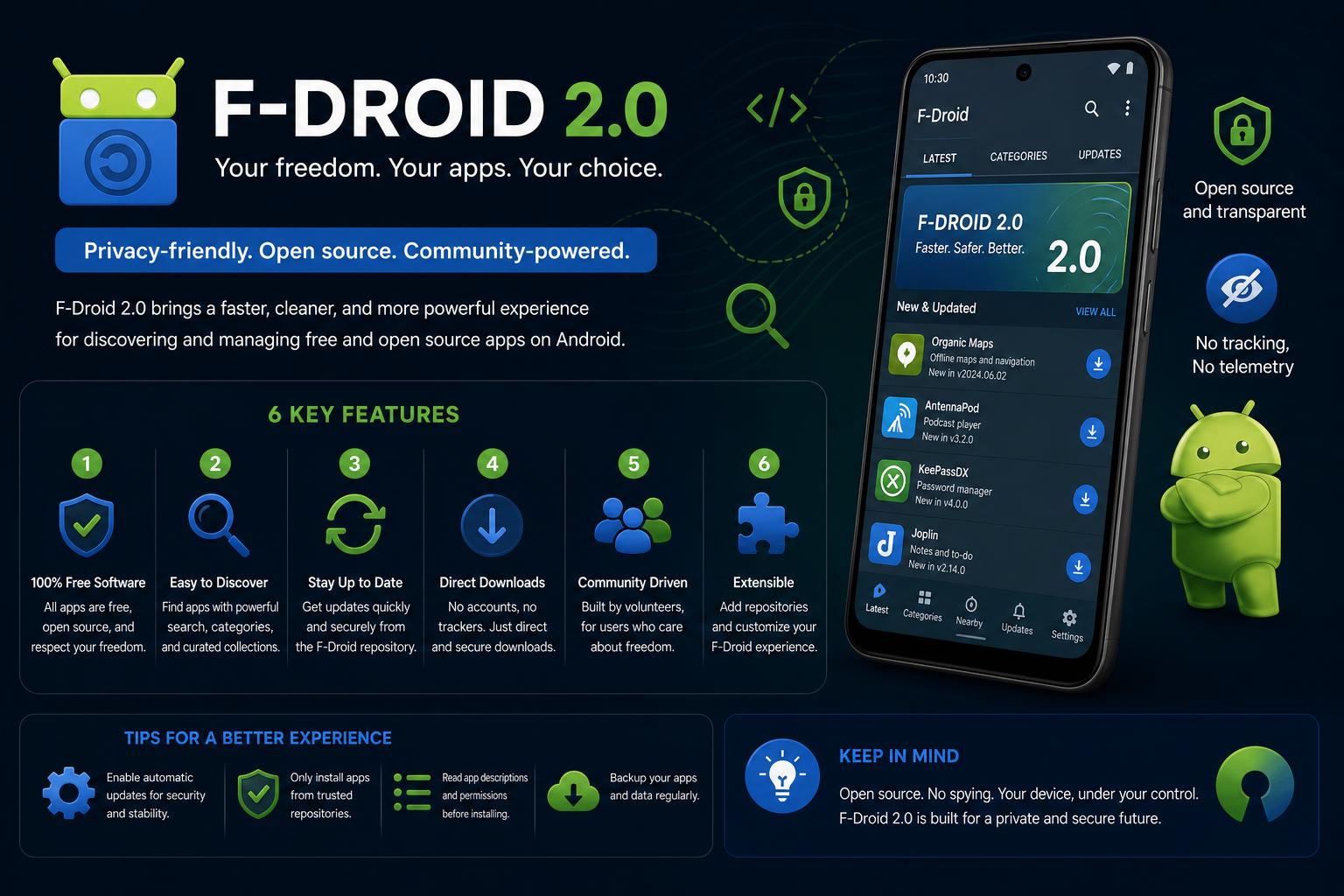
- F-Droid 2.0 marks a milestone with a full redesign, expanded filtering, and improved installation methods, offering enhanced user experience and parity with mainstream app stores.
- The platform enforces strict open-source policies and security practices, ensuring all hosted apps are fully auditable and vetted for user safety and privacy.
- Its decentralized approach empowers users through transparency, volunteer-driven development, and flexible client options, supporting true software freedom on Android.
Looking for a real alternative to commercial Android app stores? F-Droid 2.0 is here, packed with thoughtful redesigns, innovative features, and a principled open-source ethos tailored for privacy-conscious users and developers alike. Whether you’re a power user, an Android enthusiast, or just tired of invasive app policies, this is the place to discover what makes F-Droid 2.0 unique in today’s software landscape.
This guide will walk you through everything about F-Droid, with a special focus on the new F-Droid 2.0 release—its history, its foundational principles, its setup, key features, security practices, and its evolving impact on the Android ecosystem. By the end, you’ll understand how it stands apart from other app repositories and why it’s become the trusted home for those seeking freedom and transparency on their Android devices.
The Origins and Philosophy of F-Droid
F-Droid was founded back in 2010 by Ciaran Gultnieks to provide an open-source alternative to mainstream app stores like Google Play. Disturbed by increasing lockdowns, app store restrictions, and user tracking by proprietary platforms, Ciaran created F-Droid to prioritize user autonomy, privacy, and the right to study, modify, and share software. Since then, it’s become more than just an alternative—it’s the heart of the Free and Open Source Software (FOSS) movement on Android.
Since inception, F-Droid’s core mission has been to distribute only free and open-source software—with all apps built from publicly available code and scrutinized for anything that might compromise user privacy. Features like flagged “anti-features” (such as advertising, tracking, or dependencies on closed services) help users stay in control of what they install.
How F-Droid Operates
At its core, F-Droid maintains its own centralized software repository, where all submissions are vetted for open-source compliance. Its ecosystem involves several moving parts:
- F-Droid Client: The primary Android application allowing users to browse, install, and update apps from the F-Droid repository, totally free of hidden fees or registration requirements.
- fdroidserver: A toolkit for running your own F-Droid-style app repository if you wish—ideal for organizations or developers focused on private distributions.
- Jekyll Site Generator: Used to generate the repository’s website, keeping information up-to-date and transparent for users and maintainers.
All apps in the F-Droid repository are compiled from source by F-Droid itself, and users can access not just the APKs but the full codebase for every app, ensuring a level of auditing and trust not found in most app stores.
Why F-Droid Exists: Standing Apart from Google Play
While the Google Play Store boasts millions of apps, it takes a very hands-off approach to moderation, relying heavily on automated vetting that can be defeated by clever malware authors. F-Droid intentionally keeps its app numbers modest (usually around 3,800) to focus on quality and freedom—every app must be open-source, and anti-features are prominently listed to help users make informed choices.
This curated model offers a refreshing contrast to commercial alternatives, focusing on ethics, open review, and voluntary contributions. For users looking to break free from proprietary tracking or to “de-Google” their phone, F-Droid offers a robust, transparent solution.
The Evolution to F-Droid 2.0
After a decade of steady development, F-Droid 2.0 launched on 24 September 2026, representing the biggest leap in functionality and user experience since the project began. Here’s why this update stands out:
- Complete Redesign: The app is now built entirely in Kotlin—a modern, safe, and stylish programming language, replacing the Java codebase used for years. The interface has been thoroughly refreshed for ease of use and visual appeal.
- Enhanced Categories and Filtering: The category system has been overhauled—now with much clearer filters. Whether you want privacy tools, communication apps, productivity software, or games, finding them is quicker and more intuitive than ever.
- Unified Installer & Pre-Approved API: F-Droid 2.0 introduces a unified installer that leverages a standardized API, now delivering installation experiences comparable to those of Google Play. Users benefit from smoother and more reliable app installs—and developers get clear guidelines on compatibility.
- Modern Security: By incorporating the latest Android security standards, F-Droid 2.0 strengthens its defenses against interference, tampering, and attacks, keeping your software supply chain safe.
This is not just a new version. It’s a significant statement about the future of open-source app distribution on mobile.
Security, Privacy, and Trust
F-Droid takes security seriously—both in app vetting and client software. The platform aims to verify the integrity and open-source status of every submission. When vulnerabilities are detected, affected apps are removed or updated promptly, and developers are encouraged to issue fixes.
On the user side, the F-Droid client is engineered for privacy and resistance to censorship. Features include:
- No mandatory accounts or trackers: None of your activities are monitored or shared.
- Proxy and Tor support: Use HTTP proxies or Tor onion services for extra anonymity and resilience against network surveillance.
- Decentralized sharing: Use Wi-Fi or Bluetooth to distribute downloaded apps locally, turning your device into a pop-up app store for friends, colleagues, or field deployments.
App Installation and Privileged Access
Unlike commercial stores, F-Droid isn’t available in the Google Play Store and needs to be sideloaded by enabling installations from “Unknown Sources.” This might seem daunting to newcomers, but it’s a small trade-off for a truly open system.
For advanced users, F-Droid offers the Privileged Extension—a system component that takes over background updates automatically, even for non-rooted devices (as long as the extension is flashed, bundled, or otherwise given system privileges).
Key Management and App Signing
Android apps are signed with cryptographic keys. F-Droid initially used its own keys to sign all distributed apps, which meant that if you’d previously installed an app from somewhere else, you’d need to uninstall and reinstall it for F-Droid to manage updates.
With the evolution of the Android ecosystem, F-Droid adapted—now allowing developers to use their own signing keys if they participate in the reproducible build process. This aligns F-Droid with modern practices and increases compatibility for users switching from other stores.
Alternative Clients: Droid-ify and NeoStore
F-Droid’s open model has sparked the creation of alternative clients, like Droid-ify and NeoStore, which offer different user interfaces and additional features built on top of the core F-Droid repositories. These apps let you enjoy F-Droid’s library with fresh perspectives—and demonstrate the power of open ecosystems to fuel innovation.
How F-Droid Builds and Distributes Apps
All Android apps hosted by F-Droid are compiled directly from their public source code. The F-Droid build server ensures everything is reproducible, and the APKs are then signed and distributed. If you like, you can study the build logs, verify tags, and even run your own builds locally.
This transparent model not only keeps users safe—it encourages developers to hold each other accountable and improves software quality across the board.
The Role of the Community and Contributors
F-Droid is run primarily by volunteers, although some contributors receive funding or sponsorship for specific projects. The development process is open, with regular meetings on IRC, detailed translation efforts, and robust documentation to help new contributors jump in. There’s a welcoming atmosphere for coders, translators, security experts, and advocates of FOSS values at every technical level.
Reception and Impact in the Tech World
Media outlets, privacy activists, and software freedom advocates have recognized F-Droid as a special resource in the app store world. While its app count is modest compared to mainstream stores, F-Droid stands out for ethical rigor, greater transparency, and strong security practices.
Notably, F-Droid has become a go-to resource when major privacy apps vanish from other stores, and it is frequently featured in campaigns promoting digital rights, free software advocacy, and ethical tech choices. Although some alternative Android OS projects dropped F-Droid over strict philosophical differences, its influence on the broader ‘open Android’ ecosystem remains significant.
Limitations and Things to Consider
No app store is perfect, and F-Droid has distinct limitations that you’ll want to keep in mind:
- Fewer apps than Google Play: Not every mainstream app is available—often only FOSS titles are listed.
- No built-in app rating or review system: Instead, F-Droid relies on community transparency and external discussions.
- Manual update process by default: Automatic updates are available, but only with the privileged extension and additional setup.
- Potential for delayed vulnerability mitigation: Although rare, some security issues have lingered before community patches were issued.
For those who value privacy and transparency, these trade-offs can be well worth it.
Installing and Using F-Droid 2.0
Getting started with F-Droid is straightforward—you simply download the APK from the official F-Droid website and enable installation from unknown sources on your Android device. The app will guide you through the rest, providing quick access to thousands of open-source apps, customizable categories, and all the new features of 2.0.
If you’re an advanced user or organization, tap into the fdroidserver project to run your own trusted app hub, manage private apps, or bundle specialized repositories for your team. All the tools, source code, build logs, and supporting guides are available freely—making F-Droid the most transparent and community-driven solution on Android.
Why F-Droid Matters More Than Ever
F-Droid 2.0 debuts at a time when the mobile app landscape is under pressure—from mandatory developer verification policies, restrictions on alternative app stores, and increasing threats to digital rights. By providing a robust open platform, F-Droid empowers users and developers to sidestep restrictive policies and keeps Android open, innovative, and privacy-respecting.
Today, F-Droid’s mix of ethical vetting, strong community values, and technical innovation makes it more than “just another app store.” With its recent 2.0 overhaul, it’s a worthy option for anyone who wants an Android experience free from tracking, full of open possibilities, and backed by a thriving, global community. Try it out via the , or explore its GitHub and GitLab pages for details on the latest releases, development discussions, and source contributions. Whether you’re curious, cautious, or committed to digital freedom, F-Droid 2.0 promises a more open way to experience Android.
Discover the Best F-Droid Games: Ultimate Guide to Open Source Android Gaming