
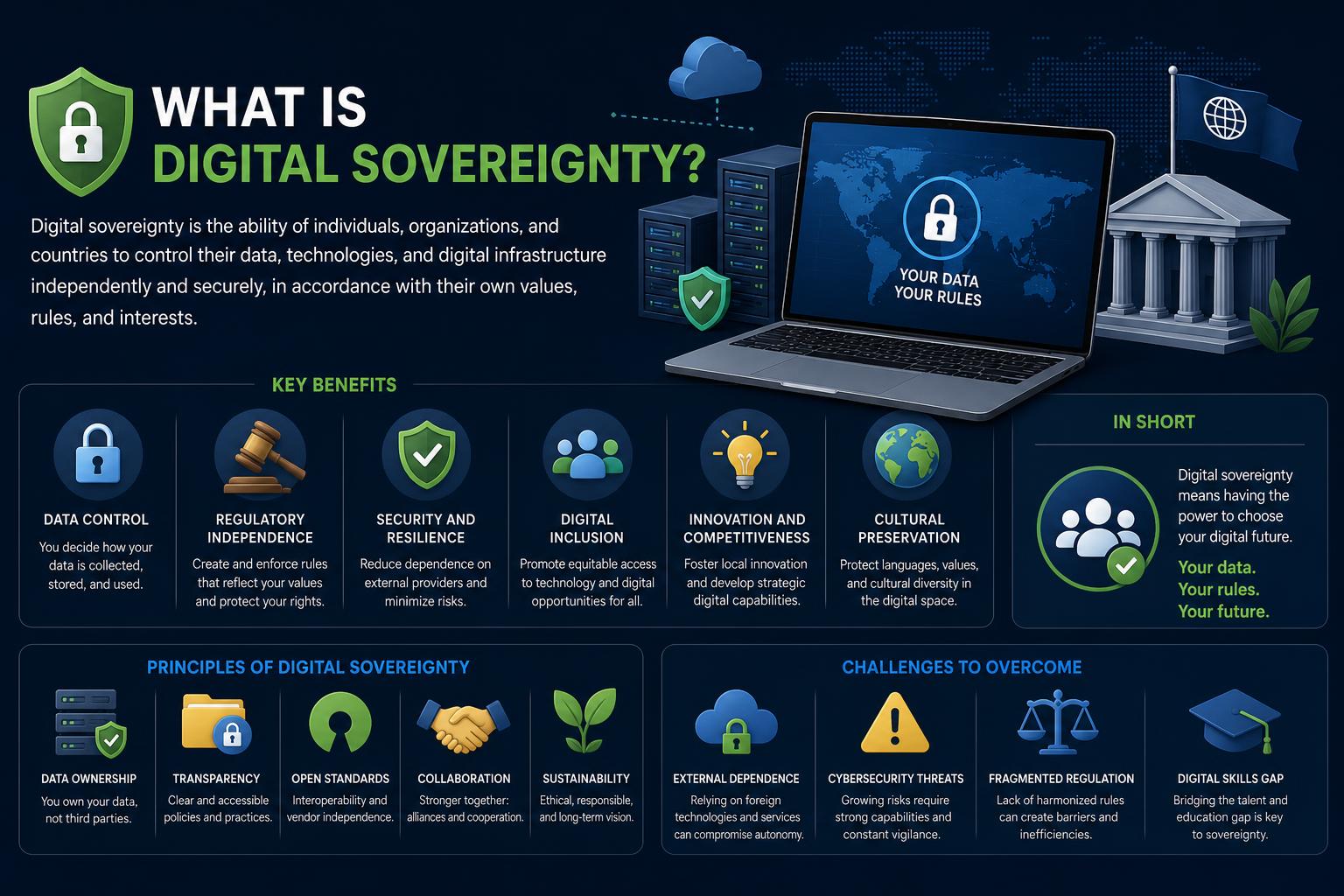
- Digital sovereignty empowers countries, organizations, and individuals to control their digital assets, infrastructure, and data independently from foreign influence.
- Recent EU legislation, as well as strategies in China and Russia, illustrate contrasting global approaches to sovereignty, security, and competitiveness in the digital sphere.
- The rise of AI has expanded the debate, pushing digital sovereignty to include oversight and control of AI models, training, and inference processes.
Living in a hyper-connected world means that our digital lives, information, and decisions are increasingly influenced by rules and technologies beyond our direct control. This ongoing transformation brings up pressing questions: Who owns your digital footprint? What happens to data after it’s collected? And who sets the standards powering the platforms and algorithms you use every day? These questions all converge on a single principle— digital sovereignty.
The concept of digital sovereignty sits at the intersection of technology, law, policy, and international relations. It’s evolved from being a niche concern to becoming a core element of national and organizational strategy, especially as governments, businesses, and individuals seek greater clarity and control in an era dominated by global tech giants and accelerated innovation. Let’s dive deep into what digital sovereignty truly means, why it matters more than ever, and how it’s being shaped by rapidly changing technologies like AI, shifting geopolitics, and new legal frameworks worldwide.
What Is Digital Sovereignty?
At its heart, digital sovereignty is all about having the power to govern digital infrastructure, software, data, and standards— independently and effectively. The essence is simple: Can you make your own rules about the systems you rely on, or are you subject to someone else’s terms and controls?
While the details differ depending on context, the central notion is universal. Digital sovereignty represents the right and capacity of a state, organization, or individual to make and enforce decisions about their digital world— from where their data lives, to which algorithms shape their lives, to how digital services interact with them.
If you want a concise modern definition: Digital sovereignty is the capacity to determine and control your digital destiny— overseeing infrastructure, software, standards, and data, and deciding under which jurisdiction they operate and how they are governed.
The Three Main Layers of Digital Sovereignty
- Infrastructure Layer: This involves technical assets such as servers, data centers, network infrastructure, cloud and edge platforms. Who owns and operates your digital backbone?
- Code and Standards Layer: This includes the software, algorithms, technical standards, design frameworks, and communication protocols shaping digital activity. Who decides how code behaves and which standards your services must follow?
- Data Layer: This encompasses everything about data ownership, storage, access, flow, and processing. Where is your data stored, who manages it, and what laws govern its treatment?
Full digital independence is rarely the goal in practice. Instead, the pursuit is about decision-making power and situational awareness— knowing your dependencies, weighing risks, and having options to avoid lock-in or unwanted exposure.
Contexts Where Digital Sovereignty Matters
National Sovereignty in a Digital Age
For countries, digital sovereignty means maintaining control over the digital systems and standards operating within their borders, so that national laws and values take precedence over external pressures.
This has ramped up in importance as cyberattacks, foreign influence operations, and economic conflicts have illustrated the risks of reliance on foreign tech giants or international clouds. The ambition for digital sovereignty often translates to calls for local infrastructure, national standards, and tighter oversight of tech imports and cross-border digital flows.
Organizational Digital Sovereignty
For organizations, it’s about controlling key dependencies— from cloud vendors and software providers to access rights and data storage locations. If you’re a business leader, you need awareness of:
- Which cloud or software providers your critical operations depend on
- Where your sensitive data is stored and processed
- Whether your digital contracts create jurisdictional exposure (for example, being subject to foreign laws like the US CLOUD Act)
Organizational digital sovereignty directly influences business continuity, compliance, and strategic resilience.
Individual Agency in the Digital Sphere
For individuals, digital sovereignty is about meaningful control over personal data, identity, and the digital services that infiltrate daily activities. With the expansion of AI, smart devices, and digital identities, this layer is becoming more relevant than ever.
Why Does Digital Sovereignty Matter?
Digital sovereignty protects against over-dependence, external interference, security vulnerabilities, and opaque controls by external parties. The practical benefits include:
- Reduced Dependency and Greater Resilience: Spreading risk across multiple providers or technologies minimizes the threat from single points of failure, vendor lock-in, and unexpected disruptions.
- Improved Compliance, Control, and Trust: Being able to specify where and how data is stored and processed strengthens regulatory compliance and trust with customers, partners, and regulators.
- Competitive Advantage and Innovation: With greater control over systems and standards, organizations can innovate more freely, negotiate better contract terms, and react swiftly to new opportunities.
- Cultural and Societal Considerations: In the public sector, digital sovereignty supports national languages, cultural values, and public-interest priorities, especially when facing the dominance of global tech platforms.
- Security and Strategic Protection: As cyber threats escalate, control over infrastructure and jurisdictional exposure becomes a vital part of national security strategy.
Digital Sovereignty Around the World: Contrasting Models and Motivations
China: Cyber Sovereignty as National Imperative
China has made cyber sovereignty a cornerstone of its digital policy since 2015. The guiding principle is that each nation should be able to regulate the internet within their borders, without foreign interference. Initiatives such as strict data localization (mandating local storage and processing of data), national data centers, and routing infrastructure aim at maximizing local control over digital assets. While these measures strengthen security and support local businesses, they also pave the way for extensive surveillance and censorship. China’s approach includes strict control of cross-border data traffic, requiring even foreign news sites to comply with national censorship regulations to remain accessible within the country. (Learn more at the Weizenbaum Institut)
Russia: State Control and Data Localization
Russia has also moved to equate digital sovereignty with tighter state control over the digital realm, including mandatory local storage of data and enhanced internet monitoring. The “Sovereign Internet Law” requires ISPs to install monitoring equipment, allowing authorities to block undesirable content and monitor traffic more effectively. Like China, the strategy emphasizes national infrastructure and data localization as security priorities.
The European Union: Balancing Openness and Strategic Autonomy
The European debate has favored strategic autonomy— reducing reliance on non-EU technologies without fragmenting global connectivity. While technical isolation, such as the idea of ‘Schengen routing’, was considered and ultimately scrapped due to the risk of creating a “splinternet,” the EU continues to advocate for robust local infrastructure and sovereignty in its digital policies. Projects such as Gaia-X exemplify efforts to create a pan-European cloud infrastructure that preserves EU laws and values, promoting digital sovereignty without cutting off global collaboration.
Key Legislation Shaping Digital Sovereignty in the EU
The EU stands out for its multi-pronged, regulatory approach to digital sovereignty, enacting several potent laws in recent years:
- The Data Act (Regulation (EU) 2023/2854): Becomes effective in September 2025, setting rules for fair access to and usage of data, particularly data produced by connected devices (IoT). It supports portability and switching between cloud services to avoid vendor lock-in, and fortifies EU authority over data flows and access.
- Data Governance Act (Regulation (EU) 2022/868): Establishes frameworks for data sharing, data intermediation, and public-sector data reuse.
- Digital Services Act (DSA) and Digital Markets Act (DMA): Targets transparency, platform governance, and regulation of big players (“gatekeepers”) to address power concentration and dependency risks.
- EU AI Act: Lays out rules for the development and deployment of AI systems within the EU market, ensuring that governance requirements for AI align with the EU’s broader digital sovereignty ambitions.
These regulations work together to give organizations the tools needed to structure data contracts, plan for interoperability and switching, assess legal risks from non-EU jurisdictions, and document governance controls— especially as AI becomes more central to daily operations.
The emergence of AI technologies has shifted the goalposts for digital sovereignty, introducing new dependencies and complexities. Digital sovereignty nowadays encompasses far more than just where your data resides— it now touches on who controls the AI models you use, the pipelines for training and fine-tuning, and the governance of inference and outputs.
AI Sovereignty: What’s at Stake?
AI sovereignty refers to the ability to control how AI models are created, trained, deployed, and evaluated— and to ensure models operate within trusted, sovereign boundaries. High-profile incidents like SolarWinds or the Colonial Pipeline cyber breaches have thrown the issue into sharp relief, raising national security and business risks when governments or organizations lack such oversight.
Questions guiding AI sovereignty include:
- Who owns or governs the foundational AI models you use?
- In which jurisdiction are the models trained and run?
- Can you audit or control fine-tuning, retrieval, and evaluation, or are you boxed in by closed vendor workflows?
- How are your prompts, logs, and outputs managed, retained, and governed?
If your company relies on foundation models from leaders like OpenAI, Google DeepMind, or Meta AI, AI model dependency needs to be treated as a strategic supply chain risk, much like any other critical vendor relationship.
Governance, Transparency, and Strategic Control
The adoption of AI intensifies the need for transparency (how decisions are made, how models behave), data provenance (where training data comes from), and the ability to audit systems for biases, errors, or security gaps. This is now a vital part of digital sovereignty discussions.
The EU AI Act is a flagship example of this approach: aiming to govern AI use across the EU market, it aligns digital sovereignty frameworks with rules around transparency, accountability, and incident response for AI systems. (Read about the AI Act)
Infrastructure and Vendor Lock-In Still Matter
AI is resource-intensive, requiring significant compute power and data handling. Concentration in key providers (think cloud hyperscalers or GPU vendors) can reinforce dependencies. Digital sovereignty in the AI era is about building verifiable alternatives, mapping dependencies, and ensuring your organization isn’t left without options if access or terms change unexpectedly.
Reducing Dependency: Practical Steps for Organizations
- Start by mapping dependencies: List cloud vendors, sensitive data storage locations, the hardest-to-replace systems, and contracts exposing you to foreign legal risk.
- Review your ability to switch providers or platforms, especially for mission-critical systems.
- Understand contract details governing data retention, AI model access, and data usage rights.
- Monitor and evaluate AI system performance, flagging issues like bias, drift, or safety risks as part of ongoing governance.
Beyond the West: Other Strategic Approaches
Countries like China and Russia show what a more isolationist version of digital sovereignty can look like— with strict border controls, surveillance, and mandatory local data processing. While these efforts undeniably raise sovereignty, they also introduce significant risks of censorship, reduced global engagement, and economic inefficiencies.
Even within Western debates, the risk of a “splinternet” (where internet access is fragmented along national or commercial lines) is an ever-present concern. The EU approach tries to balance the benefits of openness against the need for strategic autonomy and protection from dependency risks.
The Business Case for Digital Sovereignty
Recent studies illuminate just how high the stakes are: over 70% of surveyed executives now see sovereign AI as either a ‘strategic imperative’ or an existential concern. Many organizations are willing to absorb extra costs to avoid single-point dependency, preserve choice, and strengthen negotiating leverage, especially in business-critical areas.
Research even suggests most organizations are open to maintaining multiple AI vendors for strategic applications, even if it comes at a premium, to safeguard freedom and resilience in a dynamic risk environment.
Historically, regulation has lagged behind technological innovation. However, the rapid adoption of AI, cloud services, and global platforms has prompted governments— especially in the EU— to act swiftly with proposals like the still-developing Cloud and AI Development Act (CADA), offering a structure for assessing sovereignty across both cloud and AI layers. This framework proposes different assurance levels, from basic compliance to full local control and supply chain independence, though it’s still under negotiation as of late 2026. (More on EU digital policy)
For both public policy specialists and technology professionals, digital sovereignty isn’t just an abstract goal— it’s a practical discipline that shapes architecture, contracts, compliance, and future strategy across all digital domains. For anyone looking to specialize in this space, programs like the IE Master’s in Public Policy now offer pathways dedicated to digital transformation and EU affairs. (See IE’s Master in Public Policy in Digital Sovereignty)
All things considered, digital sovereignty has transitioned from a policy talking point to a competitive battleground and a matter of national security. Whether responding to new privacy regulations, safeguarding against state-backed cyber threats, or preserving operational flexibility in AI-enabled enterprises, organizations and nations alike must map their digital dependencies and assert control where it matters most— or risk being governed by invisible hands beyond their influence.