
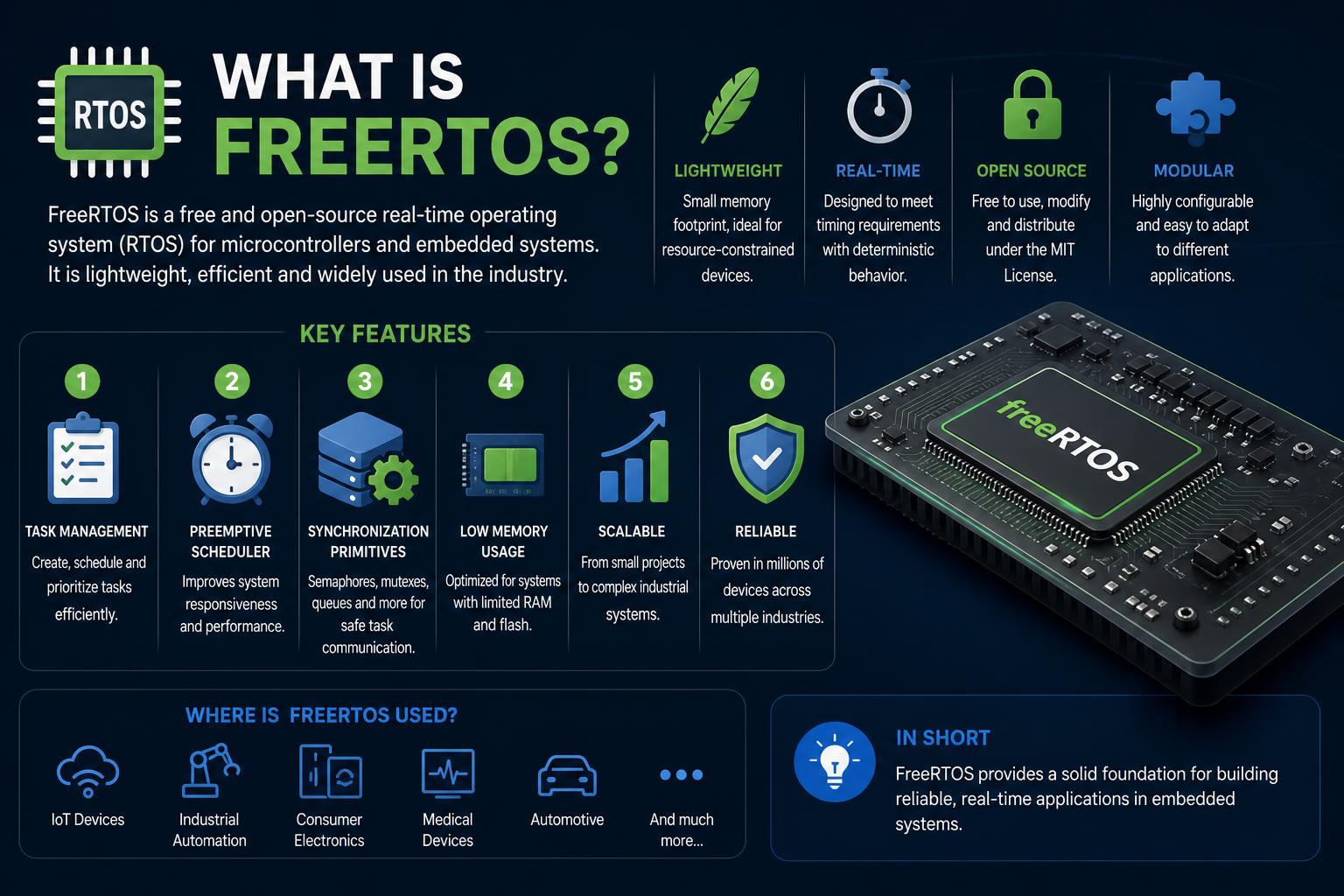
- FreeRTOS is a lightweight, real-time operating system designed for microcontrollers and embedded devices, distributed under the MIT open-source license.
- It supports over 40 hardware platforms and offers flexibility in memory management, scheduling, and power-saving configurations.
- FreeRTOS is widely adopted across the embedded industry, known for its active development, community support, and compatibility with professional and commercial applications.
When you step into the world of embedded development, “FreeRTOS” is a name that keeps popping up. It’s everywhere, from hobbyist projects to industrial applications, but with all the technical jargon floating around, it can feel overwhelming to truly understand what FreeRTOS is and why it’s so widely used. Let’s break it all down together and discover what makes this real-time operating system tick.
This deep dive will guide you through what FreeRTOS is, what it does for microcontrollers, its standout features, typical use-cases, and why even seasoned engineers rave about it (and sometimes, debate its challenges). Whether you’re a curious newcomer or an experienced developer looking to fill in the gaps, you’ll find everything you need explained right here in clear, natural language.
What is FreeRTOS?
FreeRTOS is a compact, open-source real-time operating system (RTOS) kernel designed for microcontrollers and small microprocessors. It’s a backbone for countless embedded applications and is available under the permissive MIT license, making it an ideal choice for both commercial and personal projects. Its primary goal is to handle the responsible and timely execution of multiple tasks, enabling developers to design applications that react instantly to events.
First created by Richard Barry in 2003 and now stewarded by Amazon Web Services (AWS), FreeRTOS stands out for its simplicity and reliability. The project has experienced continuous growth and improvement, supported by a global community and tight-knit collaborations with major chip manufacturers. Currently, FreeRTOS is estimated to be downloaded every few minutes, a testimony to its popularity in the embedded world.
Why Should You Use FreeRTOS?
If your project requires multitasking on microcontrollers or needs to meet strict timing constraints, FreeRTOS is almost a no-brainer. Here’s why:
- Open-source with a permissive MIT license: You get full access to the source code and can use, modify, or embed it freely, even in commercial products.
- Small memory footprint: Ideal for devices with limited resources (tiny RAM and flash memory), which is crucial in embedded development.
- Wide hardware compatibility: FreeRTOS runs on platforms ranging from ARM and AVR to RISC-V, STMicroelectronics, Microchip, Texas Instruments, and many, many more. You’ll find ready-to-use demo applications and configurations for most mainstream chips.
- Community and professional support: There’s extensive documentation, tutorials, source code, and a large community forum. AWS also provides additional resources and tools for commercial-grade applications.
Understanding the Basics: What Exactly Does FreeRTOS Do?
FreeRTOS provides the fundamental tools to run multiple, independent pieces of code (called tasks) in parallel on a microcontroller. In real-world terms, if you need to manage things like sensor readings, communication interfaces, user input, and even graphical displays at the same time, FreeRTOS allows you to do this safely and efficiently without everything happening in a tangled mess within a single infinite loop.
The kernel includes essential components like:
- Task (thread) management: creating, deleting, suspending, and resuming tasks
- Kernel tick: regular time-based interrupts to keep everything in sync
- Scheduling: prioritizes which task runs next, with options for cooperative or preemptive multitasking
- Memory management: flexible schemes for allocating and freeing memory efficiently, minimizing fragmentation
- Synchronization tools: mutexes, semaphores, and software timers help manage access to shared resources and coordinate between tasks
- Power-saving ‘tickless’ mode: the scheduler can reduce activity when no tasks need CPU time, which is brilliant for battery-powered devices
- POSIX-like I/O abstraction and command-line interface (CLI) options, making it slightly more familiar for those with desktop OS backgrounds
Features That Set FreeRTOS Apart
- Small and fast: FreeRTOS prioritizes a minimal memory footprint without sacrificing speed, which is vital for resource-constrained environments.
- Portability: Written mainly in C with architecture-specific assembly only where absolutely necessary, making it straightforward to port to new chips.
- Customizable scheduling: Supports both preemptive (tasks can interrupt each other based on priority) and cooperative (tasks yield control voluntarily) multitasking.
- Power efficiency: The tickless idle mode conserves energy, crucial for battery-powered embedded applications.
- Flexible memory allocation: Multiple heap management schemes allow projects to strike a balance between speed, efficiency, and predictability.
- Trace and debug support: Integrates with tracing tools like Tracealyzer, helping visualize system behavior and troubleshoot complex issues.
- Coroutines: Supports lightweight coroutines (simplified tasks), reducing stack usage for simple concurrent flows.
- Documentation and resources: Comes with comprehensive documentation, quick-start guides, and reference manuals. Find more official info at freertos.org.
Supported Platforms and Hardware
One of FreeRTOS’s superpowers is its massive hardware compatibility list. It’s been officially ported to over 40 different microcontroller architectures, including:
- ARM: ARM7, ARM9, Cortex-M (M0, M3, M4, M7), Cortex-A, Cortex-R, used in everything from tiny IoT devices to advanced controllers
- Atmel AVR and AVR32
- HCS12, MicroBlaze, MSP430, PIC, Renesas H8/S, SuperH, RX, x86, 8052, Coldfire, V850… the list is genuinely long
- Others: Espressif (ESP32, ESP8266), RISC-V boards, STMicroelectronics STM32, Texas Instruments MSP430 and C2000, NXP LPC, and more
For a full compatibility matrix and the latest qualified hardware platforms, the AWS FreeRTOS documentation and official FreeRTOS site keep updated lists and links to download the latest source code and demo projects.
Memory Management Schemes
Embedded developers often lose sleep over memory management, and FreeRTOS respects that. It offers five main allocation schemes, each with its own purpose:
- Simple allocation only (no freeing)
- Basic allocate and free with a fast algorithm (suitable for simple, small applications)
- Advanced allocate/free with memory coalescence, helping reduce fragmentation
- An enhanced scheme that splits heap across multiple memory regions
- Standard C library malloc/free, wrapped with some mutex protection
Using the right scheme for your project can significantly improve stability and predictability, especially if you’re worried about memory leaks or fragmentation affecting long-term reliability.
Typical Uses, Benefits, and When to Skip FreeRTOS
FreeRTOS shines brightest in embedded applications where tasks need to happen reliably on time, but not all scenarios are a perfect match.
Where FreeRTOS Excels
- IoT devices: Wireless sensors, smart home gadgets, and edge devices that need to juggle networking, security, and user input of some form
- Industrial automation: Managing multiple machines, sensors, and communication interfaces with precise timings
- Consumer electronics: Devices like smartwatches, fitness trackers, or toys
- Automotive: Handling input from sensors, CAN bus, user buttons, and displays all at once
- Robotics: When event-driven behaviors, concurrent processing, and real-time responsiveness are key
Things to Watch Out For
Not every project needs the complexity of an RTOS, and using FreeRTOS introduces challenges every engineer should keep in mind:
- Increased system complexity: Breaking your code into multiple tasks, handling inter-task communication and synchronization, and learning new APIs can steepen the learning curve.
- Dynamic memory allocation risks: On very constrained devices, dynamic allocation can risk fragmentation and unexpected failures over time. Some projects overcome this with static allocation or simple heap schemes, but it’s always a factor to consider.
- Steeper debugging: Multithreaded issues like race conditions and deadlocks become real possibilities, and debugging can be trickier than in simpler, single-task applications. Some low-cost debuggers may struggle to track FreeRTOS’s task switching, especially during preemption.
- Higher RAM needs: Each FreeRTOS task (thread) has its own stack, so a proliferation of tasks can chew through RAM unexpectedly.
- Microcontroller limitations: On small microcontrollers without hardware multitasking or limited RAM, the RTOS “overhead” might outweigh benefits if your application is straightforward and could just use a combination of interrupts and timers.
Seasoned engineers often debate whether the benefits outweigh the additional complexity in simple applications. Many prefer simple “super loop” systems driven by interrupts and DMA for small projects, only introducing FreeRTOS when scheduling and concurrency become non-negotiable.
Real-Life Feedback and Community Experiences
The embedded developer community is refreshingly honest about FreeRTOS. On forums like Reddit, you’ll find deep-dive discussions where some users have regretted adding FreeRTOS to simple projects only to be tripped up by increased RAM usage, debugging headaches, and infamous “RTOS black magic” involving memory allocation and preemption quirks.
However, most agree that FreeRTOS makes complex, multitasking projects possible where they’d otherwise be “literally impossible” without an operating system kernel. Features like software timers, reliable inter-task communication, and the ability to handle asynchronous events with real priority schemes can unlock productivity and reliability that’s hard to achieve in monolithic designs.
Key Related Projects, Forks, and Commercial Variants
During its journey, FreeRTOS has inspired several variants that address different niches:
- SAFERTOS: A safety-certified RTOS for critical applications (like medical or industrial control), with rigorous safety analysis and IEC 61508 SIL 3 certification.
- OPENRTOS: A commercially licensed FreeRTOS variant, aimed at organizations that require support and a commercial legal framework, distributed by Wittenstein High Integrity Systems.
- Amazon FreeRTOS: An extension (now deprecated) that bundled FreeRTOS with additional libraries for secure cloud connectivity and IoT device management, optimized for AWS.
Despite these forks, the main FreeRTOS project remains open, active, and community-driven – with source code and contribution instructions readily available on GitHub.
Libraries and Advanced Capabilities
FreeRTOS is more than just the kernel. It comes with a growing set of tested libraries for:
- Connectivity (Bluetooth, Wi-Fi, Ethernet, etc.)
- Security features (TLS, MQTT, over-the-air updates, etc.)
- Storage and filesystem support for SD cards, mass storage, and non-volatile memory management
- Integration with popular cloud services and IoT frameworks (especially via AWS and its device qualification programs)
The official documentation covers qualified boards and chips, listing compatible hardware and offering step-by-step guides and demo applications to jumpstart your development. Make sure to check the official FreeRTOS site for the most up-to-date downloads and guides.
Getting Started with FreeRTOS
Getting up and running isn’t complicated, especially if you pick a supported development board. Here’s a quick roadmap:
- Download the official FreeRTOS kernel and libraries from freertos.org.
- Check the documentation and demo projects specific to your board or chip.
- Set up your toolchain (compiler, IDE, debugger). Most mainstream IDEs and embedded toolchains (like STM32CubeIDE, Atmel Studio, MPLAB X, or TI Code Composer Studio) have FreeRTOS support built-in or as an optional plug-in.
- Start by building and running a demo application, then modify it step-by-step to fit your project needs.
- Ask questions, share ideas, or report issues on community forums or the FreeRTOS GitHub repository.
Where to Find Documentation and Community Support
Excellent documentation is one of FreeRTOS’s greatest assets. You can access:
- Official user guides, porting instructions, and quick-start resources at freertos.org
- AWS-specific documentation and integration tips at AWS FreeRTOS User Guide
- The Markdown source for official documentation on GitHub
Dozens of online communities, tutorials, and forums provide extra help, and the documentation welcomes community contributions for improvements and clarifications.
Final Thoughts
FreeRTOS has carved out its place as a go-to RTOS for embedded systems by excelling in portability, reliability, and resource efficiency. Its open approach, massive hardware support, flexible memory and scheduling features, and active community make it a solid foundation for professional and hobbyist developers alike. While it introduces certain complexities — especially around memory allocation and multitasking bugs — it also opens the door to building far more sophisticated and reliable embedded applications than “bare metal” development alone. As long as you assess your project needs carefully and stay mindful of FreeRTOS’s best practices, it’s a tool that will serve you— and your devices —extremely well.