
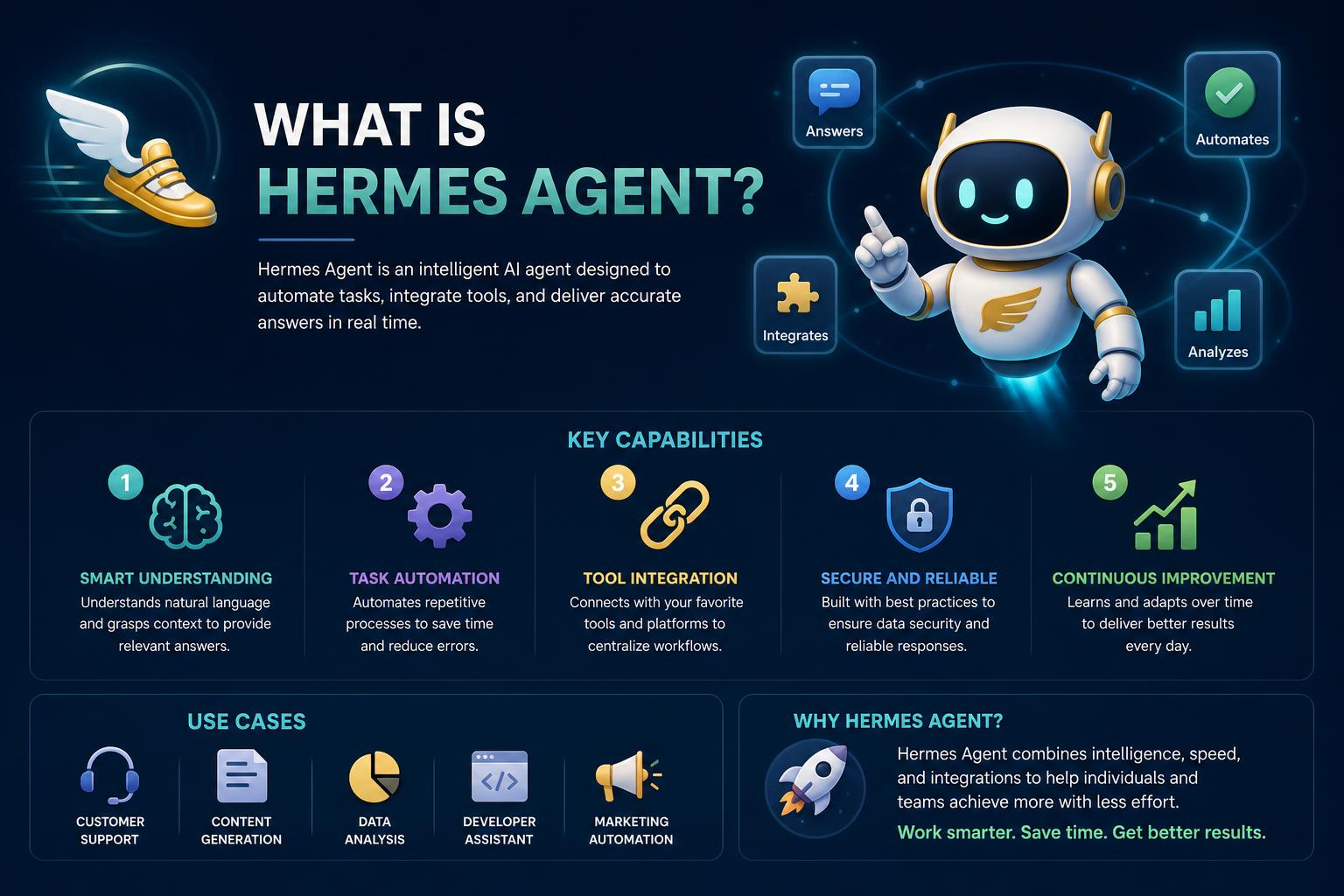
- Hermes Agent stands out as an open-source AI agent with persistent memory and a unique self-improving learning loop that grows smarter over time.
- Unlike stateless chatbots or coding assistants, Hermes builds reusable skills and a structured user model, retaining knowledge across sessions and platforms.
- Multi-agent architectures, compatibility with various deployment environments, and extensive customization make Hermes ideal for teams and individuals with repetitive, evolving workflows.
Artificial intelligence agents are evolving rapidly, but few frameworks stand out for their ability to learn, adapt, and improve over time in the way that Hermes Agent does. If you’ve been following recent discussions in the AI community or searching for alternatives to traditional, stateless agents, you’ve probably come across the name Hermès Agent. But what exactly is it, how does it work, and what makes it fundamentally different from its competitors?
This article dives deeply into Hermes Agent: from its core philosophy and architecture to practical deployment, multi-agent setups, and real-world advantages (and tradeoffs). We’ll unpack everything the documentation, developer commentary, and community feedback reveal—giving you a complete, natural-language walkthrough of the state-of-the-art in persistent, self-improving AI agents.
What Is Hermes Agent? Breaking the Mold of Typical AI Tools
Hermes Agent, developed by Nous Research, is not your typical coding assistant or single-API chatbot. Unlike most AI agents, it’s designed as an open-source, self-improving framework that gains capabilities the more you use it. Instead of starting fresh for every session and forgetting user preferences or past runs, Hermes Agent persists knowledge, skills, and behavioral patterns across all interactions. This enables it to genuinely learn from experience and become more effective with each task.
The secret sauce? Hermes operates with a built-in learning loop. It lives directly on your server (virtual or bare metal) and supports virtually any environment—Linux, macOS, native Windows, WSL2, and even Android via Termux. With easy installation (often a single curl or PowerShell command does the job!), Hermes aims to be accessible yet robust for both individuals and teams.
Why Is Persistent Memory a Game-Changer?
Most agents are stateless by design—each session is a clean slate, empty of historical context. This means every time you begin a new task, the agent has no idea what worked before, what your preferences are, or how previous challenges were solved. Hermes Agent fundamentally challenges this limitation by storing and retrieving experiences via persistent, agent-curated memory structures. Over time, it builds a deep profile of you (or your team): preferences, feedback, common task flows, and successful approaches are all tracked and evolved.
This persistent memory translates directly into greater efficiency. Users don’t need to repeat themselves. When the agent notices recurring patterns, it applies lessons learned automatically—saving time and reducing friction, especially in professional, repetitive workflows.
How Does the Learning Loop Really Work?
Hermes’ learning loop isn’t just a buzzword—it’s a specific closed cycle that drives the agent’s continuous improvement. Here’s the step-by-step breakdown, inspired by the architecture and research discussed across the documentation and community posts:
- 1. Task Execution: Hermes receives a goal, plans a solution, chooses the appropriate tools, and executes the steps. This part should feel familiar to anyone who has used AI agents before.
- 2. Outcome Evaluation: After completing each assignment, Hermes critically evaluates the success of the results. Feedback can be explicit (the user accepts, rejects, or edits the outcome) or implicit (the user moves forward without changes).
- 3. Skill Extraction: When the agent handles a non-trivial success, it abstracts the reasoning pattern and procedure into a named skill—a structured template representing a proven approach for similar tasks.
- 4. Skill Refinement: As new data comes in—different approaches, shifting preferences, or evolving contexts—Hermes reviews its skills and updates them. The best-performing method for recurring problems becomes the new standard.
- 5. Skill Retrieval: The next time a similar request is encountered, Hermes consults its library of acquired skills and applies the most relevant pattern. This makes it quicker and more accurate for repeat task types, driving down time-to-solution and increasing reliability.
In short, Hermes turns one-off success into repeatable excellence—and evolves over time as conditions or use cases change.
Unique Features That Set Hermes Agent Apart
- Closed learning loop: Instead of only reacting to real-time commands, Hermes creates and refines a repository of actionable skills, learning not just from explicit instructions, but implicit behavioral cues.
- Platform-agnostic deployment: Hermes Agent runs on nearly any setup—local systems, Docker containers, cloud providers, or serverless environments. Want to manage your AI assistant from a Telegram chat while the core runs on a zero-maintenance VPS? No problem.
- Persistent cross-session memory: Hermes’ memory system doesn’t vanish when you close your laptop—it spans days, weeks, or months, tracking not just conversations but also feedback loops and behavioral shifts.
- Multi-platform gateway: Control Hermes via command line, popular messaging platforms (Telegram, Discord, Slack, WhatsApp, Signal, and more), integrated voice input, or even through automation triggers.
- Open skills standard and compatibility: The agent is fully compatible with agentskills.io—allowing skills to be portable, reusable, and even community-shared.
- Scheduled automations: Hermes includes a built-in cron-like task scheduling engine, enabling daily, weekly, or event-triggered actions across any supported platform—no external tools required.
- Parallel workflow support: Hermes can spawn isolated sub-agents for concurrent tasks, allowing for both single-threaded and distributed, parallel processing.
- Robust security model: With container isolation, command approval mechanisms, and configurable authorization, Hermes aims to be enterprise-ready and safe for multi-user scenarios.
User Modeling: Making AI Genuinely Personal
“Personalization” is a word that gets thrown around often, but Hermes Agent actually operationalizes it by building an ongoing, structured model of each user. Here’s exactly how this works according to the extensive documentation and editorial analysis:
- Task preferences: Hermes observes how users like their outputs formatted (for example, bullet lists vs. paragraphs), preferred data structures, stylistic nuances, etc.
- Decision history: It records what choices a user has made in similar situations, making it possible to pre-empt queries the user has already answered in the past.
- Task patterns: The agent tracks which kinds of requests a user or team habitually assigns—learning when, why, and how certain workflows are repeated.
- Feedback signals: Both explicit corrections and silent acceptance are treated as crucial feedback. If a user consistently modifies a certain template, for instance, the agent learns to adapt automatically in the future.
This progressive user-model makes Hermes less intrusive and more aligned over time—eliminating redundant clarification questions y adaptándose proactivamente a tu forma de trabajar. Para contenido de equipos, investigadores y desarrolladores que usan el mismo asistente de IA día a día, esto puede suponer un aumento notable de productividad.
Deploying Hermes Agent: From One-Liners to Enterprise Integrations
Setting up Hermes Agent is fast and straightforward. Most users can get started with a single-terminal command: either a curl statement (for Linux/macOS) or a PowerShell command (for Windows). The installer is comprehensive: it grabs all core dependencies (Python, Node, uv, ripgrep, ffmpeg, MinGit), checks for existing installations to avoid overwrites, and sets up Hermes in isolated directories to prevent environment conflicts.
Platform support extends to:
- Linux (Debian/Ubuntu, CentOS, Arch, Fedora, etc.)
- macOS (all supported releases)
- Windows (native, with or without WSL2)
- Android (via Termux, with minor limitations)
- Nix/NixOS
- Containerized deployments (Docker, Singularity, and more)
Voice functionality and messaging integrations require only minimal extra setup and allow you to. With the Hermes Desktop application, installation on Windows and macOS is even simpler: just download the installer, run it, and you’re ready to dive into multi-modal AI workflows.
Command Line, Messaging, and Automations: Total Flexibility for Any Workflow
Hermes offers rich command line (CLI) and messaging-based interfaces, ensuring compatibility for solo users, teams, and automation pipelines alike. Whether you’re interacting through Telegram, Discord, Slack, WhatsApp, or the local shell, most bot commands and automations are shared across platforms—making the learning curve flatter when shifting environments.
- CLI Interface: Launch Hermes in terminal mode with its built-in TUI (Text User Interface), opening up features like slash-command autocomplete, streaming tool output, and persistent history.
- Messaging Gateway: Configure Hermes as a bot across dozens of platforms. Bidirectional messaging, voice note transcription, and platform-specific settings are supported.
- Automated jobs: The agent includes a built-in scheduler for daily, weekly, or custom event-based tasks. Think backup reports, notifications, or even custom workflow triggers—without needing a separate cron job manager.
Multi-Agent Architectures: Specialization at Scale
Hermes doesn’t just support solo operation—it thrives in multi-agent environments. In sophisticated set-ups, you can spin up multiple domain-specific Hermes agents, each specializing in an area (like legal review, devops, research, etc.). A central coordinator agent routes tasks to the best-qualified specialists based on their accumulated skill libraries. Skills can even be transferred between agents (with controls), allowing new areas to benefit from existing expertise. This approach aligns perfectly with cutting-edge AI research on emergent, collaborative multi-agent systems.
- Coordinator-agent routing: Centralized assignment of incoming tasks for maximum expertise.
- Skill inheritance and sharing: Skills acquired in one agent can, where relevant, be propagated to related agents—accelerating new deployments.
- Feedback propagation: Win scenarios or improvements in one domain can trigger updates throughout the network, driving continuous improvement at scale.
Hermes Agent vs. OpenClaw and Other Alternatives
Why choose Hermes over other frameworks like OpenClaw? Based on in-depth editorial reviews and documentation, it comes down to a difference in philosophy:
- OpenClaw: Focuses on broad, reactive capability—stringing together powerful tools for wide-ranging, one-off tasks. Setup is lightweight, but there’s no native cross-session learning or skill extraction. Each run starts from zero, no matter how many times similar requests are made.
- Hermes Agent: Prioritizes long-term, structured improvement over time. There’s a slightly higher upfront setup cost, but the reward is an agent that genuinely grows with usage, capturing nuance and expertise with every repeat interaction. Skills are created, revised, and retrieved as needed—enabling persistent evolution.
The tradeoff is simple: if you want rapid-fire, breadth-first capability across an unpredictable range of tasks, OpenClaw (and its equivalents) may be simpler. If your workflows are repetitive, structured, and occur in consistent teams or environments, Hermes will deliver compounded value session after session.
Security, Customization, and Community
Hermes Agent takes security and extensibility seriously.
- Security: All command executions can be gated, require explicit approval, and run in isolated containers where necessary. This is crucial for production or sensitive deployments.
- Customization: Create named Bots, each with their own persona, memory, skill library, routines, and messaging chats. Define default behaviors using the global
SOUL.mdand use project-specific Context Files to shape discussions. - Integrations: Connect seamlessly with popular endpoints: Nous Portal, OpenRouter, OpenAI, and virtually any other standardized model or tool via configurable providers. For managed all-in-one access, Nous Portal offers bundled tools (web search, TTS, image gen, etc.) via a single sub.
- Community driven: Skill standardization (agentskills.io), a thriving Skills Hub for sharing, and plug-and-play compatibility with other agent frameworks.
Who Should Use Hermes—and Who Shouldn’t?
Hermes Agent isn’t a one-size-fits-all solution—and that’s actually one of its strengths. Knowing when to use it will make your AI workflow significantly more effective.
Best use cases:
- Teams or individuals handling structured, repetitive workflows, such as document processing, research cycles, content creation, code review, or legal analysis.
- Environments where the same users or groups work with the agent regularly, so user modeling creates cumulative value.
- Projects where quality and efficiency can be tracked, measured, and improved over time—enabling you to see the real impact of the learning loop.
When to consider alternatives:
- If you need an agent for broad, one-off task coverage with little repetition, Hermes’ skill system may provide less benefit (most skills never get reused).
- If infrastructure complexity or operational overhead are critical issues, stateless or managed platforms may be easier to implement—Hermes, as an open-source and self-hosted tool, does require some technical maintenance (though guides and automated installers help a lot).
Hermes Agent in Practice: Real-World Deployment & Migration Advice
If you’ve been using OpenClaw or another LLM-driven agent, the Hermes setup wizard can detect prior configurations and offer to import memories, skills, API keys, and persona files on first install. This makes migration straightforward and minimizes the learning curve.
For distributed or cloud-based teams, it’s possible to deploy Hermes on low-cost VPSes, GPU clusters, or serverless platforms like Daytona and Modal—making it extremely cost-efficient, especially with serverless environments where your AI hibernates when not in use.
Once installed, core interaction can be through the CLI or by running the gateway and chatting via your favorite messaging app. A range of slash commands, context files, and automation hooks makes fine-tuning and extension straightforward for even complex tasks.
Key Takeaways
- Hermes Agent transforms AI from one-off task solver to continuously learning assistant, creating and refining skills for real parallelization and personalization.
- The persistent learning loop—execution, evaluation, skill extraction and refinement, retrieval—lies at the heart of Hermes’ self-improvement and distinguishes it from stateless competitors.
- User modeling means the agent knows your preferences and adapts, driving out repetitive clarification and increasing efficiency session by session.
- Hermes flourishes in structured, repeated-use environments where memory and gradual enhancement payoff multiply over time.
What Is Retrieval-Augmented Generation (RAG) in Artificial Intelligence: Complete Guide and Examples