
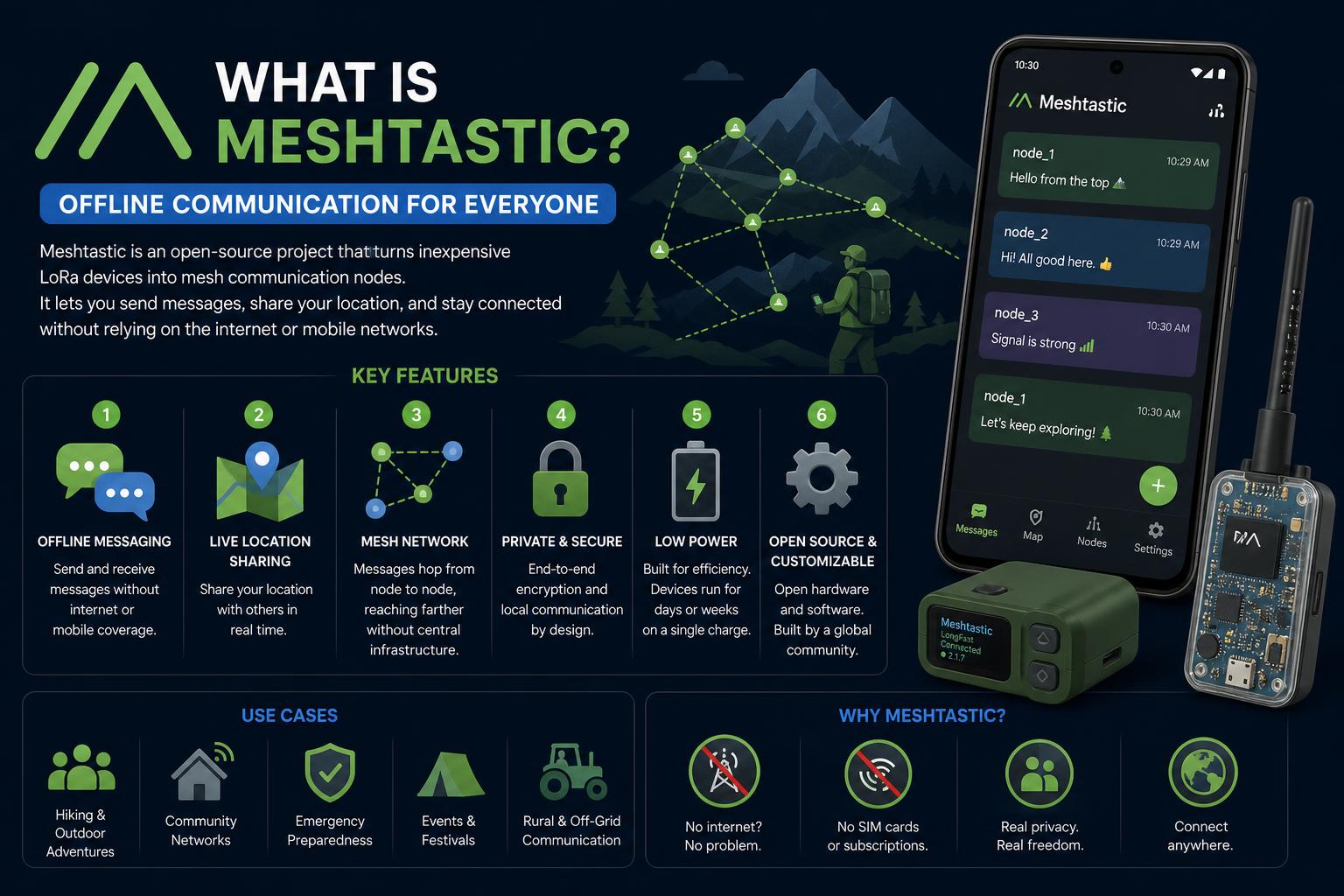
- Meshtastic provides off-grid text messaging and data exchange using LoRa-based mesh networking, ideal for remote communication without reliance on cellular or Wi-Fi infrastructure.
- Its open-source nature and community-driven development make it accessible and highly customizable for a range of use cases, from hiking to disaster response and IoT integration.
- While Meshtastic excels in small to medium decentralized networks, competing solutions like MeshCore and Reticulum address scalability and integration across diverse physical networks, each presenting unique strengths and challenges.
Imagine sending a message from a remote mountain peak or deep in the woods, knowing you’re completely off-grid but still able to ping your friends’ devices wirelessly for an update. Enter Meshtastic: a project that’s turning that very scenario into reality, no cell towers required, no overpriced satellite gadgets in sight. Over the last few years, LoRa-based mesh networking has exploded among outdoor enthusiasts, explorers, emergency preppers, and tech geeks. But what exactly is Meshtastic—and why has it become the de facto reference point for off-grid, decentralized communication?
This article will walk you through everything you need to know about Meshtastic. We’ll dive into how it works, its technical nuts and bolts, the kinds of hardware you can pair with it, the use cases it shines in, challenges it faces, and how it compares to alternatives like MeshCore and Reticulum. By the end, whether you’re a hiking junkie, urban explorer, or just curious about mesh technologies, you’ll have a comprehensive understanding—plus some fresh ideas on how you might use or even improve this open-source marvel.
Defining Meshtastic: A Snapshot
Meshtastic is an open-source communication platform that leverages LoRa (Long Range) radio technology to create peer-to-peer mesh networks, enabling encrypted messaging and data transfer in areas without conventional connectivity. It’s accessible via meshtastic.org and has grown rapidly thanks to an active community, DIY spirit, and robust support for popular microcontrollers and dev boards.
How Does Meshtastic Actually Work?
At its core, Meshtastic uses LoRa radios: small, low-power modules capable of transmitting data over impressive distances (typically 2–5 km, but community records have pushed over 300 km in the right conditions). Each device on the mesh can rebroadcast messages from its neighbors, enabling even greater reach using the “hop” principle. LoRa operates in license-free sub-gigahertz ISM radio bands, which is crucial: anyone can use this spectrum without special permits.
Devices are usually built around accessible hardware like the ESP32, nRF52840, or commercial devboards from names like LilyGo, Heltec, RAK Wireless, and Seeed Studio. By connecting their device to a phone with Bluetooth or Wi-Fi, users can send and receive short text messages and telemetry data off-grid, even if just a handful of nodes make up the network.
- Text-only for now: No voice, video, or files due to tight bandwidth—think SMS, not WhatsApp.
- Resilient by design: If you’re out of range of one node, as long as another is close enough, your message hops through automatically.
- Low-bandwidth, but long range: LoRa’s magic is the tradeoff: range over speed, perfect for simple messaging or sensor data.
Meshtastic’s Origin Story: From Hobbyist Dream to Community Powerhouse
Kevin Hester kicked off Meshtastic in early 2020, looking for a way to stay in touch during activities where reliable internet just wasn’t there. What started as a practical solution for hikers and outdoor adventures quickly snowballed into an energetic, grassroots global movement. Hundreds of contributors, open-source code, and an inclusive developer philosophy continue to attract everyone from weekend trekkers to emergency response teams and IoT experimenters.
The ethos is simple: build useful, decentralized tools that work anywhere, even when everything else doesn’t. The rapidly evolving software stack allows regular users to get started with minimal technical know-how, while tinkerers and advanced users can customize, extend, or integrate Meshtastic almost endlessly.
Meshtastic Under the Hood: Technical Foundations
1. The Building Blocks: LoRa and BLE
Meshtastic’s secret sauce is in marrying LoRa for its physical radio layer with BLE (Bluetooth Low Energy) for convenient phone connectivity. Here’s the rundown:
- LoRa: Delivers low-bandwidth data over long distances using sub-GHz frequencies (such as 915 MHz in North America, 868 MHz in Europe).
- BLE/Wi-Fi: Simplifies pairing the radio hardware with your Android or iOS device, or even a laptop.
- Microcontrollers: Devices like the ESP32 or nRF52840 are favorites for their power efficiency and affordability.
- Optional extras: Many boards include integrated GPS/GNSS chips for location tracking and Wi-Fi for additional bridge/gateway features.
2. Mesh Networking: How the Hops Work
Each Meshtastic device doesn’t just send to its immediate neighbor—it acts as both client and relay (‘mesh node’), rebroadcasting messages to extend coverage as far as physical geography (and node density) allow.
- This system thrives in line-of-sight conditions. Obstacles like mountains, buildings, or dense forests can block signals, so more nodes mean better reliability.
- Range improves with altitude and fewer obstructions. Just like ham radio, putting a device on a hill or tower dramatically extends reach.
3. Bandwidth: Limitations and Opportunities
Don’t expect to stream music—LoRa is tailored for low data rates. This keeps devices efficient, but limits throughput: short text and telemetry are the main game. The upside is ultra-low power consumption, perfect for solar-powered, unattended installations.
Meshtastic’s Roles: Tailoring the Network to Fit
One of Meshtastic’s standout features is ‘roles’—different operating modes for different use cases or kinds of devices. Here’s a breakdown:
- Client: Your ‘normal’ node, ideal for end users. It broadcasts its presence, sends telemetry, and rebroadcasts (‘hops’) messages for its neighbors.
- Client Mute: Like a client, but disables rebroadcast to prevent overloading when you have, say, two nodes in the same backpack.
- Client Hidden: Almost invisible—only transmits when necessary. Used where power savings are essential, or minimal visibility is needed.
- Client Base: Optimum for fixed, well-placed nodes (on a rooftop, for example) to prioritize rebroadcasting for select users.
- Tracker: A node whose main job is location tracking, perfect for pets, equipment, or group members on the move.
- Lost and Found: A noisy, public role for recovery—broadcasts location persistently if a device is lost.
- Sensor: For weather stations and telemetry—telemetry has highest priority.
- Repeater: An infrastructure node that rebroadcasts every received message. Invisible in node lists but critical to network backbone.
- Router: Similar to repeater, but also provides network telemetry and appears on node lists. ‘Router Late’ behaves like a router, but waits until other nodes have had a chance before re-broadcasting, plugging coverage gaps.
- TAK / TAK Tracker: Specialized for ATAK tactical apps—primarily for military, search and rescue, or similar environments.
Hardware for Meshtastic: What Devices Should You Consider?
The sweet spot for Meshtastic is hardware you can tinker with, re-flash, and deploy anywhere:
- Development boards: Esp32, nRF52840, and hybrids like the LilyGo T-Beam or Heltec Wireless Stick.
- Commercial ready-made devices: Several manufacturers produce out-of-the-box nodes complete with e-ink displays, GPS, and sturdy cases.
- DIY kits: Experienced users routinely build their own, add solar, weatherproofing, and custom features.
For complete details on compatibility and official recommendations, check the device list on the official Meshtastic site.
Meshtastic in the Wild: Real-Life Use Cases
The versatility of Meshtastic has led to creative deployments across many fields. Here are some real-world scenarios:
1. Expedition and Fieldwork Communication
Groups like The Mars Society have used Meshtastic during analog astronaut missions in remote deserts, where cellular coverage is nonexistent and Wi-Fi is a pipe dream. Keeping in touch isn’t just convenient—it’s often a safety requirement. Knowing you can get an alert out, or track a team member’s GPS, makes risky exploration a lot safer.
2. Hiking, Climbing, and Backcountry Sports
Outdoor enthusiasts, hikers, and climbers are among Meshtastic’s biggest fans. A handful of pocketable nodes can establish reliable group messaging without the need for any base infrastructure. Parents tracking kids, friends organizing meetups in the wild, groups coordinating during endurance races—all benefit from off-grid mesh messaging.
3. Disaster Preparedness
When infrastructure collapses—wildfires, hurricanes, power grid failures—conventional comms may fail. Meshtastic enables rescue teams, neighborhood watches, or families to maintain situational awareness and coordinate responses, even in chaos, by building ad-hoc networks of nodes. Some cities (particular in disaster-prone areas) are even piloting Meshtastic as a backup for civil defense.
4. Privacy and Censorship Resistance
Areas with internet blackouts or censorship can benefit from low-profile, decentralized messaging networks like Meshtastic. Since every device is a relay, there’s no single point of failure or control, and users aren’t reliant on traditional ISPs. While it won’t replace the internet, it’s a lifeline for local communication and sharing, even in heavy censorship environments.
5. IoT and Sensor Networks
Meshtastic isn’t just about people sending texts. Sensors for weather, environmental monitoring, smart agriculture, and industrial projects can use the same mesh principles, broadcasting sighting or analytic data across wide areas without expensive infrastructure or 4G/LTE connectivity. Some use-cases even leverage low-powered nodes as stationary weather stations (the ‘Sensor’ role), pushing real-time updates across the mesh.
The DIY and Community Aspect
What sets Meshtastic apart, culturally as much as technically, is its DIY, community-powered philosophy.
- Hundreds of open-source contributors continually refine features, squash bugs, and develop plugins/extensions.
- Documentation, troubleshooting guides, and active forums help new users onboard and experiment with custom setups.
- The network can grow ‘organically’—anyone can add a homemade node, experiment with boosting range, add solar panels, or build custom node enclosures.
As seen on sources like Wikipedia and active community forums, the blend of approachability and tinkerer potential is a huge reason for its popularity—whether you’re a dad keeping his family safe or an RF hacker plotting solar-powered relays.
Challenges, Bottlenecks, and Event Lessons
No technology is a panacea, and Meshtastic has its limitations—especially as networks scale.
- Line-of-Sight Disease: The most common limitation is simple physics: signals drop out when heavy obstructions block the way. Urban environments full of concrete, thick forests, or hilly terrain all impact usability.
- Density Needed: The mesh is only as good as its node density; coverage gaps mean lost or delayed messages.
- Bandwidth Choke: The low data rate that makes LoRa so thrifty on power also means that crowded networks or too much traffic (like a barrage of chat during a big event) can overwhelm capacity. Notably, at Hamvention 2024, one user overwhelmed a public mesh using MQTT bridges, causing network congestion. The fix? Special firmware for events, optimized broadcasting modes (“Short Turbo”), and limits on rebroadcasts, keeping thousands of nodes stable at conferences like DEF CON.
- No Internet Replacement: Meshtastic doesn’t bring the internet off-grid; it’s all about short, reliable text/data. Sharing Wikipedia or large data sets on the mesh isn’t an option, though you can send emojis with your text for some fun.
Meshtastic Alternatives: MeshCore and Reticulum
The mesh networking space isn’t a one-horse race. As user needs have shifted and networks have grown, other projects like MeshCore and Reticulum have gained traction—each with different philosophies, strengths, and drawbacks.
The MeshCore Approach
MeshCore arose as an answer to some of Meshtastic’s scalability limits, particularly for larger, more public networks. It introduces a more sophisticated routing protocol, cutting back on “flooding” (where every message pings every node) and instead forwards messages via defined paths, dramatically reducing radio clutter and congestion.
With support for up to 64 hops, MeshCore can, in theory, service much broader regions than Meshtastic’s default, though it sacrifices some decentralization: two main device types exist—’companions’ to send messages and ‘repeaters’ to span the mesh. This centralization may offer increased reliability but also introduces dependencies, and the ecosystem is less open—with some proprietary client software and ‘paywalled’ features. This has triggered debate among open-source advocates, as seen on Hacker News and community forums.
Installation is similar—the same LoRa hardware often works for either project (after flashing the right firmware), but users must decide between open communities and proprietary dependencies.
Enter Reticulum: Going Beyond LoRa-Only Meshes
If you think of Meshtastic and MeshCore as LoRa-centric messengers, Reticulum aims for something much bigger: a truly interlinked, protocol-agnostic mesh network.
Reticulum is a networking protocol that automatically routes data not just over LoRa radios but across any medium—Wi-Fi, LAN, TCP/IP, Internet, point-to-point microwave, or even packet radio. Its promise is to treat all these transport types as equal, seamlessly bridging local, regional, or global segments into a single, scalable mesh. Hikers in Minneapolis could interconnect with friends in Chicago via the Internet, but if that fails, direct radio or point-to-point links take over—no central servers required, no single failure point.
This multi-medium connectivity is huge: networks can interlink even if they use different ISM bands or legal frequencies, and the “address space” for nodes is global, avoiding the overlap and address management headaches of IP addressing. The protocol is also encryption-heavy by default, ensuring privacy and resilience.
Downsides? Reticulum isn’t tied to cheap standalone radios (like those flashed with Meshtastic); data is routed via dumb modems (like RNode firmware) connected to minimal computers—Raspberry Pi Zeros, laptops, or similar. This extra hardware and power requirement is a roadblock for remote solar-powered relays, though efforts like “microReticulum” aim to bring full functionality to microcontrollers soon.
Reticulum’s organizational flexibility means local networks can remain private and autonomous, but as soon as even a single device connects two groups (via radio, Ethernet, or otherwise), both become parts of a global mesh. There’s no central coordination or gatekeepers: anyone can bridge any two networks at any time. The documentation and protocol are transparent and evolving, inviting innovation but currently lack flashy, user-friendly mobile apps for casual users.
Comparing Meshtastic, MeshCore, and Reticulum
| Feature | Meshtastic | MeshCore | Reticulum |
|---|---|---|---|
| Openness | Fully open-source | Mix (open protocol, but some proprietary clients) | Fully open-source |
| Hardware Support | Broad (ESP32, nRF52840, LilyGo, Heltec, etc.) | Similar LoRa support | Any device with serial/TCP interfaces |
| Network Flexibility | LoRa-based mesh only | LoRa-based mesh | Multi-medium (LoRa, Wi-Fi, LAN, Internet, more) |
| User Focus | Messaging, tracking, IoT for small/medium groups | Large mesh networks, region-wide messaging | Full protocol routing, massive scale, app agnostic |
| Mobile Apps | Yes (Android/iOS) | Yes, but some proprietary/paywalled | Few, mostly desktop/terminal, some GUI in development |
| Scalability | Limited: traffic congestion in very large meshes | Much greater, with path-based routing | Theoretically unlimited (global routing) |
| Community | Large, active, open | Smaller, niche, mix of open/proprietary | Small but growing, highly technical |
| Typical Use Cases | Off-grid text, disaster comms, hiking, small IoT | Large public events, city-wide messaging | Building alternative Internet, research, experiments |
For the average off-grid user (hiker, family, local club), Meshtastic remains the most approachable, plug-and-play solution. The mobile apps are slick, the hardware is cheap and accessible, and getting started takes minutes. For groups aiming to build resilient, city-wide, or event-scale networks, MeshCore addresses core scalability concerns—but at the cost of some openness and decentralization. Reticulum is the white whale for ambitious builders and researchers interested in multi-layered, fail-safe mesh networking that could one day rival internet-like robustness—at the cost of added hardware and a steeper learning curve.
Community, Support, and Real-World Deployment
Thanks to an inclusive, supportive, and vocal community, Meshtastic resources abound:
- Documentation and guides on official docs and GitHub.
- Lively forums on the official forum, Reddit, and Discord servers.
- Hundreds of blogs, YouTube channels, and walk-throughs demonstrating use cases from basic setup to custom solar-powered relay builds and experimental mesh expansion.
Community records continue to be broken as users push distances further (the current record is over 300km!) and test new hardware combinations. Collaborations abound, from Mars Society research expeditions to city-level pilot programs for disaster preparedness. The open ethos means anyone, anywhere can instantly join, contribute, or spin up their own region with a handful of affordable radios.
Limitations to Keep in Mind
Before you throw your smartphone in a lake and declare digital independence, a few practical caveats:
- Battery Life: LoRa is frugal, but regular chats or GPS tracking will drain devices faster, especially with compact batteries or small solar setups.
- Bandwidth: Text only—no images, video, or big files. Expect delays if messages stack up or if nodes are far apart.
- Interference: Like all ISM-band radios, LoRa nodes can suffer from interference from Wi-Fi, microwaves, or competing devices—though usually less so than traditional Wi-Fi or Bluetooth.
- Setup and Maintenance: While much easier than setting up amateur radio, expect occasional firmware upgrades, configuration tweaks, and the odd troubleshooting session (especially in DIY setups).
Looking to the Future: Ongoing Innovation and Integration
Meshtastic isn’t sitting still—the pace of development is accelerating as new contributors, hardware, and partnerships join up. Features in the pipeline include improved message encryption, richer telemetry support, cross-compatibility with gateway services (like MQTT for bridging isolated meshes to the internet), expanded hardware support, and new role types enhancing network intelligence.
Reticulum and similar projects continue to inspire ‘cross-pollination’: Some plugin experiments have seen Meshtastic nodes piggyback on Reticulum routing, providing hybrid setups with both LoRa mesh and internet fallback. Community discussions are ripe with ideas around integrating u-blox GPS, developing “supernodes” for regional coverage, and simplifying onboarding for complete beginners.
Getting Started with Meshtastic
- Choose your hardware—preferably a node from the compatibility list, or a tried-and-true development board. Solar kits are perfect for extended outdoor use.
- Install the firmware: Official software and guides make the flashing process (with tools like esptool or web-based flashers) beginner-friendly.
- Pair with your phone or laptop: Bluetooth makes this a snap, with native mobile apps for Android and iOS to handle messaging, settings, and GPS sharing.
- Configure your device’s role: Are you a client? Repeater? Get the right mode for your setup.
- Organize your network: For groups, plan node locations to maximize coverage. Experiment with outdoor placement, repeaters in high spots, and backup batteries.
Community forums and documentation, especially the , can step you through troubleshooting guidance, best practices, and updating your software as new features arrive.
Meshtastic—and the wider family of mesh projects like MeshCore and Reticulum—represent a surge of creativity for anyone dissatisfied with the limitations and centralization of mainstream connectivity. It’s stirring to see open-source, grassroots collaboration building genuinely useful alternatives for times and places where modern infrastructure just doesn’t reach, or isn’t trustworthy. Whether for hiking, disaster response, or just plain off-grid tinkering, LoRa mesh is set to be a backbone technology for privacy advocates, explorers, and community-minded builders for years to come.