
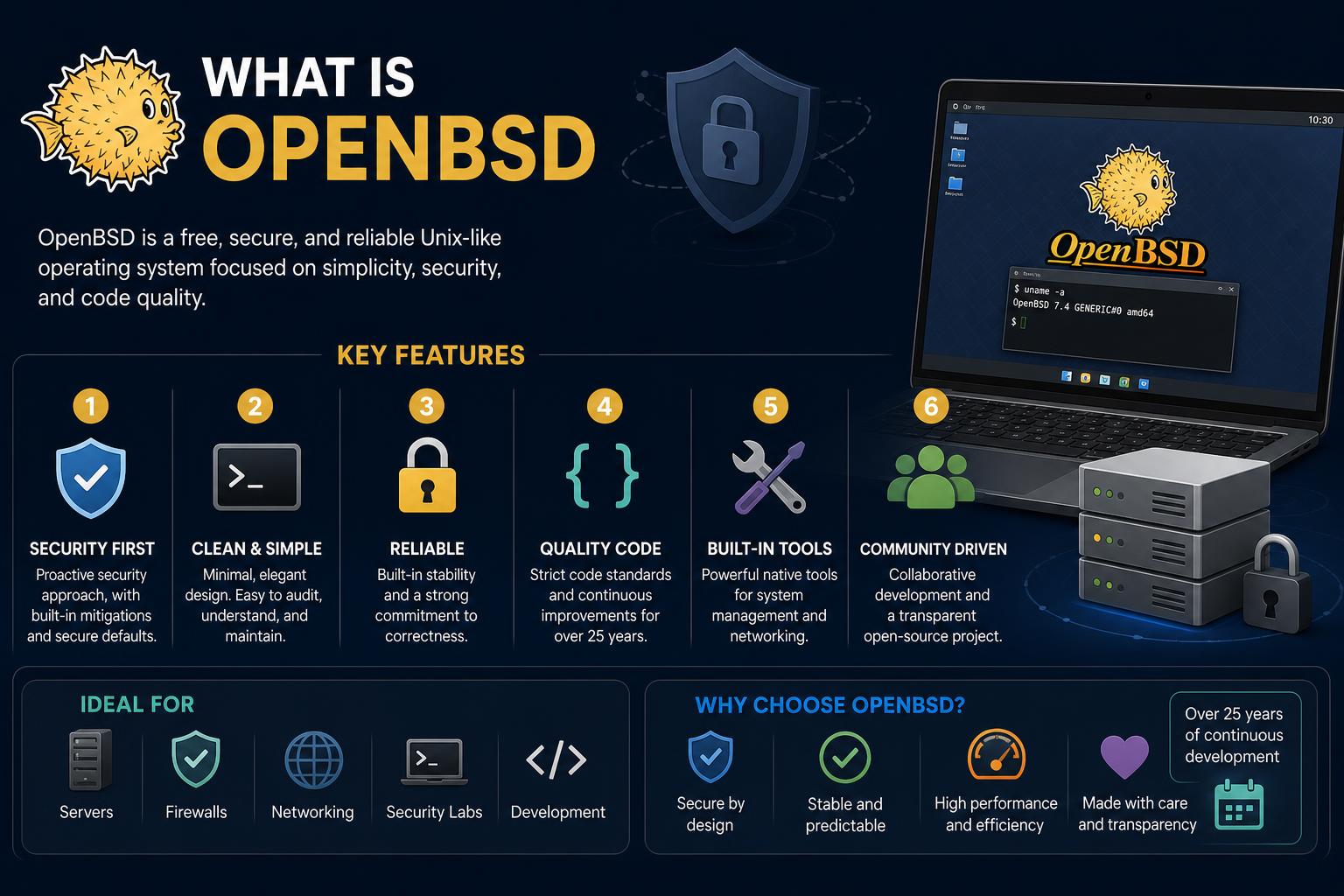
- OpenBSD is a security-centric, open-source Unix-like OS with a strong emphasis on code correctness, stable behavior, and minimalist design.
- Its security record is unmatched, featuring innovations like privilege separation, W^X, pledge, unveil, and proactive code auditing adopted by many critical infrastructure projects worldwide.
- OpenBSD excels on a wide range of hardware, making it a go-to solution for firewalls, secure servers, and learning platforms needing reliability across diverse architectures.
OpenBSD stands as a remarkable chapter in the modern history of secure operating systems. Renowned among IT professionals and security enthusiasts, it is often considered the gold standard for software security, code correctness, and predictable operational behavior. Whether you are a system administrator, a student delving into Unix-like platforms, or someone simply pondering which OS to trust for your critical workloads, understanding OpenBSD is vital in a landscape where reliability and integrity matter more than buzzwords and flashy new features.
But what actually makes OpenBSD so special? This article is your deep-dive tour through every aspect of OpenBSD. We’ll explore its roots, architecture, security philosophy, hardware compatibility, real-world use cases, and comparisons with other Unix-like platforms such as FreeBSD, NetBSD, and Linux. By the end, you’ll see how OpenBSD’s meticulous design choices have built a loyal following, and why—despite not being the most feature-packed or widely marketed OS—it has outlasted expectations and continues to be essential for those who truly care about robustness, simplicity, and security above all else.
What Is OpenBSD? The Soul of Predictability and Security
OpenBSD is a free and open-source Unix-like operating system that emerged in 1995 after being forked from NetBSD. Its philosophy revolves around making secure choices the norm—and not relying on the habits or expertise of the administrator to “fix” unsafe settings post-install. The result? Out-of-the-box security, a transparent codebase subjected to continual audits, and the type of reliability that builds trust in high-stakes environments like network infrastructure, firewalls, and security appliances.
Built from the distinguished BSD lineage (Berkeley Software Distribution), OpenBSD traces its DNA to the powerful and storied Unix systems developed in the 1970s at the University of California, Berkeley. While the acronym “BSD” might confuse some with variations like “b sd” in informal searches, rest assured it always refers to an unbroken tradition of robust, open Unix-like operating systems.
OpenBSD’s signature is its rigor: each release undergoes meticulous code reviews, frequent security audits, and is curated to avoid unnecessary bloat. If Linux distributions prioritize flexibility and application compatibility, OpenBSD chooses clarity, minimalism, and resilience, thus appealing to those who demand a platform that resists carelessness and complexity as a matter of design.
A Brief Chronology of OpenBSD’s Journey
The story of OpenBSD begins in 1995, when Theo de Raadt—a co-founder and core developer of NetBSD—branched out to establish a project dedicated to uncompromising security and openness. The initial parting was more than a technical disagreement; it was a philosophical divergence about code transparency, project management, and the importance of correctness in every line committed.
Key milestones in OpenBSD’s development:
- 1995: The fork from NetBSD creates a unique, security-obsessed path for OpenBSD, emphasizing openness and code auditing.
- 1996: OpenBSD’s initial releases pave the way for twice-yearly releases, a practice still maintained for over two decades.
- Proactive Security: Introduction of features like privilege separation, W^X (Write XOR Execute), guard pages, and in-depth memory protections long before they became industry trends.
- Infrastructure Contributions: First to offer tools like OpenSSH, PF (packet filter), doas, OpenSMTPD, and more, most of which are now standards across platforms, including Linux and Windows.
- Culture of Openness: OpenBSD leads in providing anonymous access to its source code repositories—well before open source became mainstream, making contributions from the global community seamless.
- 2010s–2020s: Ongoing hardware platform support expands (including advanced PowerPC, SPARC64, ARM, and RISC-V), while releases consistently prioritize minimal footprint and top-tier security defaults.
OpenBSD Philosophy: Security by Design
Few operating systems have the courage to make security the default—OpenBSD does, unapologetically. Its core concept: “secure by default,” means that from the moment you install OpenBSD, you have a hardened system without requiring any post-install wizardry or deep configuration knowledge. This is the antidote to systems that ship exposed, under-protected, and hope the administrator knows enough to lock things down before it’s too late.
But security is only the beginning. OpenBSD’s commitment to:
- Code Correctness: “It just works,” not only means expected features are functional, but also that they are correct in their implementation—catching bugs and logic errors long before they become vulnerabilities.
- Documentation: OpenBSD has arguably the most accurate, up-to-date, and exhaustive documentation in the Unix-like ecosystem. The man pages aren’t just references; they are considered the canonical, authoritative guides. If it isn’t in the man page, question if it should even exist.
- Minimalist Approach: If a feature increases the attack surface or complexity without substantial value, OpenBSD would rather exclude it—even if it means slower “feature growth” compared to more commercial systems or those chasing buzzword-driven development.
- Portability: OpenBSD’s NetBSD roots shine through—support for a wide variety of hardware, from classic x86 machines to exotic architectures, is common. This diversity also acts as a force magnifier for bug-finding: the more platforms, the more unique edge cases emerge and are corrected.
OpenBSD’s Unique Security Technologies
If you’ve ever wondered why OpenBSD boasts some of the best real-world security records, it’s thanks to innovations that most systems only adopted years later—if ever.
- Privilege Separation: Applications are designed to start with elevated privileges only for the functionality that needs it, and immediately drop to minimal privilege for the bulk of their operation. For example, web servers run chrooted as a special unprivileged user with a shell that cannot accept logins. This is security through compartmentalization, not just by policy but enforced at the process level.
- W^X: Write XOR Execute is a policy where memory pages are marked as either writable or executable, but never both—making many common attacks dramatically more difficult. OpenBSD implemented this back in 2003, years before it became a buzzword in the Linux world.
- Guard Pages: Rigorous use of guard pages placed between memory allocations helps identify and block buffer overruns, one of the most common sources of vulnerabilities in C/C++ environments.
- Address Space Randomization (ASLR/PIE): OpenBSD pioneered randomizing where code and data reside in memory, making attacks that rely on predictable memory layouts much harder.
- Pledge and Unveil: Unique to OpenBSD, these system calls tightly restrict what an application is allowed to do. Pledge restricts which system calls are available to a process. Unveil locks down filesystem access to only what the program needs (e.g., web browsers can only write to the Downloads folder and cannot snoop around your home directory).
- Always Secure Defaults: OpenBSD starts with nearly every network service disabled, only enabling them as needed. Its firewall PF is best-in-class, and its cryptographic features are deeply integrated and not suffering from export or legal restrictions thanks to OpenBSD’s Canadian base.
- Audited Third-Party Software: Even externally sourced programs and libraries are patched and reviewed by the OpenBSD team before inclusion in the base system.
- Strong, Ongoing Code Auditing: OpenBSD’s codebase is subject to perpetual reviews—a never-ending process, with the aim to spot not just current vulnerabilities, but to eliminate whole classes of mistakes before they even surface in production.
Base System and Included Software
When you install OpenBSD, you get much more than just a kernel and minimal tooling. The philosophy is to ship a complete, coherent platform, curated for maximum interoperability, security, and ease of maintenance—without assuming you’ll glue together your own set of utilities from various sources. Here’s what you can expect:
- Shell and Base Utilities: The default shell is a public-domain variant of the Korn Shell (ksh), providing a robust, scriptable environment out of the box. Bash and numerous alternatives are available as packages. Core Unix tools, editors, and management commands are all included and thoroughly documented.
- Networking and Firewall: OpenBSD ships with the PF packet filter for stateful firewalling, Network Address Translation, and advanced traffic shaping/queuing. Routing, VPNs (including integrated IPsec), OpenBGPD (border gateway protocol daemon), OpenIKED (IKEv2), and OpenOSPFD are all ready to go.
- Security Services: OpenSSH, SSL/TLS libraries (LibreSSL), OpenSMTPD (simplified mail server), and a collection of authentication and cryptography solutions, all maintained or forked by the OpenBSD team.
- Graphical Environment: Xenocara, a customized build system for X.Org, comes with several window managers (FVWM, cwm, twm), drivers for Intel and AMD graphics, and support for a range of hardware including Laptops, PowerPC Macs, and more.
- Servers: OpenBSD includes web servers (httpd), mail servers, FTP, DNS, NFS, and more. Service hardening is the default; if a server runs, it does so with strong privilege separation and careful sandboxing.
- Extensive Documentation: The legendary OpenBSD man pages are considered the bible for the system and are exhaustively maintained with every release. Developers are expected to update documentation along with code changes.
- Packages and Ports: While the base system is intentionally minimalist, thousands of third-party packages (GNOME, KDE, Firefox, MariaDB, PHP, etc.) are available through the ports tree, and binary packages are provided for each supported release. Our OpenBSD package management, pkg_add, makes these simple to install and maintain.
Supported Hardware and Platform Diversity
One of OpenBSD’s undervalued strengths is its unrivaled platform support, spanning a vast spectrum of hardware. This philosophy not only makes OpenBSD useful for legacy enterprise hardware or less common server classes, but it actively helps flush out code anomalies—ensuring code correctness and stability across the board.
- Classic Platforms: x86 and x86_64 architectures are fully supported, making OpenBSD a plug-and-play option for most major laptops, desktops, and servers from well-known vendors like Dell, Lenovo, and HP. Even 486-era machines can run OpenBSD, albeit with significant resource constraints.
- Server-Grade Hardware: IBM’s POWER-based PowerNV servers, Sun UltraSPARC, Fujitsu SPARC64, and Cavium Octeon (MIPS64-based) hardware are directly compatible. OpenBSD also supports ARM-based boards—like BeagleBone, PandaBoard, Raspberry Pi (to an extent), and many more.
- Exotic/Legacy Platforms: Digital Alpha, Omron LUNA-88K, IO-DATA Landisk (SH4 CPUs), Loongson 2E/2F, Apple New World PowerPC machines (from the iMac era onward), and newer RISC-V systems (as of recent releases) are all capable of running OpenBSD.
- Networking Appliances: OpenBSD is popular for network devices, routers, firewalls, and bespoke appliances, including commercial products by vendors like Calyptix, GeNUA, vantronix, and Armorlogic—all of whom base their security solutions on OpenBSD’s robust internals.
- Hardware Support Philosophy: OpenBSD’s conservative approach means drivers are focused on reliability and maintainability, not racing to support every consumer device. The team prioritizes quality, open documentation, and maintainable code. Support for proprietary blobs or restricted binary drivers is rare or nonexistent (with a few pragmatic exceptions for firmware required to use some hardware).
Development Model and Release Cycle
One of the touchstones of OpenBSD’s stability is its relentless release discipline.
- Twice-Yearly Releases: Every six months, a new stable release is issued, typically in May and November. Each is supported for one year (two release cycles).
- Development Branches: -CURRENT is the rolling development branch; -STABLE is derived from a recent -RELEASE with errata. Administrators are encouraged to run the standard GENERIC kernel rather than customizing.
- Patching: The syspatch tool automates the process of applying security updates and critical bug fixes on supported releases. Sysupgrade can also be used to migrate to new releases or development snapshots efficiently.
- Open Community: Anyone with sufficient skill can contribute, but commit privileges are awarded on merit—a blend of openness and careful stewardship, with Theo de Raadt still coordinating the project.
- Hackathons: The OpenBSD team regularly organizes hackathons, international gatherings specifically for sitting down and writing code, leading to legendary productivity spikes.
Licensing and Open Documentation
OpenBSD’s approach to licensing is as rigorous as its code style:
- Permissive Licensing Only: ISC, BSD, and equivalent licenses are preferred. GPL-licensed utilities are replaced where possible. Code with ambiguous, restrictive, or encumbered licenses is excluded from the base system.
- No NDAs or Restricted Code: Code with NDA restrictions, closed-source requirements, or unreviewable binaries is not accepted (aside from some firmware exceptions forced by hardware realities).
- Hardware Documentation Openness: The OpenBSD team is a fierce advocate of open documentation for hardware. Theo de Raadt has explained repeatedly that binary drivers from vendors are neither trusted nor supported; without documentation, maintenance and security are impossible.
- OpenCVS and Source Management: The project pioneered anonymous CVS—anyone, anywhere can fetch the full source at any revision. Even as the industry has moved to Git and other systems, OpenBSD manages its own robust, open version control for ultimate transparency.
- Documentation as a First-Class Citizen: Man pages are always updated alongside code changes, making OpenBSD unique in how it values exhaustive, accurate documentation as an integral part of every release.
Security Innovation: A Closer Look
Let’s drill down into some of the advanced security features and philosophies that have made OpenBSD a legend among secure OS enthusiasts:
- Privilege Separation, Revocation, and Chrooting: Many daemons are split into minimal-privilege helper processes; critical functions are isolated, and unnecessary access is revoked as early as possible.
- Dynamic Memory Allocation Hardening: OpenBSD’s malloc implementation includes guard pages, allocation randomization, and ever-evolving protections against use-after-free and buffer overflow errors.
- Proactive Code Auditing: Far beyond periodic security checks, the OpenBSD team engages in continuous, source-wide audits to surface issues aggressively. When a new class of bug is discovered, scans are run to ensure the entire codebase is reviewed; documentation and even the toolchain are updated as needed to prevent future mistakes.
- OpenSSH and Cryptography: OpenBSD’s crowning achievement is OpenSSH, now a de facto standard on Unix, Linux, and even Windows (with LibreSSL). OpenBSD also leads in integrating strong encryption throughout, especially since Canadian jurisdiction removes certain U.S. export controls.
- Reproducible Builds and Kernel Randomization: Recent releases include kernel relinking at every boot, ensuring that the binary image layout varies each time, foiling memory-based attacks that rely on static locations.
- Security by Restraint: By not including every conceivable service in the default install, OpenBSD keeps its exposure minimal. Administrators (and novices) are encouraged to think before enabling new services, reducing the chance of >accidental or careless risk increases.
- Transparent Security Record: OpenBSD’s win-slogan for years was “Only two remote holes in the default install in a heck of a long time!”, a claim that remains unmatched in the industry.
Third-Party Ecosystem and Subprojects
Despite OpenBSD’s focus on a small, clean core, it has been the birthplace of some of the most widely adopted open-source security software and infrastructure tools. Many started as OpenBSD components before being adopted broadly:
- OpenSSH: The world’s most popular SSH client/server. Its portable version is on nearly every Unix-like OS and even Windows 10/11.
- PF (Packet Filter): Powerful firewall used in FreeBSD, NetBSD, and macOS.
- doas: Lightweight alternative to sudo.
- LibreSSL: Secure fork of OpenSSL, started after vulnerabilities in the upstream code were discovered.
- OpenBGPD, OpenNTPD, OpenIKED, OpenOSPFD, OpenSMTPD: Critical daemons for BGP, time synchronization, VPN, OSPF, and email respectively—and all available for other platforms.
- tmux: Terminal multiplexer now popular across Unix, born from OpenBSD’s culture of robust base tools.
- Xenocara, cwm, bioctl, CARP, sndio, spamd, and others—each built with an eye toward minimalism, correctness, and portability.
OpenBSD in the Wild: Use Cases and Real-World Deployments
Where does OpenBSD shine? Its clean, hardened-by-default approach makes it invaluable in security infrastructure, controlled environments, and anywhere you want things to “just work“—securely, for years, with minimal patching drama.
- Firewalls and Routers: OpenBSD remains a dominant platform for custom and commercial firewall appliances, often using PF, OpenBGPD, and a small subset of the base system for minimal, auditable deployments. Projects like pfSense and OPNsense, while now based on FreeBSD, originally drew inspiration from OpenBSD’s technologies and philosophy.
- Bastion Hosts: If you want an externally exposed, tightly secured gateway or administrative jump host, OpenBSD is the risk-averse professional’s first choice.
- Secure Servers: Its use as a web, mail, DNS, or NFS server is common in security-conscious shops. Thanks to privilege separation and chroot by default, compromise of one process is unlikely to jeopardize the entire system.
- Network Appliances: Commercial security solutions from Calyptix, GeNUA, Armorlogic, and others use OpenBSD as their base based on its predictability, quality, and strong security engineering.
- Personal and Desktop Use: With robust hardware support, strong documentation, and extensive desktop packages, OpenBSD is also a solid option for those seeking a stable Unix environment on their laptop or workstation.
How Does OpenBSD Compare? A Look at BSD Relatives and Linux
OpenBSD, FreeBSD, and NetBSD often get grouped together, but they offer distinctly different flavors tailored for different needs:
- FreeBSD: The most flexible and performance-oriented, with a vast third-party ecosystem, top-notch storage solutions (ZFS), and commercial backing. Best suited for performance-tuned server roles and as the base for commercial projects like pfSense.
- NetBSD: Famous for portability (“Of course it runs NetBSD”—on nearly everything from toasters to mainframes), it’s the tinkerer’s paradise, great for rare hardware and odd platforms.
- OpenBSD: If your primary concern is security, code correctness, and consistent, minimal updates, OpenBSD is unrivaled. It won’t have the largest package set or bleeding-edge performance tweaks, but it will be the system you trust to be as simple and unbending as possible.
Against Linux distributions:
- Linux: Wins on hardware support, available third-party software, and ecosystem breadth due to its massive user base and commercial interest. Suits desktops, commodity hardware, and diverse server roles. .
- OpenBSD: Trades breadth for depth—security, stability, and minimalism are prioritized above all else. The learning curve for those used to the Linux paradigm is real, as is the stricter approach to system configuration and documentation.
OpenBSD’s Approach to Community and Project Funding
OpenBSD is community-supported in the truest sense. The core development and much of the hardware maintenance is conducted by volunteers, with financial support coming mainly from individual donations, small organizations, and the occasional contribution from larger firms or research grants.
- OpenBSD Foundation: Created to provide a legal entity for funding, accepting equipment donations, and supporting developer events. It has received major donations from Microsoft, Facebook, Google, DuckDuckGo, and others.
- Grassroots Support: The “little people“—individual users and small businesses—are the backbone of OpenBSD’s financial health. Their purchases of CDs, stickers, and direct monetary contributions keep the lights on.
- Transparency: Fundraising campaigns, expenses, and financial difficulties (such as requests for funding to cover electricity and hardware costs) are public—testament to the openness at all organizational levels.
Why Choose OpenBSD: Five Impactful Reasons
Mailing Lists, Reporting Bugs, and Community Engagement
OpenBSD’s transparency extends to its communication style. Whether you’re troubleshooting a bug, proposing a patch, or seeking community support, you’re encouraged to:
- Engage with official mailing lists—announce, bugs, misc, ports, source-changes, and tech.
- Submit bug reports with exact configuration data, including the full dmesg output, reproduction steps, and all system specifics. Comprehensive bug reports are critical, thanks to the depth and coverage of OpenBSD’s ongoing audit.
- Contribute documentation, help answer questions, submit code, donate resources, or simply spread the word—every user counts, and the project’s ethos is to remain accessible to everyone.
Getting and Upgrading OpenBSD
Staying current is simple—thanks to predictable, well-documented, and robust tooling:
- Download: You can get OpenBSD as source via anonymous CVS, pre-built binaries via HTTP, FTP, and rsync, or, for the nostalgic, physical CD-ROM (through version 6.0).
- Install and Upgrade: The sysupgrade and syspatch tools make keeping your system patched or upgrading between releases a straightforward operation.
- Package Management: The pkg* tools provide simple mechanisms for installing, updating, and managing software beyond the base system.
Limitations and Considerations—Is OpenBSD Right for You?
OpenBSD’s strengths are most evident in environments where security, discipline, and stability are absolute priorities—but it’s not a one-size-fits-all:
- Package Choice: The third-party package ecosystem is vast but smaller than Linux’s, with some popular commercial or niche applications missing.
- Hardware: Before deploying, always double-check the hardware compatibility lists, especially for cutting-edge consumer devices or rare peripherals. The development team prioritizes robust, server-grade hardware.
- Not Aimed at Every Desktop or Large-Scale Cloud: If your use case is gaming, multimedia, or highly specialized cloud-native workloads, a major Linux distribution may align better with your needs.
- Documentation, Not Wizards: OpenBSD assumes you are willing to read and follow the best documentation in the industry. If you prefer graphical configuration tools or auto-magic setup, know that OpenBSD values explicit, reproducible configuration.
OpenBSD’s Influence Beyond Itself
OpenBSD’s impact is not measured solely by its installed base. Much of the backbone of modern secure computing—be it OpenSSH, PF, movement toward privilege separation, robust network daemons, or culture of proactive code auditing—originates directly from the OpenBSD project. Even systems running Linux, Windows, or macOS owe a debt to OpenBSD’s disciplined philosophy and tools.
For a system administrator, security researcher, or student wanting to truly understand what “secure by design” can mean, deploying, exploring, or contributing to OpenBSD is as much a professional asset as it is a personal achievement.
In today’s fast-changing world of technology, where systems often favor feature sprawl and compatibility over understandability and resilience, OpenBSD proves that a steady, opinionated, and meticulous approach produces platforms that remain trusted for decades, not just product cycles. Whether it’s at the edge of your network, guarding your most sensitive data, or teaching you the value of correctness and discipline in operating systems, OpenBSD’s lessons are timeless, its community is welcoming, and—from security appliances to mission-critical servers—it remains unmatched in its field.
Everything You Need to Know About Ubuntu 25.10 “Questing Quokka”: Features, Changes, and Expert Insights