
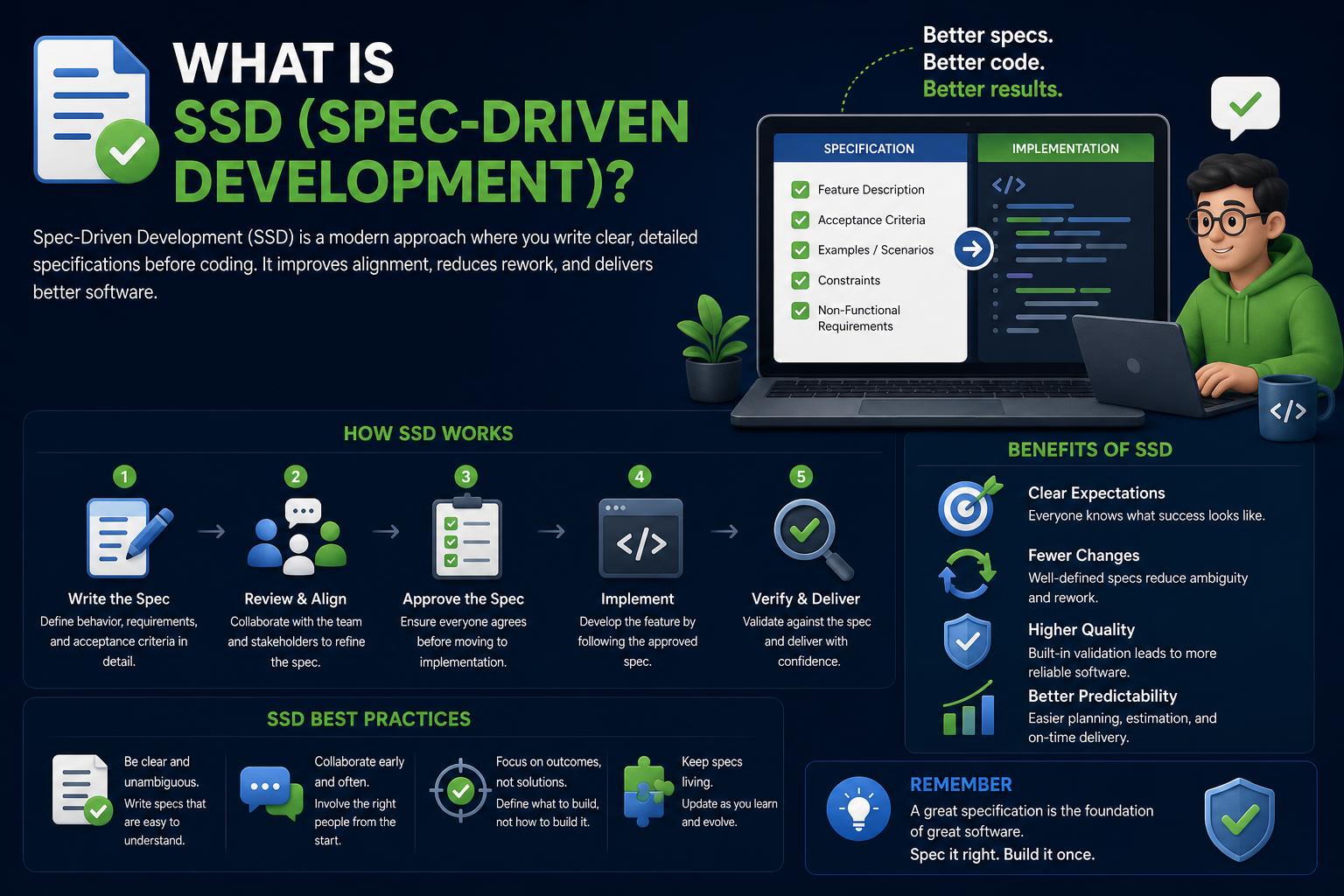
- Spec-Driven Development (SDD) makes specifications the primary executable contract, guiding AI agents to generate, test, and validate code.
- Modern SDD workflows break down work into four phases—specify, plan, task breakdown, and implement—with verification checkpoints to prevent drift or misunderstanding.
- Effective SDD relies on living, versioned specs featuring explicit outcomes, constraints, and verification criteria, kept in sync with code through CI automation and agent coordination.
Spec-Driven Development (SDD) has wrapped itself around the modern engineering conversation, especially as AI radically shifts how software is built, maintained, and delivered in 2026. While the concept sounds fresh, at its core SDD blends elements of design thinking, agile rigor, and AI pair programming – but takes them one bold step further. The result? Software where the spec isn’t a one-time plan or forgotten document, but the living, breathing heart of code itself.
With the rise of AI-powered coding assistants, “vibe coding” – quickly prompting an agent and hoping for the best – no longer makes the cut when you’re managing complexity, compliance, or the harsh realities of production. Today’s best engineering outcomes aren’t about typing faster. They’re about specifying better. Let’s break down SDD: its theory, evolving practices, core phases, and firsthand advice pulled from the very forefront of spec-first development.
What is Spec-Driven Development?
Spec-Driven Development is a methodology that positions machine-readable, detailed specifications as the cornerstone of any feature or system. Rather than treating specs as supporting artifacts, SDD turns them into executable contracts: rules and requirements that guide, verify, and even automatically generate code, tests, and documentation.
Traditional software specs—like PRDs and design docs—have always existed, but were often disregarded, ambiguously written, or left to rot after their initial purpose was served. Learn how requirements definition can improve by checking out how to view printers on Windows 11 and other configuration and requirements management mechanisms.
The real magic begins when AI coding assistants step in. By providing context, constraints, and acceptance criteria, machines can finally produce code that doesn’t just ‘look right,’ but fits your intent, adheres to design norms, and passes both architectural and system-level tests—at scale.
Why SDD Matters Now
There’s a perfect storm of forces making SDD the workflow of choice in 2026:
- AI-generated code is everywhere, but not always safe. Industry benchmarks report vulnerable code rates from 10–40% for AI-generated output. These vulnerabilities are often architectural—meaning they escape simple unit tests. SDD specs embed rules to prevent such drift or defects before they become technical debt.
- Compliance and audit requirements are relentless. With international legislation like the EU AI Act and the AI Omnibus, proof isn’t optional. SDD turns specs into audit evidence and validation gates, preventing non-compliant changes from slipping through CI.
- Modern architectures demand formal contract governance. When orchestrating multiple services, APIs, or teams, ambiguous requirements aren’t just annoying – they’re catastrophic, making integration and long-term maintenance far more volatile.
SDD vs. Other Popular Methodologies
It’s easy to confuse SDD with its predecessors (like TDD or BDD), but each plays a specific role:
- Test-Driven Development (TDD): Focuses on writing unit tests before code to enforce function-level correctness. SDD, on the other hand, tackles system and architectural requirements that unit tests can’t catch.
- Behavior-Driven Development (BDD): Uses scenarios written in natural language to describe and test behavior. SDD takes BDD further by making these specs not just readable, but enforceable and executable by machines.
- Vibe Coding: Relies on writing prompts for AI agents. Fast in prototyping, but prone to drift, misunderstanding, and security risks at scale. SDD brings predictability and traceability.
The key differentiator: SDD transforms specifications from passive documentation into active gates and contracts that control the code’s evolution.
How Spec-Driven Development Works: The 4 Phases
SDD decomposes the engineering workflow into discrete, rigorous stages to manage both the “what” (intent) and the “how” (implementation):
- Specify: Define, in clear, non-technical terms, the outcome you want and why it matters. Articulate user journeys, desired experiences, and the boundaries of your feature or system. This isn’t about stacks or tools yet—it’s purely about goals and requirements.
- Plan: Translate intentions into a concrete technical plan. Specify the architecture, technologies, third-party dependencies, and compliance rules. Include known decisions and constraints here for the AI.
- Task Breakdown: Break down the plan into actionable, bite-sized tasks and acceptance criteria. This turns “build a login system” into “implement an endpoint for user authentication with these constraints and tests.”
- Implement: The AI agent generates code based on the spec, plan, and tasks—while engineers steer, review, and verify every checkpoint. Strong SDD workflows assign verifier roles (either human or machine) to ensure outputs match the specification before any code merges.
The Pillars of Effective Specifications in SDD
What makes a good SDD spec? The ingredients are fundamental and universal, echoing through enterprise case studies and hands-on experience:
- Clear Outcomes: Not just features, but specific user-visible or system results. For example: “A user can reset their password via email, and the reset token expires after five minutes.”
- Defined Scope / Out-of-Scope: Explicitly declare what this work will and won’t cover to prevent AI agents from overreaching.
- Constraints and Assumptions: Cover things like compliance standards, tech stack restrictions, API limitations, or performance targets.
- Documented Decisions: Already picked out the database schema, encryption library, or interface? State them to avoid unnecessary choices by AI agents.
- Task Breakdown: Each meaningful sub-task described with its own context, not just a laundry list.
- Verification Criteria: List acceptance tests and explicit checks. For instance, “Account lockout triggers after five failed attempts; all sessions invalidate on password change.”
An SDD spec is far more than a checklist—it’s a living artifact that grows as the codebase does. Teams often start with high-level specs, and as features evolve (or bugs are found), the spec (not the code!) becomes the point of update and control.
Levels of SDD Implementation
Adoption isn’t a binary switch—SDD works on a spectrum:
- Spec-First: The spec is written before code and constrains generation, but code remains the main artifact.
- Spec-Anchored: The spec is regularly updated and checked throughout the lifecycle, with governance checkpoints and audit trails built in. Enterprise-grade teams chasing compliance or needing coordination gravitate here.
- Spec-as-Source: The spec literally becomes the only source file humans touch; all code, tests, and docs are derived automatically. Editing code directly is discouraged or prohibited. This approach fits API-first development and teams deep into automation.
Choosing your SDD pattern depends on team maturity, risk tolerance, and the complexity of the project. Most teams start with the Spec-First approach and evolve towards more automated models as confidence and tooling improve.
SDD in Action: A Practitioner’s Breakdown
The best way to understand SDD is through workflow scenarios revealed by active teams and open source communities.
Starting Greenfield
When launching a new project, the temptation is to just start coding—especially with an AI agent that can spit out whole apps in minutes. But without a robust spec, you’re gambling on the AI’s training data, not your unique needs. SDD compels you to nail down feature outcomes, constraints, and user goals first, producing a detailed spec that guides the AI at every step.
Adding Features or Modernizing Legacy Systems
Most value from SDD emerges here: adding features to sprawling codebases or upgrading old systems. Instead of fighting context drift (“Why did this button now crash the profile page?”), SDD ensures requirements are versioned and testable. Systems like Spec Kit encode architectural decisions so every future AI task is aligned and validated.
Handling Compliance, Security, and Distributed Architectures
Modern distributed systems can span hundreds of services, libraries, and coordinated teams. SDD is the answer to maintaining security, regulatory compliance, and high reliability across all boundaries. Specs are not just documentation—they are used as actual validation gates in the CI pipeline. If the code violates a constraint, deployment fails before a human even reviews the PR.
Popular SDD Tools and Toolchains
The SDD space is moving rapidly, with frameworks and toolkits born out of real pain points. Here’s a breakdown of the most recognized tools in 2026:
- : A widely-adopted open source toolkit. It provides a structured command-line interface to define specs, plans, and tasks, enforcing checkpoints at every stage. Features a “constitution” artifact that encodes architectural principles and governance rules.
- SpecDriven.ai: This framework emphasizes precise, machine-readable specs. Asserts that the bottleneck is no longer code writing, but the definition of intent. Eliminates “ambiguity tax” via specs as the single source of truth.
- Kiro: Amazon’s IDE plugin. Manages requirements, design, and tasks as separate spec files. It automates doc/test generation in response to code changes, aiming for a streamlined, memory-bank-based workflow ideal for agent interactions.
To dig deeper into how standards and specifications can integrate with requirements management in embedded systems, choosing the right tools and methodologies for SDD can make a real difference in automating and controlling the software lifecycle.
Designing Effective SDD Specifications: Best Practices
Writing specs for human readers isn’t enough—the AI must understand and execute on them:
- Structure your specs by outcome, not by feature label. “Add login” is vague. “A user must be able to log in with email; sessions persist for 2 days; wrong password locks account after 5 tries” is actionable.
- Explicitly call out what is out of scope (e.g., “OAuth is not included in this release.”) to guide AI agents.
- Surface all known decisions and architectural constraints upfront. A spec that documents “must use Postgres 14, bcrypt for password hashing” will avoid expensive back-and-forths.
- Emphasize acceptance tests and edge-case handling. SDD works best when specs state requirements for error handling, unusual scenarios, and negative paths.
- Avoid over-specifying trivial fixes or experiments. Not every change needs its own spec. A price is paid in overhead, so use specs strategically for areas where misunderstanding would be costly.
Spec-Driven Development in Real Life
Let’s illustrate with a real SDD spec inspired (and anonymized) from successful teams:
FEATURE: User Login
- Overview: Allow users to authenticate with email and password.
- Acceptance Criteria:
- The login form accepts both fields; empty fields prompt a client-side error.
- Valid credentials lead to the user dashboard; errors are generic for security.
- Five failed attempts lock the user for 15 minutes.
- Passwords are transmitted over HTTPS; never stored plain text.
- Form remains functional if JS is disabled.
- Out of Scope: Social login, two-factor authentication, password reset.
- Edge Cases: Expired sessions, empty fields, browser constraints.
This spec isn’t prose—it’s testable, clear, and unambiguous; suitable for direct consumption by humans, AI agents, and validation frameworks alike.
Automating SDD: Workflows and AI Agent Coordination
AI enhances SDD when used as a coordinated team, not just a black-box coder. Advanced patterns used by successful teams include:
- Coordinator-Implementor-Verifier: One agent breaks down work, multiple implementors handle discrete tasks in parallel, and a separate verifier agent checks outputs against the spec before changes merge.
- Constitutional Constraints: Governance files (often called “constitutions”) are used to encode non-negotiable rules like compliance requirements, design patterns, or security standards. The AI must check against these at every phase.
- Living Documentation: Specs are updated in real time and versioned, not written once and forgotten. In enterprise settings, this enables full traceability and continuous adaptation as the system grows.
SDD: Where It Shines, and Where It Stumbles
Despite the hype, SDD is not a silver bullet. Here’s where it outperforms—and where it can drag teams down:
Perfect Contexts for SDD
- Multi-team collaboration or distributed architecture: SDD ensures everyone works from the same source of truth, keeping code, specs, and intent aligned.
- Heavy compliance, security, or audit trail needs: Automated spec enforcement dramatically lowers risk of regulatory misses.
- Sustained development of mission-critical or high-risk features: SDD shines when the cost of misunderstandings is measured in downtime or lost revenue.
- Legacy modernization, especially when business logic is implicit: Specs can gradually be extracted from existing code, locking down requirements as you go.
When to Avoid SDD (or Use Lightly)
- Exploratory R&D or rapid prototyping: Overly rigid specs slow feedback cycles and may not survive fast pivots.
- Tiny teams or high-churn environments: For simple features or quick bugfixes, the spec overhead can outweigh any benefit.
- Legacy systems with deep, implicit logic: Reverse engineering full specs may not be cost-effective. Sometimes, “spec as you go” is better.
The Reality of SDD Tooling in 2026
Adopting SDD means investing in the right tools and setting realistic expectations about what they can (and cannot) automate. Most open source and enterprise-grade SDD tools rely on the “spec sits beside code” assumption—but as architectures go multi-repo, the complexity leaps.
Platforms like Cosmos (from Augment Code) address this by mapping relationships across huge file sets, so agents can enforce specs across dependency graphs, not just within one folder. These tools are best for big organizations running at scale—not solo engineers.
SDD in the Wild: Common Pitfalls and Hard-Learned Lessons
Teams adopting SDD often fall prey to several predictable traps—here’s what to watch for:
- Spec review overload: Some tools generate so many files (especially with Markdown-heavy workflows) that productive review becomes impossible. Streamline or annotate aggressively.
- AI over- or under-following instructions: Agents may ignore important context or overapply constraints (e.g., duplicating logic instead of augmenting existing classes). Human vigilance at review checkpoints remains crucial.
- Blurring functional and technical specs: Maintain clarity: functional (what) and technical (how) belong in designated sections of your spec, and agents should be coached to update only the appropriate fields.
- Not all requirements can be foreseen: SDD excels with precise, mature requirements. If you’re still figuring out your needs, use lighter-weight approaches or update the spec rapidly as you learn.
- Specification entropy: Complexity does not vanish; it just moves from code to specs. Maintaining, versioning, and reviewing specs is an ongoing responsibility.
Best Practices for Living with SDD
Apply SDD selectively and scale up as your team’s needs grow. Real-life advice includes:
- Start with a single service or feature. Introduce SDD incrementally, using it where specification errors would be most costly.
- Automate enforcement. Use CI/CD spec checks, not just manual code review, so drift is caught before reaching production.
- Choose tools that fit your coordination needs. For multi-repo environments, invest in tools like Cosmos or similar that can reason about cross-service interactions.
- Assign roles for writing, implementing, and verifying specs. Don’t expect one person (or AI) to do it all; split responsibilities for quality.
- Regularly update your “constitution.” As projects and standards evolve, make sure your architectural rules and design patterns are captured and enforced in the central spec files used by your agents.
- Don’t spec everything. Use your judgment—if you’d be frustrated by an agent “getting it wrong,” write the spec. If you could fix it yourself in a minute, skip the full overhead.
Future Directions: SDD Beyond 2026
As spec-driven approaches become ubiquitous, expect to see:
- Deeper VS Code integrations for seamless spec editing and review.
- Comparison and diffing tools (for both specs and implementations) to accelerate multi-agent collaboration.
- Advanced context engineering—AI agents reading design systems (like Figma), documentation, and legacy code to build more contextual, precise specs and fixes.
- Multi-agent, role-based SDD workflows, with verifiers and implementors operating in parallel, unlocking a new scale of coordination.
The move from “code is truth” to “spec is truth” is already remaking how teams build, upgrade, and secure systems. With the right workflows, tradeoffs, and tooling, the question is no longer whether to adopt SDD, but how quickly your organization can adapt.