
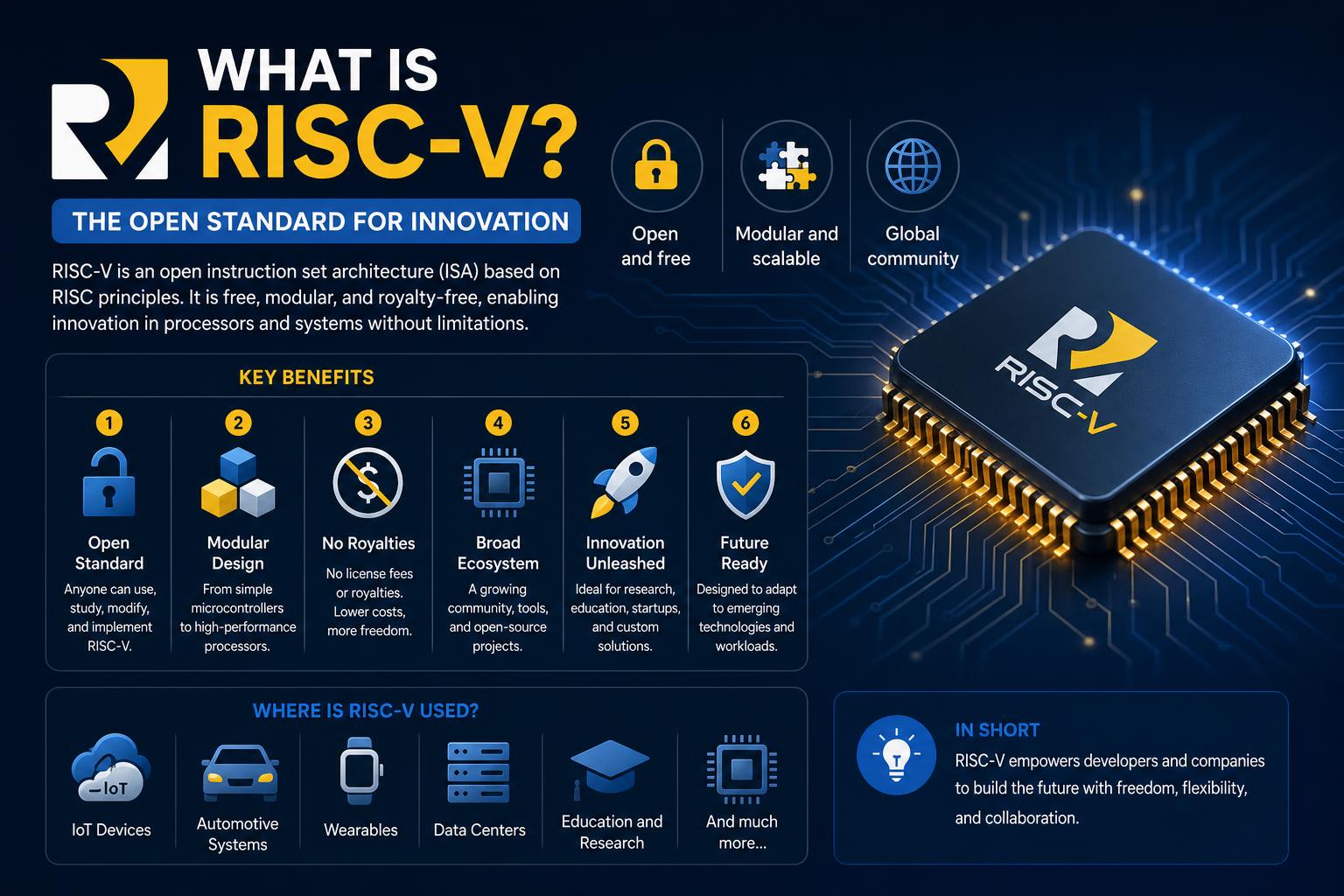
- RISC-V is an open, royalty-free instruction set architecture (ISA) that empowers innovation through collaboration and modularity.
- This architecture enables customizable, scalable CPU and system design for a vast array of applications, from microcontrollers to high-performance servers.
- Its growing global adoption, expansive tool ecosystem, and support from major hardware and software vendors are positioning RISC-V at the forefront of modern processor development.
Imagine a world where anyone can design a futuristic CPU, launch a new gadget, or even reimagine computing itself—all without worrying about licenses, hidden costs, or closed doors. RISC-V isn’t just a buzzword in the chip industry; it’s the spark igniting the next phase of open and collaborative computing. For the curious, tech enthusiasts, or professionals betting on the future of hardware, understanding RISC-V is no longer optional—it’s a necessity. If you’re trying to figure out what all the buzz is about, you’ve come to the right place.
In this deep-dive, we’re rolling up our sleeves—not just rattling off specs or repeating the usual marketing pitches. We’ll walk you through what RISC-V really is, why it’s different from industry standards like ARM or x86, how its openness is revolutionizing the world of processors, and what it means for hardware, software, innovation, and even geopolitics. Whether you’re a student, a seasoned engineer, or just wondering where the next tech wave will come from, this complete guide has everything you need.
What Exactly Is RISC-V? (Let’s Start with the Basics)
RISC-V (pronounced “risk-five”) is an open standard instruction set architecture (ISA) for CPUs. An ISA defines the instruction set—the vocabulary of a processor—that hardware and software use to communicate and operate. But here’s the twist: RISC-V isn’t just another proprietary platform. It’s free, open source, and anyone can use it for any purpose without paying royalties or dealing with endless paperwork.
RISC-V’s DNA is based on the principles of RISC (Reduced Instruction Set Computer) design. If you’ve ever heard of RISC, the classic philosophy behind many of today’s fastest chips, you’ll know it favors simplicity, efficiency, and streamlined operations over the complex, convoluted CISC (Complex Instruction Set Computer) approaches of past generations.
For decades, giants like x86 (Intel, AMD) and ARM (used in nearly every smartphone) have dominated CPU architecture. But both ISAs are proprietary—meaning you need to sign agreements, pay fees, and accept strict rules for every chip you produce. RISC-V breaks with this old order by publishing its specifications under open licenses, inviting a global community of engineers, academics, startups, and companies to innovate collaboratively.
Who Created RISC-V and Why Did It Emerge?
The story of RISC-V begins at the University of California, Berkeley, in 2010. Krste Asanović, David Patterson (a legend in RISC computing), and a handful of grad students realized that even the existing “open” alternatives weren’t truly open or practical. They wanted to create an ISA simple enough for education and solid enough for real-world adoption. Asanović once called RISC-V “a short, three-month project over the summer.” That initiative, as it turns out, lit a fire across the computing world.
In 2015, leadership passed to RISC-V International, a nonprofit organization based in Switzerland that now oversees the specification and its evolution. Membership has exploded, with more than 4,500 organizations in 2025, ranging from major hardware manufacturers and academic labs to enthusiasts and community developers worldwide.
Why now? One major reason is that modern semiconductor design has become a global, collaborative process, and the old proprietary model created bottlenecks. From universities navigating legal minefields to companies wanting to innovate quickly (but without paying exorbitant fees), RISC-V became a global equalizer. Even governments back it—China and the European Union, for instance, see it as the foundation for technological sovereignty and chip independence amid supply chain uncertainty and political pressure.
Open Standard: What “Open” Means in RISC-V
RISC-V is open in every meaningful sense:
- Anyone can design, manufacture, and sell RISC-V chips—entirely royalty-free.
- The full ISA specification, extensions, and technical documentation are accessible for review, critique, and improvement worldwide.
- This openness extends not only to hardware designers, but also to toolchain developers, operating system engineers, and end users.
But, openness doesn’t mean chaos. RISC-V has a formal specification process. The nonprofit RISC-V International regulates ratification, compatibility testing, and the official “RISC-V Compatible” trademark. Only member organizations that follow the process can use this logo commercially, but anyone can build on the standard.
Demystifying the ISA: Why RISC-V Matters as an Instruction Set Architecture
The ISA is the most important contract in computing. It’s the point where hardware (the CPU, SoC, or microcontroller) and software (the operating system, firmware, applications) must agree on “how things are done.”
Historically, vendor lock-in at the ISA level made it harder to develop a software ecosystem. Closed ISAs mean device and software makers depend on a handful of corporations, where the pace and direction of innovation are controlled by boardrooms and lawyers, not engineers. RISC-V’s base ISA and public extensions give everyone the same foundation and freedom.
It’s no coincidence that modern software development thrives on open standards (think Linux, Python, JavaScript, and now, hardware with RISC-V).
Key Advantages: Why RISC-V Is Shaking Up the Market
- No royalties, no gatekeeping: No license fees, no red tape. Any chip, tool, or product can use it.
- Flexibility and modularity: Start with a simple “core” and add only the features you need (like floating point, vector processing, encryption, and more). This avoids unnecessary overhead and costs.
- Scalable architecture: RISC-V works just as well in a 10-cent microcontroller as it does at the heart of a supercomputer.
- Transparency for trust: Documentation, reasoning, and design decisions are public for review and refinement.
- Global community: Not controlled by a single company, but by thousands of engineers, researchers, startups, and corporations around the world.
- Speed of innovation: Anyone can experiment, propose changes, or create custom extensions for specific use cases.
How RISC-V Works: Core Principles and Operation
RISC-V’s Design Philosophy
The “RISC” in RISC-V stands for Reduced Instruction Set Computer. At its core, this philosophy emphasizes simplicity—few instructions, easy to decode, regular encoding—rather than implementing dozens of complex operations in the ISA.
The standard RISC-V ISA is modular. Instead of one giant bundle of features, the architects split the ISA into a “base” (the essential instructions for any viable CPU) and a series of optional extensions. These can be combined to tailor the processor:
- Basic integer instructions (I): The bare minimum for computation and memory access.
- E (embedded): A reduced register set for small chips (like microcontrollers).
- M (multiply and divide): For math-intensive tasks and accelerators.
- A (atomic): For support in concurrency, multithreading, and parallel computing.
- F, D, Q (floating point): For single, double, and quad precision operations, used in science and multimedia.
- C (compressed): To reduce code size through short 16-bit instructions, vital in resource-constrained environments.
- V (vector), B (bit manipulation), Zk (cryptography), H (hypervisor), S (supervisor): The list of extensions grows every year.
All of these can be combined to create highly specialized or very general-purpose CPUs. For example, a smartwatch processor might only need the I, C, and E sets, while an AI accelerator might integrate V, F, D, and AI-specific extensions.
The Instruction Cycle in RISC-V
Like other modern ISAs, RISC-V executes instructions through a fetch, decode, and execute cycle. The process works as follows:
- Fetch: The CPU retrieves the next instruction from memory, guided by the program counter (PC).
- Decode: The instruction’s bit pattern is inspected to determine what operation to perform, which registers or memory locations to use, and what immediate values it includes, if any.
- Execute: The arithmetic/logic operation, memory access, or control transfer (branching) is carried out.
- Repeat: The cycle continues until the program ends.
This model keeps operation fast and efficient—but since RISC-V is clearly specified, it’s simpler for hardware designers to build and optimize chips without ambiguity.
Core Architectural Elements in RISC-V
Registers
RISC-V CPUs (in their standard configuration) typically have 32 integer registers (x0–x31) and, if floating point is supported, 32 floating-point registers (f0–f31). The significance of this lies in:
- x0 (zero): Always reads as zero and ignores writes. Your safety net against errors.
- ra (return address, x1), sp (stack pointer, x2), gp (global pointer, x3), tp (thread pointer, x4): Have dedicated roles, optimizing function calls and data access.
- t0–t6 (temporaries): For holding intermediate values and calculations, “caller-saved.”
- s0–s11 (saved registers): “Callee-saved,” reliable for stability across calls.
- a0–a7 (arguments and return values): For passing parameters to functions and returning values.
The “E” variant offers a minimal set of 16 registers (for ultra-small devices).
Addressing Modes
RISC-V supports immediate, direct, and indirect (register-based) addressing. Instructions like lw (load word), sw (store word), and others make it easy to move data between memory and registers, with 12-bit offsets for flexible handling of stacks and arrays.
Default endianness: RISC-V, like x86, uses little-endian byte ordering (the lowest-address byte is received first). Big-endian compatibility is in development, but it remains a minor option.
Stack Handling and Function Calls
There are no dedicated hardware instructions for “push” or “pop”: All stack operations are done by explicitly adding or subtracting from the stack pointer (sp), combined with load/store instructions. Calling conventions (who saves which registers) are standardized for portability and reliability.
Subroutine calls use “jal” (jump and link) and “jalr” (jump and link register) instructions. The return address is saved (not on the stack, but in a register), avoiding slow memory accesses for basic call-and-return operations. Saving the return address on the stack is only needed for non-leaf functions.
Pseudo-instructions: Simplifying Programming
The “real” instruction set in RISC-V is designed for minimal hardware, but most assemblers and compilers offer high-level pseudo-instructions like li (load immediate), mv (move), and la (load address), so programmers don’t have to deal with the verbosity directly.
ISA Extensions: Tailoring CPUs for Everything (and More)
The advantage of RISC-V lies in its granularity and extensibility. So, some common and emerging extensions enable designers to:
- F (single precision) and D (double precision): Enable advanced calculations, science, graphics, and multimedia.
- M (multiply and divide): Adds hardware support for signed and unsigned multiplication and division.
- A (atomic): Needed for concurrency, safe programming, and multi-core hardware.
- C (compressed): Reduces instruction length to 16 bits for more compact code in IoT and embedded systems.
- V (vector): Adds high-performance computing for machine learning, AI, and science.
- B (bit manipulation): Improves performance in cryptography, compression, and networking.
- H (hypervisor/virtualization), S (supervisor), J (dynamic languages), P (packed SIMD): Specialized extensions that make RISC-V adaptable as technology evolves.
- Cryptography (Zk): Adds advanced cryptographic primitives for security and privacy.
For full details, the RISC-V specifications library tracks the versions and status of extensions (ratified, drafts, proposals).
The Philosophy Behind Modularity
Why modular? Commercial ISAs often force you into an “all-in-one” approach—even though your processor only needs part of that functionality. RISC-V’s modularity reduces unnecessary silicon, lowers power consumption and size, and simplifies hardware-software co-design.
Of course, flexibility adds complexity: too many options could fragment support if not managed well. That’s why RISC-V actively works on “profiles”—standardized bundles of extensions (like RVA23, RVA22) that enable software compatibility across different devices.
Memory Model: Load, Store, Ordering, and Synchronization
RISC-V is fundamentally a load-store architecture. All operations are performed on registers. Only specific instructions load or store data between memory and registers, not within calculations or control flow.
Default memory access (endianness): RISC-V uses little-endian ordering (the byte at the lowest address comes first). Big-endian compatibility is in development, but most of the ecosystem remains little-endian.
Fences, memory barriers, and atomics: Synchronization in multi-core CPUs or multi-threaded systems requires instructions like fence, atomic extensions (A), and ordering guarantees. RISC-V was designed to maximize concurrent performance, ensuring correctness with instructions like compare-and-swap (CAS) and load-reserved/store-conditional (LR/SC).
Compressed Instruction Set (RVC): Code Size Efficiency
A major challenge in embedded computing is code size. Standard 32-bit instructions offer good performance, but data memory is limited on microcontrollers. RISC-V solves this with the “C” extension—compressed instructions encoded in 16 bits, enabling higher code density. This can reduce size by 20–25% compared to other chips and nearly match ARM’s Thumb mode.
Privilege Levels and Modes in RISC-V: Security and System Design
RISC-V separates unprivileged (user) instructions from privileged (system, kernel, hypervisor) operations. The privileged ISA specification defines three standard levels:
- Machine mode (M): Maximum privilege. Direct hardware control, boot code, chipset handlers.
- Supervisor mode (S): For the operating system kernel.
- User mode (U): Standard applications.
Optionally, Hypervisor mode (H): added for advanced virtualization (virtual machines, containers, cloud infrastructure). “Harts” (hardware threads) are also formally defined, making it easier to build multi-core, multitasking CPUs.
Standardization Profiles, Platforms, and Ecosystem Interoperability
Flexibility is useful, but so is having a common denominator for software.
- Profiles: RISC-V International works on standardized “profiles” (like RVA22U64 or RVA23) that group common extensions for different classes of devices. This creates clear targets for operating systems and developers to support.
- Platforms: Define how hardware and software interact, including boot requirements, memory layout, interrupts, and more.
These efforts help avoid excessive fragmentation and make it easier for major systems like Linux, compilers, or hypervisors to work “out of the box” across a wide range of RISC-V systems.
Comparing RISC-V with x86, ARM, and Others
Let’s be honest: x86 (Intel, AMD) and ARM are titans of the industry. But both are deeply proprietary—with all the legal and political weight that comes with it. Here’s how they compare:
- Openness: RISC-V is open, x86 and ARM are not.
- Customization: With RISC-V, you only add the extensions you want. ARM offers “license types,” but ultimately controls the ISA.
- Licensing and fees: RISC-V charges no royalties. x86 and ARM charge per chip or design.
- Documentation: RISC-V specifications are open, reviewed, and improved globally. ARM/x86 are described as opaque, with critical details hidden or only available after payment.
- Ecosystem: x86 and ARM lead in software and hardware support (for now), but RISC-V is catching up fast, especially in embedded systems, academia, and research.
Is RISC-V faster? The core philosophy isn’t about raw speed, but about empowering developers to build chips optimized for their market (IoT, servers, mobile, AI, etc.). In recent benchmarks, RISC-V designs are nearly on par with established competitors in their class, and open innovation is quickly closing those technical gaps.
RISC-V Implementations: From Hobby Boards to Supercomputers
RISC-V’s openness has led to a wild diversity of implementations—from 10-cent microcontrollers to performance monsters for AI and high-performance computing.
Commercial Systems and Microcontrollers
- SiFive: American pioneer, with cores like the U8, P870, multi-core RV64GC SoCs running Linux, and chiplets for modern workloads. More info
- StarFive: Offers SoCs for big data and computation, especially in the Chinese market. More on StarFive
- Andes Technology: From compact cores to advanced 64-bit ones with DSP, FPU, vector extensions. Andes Tech
- Espressif: Famous for the ESP32 family, now with low-power RISC-V coprocessors.
- Imagination Technologies: Catapult RISC-V cores integrated with IMG GPUs for accelerated graphics and computing. Imagination RISC-V
Open-Source Implementations
- Rocket and BOOM (Berkeley): Open-source Chisel-based cores, from simple to complex out-of-order CPUs. Rocket Chip
- PicoRV32, PULPino, NEORV32, SERV: Small, efficient cores for teaching, prototyping, and mass-market IoT.
- CORE-V: Family of open cores from the OpenHW Foundation (used in high-performance systems). More info at OpenHW
Developments and Global Adoption
- China: RISC-V is strategic for semiconductor sovereignty. Major SoCs and server CPUs (like Alibaba’s DAMO Xuantie series) are aimed at AI, cloud, and the future of desktops/servers.
- European Union: Funds projects to reduce dependence on non-European technology.
Other notable vendors: Codasip, Cortus, Syntacore, GreenWaves, GigaDevice, Bouffalo, MIPS Technologies (now RISC-V-focused), and more. Even Google uses RISC-V in its Titan M2 security module.
For an up-to-date list of RISC-V CPUs and SoCs, visit the RISC-V Exchange.
RISC-V in the Real World: Laptops, Servers, Phones, and More
You’ll be surprised how many places RISC-V already shows up:
- Laptops: DeepComputing’s DC-ROMA models and Framework’s RISC-V motherboards (with SpacemiT, StarFive processors).
- Development boards: Sipeed’s Longan Nano (GigaDevice MCU), Nezha D1-H, OrangePi RV2, LicheePi 3A, among others.
- Hobby computers: ClockworkPi’s DevTerm and uConsole kits.
- Enterprise and cloud: Alibaba’s Xuantie, SpacemiT’s Key Stone K1, VitalStone’s V100, and European supercomputing projects.
- Mobility/IIoT: Espressif, Bouffalo Lab, Ch32Vxxxx.
- Aerospace and defense: India’s ISRO and SHAKTI projects use 64-bit RISC-V chips in space applications.
Major Industry and Tech Support for RISC-V
Major hardware and software players support RISC-V, with growing adoption every year:
- Linux distributions: Debian (since Trixie, 2025), Fedora, openSUSE, Ubuntu (specific profiles).
- Operating systems: Linux kernel, FreeBSD, NetBSD, OpenBSD, and, in progress, Haiku; RTOSes like FreeRTOS, Zephyr, embOS.
- Development tools: GCC, LLVM, GDB, QEMU, OVPsim, RARS, WepSIM, Kite, and integrated environments like CREATOR and the RISC-V Exchange listing.
- Hardware simulators: QEMU, Spike, browser-based tools like BRisc-V and Kite for education and prototyping.
The RISE (Software Ecosystem) initiative (Linux Foundation Europe, 2023) brings together major companies like Red Hat, Samsung, Nvidia, MediaTek, Intel, and Google to accelerate support for operating systems, drivers, and development tools. More at the RISE Project page.
RISC-V in Education: The Next Generation of CS and EE Students
RISC-V’s accessibility, clarity, and simplicity have made it a favorite in academic curricula around the world. No more obstacles to using basic learning environments. Professors and students can inspect every bit, implement their own cores, and even simulate hardware on FPGAs—all with official documentation and support materials available worldwide.
For example:
- RARS Simulator and MARS: Java-based simulators for assembly instructions and compiler testing.
- PyRISC: Python-based simulation for flexible teaching and research.
- OpenHW Foundation: Open-source designs and materials for universities and development networks.
Major Challenges and Everyday Difficulties: Where RISC-V Isn’t Perfect
No standard is free of challenges—and RISC-V is no exception. Here are some of the most debated or challenging aspects:
- Fragmentation vs. flexibility: Too many options and too little standardization, especially around profiles and ABI, can slow mass adoption. The community is working to balance modularity with “for everyone” compatibility.
- Ecosystem maturity: x86 and ARM have decades of head start, especially in mass-market devices (laptops, phones, tablets) and in “boring” tasks like firmware or legacy OS support. RISC-V is catching up fast, but gaps still exist, especially for modern Windows workloads.
- Hardware support: Some newer extensions (like RVA23, vector, cryptography, hypervisor) aren’t yet fully implemented in commercial chips. In 2025, Ubuntu and others dropped support for older profiles, and the newer profiles are still scarce in real hardware.
- Big-endian controversy: Although designed to support it, big-endian adoption is only now picking up, and its ecosystem remains very limited compared to little-endian. Support in QEMU and a few chips (like MIPS I8500, CVA6) is just starting to appear.
- Geopolitics: RISC-V sits right in the middle of global politics, intellectual property law, and technological sovereignty. The road ahead could get bumpy if opposing powers champion open vs. proprietary models.
How to Get Started with RISC-V: What Do You Need?
Want to dive into the world of RISC-V?
- Emulation/Simulation: Download or use cloud-based simulators like RARS, QEMU, and WepSIM to test assembly programs without real hardware.
- Starter hardware: Boards like the Longan Nano, LicheePi, Milk-V, or open dev kits with ESP32-C3/C6, StarFive VIC7100/JH7110, or open-source FPGA platforms.
- Development tools: GCC (with riscv64-unknown-elf), LLVM/Clang, Embedded Studio, and full IDE/debugger suites like IAR, Lauterbach, and SEGGER.
- Operating systems: Try Debian, Fedora, and Ubuntu (with compatible profiles), or build your own system targeting RISC-V.
Security, Debugging, and Tracing
Security is essential for future CPUs—and RISC-V is being taken seriously on this front. Atomic instructions, cryptographic extensions, and ongoing research into secure operations position RISC-V to be as trustworthy as traditional standards.
Debugging and analysis: Debug interfaces, optional trace units, and community tools make hardware and software design easier. Companies like UltraSoC, SEGGER, Lauterbach, and IAR Systems have rolled out support for RISC-V debugging.
RISC-V’s Influence on Policy, IP, and Geopolitics
RISC-V isn’t just a technical innovation—it’s also a political and economic force.
- Export controls and sanctions: Its open model is appealing to countries wanting to avoid U.S. restrictions on x86 and ARM. China has made RISC-V a national priority, and the EU is funding projects for its development.
- Standards and trust: IP ownership sits with a Swiss organization, with no absolute control by a single entity.
- U.S. response: Political and industry leaders are watching its growth closely. The main debates center on security, competition, and supply chain resilience.
Innovation Hubs: What Are Startups and Research Projects Doing?
This is where creativity explodes—RISC-V enables a burst of innovation that wouldn’t be possible with closed ISAs. Some examples:
- Application-specific CPUs: AI, IoT, encryption, real-time DSP, low-latency servers, even open-source wearables.
- Custom extensions: Groups add their own instructions to accelerate workloads, such as the Vector extension for AI/ML or Zk for advanced encryption.
- Reconfigurable and heterogeneous computing: FPGA projects, soft cores, and hybrid chiplets.
- Secure hardware: U.S., EU, and Indian governments back RISC-V for security in military and government technology, in projects like IIT Madras and SHAKTI.
- Open hardware for everyone: From accessible tools for K-12 education to affordable SoCs for developing countries, RISC-V democratizes processor design like never before.
The Software Development Ecosystem: Compilers, OS, and Toolchains
Software is advancing quickly.
- Compilers: GCC and LLVM support RISC-V (nearly all extensions).
- Debuggers: GDB supports remote debugging and open interfaces.
- Simulators: QEMU, Spike, OVPsim, browser-based tools like BRisc-V and Kite for testing and learning.
- Operating systems: Linux with primary support, FreeBSD, NetBSD, OpenBSD, with Haiku in progress; RTOSes like FreeRTOS, Zephyr, embOS.
For kernel and driver developers: You’ll need documentation, community support, and real hardware, often free or low-cost.
Looking Ahead: RISC-V’s Promise and the Road Still Ahead
By 2025, RISC-V cores are forecast to account for more than 14% of the total CPU market across all major applications. Adoption is growing because of:
- Hardware adaptability: From microcontrollers to supercomputers, RISC-V is set to become the universal ISA.
- Open innovation: From individual startups to multinational companies, everyone can contribute and benefit.
- Software maturity: Linux distributions, compilers, and IDEs already “just work” on the latest RISC-V chips, with growing support worldwide.
- Geopolitical momentum: Governments and tech leaders are betting on RISC-V as a safe, sovereign alternative to proprietary ISAs.
- Community: Educational resources, open-source tools, and collaborative networks make RISC-V an accessible space for everyone.
Whether you want to build an AI accelerator, teach future engineers, design new smart devices, or simply experiment with open chips, RISC-V is your platform. Its combination of genuine openness, flexibility, global trust, and relentless pace of innovation is hard to match, and its ecosystem keeps growing every year. Instead of being told how to compute, RISC-V invites you to imagine and build what comes next, on your own terms, alongside a community of like-minded creators. If the last decade was defined by closed hardware, the future is open—and it’s spelled RISC-V.