
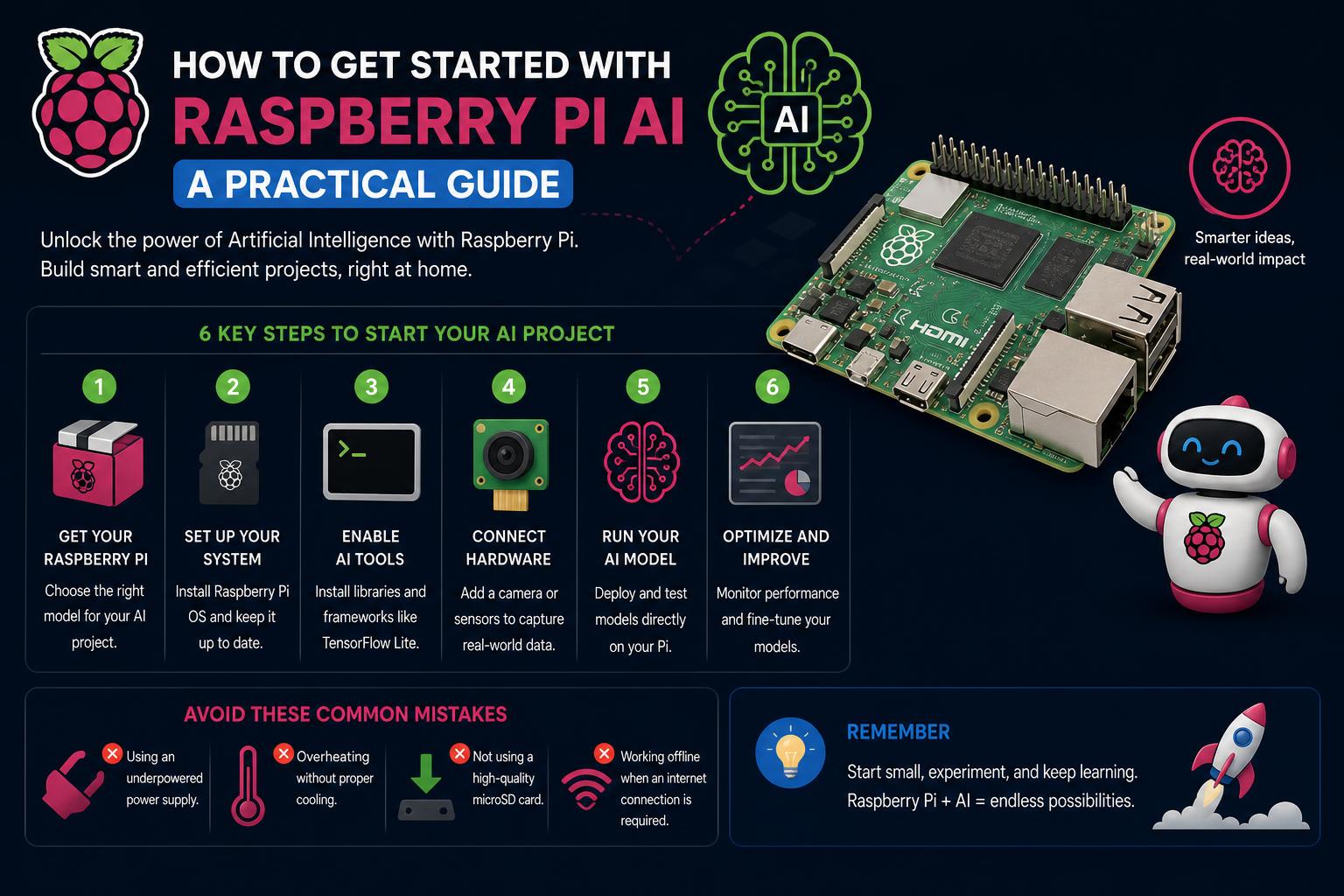
- Raspberry Pi AI HAT+ 2 brings powerful generative AI to Raspberry Pi 5 with local, private processing.
- Project highlights show real, practical uses—computer vision, LLMs, translation and more, all running offline.
- The AI Kit ecosystem supports easy model deployment, custom training, and seamless camera integration for makers and professionals.
Something incredible is happening in makerspaces, classrooms and home labs worldwide—artificial intelligence has officially arrived on the Raspberry Pi, and it’s changing the way we interact with technology at the edge. Just a few years ago, running anything more than modest computer vision or machine learning workloads on tiny, affordable PCs like the Raspberry Pi felt almost impossible. But recently, a series of low-power neural accelerators and dedicated AI hardware have set the stage for a new era of real, local AI processing—no cloud subscription, no privacy worries, and no huge power bills.
If you’ve ever wanted to dive into AI right from your desk, teach your Pi to see, or even host your own chatbot without relying on OpenAI or cloud giants, the newest generation of official hardware and open projects makes it easier than ever. In this deep dive, we’ll break down what the Raspberry Pi AI HAT+ 2 offers (and how it compares to its predecessor), explore standout projects and use-cases enabled by these powerful add-ons, and guide you through the evolving Raspberry Pi AI Kit ecosystem.
The Evolution: From Edge Vision to Generative AI on the Raspberry Pi
The Raspberry Pi foundation first shook things up by introducing the original AI HAT+, bundling Hailo-8 neural network accelerators for the Pi 5 with 13 or 26 TOPS of dedicated AI power. These boards supercharged classic computer vision tasks—think object detection, pose estimation, and scene segmentation—while keeping all data and processing local for maximum privacy and control.
What made the AI HAT+ stand out? No cloud required, true local inference, and smooth handling of complex vision models—for tasks like security camera duties, robotics, or visual automation, it was a huge leap forward at a low price. Vibe coding techniques are key when developing these responsive AI systems on Raspberry Pi.
But as generative AI models exploded in popularity (LLMs like ChatGPT, Stable Diffusion for images), it became clear that vision-only acceleration wasn’t enough. That led to the brand-new Raspberry Pi AI HAT+ 2—an add-on created specifically to bring real-time generative AI to the Raspberry Pi 5, pushing its creative and problem-solving potential to new heights.
Introducing the Raspberry Pi AI HAT+ 2: Hardware Highlights
The AI HAT+ 2 is built around Hailo’s latest chip, the Hailo-10H neural accelerator, capable of a staggering 40 TOPS (INT4) performance—enough to run large language models, vision-language models, and advanced generative AI workflows locally. This new board sports 8GB of dedicated on-board RAM, a key upgrade that unlocks handling of much bigger AI models than before. Everything runs over the fast PCI Express interface of the Raspberry Pi 5, and compatibility with the Pi’s camera stack (libcamera, Picamera2) is fully integrated.
- You can expect comparable (if not slightly improved) vision model performance compared to the 26 TOPS HAT+, thanks to the extra RAM and refinements in hardware design.
- All AI processing happens locally—no need for a network or external GPUs/cloud connections, so your data remains private and latency is minimal.
- There’s seamless transition for those already using the AI HAT+: software stacks are backward-compatible, so moving to the HAT+ 2 is painless.
With the new architecture, the door is open for LLMs, VLMs, code generation, cross-language translation, and advanced vision-based applications—all running offline at the edge. If you want to understand the connection between AI hardware and software optimization, exploring Claude Cowork principles can offer some insights.
Everything You Can Do: Generative AI and Real Applications
So, what kind of magic can you actually pull off with this combo? Unlike previous hardware, the HAT+ 2 lets you run sophisticated large language models (LLMs) like Qwen2, Qwen2.5-Coder and more—out-of-the-box—without having to pipe your questions to cloud APIs. Open WebUI-based browser interfaces make local chat and code generation not only possible, but user-friendly.
For developers and AI tinkerers, the Hailo-ollama LLM backend lets you effortlessly connect various models to a secure chat interface or build on top of the platform. Teams and hobbyists have already demonstrated:
- General Q&A with local LLMs—ask questions, brainstorm, summarise, all running directly on your Pi 5.
- Automated code writing—leverage purpose-tuned code models like Qwen2.5-Coder for coding support.
- Language translation—do things like translating French to English in real time with no external servers required.
- Scene description—combine vision and language by having the Pi 5 “describe” what’s seen from a camera, all performed locally via a VLM.
Models on the HAT+ 2 are more modest (in the 1–7B parameter range) compared to cloud giants such as ChatGPT or Meta Llama, but this is often enough for many use cases. Many makers and smart devices can create useful, specialized tools, and the models can be further improved through fine-tuning.
Fine-tuning, Personalization, and Training Your Own AI
One of the most exciting aspects of the AI HAT+ 2 is the ease of customisation and fine-tuning for unique needs. Users can retrain vision models (e.g. YOLO for custom object detection tasks) or apply Low-Rank Adaptation (LoRA) to text models for job-specific language tools—all while keeping most of the model parameters frozen for efficiency.
The Hailo Developer Zone and their GitHub provide adapters, frameworks, and guides to help with custom vision, translation, speech recognition, and more. Anyone interested in deep AI personalization now has the toolkit to make it a reality on affordable hardware.
What’s in the Box? AI HAT+ 2 Features & Setup
Each AI HAT+ 2 is ready to slot right onto your Raspberry Pi 5, including:
- Hailo-10H neural accelerator – 40 TOPS INT4 inferencing, groundbreaking for the form factor.
- 8GB on-board RAM – enables much larger models and smoother multitasking.
- Seamless camera integration – works directly with rpicam-apps and the Raspberry Pi’s camera stack.
- Simple installation – includes a stacking header, spacers, screws, and optional heatsink—designed for easy DIY.
- Starter kits available – bundled with Pi 5, Camera Module 3, robust case, perfect for jumping straight into projects.
Everything is compatible with the standard Raspberry Pi OS (fully up-to-date), and AI tasks are automatically available once the HAT is detected. No huge driver wrangling or kernel hacks—just plug, install supported models, and start building.
Real Projects: Making the Most of AI on Raspberry Pi
The AI Kit experience isn’t just theoretical—it’s already powering inventive projects around the world. The creative Raspberry Pi and MagPi communities have delivered a portfolio of hands-on applications to showcase what’s possible once you add local AI:
Peeper Pam Boss Detector
A clever take on workplace awareness, this project uses the AI Kit and camera module to spot if someone (like your boss!) is creeping up behind you. The Pi 5 processes live video, detects human figures, and wirelessly alerts a remote Pico W microcontroller, which can display certainty on a voltmeter. Modular code, sockets for low-latency communication, and open-ended use—just swap models for different detection tasks, like monitoring pets or spotting wildlife.
Monster AI Pi PC
Maker Jeff Geerling built an absolute beast by stacking eight neural processors via a custom PCIe switch setup. With 55 TOPS across multiple NPUs and the AI Kit’s own Hailo-8L, this “super Pi” demonstrated parallel AI action rivaling some desktop chips. Not exactly for the faint of heart or average user, but an incredible proof of the AI HAT+ system’s flexibility and headroom.
Car Detection & Tracking at Toll Plazas
This practical project applies AI Kit-powered computer vision to automated vehicle counting and toll management. Using a wide-lens camera, a trained YOLOv5 model and Edge Impulse, the system accurately tallies cars passing through multiple lanes. The approach is readily extensible to parking management, security, and urban infrastructure monitoring.
Safety Helmet Detection System
This computer vision-based system delivers real-time (30fps) safety helmet detection using the YOLOv8 model, all running efficiently on a single Pi 5 with the AI Kit. Makers are provided with detailed installation and training guides, as well as a 5,000-image annotation dataset featuring helmets, people, and heads—crucial for workplace safety compliance and automated enforcement workflows.
Accelerating Google MediaPipe on Raspberry Pi
Mario Bergeron ported popular hand, face, and pose detection MediaPipe models, benchmarking dramatically improved inference speed using the Hailo-8L AI accelerator. With up to 5.8x faster performance than plain Raspberry Pi 5 TensorFlow Lite models, it opens the door for responsive gesture interfaces, accessibility tools, and on-device tracking.
What the Community Is Saying: Real-World Feedback
If you frequent forums or Reddit, you’ll spot ongoing debates about the value-for-money and performance proposition of the Raspberry Pi AI HAT+ 2 compared to small PCs or used business mini-PCs with modest GPUs. Some users highlight its competitive pricing and low power draw ($110–$130 for a Pi 5 plus HAT+ 2), while others point out the hardware limitations (no full-sized GPU, bottlenecks in PCIe lane bandwidth) when tackling very large models or massive concurrency.
For standard maker uses—chatbots, small LLMs, image generation for blog posts, real-time camera inference—the AI HAT+ 2 stands out as an affordable, reliable solution that avoids the costs and complications of traditional PC hardware and operating system support. Enthusiasts can always go bigger for more power, but for embedded AI and edge computing, this approach is hard to match.
Getting Started: Software, OS, and Model Support
One thing the Raspberry Pi team has focused on is making AI approachable for newcomers as well as experts. With up-to-date Raspberry Pi OS, the HAT+ 2 is autodetected and made available for tasks right away. The camera ecosystem is natively integrated—your Pi can seamlessly use the AI accelerator for post-processing in video pipelines, robotics, or smart security setups.
You aren’t limited to built-in models either—Hailo maintains a well-stocked GitHub repository with sample models, official applications, and a Dataflow Compiler for custom adaptations. Whether your goal is speech-to-text, language translation, or visual scene understanding, there’s a clear path for scoping and training models to fit within the hardware’s generous 8GB memory envelope.
[relacionado url=”https://www.ikkaro.net/what-is-claude-science/”]
Availability, Kits, and Support for Makers
As the hardware continues to attract huge demand (expect short lead times from official vendors), kits are available that bundle a Pi 5 (8GB), the AI HAT+ 2, Camera Module 3, and a high-quality case to keep things cool and tidy. The HAT+ 2 is designed to work with the Raspberry Pi Active Cooler and comes with optional heatsinks, so you won’t risk thermal throttling during long inference runs.
Full documentation, step-by-step guides, model downloads, and discussion forums are available via the official Raspberry Pi site, the MagPi magazine, and the Hailo Developer Zone. The growing body of projects and tutorials ensures you’ll always have inspiration and community backup, no matter your skill level.
As edge AI becomes a must-have for DIY tech, smart home automation, and educational innovation, the Raspberry Pi AI Kit ecosystem is carving out a niche for affordable, secure, and accessible machine learning at the edge. Whether you’re building your own AI-powered sensors, chatbots, or camera systems—or just experimenting with tomorrow’s tech today—this new wave of hardware and software puts cutting-edge tools truly within reach for all makers and learners.