
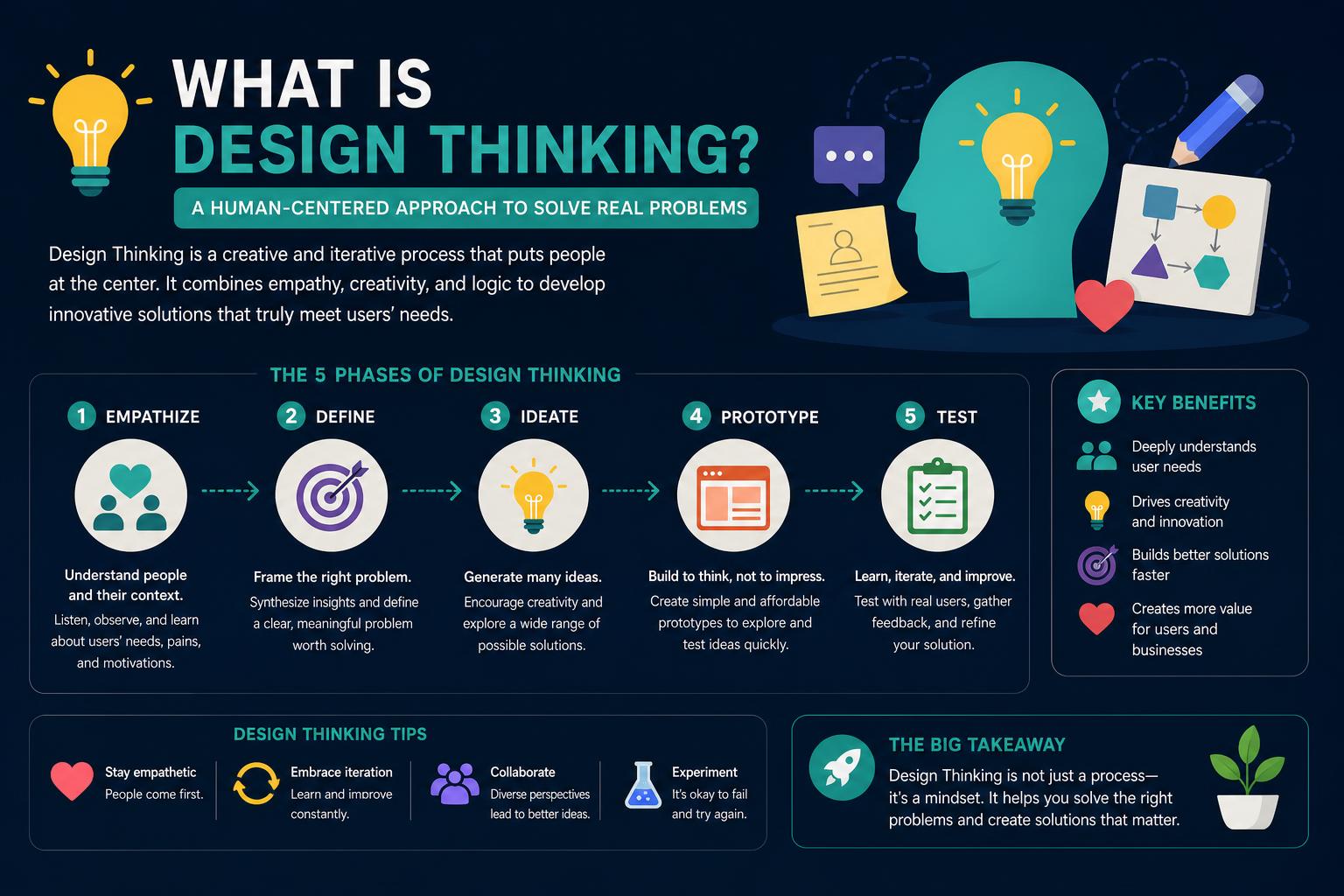
- Design thinking focuses on human-centered, iterative problem-solving.
- This framework integrates empathy, creativity, and rapid prototyping.
- Major companies leverage design thinking for innovation and growth.
- Applicable across industries, its process drives impactful solutions.
Design thinking has emerged as a transformative methodology not only for designers, but for anyone seeking effective ways to confront complex problems, innovate, and create meaningful change. While rooted in the creative process, design thinking’s influence now extends far beyond traditional product design, permeating areas like business strategy, healthcare, education, and public services. This approach centers on deeply understanding users and champions a collaborative, action-oriented mindset, making it particularly relevant in today’s rapidly evolving and user-focused world.
What is design thinking? For those interested in exploring this innovative approach further, a detailed explanation can be found in the What is Design Thinking overview. What sets design thinking apart is its unique blend of empathy, creativity, rational analysis, and iterative experimentation. Rather than rushing to solutions, it encourages teams to reframe problems, challenge assumptions, and uncover real user needs through direct observation and engagement. By cycling through specific phases such as empathizing, defining the problem, ideation, prototyping, and testing, design thinking bridges human insight and technical possibilities to produce solutions that are truly desirable, feasible, and viable—delivering lasting impact in both business and society.
Understanding Design Thinking: A People-First Problem-Solving Mindset
Design thinking is fundamentally a human-centered, iterative method for tackling problems. Unlike many traditional frameworks that rely on top-down logic or linear processes, design thinking places people—the true end users—at the heart of every decision. It draws on designers’ traditional approaches to creative problem-solving, but opens them up so that anyone, in any field, can approach challenges with fresh eyes and empathy.
The key idea? Instead of focusing on what’s technically possible or what’s already been done, design thinking begins by seeking to understand the real pain points, motivations, and ultimate goals of users. This genuine curiosity drives every step of the process, aiming for solutions that are not only novel but also meaningful in real life.
Tim Brown (former CEO of IDEO) and influential organizations like Stanford’s d.school have been pivotal in bringing this approach into the mainstream. Their work has helped shift the conversation from designing for users to designing with users, fundamentally redefining what it means to innovate.
The Core Principles of Design Thinking
Regardless of the framework used, four guiding principles define the design thinking approach:
- Human-Centricity: Every stage, from insight-gathering to ideation and delivery, is rooted in understanding and addressing real user needs.
- Embracing Ambiguity and Iteration: Design thinking celebrates uncertainty and uses it as fuel for innovation. Teams are encouraged to rapidly prototype and iterate, learning from experiments and refining ideas rather than expecting perfection on the first try.
- Collaboration and Cross-Disciplinarity: Few problems are solved in isolation. Design thinking breaks down silos, involving stakeholders from diverse backgrounds to gain richer perspectives and drive breakthrough solutions.
- Bias Toward Action: Rather than becoming paralyzed by analysis, design thinking emphasizes quick prototypes, direct user feedback, and a willingness to try, fail, and learn fast.
These tenets ensure that design thinking solutions are grounded, adaptable, and always moving toward real-world impact.
The Design Thinking Process: Key Phases Unpacked
While there are multiple models of design thinking, the most widely taught and practiced framework is the five-phase model popularized by Stanford’s d.school, as well as IDEO and other leading organizations.
It’s important to remember that these phases are neither strictly linear nor mutually exclusive. Teams often revisit earlier stages, loop back, or pursue several activities in parallel as new insights emerge. What matters is the shared understanding and momentum built throughout the process.
1. Empathize: Getting Under Users’ Skin
The journey begins by deeply immersing in the user’s world. It’s not enough to send out a quick survey or speculate based on assumptions. Instead, this phase asks you to step into your users’ shoes—conducting in-depth interviews, observing behaviors, mapping customer journeys, and engaging in empathy exercises to grasp their struggles, goals, and motivations.
- User Interviews: One-on-one conversations to explore the reasons behind behaviors, needs, and emotions.
- Observation: Shadowing users as they interact with products or services to spot unspoken challenges or workarounds.
- Empathy Mapping: Visualizing what users think, feel, do, and say—turning raw feedback into actionable insight.
- Journey Mapping: Plotting the full end-to-end experience to pinpoint pain points and opportunity areas.
Direct, unbiased engagement not only uncovers users’ obvious needs, but often reveals deeper frustrations and aspirations that would otherwise go unnoticed.
2. Define: Framing the Real Problem
Once information is gathered, it’s time to synthesize and make sense of the findings. The Define phase centers on distilling all user data into a precise, actionable problem statement—a challenge that inspires creativity but doesn’t pre-bake the solution. Seizing this moment is crucial to avoid superficial solutions and instead target problems that can truly generate impact.
- Problem Statements (How Might We): Formulating the challenge in the form of “How might we…” encourages open-ended exploration without being overly vague or too restrictive.
- User Personas: Crafting representative archetypes to guide the solution toward specific real-world needs.
- Root Cause Analysis (5 Whys): Digging deeper by repeatedly asking “why?” until the fundamental issue emerges.
3. Ideate: Opening the Creative Floodgates
With a crystal-clear problem in hand, the next move is idea generation—wildly and without judgment. Brainstorming is the most well-known activity here, but a host of structured methods help teams break out of habitual thinking and spark original solutions.
- Mind Mapping: Connecting and expanding on initial thoughts to unravel unexpected possibilities.
- Brainstorming & Brainwriting: Generating a high volume of ideas quickly, deferring criticism until later stages.
- SCAMPER: A technique to Substitute, Combine, Adapt, Modify, Put to another use, Eliminate, Rearrange existing components for new ideas.
- “Worst Possible Idea”: Deliberately proposing the most outrageous concepts to unblock creative deadlocks.
The magic happens when diverse minds are in the room, challenging one another and building on each other’s contributions—because sometimes, the breakthrough comes from the wildest suggestion.
The Complete Guide to Spec-Driven Development (SDD) for Modern Software Teams
4. Prototype: Making Ideas Tangible Fast
Ideas don’t exist in a vacuum—they need to be swiftly translated into tangible form. The Prototyping phase encourages teams to manifest their concepts as mockups, sketches, models, digital wireframes, or even simple role-plays.
- Low-Fidelity Prototypes: Paper sketches, storyboards, basic interactive wireframes. Perfect for quickly exploring and discarding ideas.
- High-Fidelity Prototypes: More polished digital mockups, clickable demos, or even beta products that simulate real user interactions.
- Storyboards: Visual narratives that showcase user journeys through the solution, exposing gaps in logic or usability.
This phase is all about action. It’s better to test three rough sketches than spend weeks perfecting one solution—the insights come from user reaction, not endless internal debate.
5. Test: Validating and Refining Solutions
The final phase puts prototypes in the hands of real users to gather honest feedback, spot usability issues, and reveal unforeseen consequences.
- Usability Testing: Observing users as they interact with prototypes to pinpoint bottlenecks or confusion.
- A/B Testing: Comparing variations to see which approach resonates best.
- Analytics & KPIs: Setting up metrics to track user engagement, conversion rates, satisfaction scores, and longer-term impact after launch.
Testing is iterative and often loops back to ideation or even empathy stages in light of new insights. The goal isn’t to “prove” an idea works, but to learn what needs refining – and no solution is above revision!
Mastering CAD Software: In-Depth Guide to Computer-Aided Design
Design Thinking’s Broader Mindset: Beyond the Steps
While the five phases provide structure, design thinking is really a way of thinking as much as a process. Breakthrough teams go beyond just following steps. They cultivate a mindset marked by openness, adaptability, and relentless curiosity.
- Prioritizing people over procedures: Never lose sight of the human at the center.
- Learning to love uncertainty: Treat ambiguity as an opportunity, not a threat. Frequently, the best solutions arise from questions rather than answers.
- Diversity as a superpower: Invite voices from other fields, backgrounds, or lived experiences.
- Doing beats talking: Always favor action, experimentation, and real user learning over theoretical debates.
This ethos is what helps teams rapidly iterate, avoid analysis paralysis, and turn vague ideas into tangible impact.
Popular Design Thinking Frameworks Side-by-Side
Different organizations have developed their own takes on the design thinking process, tailored to various industries and team styles. Three frameworks in particular are widely adopted:
Stanford d.school: The 5-Phase Model
The Stanford d.school model follows the familiar five-stage sequence: Empathize, Define, Ideate, Prototype, and Test. This version is particularly valued for its clear steps and widespread application in both education and innovation-driven companies.
IDEO: The Human-Centered 3-Phase Approach
IDEO’s model condenses the process into three broad phases:
- Inspiration: Deep user observation and research to discover hidden needs.
- Ideation: Divergent exploration, rapid prototyping, and frequent iteration.
- Implementation: Scaling and refining the solution for real-world adoption.
This framework puts extra emphasis on storytelling and deep empathy, making it ideal for uncovering transformative insights.
Design Council’s Double Diamond
The UK Design Council’s Double Diamond model highlights divergence (broad exploration) and convergence (focused narrowing):
- Discover: Research the problem landscape widely.
- Define: Pinpoint a specific challenge worth solving.
- Develop: Generate, prototype, and test multiple ideas.
- Deliver: Refine, implement, and scale the best solution.
This approach helps teams avoid jumping to solutions and ensures thorough consideration before progressing.
Not Just for Designers: Who Should Use Design Thinking?
One of the biggest misconceptions about design thinking is that it’s only useful for professional designers or creative teams. In practice, the methodology is widely applicable across industries, roles, and domains—including:
- Business Leaders: Rethinking customer experiences, launching new product lines, or navigating operational challenges.
- Educators: Designing modern learning environments, new teaching strategies, and curricula tailored to students’ changing needs.
- Healthcare Professionals: Streamlining workflows, improving patient journeys, or addressing systemic inefficiencies.
- Software Developers: Building user-friendly apps, reducing feature bloat, and boosting retention rates.
- Marketers: Crafting messaging and campaigns that genuinely resonate with diverse audiences.
From startups to government bodies and NGOs, design thinking is actively reshaping how institutions innovate and serve their communities.
How Top Companies Put Design Thinking to Work
Several case studies show the power of design thinking to unlock breakthrough innovation and business growth. Let’s look at some standout examples:
Netflix: Reinventing Entertainment
Netflix’s evolution offers a masterclass in design thinking applied at scale. By continually engaging users and studying pain points, Netflix anticipated consumers’ desire for convenience long before competitors like Blockbuster saw the writing on the wall. Home DVD delivery was just the first step.
They didn’t stop there. As technology advanced and user expectations shifted, Netflix pivoted toward on-demand streaming. By monitoring feedback and user behavior, they refined every aspect—from recommendations to interfaces—shaping how the world consumes TV today.
Airbnb: Building Trust in the Sharing Economy
Airbnb’s approach exemplifies empathy-driven innovation. In its early days, the company faced trust issues among users booking strangers’ homes. By adopting design thinking—identifying these fears through user research, offering professional photography, and transparent listings—they transformed their platform and rapidly grew revenue.
IBM: Enterprise Transformation Through User-Centric Cloud Development
IBM applied design thinking to develop its cloud platform. User research revealed pain points like complex setups and poor usability, leading IBM to prioritize simplifying the user experience. As a result, they attracted over a million developers and set new standards for cloud solutions.
Design Thinking and Related Methodologies: Agile & Lean Startup
It’s common to see design thinking, agile, and lean startup methodologies discussed together, and for good reason—each brings something unique to the table. Here’s how they relate and differ:
- Design Thinking: Focuses on understanding the right problem and exploring the “what” and “why” of solutions.
- Agile: Emphasizes fast delivery of working solutions through iterative sprints, focusing on the “how” and “when”.
- Lean Startup: Prioritizes rapid experimentation and validated learning via MVPs to reduce risk and guide development.
Together, these frameworks complement each other by combining user-centered exploration, rapid implementation, and validated learning for optimal innovation.
Design Thinking in Education, Healthcare & Society
Design thinking is gaining traction outside of commercial sectors as a tool for societal impact. Schools integrate it into curricula and organizational practices; healthcare systems use it to improve patient care; NGOs leverage it to address systemic issues like accessibility and climate resilience, involving communities directly for impactful solutions.
Common Myths, Traps, and How to Avoid Them
Despite its popularity, design thinking can be misunderstood. Common pitfalls include:
- Myth: Only for Designers. In reality, its focus on real-world problems makes it accessible and beneficial for anyone.
- Myth: Linear Process. It’s non-linear—insights can send teams back to earlier phases at any time.
- Myth: Impractical Ideation. Creativity is encouraged but always aligned with real-world feasibility.
- Superficial Use: Genuine impact requires ongoing commitment, leadership support, and openness to feedback.
Building a culture of experimentation, listening, and continuous learning unlocks the true potential of design thinking.
“Wicked” Problems and Design Thinking
Challenges like climate change, poverty, or health disparities are “wicked problems” that resist simple solutions. Design thinking helps by
- Fostering cross-disciplinary collaboration to explore different perspectives.
- Reframing issues into manageable parts for incremental, human-centered innovations.
- Promoting adaptability through iterative cycles, allowing solutions to evolve over time.
Adopting this approach enhances resilience, enabling organizations to navigate uncertainty and change effectively.
Getting Started: Building Your Team’s Design Thinking Muscles
You don’t need to be a professional designer to use design thinking methods—they are often intuitive and accessible. For immediate application, consider:
- Engage with users regularly: Interview, observe, and map journeys early in projects.
- Create quick visual prototypes: Sketch ideas or build simple wireframes and share for feedback.
- Build and test prototypes: Develop basic versions and iteratively refine based on user input.
- Focus on iteration: Each cycle offers learning opportunities and sparks innovation.
Encourage diverse perspectives to enrich solutions, ensuring greater adaptability and impact.
The Evolution, History, and Future of Design Thinking
Roots of design thinking date back to the 1950s and 1960s, influenced by pioneers like John E. Arnold and Bryan Lawson. Over the years, it took shape through academic work, corporate practice, and finally widespread adoption by the early 2000s. Today, it’s embedded in education, business, and social sectors, with ongoing debates about its scope and integration with new technologies like AI and systems design. Its future likely involves deeper integration with analytics and digital tools to amplify empathy, creativity, and experimentation.
Fundamentally, design thinking transforms complex, ambiguous challenges into opportunities for innovation by prioritizing people, fostering courageous exploration, and emphasizing action-based learning. Its adaptable mindset empowers individuals and organizations to lead positive change, staying ahead in a fast-changing world.