
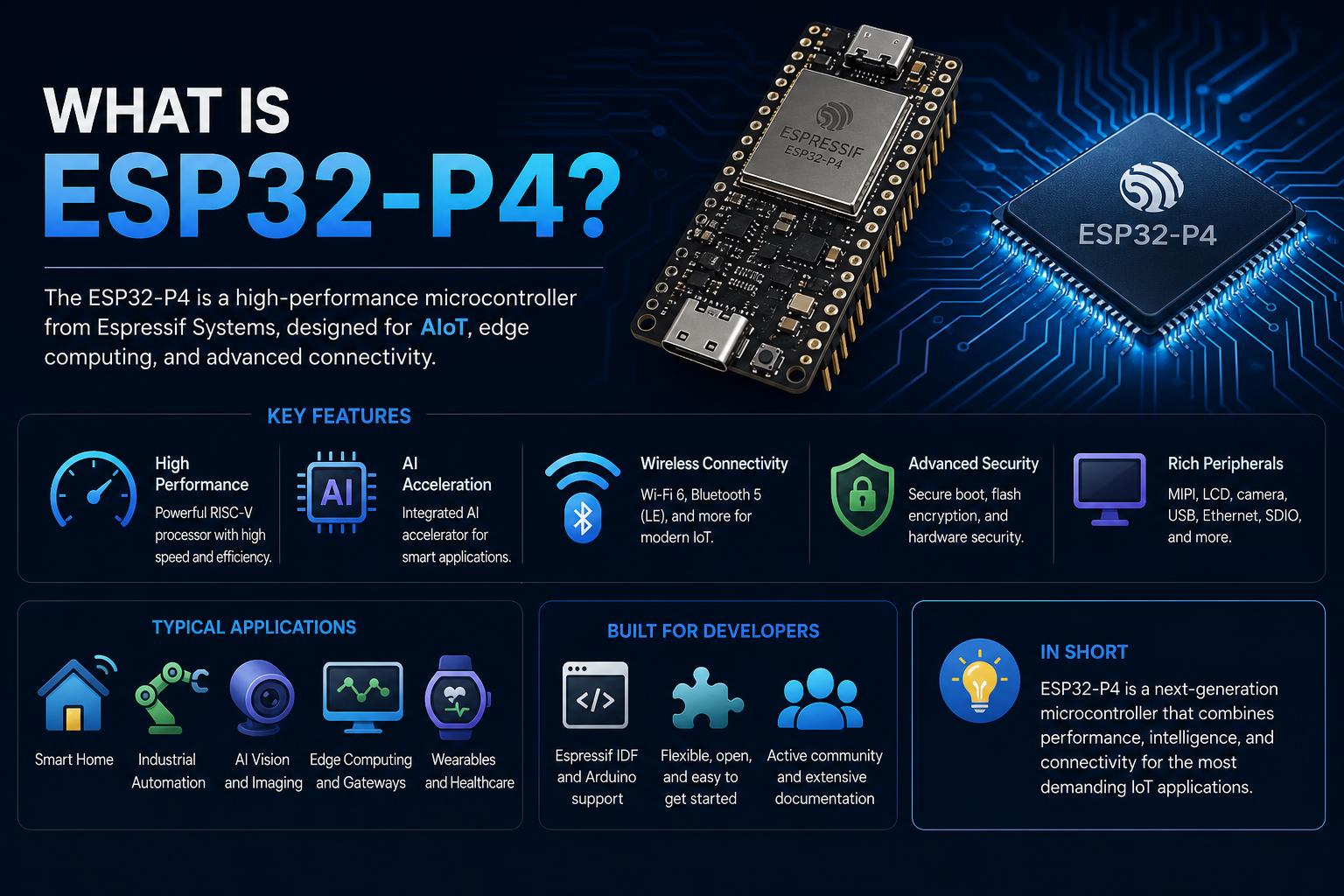
- The ESP32-P4 features a dual-core RISC-V CPU, flexible IO, and hardware multimedia processing.
- Unlike previous models, it does not include built-in Wi-Fi or Bluetooth, focusing on modular connectivity.
- Targeted at demanding edge-computing, HMI, and security-intensive environments, best used with ESP-IDF for now.
The surge of IoT and advanced embedded applications has made device selection increasingly critical for engineers, hobbyists, and tech enthusiasts. Enter the ESP32-P4, an innovative microcontroller that’s stirring up excitement with its remarkable performance, robust security, and extensive multimedia features. If you’ve scrolled through search results looking for a one-stop, deeply informative piece on what the ESP32-P4 brings to the table, you’ve landed in the right place!
In this article, we’ll break down the ESP32-P4’s architecture, security mechanisms, IO capabilities, supported development platforms, and how it compares to its siblings (notably the ESP32-S3). Along the way, we’ll highlight information sourced from leading documentation, respected forums, manufacturer summaries, and expert reviews, all tied together in a reader-friendly, engaging manner that both newcomers and pros will appreciate.
What is the ESP32-P4?
The ESP32-P4 is Espressif’s latest high-performance microcontroller unit (MCU), specifically engineered for demanding embedded systems. Anchored by a dual-core RISC-V CPU with AI instruction extensions and an advanced memory subsystem, the P4 targets scenarios requiring not only speed but also robust security and cutting-edge multimedia handling. Designed to handle Human-Machine Interfaces (HMIs), edge computing, and hardware-intensive operations, the ESP32-P4 is perfect for projects where raw processing power and high IO flexibility are essential.
Architectural Deep Dive: RISC-V Cores Unleashed
One of the ESP32-P4’s most talked-about features is its dual-core RISC-V processor design. Compared to previous Espressif offerings—which often leveraged the Xtensa architecture—the P4’s RISC-V implementation allows for up to 400MHz on its high-performance (HP) cores, paired with an auxiliary 40MHz low-power core. This combination offers enhanced computational throughput and flexible task assignment, making it highly suitable for heavy lifting in industrial and AI applications.
Here’s why this matters: with dual high-speed RISC-V cores, projects that previously strained microcontroller capabilities—such as real-time visual AI, sophisticated GUIs, or complex automation routines—now see a significant performance boost. The ESP32-P4 is not just faster, but also more energy efficient, thanks to its clever division of tasks between high-performance and low-power cores.
Memory Layout and Expansion Capabilities
Working with advanced embedded applications demands robust and flexible memory support. The ESP32-P4 doesn’t disappoint:
- 768 KB on-chip SRAM for rapid data access and processing.
- 8KB Scratchpad Memory (SPM) to speed up compute-heavy operations.
- On-board and expandable external memory options such as 32MB PSRAM and up to 16MB NOR Flash (as found on boards like the ESP32-P4-NANO).
This architecture ensures the P4 effortlessly manages large data buffers, complex multimedia streams, or high-resolution image processing.
Connectivity and IO: Wired for Flexibility
Where the ESP32-S3 wowed audiences with its integrated wireless solutions, the ESP32-P4 carves a unique niche: ultimate IO flexibility without built-in wireless. This decision by Espressif is strategic. While the P4 omits onboard Wi-Fi or Bluetooth, its extensive array of IO peripherals means it excels at roles where connectivity is modular or where more powerful radios (such as Wi-Fi 6 or mesh) are needed via companion chips.
Core IO and connectivity highlights include:
- High-Speed USB 2.0 OTG (480Mbps): Enabling rapid data transfer and peripheral expansion.
- Ethernet MAC: Adds robust, wired network capabilities for industrial or commercial gateways.
- MIPI-CSI & MIPI-DSI: Advanced camera and display interfaces, unlocking next-gen HMIs.
- SDIO Host 3.0, ADC, I2C, SPI, UART, TWAI, RMT, PWM, I2S: Supports virtually any sensor or accessory you might want to attach.
- 28 Programmable GPIOs: Increased IO scalability for more sophisticated hardware projects.
This suite of high-speed interfaces transforms the ESP32-P4 into the heart of expansive control systems—from touchscreen kiosks, industrial robots, and complex smart devices, to edge gateways aggregating and filtering data before pushing it to the cloud.
Security: Hardware-Driven, Enterprise-Grade Protection
Today’s edge computing and IoT deployments can’t afford to compromise on security. The ESP32-P4 addresses this with advanced hardware-integrated features:
- Dedicated Key Management Unit (KMU): Secure handling of crypto keys and sensitive operations.
- Digital Signature Peripheral: Enforces code and data integrity, critical for secure boot and firmware updates.
- Secure Boot, Flash Encryption, Cryptographic Accelerators & True Random Number Generator (TRNG): Top-tier foundational security mechanisms.
- Access Permission Management & Privilege Separation: Hardware-enforced memory and execution boundaries, reducing the risk of unauthorized access or code execution.
These layered protections make the P4 appealing not just for consumer projects, but also for industrial automation, smart appliances, and critical HMI systems where data protection is essential.
Multimedia Processing: Setting a New Benchmark
One of the areas where the ESP32-P4 really stands out is multimedia processing and graphics acceleration. Espressif’s new MCU wasn’t designed just for standard control systems, but also for the future of visually rich interfaces and real-time video streams.
What makes this possible?
- Hardware H.264 Video Encoder: Capability for real-time video streaming and encoding, ideal for cameras, smart doorbells, or visual monitoring.
- JPEG Codec, Pixel Processing Accelerator, and Built-in ISP: Handles everything from real-time photo optimization to vibrant 2D interface rendering.
- MIPI-CSI/DSI Interfaces: Direct connection to modern displays and cameras, eliminating bottlenecks.
Thanks to these features, designers can build responsive, immersive HMI systems with video capabilities on devices that previously required much more expensive hardware.
AI Capabilities: Vision AI at the Edge
The ESP32 family has always placed an emphasis on AI functionality, and the P4 brings something unique: leveraging its AI instruction extensions and computing power, it’s built for complex computer vision tasks. While the ESP32-S3 uses dedicated vector instructions for traditional AIoT tasks (like voice recognition or sensor analysis), the P4’s architecture combines powerful general-purpose processing with a professional-grade ISP, making it ideal for image-based inference, such as object recognition, facial detection, and interactive GUIs.
Developers can process camera data in real time and run sophisticated ML models without needing to offload calculations to the cloud or an external NPU, which is especially useful for low-latency applications or those dealing with sensitive data, such as security, health monitoring, or industrial automation.
Community & Development Tools: Arduino, ESP-IDF, and Beyond
If you’re ready to get started with the ESP32-P4, it’s important to consider the current state of support across development platforms. Full Arduino compatibility is currently limited; Espressif’s main recommendation is to use ESP-IDF (Espressif’s IoT Development Framework). For enthusiasts wanting to use Arduino, there are active discussions on GitHub, where community contributions and future updates will improve compatibility over time.
Because of this, professional or commercial developers looking for solid stability should start with ESP-IDF, while broader adoption by hobbyists will grow as Arduino libraries mature.
The Complete Guide to Node.js and ESP32 Integration: Communication, Native JavaScript, and Real-World Projects
ESP32-P4 vs. ESP32-S3
This comparison is one of the hottest debates in the Espressif community. The arrival of the ESP32-P4 sparked direct comparisons with its predecessor, the ESP32-S3. But reducing them to simple generational upgrades is a limited view—both serve complementary, not identical, purposes. Let’s break down the key differences:
| Feature | ESP32-P4 | ESP32-S3 | Ideal for |
|---|---|---|---|
| Main CPU | Dual-core RISC-V (400MHz) + 40MHz core | Dual-core Xtensa LX7 (240MHz) | P4: High performance; S3: Balance |
| Connectivity | Not built-in (external co-processor required) | Built-in 2.4 GHz Wi-Fi + Bluetooth 5 | P4: Modular; S3: All-in-one |
| Multimedia | Hardware H.264, JPEG, MIPI-CSI/DSI, ISP | Software interfaces for LCD/DVP displays | P4: Video and GUIs; S3: Simple displays |
| AI | Strong in vision AI (via CPU/ISP) | Vector instructions for AIoT | P4: Vision; S3: Low power |
| SRAM Memory | 768 KB + 8 KB SPM | 512 KB | P4: More memory |
| Connectivity | USB 2.0 OTG, Ethernet, MIPI, SDIO | USB 1.1 OTG | P4: High speed; S3: Simplicity |
| Applications | HMI, industrial, edge gateways | Smart appliances, wearables | Specialization vs. integration |
Who Should Use the ESP32-P4?
- Developers building high-resolution interactive touch systems or edge visual devices.
- Projects that require security, large memory, and high-speed peripherals.
- Scenarios that need raw processing power without built-in Wi-Fi, ideal for multi-chip solutions.
- Industrial automation, smart displays, video monitoring, or applications centered on graphics and computation.
When Should You Stick with the ESP32-S3?
- Mass-market, budget-friendly devices with simple functions (such as lighting or voice sensors).
- When built-in wireless connectivity is essential and simple graphics are enough.
- Projects that take advantage of a mature ecosystem with ready-to-use Arduino support.
Exploring ESP32-P4 Development Boards
There are already early boards that take advantage of everything the P4 microcontroller offers. It combines high-speed camera and display hardware (MIPI-CSI/DSI), generous onboard memory, and security hardware. It’s a solid choice for prototyping or production, leveraging the P4’s strengths in advanced human interface applications, efficient edge processing, and secure data analysis.
These models expand the possibilities for engineers wanting to build devices designed for next-generation HMIs, edge computing, and data protection, making it quick and easy to prototype with extensible GPIO.
Development Experience and Community Evolution
Support for the ESP32-P4 continues to expand across the main ecosystems. Although Arduino support is still maturing, ESP-IDF (Espressif’s IoT Development Framework) remains the recommended option for professional, stable projects. Espressif’s communities and forums offer timely updates, resources, and collaborative troubleshooting, reflecting strong, active interest that will benefit both newcomers and expert developers alike.
Frequently Asked Questions About the ESP32-P4
Q: Does the ESP32-P4 support Wi-Fi or Bluetooth natively?
A: No, the ESP32-P4 doesn’t include built-in wireless connectivity. For network connectivity, you need an external co-processor, such as those offered by Espressif (for example, the ESP32-C6), which provides flexibility to meet specific radio and protocol requirements.
Q: Can I use Arduino to develop for the ESP32-P4?
A: Arduino compatibility is currently limited. To fully access its advanced features, Espressif recommends using ESP-IDF. The community will continue to discuss and improve Arduino compatibility going forward, so it’s a good idea to follow updates on GitHub.
Q: What types of applications benefit the most from the ESP32-P4?
A: This microcontroller excels in scenarios combining complex graphics, high-speed multimedia, robust security, and heavy computational loads—such as industrial HMI interfaces, advanced smart devices, edge gateways, and applications that process video or images in real time right on the device.
Q: Can the ESP32-P4 be used for voice or audio processing?
A: Yes. Boards with dedicated audio interfaces and signal-processing hardware make it well suited for advanced voice and sound applications.
The ESP32-P4 represents a significant leap forward in microcontroller design for today’s IoT and embedded landscape. With its RISC-V architecture, high-level multimedia and AI capabilities, and hardware-based security features, it’s well equipped for emerging applications that demand performance and flexibility. While the early stages of development prioritize ESP-IDF over Arduino, the active community, robust boards, and Espressif’s strong commitment point to a promising future. Whether you’re working on next-generation industrial systems or innovative consumer devices, the ESP32-P4 is a powerful option worth considering.