
- Discord has evolved from a gaming chat tool to a global, multi-faceted social platform
- Its features now serve millions for not just gaming, but community management, education, business, and more
- Understanding Discord involves its technical, social, and cultural impact, including controversies and regulatory measures
Discord has become a cornerstone in modern online communication, expanding far beyond its gaming roots to host one of the web’s most vibrant, diverse communities. Originally built for gamers needing real-time voice chat during intense sessions, the platform now draws everyone from students and musicians to political activists and tech professionals.
With over 200 million monthly users by 2025, : be it lively debates, fan clubs, support groups, or enterprise teams. But what exactly is Discord, and why has it sparked such passion, controversy, and global reach? Dive into the technical, historical, and social layers of this platform—past its simple chat surface—to understand its monumental rise, the headaches it faces, and the reasons behind its enduring appeal.
What is Discord?
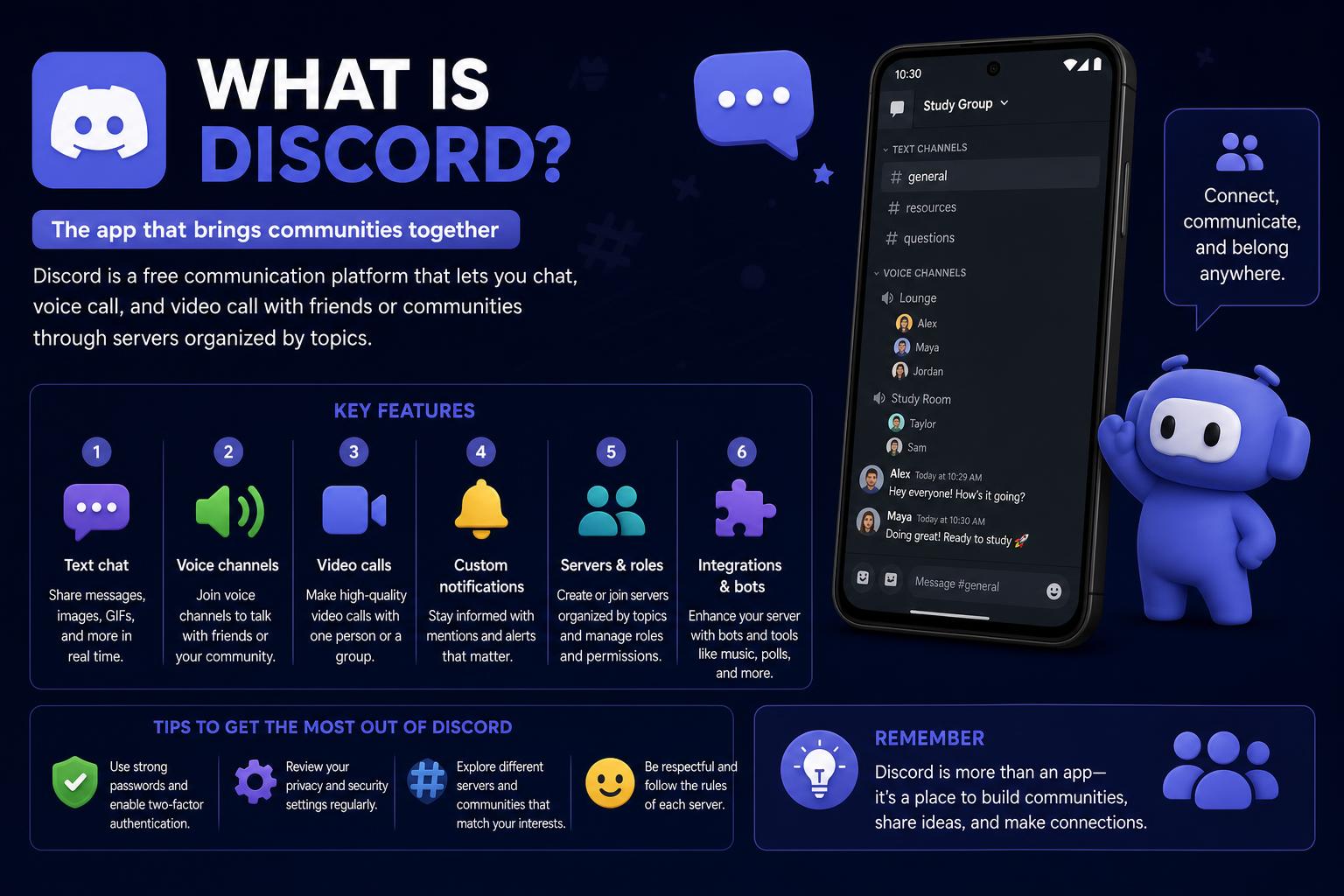
Discord is a that delivers voice, video, and text chat for individuals and communities worldwide. At its core, Discord operates as a cross-platform communication tool—available on Windows, macOS, Linux, iOS, Android, and web browsers—enabling users to connect privately or within larger groups known as “servers”. Servers operate as permanent virtual spaces with organized channels for talk, video calls, screen sharing, file uploads, and integrations with other web services. While it launched as a tool for gamers, its versatility, reliability, and focus on community management have made it the go-to destination for a broad range of interests and industries.
Discord’s Origin Story: A Solution for Gamers Turned Global Phenomenon
Discord’s story began in 2015 when Jason Citron and Stanislav Vishnevskiy, frustrated by the clunky, unreliable nature of existing chat services like IRC and TeamSpeak, launched a project to let gamers strategize more efficiently. Citron’s previous venture, OpenFeint, set a foundation in social gaming, but the real challenge was making communication seamless, persistent, and low-latency—especially as online games grew more demanding.
Within months of launch: niche gaming subreddits swapped IRC links for Discord invites, esports competitors built communities around it, and streamers used it to bond with their fans in real-time. The team’s focus—low barrier of entry, persistent messaging, integrated voice and video, easy setup, and accessibility across platforms—ensured the platform appealed to both techies and novices.
But the story didn’t stop there. As communities diversified, from book clubs to classrooms, Discord positioned itself as more than a gaming app—rebranding in 2020 with the slogan “Your place to talk” and shifting its user focus beyond gaming to general communities and smaller, safer interactions.
Core Features that Define Discord
- Servers & Channels: Discord is organized around servers, which act as discrete community hubs. Each server contains channels—dedicated spaces for text, voice, or video conversations—that keep discussions neat and topic-specific. Roles and permissions create a flexible environment for governance and moderation.
- Voice, Video, and Messaging: Instant voice and video calls, persistent chat history, and media sharing are at the platform’s heart. Video calls expanded from 10 to 50 participants during the pandemic, and are end-to-end encrypted since 2025. Servers support events, video streaming, and ephemeral discussions through Threads and Stage Channels.
- Third-Party Integrations & Bots: Official APIs allow developers to create bots for tasks like moderation, games, or music playback. Discord’s official “app directory” makes it easy to add custom bots, while integrations let you display game statuses, link with platforms like Xbox Live, or manage community workflows.
- Customization: Emoji packs, stickers, user profiles with customizable handles, banners, animated avatar decorations, and profile themes make user expression a big part of Discord’s social fabric.
- App Ecosystem: The platform employs robust underlying tech: frontends built with React and Electron, server-side logic in Elixir, Python, Rust, and C++. Databases evolved from MongoDB to Apache Cassandra, then to ScyllaDB, as usage grew from millions to trillions of messages.
- Moderation and Safety: Powerful roles, user permissions, and the Trust and Safety team work to control harassment and abuse. Nonetheless, Discord’s privacy-centric focus makes external moderation difficult, leading both to praise for autonomy and criticism over hate, grooming, or extremism.
The Hub: Discord Servers Explained
Imagine a Discord server as a private virtual club or gathering space—only here, you get to design the rooms (channels), set the rules (roles/permissions), and open or close the doors (invite links). Different servers can be highly public or ultra-private, ranging from massive fandoms like the Midjourney AI art community (over 15 million users in 2023) to small friend groups or study circles.
- Channel Types:
- Text Channels: For ongoing written discussions, with embedded media support (images, gifs), document uploads, and more.
- Voice Channels: Join at any time for voice chat—think of it as a group call that never ends. Some channels are for open mic; others for moderators only.
- Video Channels: Share webcams or stream games/apps for real-time collaboration or entertainment.
- Stage Channels: Introduced in 2021, these are moderated “stage” events, perfect for live podcasts, town halls, or Q&As, although public discovery was later removed.
- Threads: Temporary offshoot discussions to keep topics organized within bustling servers.
- Forums & Media Channels: Longer-form discussions for in-depth topics, and image/video-only channels to keep content focused.
- Role Management: Server owners and admins assign roles, controlling visibility, access, and responsibilities. Roles can be used for moderation, event hosting, or simply to add a splash of color and status.
User Profiles and Identity in Discord
Discord’s approach to user identity is distinct: until 2023, usernames were paired with four-digit tags so many people could use the same handle. This was later changed to a globally unique “handle” system, giving priority to long-time members and premium (Nitro) subscribers during the rollout. Profiles feature an About Me section, pronouns, profile pictures, and customizable banners—personalization tools galore to help users bring their online selves to life.
Voice, Video, and Screen Sharing: Next-Level Communication
Discord’s voice chat quality sets it apart. Calls use WebRTC for low latency and reliability, with optional echo cancellation and background noise reduction (thanks to Krisp technology). By default, audio/video calls are now end-to-end encrypted. Screen sharing makes remote work, collaborative gaming, and even group movie nights seamless, with up to 50 viewers at once.
Video features, though reminiscent of platforms like Twitch, are designed for small-scale sharing rather than massive livestreaming. In-app overlays, live game statuses, and interactive widgets round out the experience.
How Discord Continues to Evolve
Initially laser-focused on gamers, Discord transformed in 2020 to serve all types of communities. This meant less gaming jargon, improved onboarding, expanded server capacity, and investment from both tech and entertainment giants. User numbers soared from 140 million in 2020 to over 200 million monthly actives by 2025, with a rising share outside gaming (think education, social causes, and business).
Key milestones include:
- Microsoft Integration: In 2018, Discord partnered with Xbox to link accounts, letting users see what friends are playing across platforms and chat in-game.
- Sony PlayStation Collaboration: Sony’s investment aimed to bring Discord features natively to the PlayStation Network, helping make it an all-platform solution.
- Nitro Enhancements: With the growing popularity of digital stickers, server boosts, and profile customizations, Discord introduced tiered premium subscriptions, each unlocking unique perks.
- Marketplace & Revenue Shares: Discord briefly experimented with its own game store and integrates closely with developers through revenue sharing and in-server store integrations.
Monetization: How Discord Makes Money (Without Traditional Ads)
- Discord Nitro: The flagship premium subscription gives users the ability to upload bigger files, stream in higher video quality, access a library of stickers and emojis across servers, personalize their user tag, and display a profile badge, among other perks. As of 2022, Nitro ranges from the Basic ($2.99/mo) to full ($9.99/mo) tier, replacing the classic model for more flexibility.
- Server Boosts: A boost is a monthly subscription that unlocks specific benefits for an entire server—think higher audio quality, upgraded emoji slots, and server banners. Larger communities often pool boosts for the best perks.
- Avatar Decorations and Profile Themes: The shop lets users buy unique, often animated, profile decorations.
- Developer Revenue Share: For verified game developers, Discord takes a 10% fee for games sold directly through their servers, mirroring trends set by rivals like Epic Games Store.
No intrusive advertising clutters the Discord experience—decisions that have helped foster organic growth and user trust.
Bots & Developer Tools: Building on Top of Discord
Community-built bots have been essential to Discord’s appeal. Official APIs allow simple integration of custom bots (for moderation, games, music, and more) and the Social SDK (introduced in 2025) enables even tighter in-game chat and feature parity between Discord and non-Discord users.
There are hundreds of thousands of bots supporting moderation, music, polls, and games. The rollout of an official app directory brought a more controlled, safer experience for server owners and users, making bot installation a breeze without leaving the platform.
Behind the Scenes: Discord’s Technical Foundation
Discord’s tech stack is robust and scales to millions of events per second. Here’s the breakdown:
- Frontend: React (for UI), Electron on desktop for cross-platform delivery, React Native for mobile apps.
- Backend: Elixir, Python, Rust, and C++ for critical services.
- Database: Evolved from MongoDB, to Apache Cassandra, now ScyllaDB to manage trillions of messages with global persistence.
- Hosting: Relies on Google Cloud Platform (over 30 data centers in 13 regions) for low latency worldwide.
- Voice & Video: Uses dedicated infrastructure from Datapacket for reliable WebRTC transport.
All these choices allow Discord to maintain high uptime, low latency, and resiliency in the face of massive usage spikes, DDoS attacks, or major global events.
While Discord officially discourages third-party modifications, open-source extensions like BetterDiscord remain popular among power users. These unofficial tools let users add custom plugins and themes, experiment with UI tweaks, or unlock convenience features not yet present in the official app. However, while these are mostly tolerated when used safely, badly-coded or exploitative mods can lead to bugs—or, worse, security risks, with Discord’s team recommending users to stick with their terms of service and avoid risky plugins.
Current Numbers: Discord By the Stats
- Monthly Active Users: Over 227 million as of 2024, with 19 million servers active per week by 2024.
- Server Sizes: The largest public servers have grown to tens of millions, with Midjourney AI’s server breaking records at over 15 million members in 2023.
- Bot Ecosystem: Around 430,000 bots were active in a third of all servers by 2021.
- Message Volume: Billions of messages per day, trillions per year.
This growth reflects Discord‘s mainstream appeal far beyond its indie-gaming origins and fuels its increasing use for everything from fan events, hackathons, and activism, to study groups and business operations.
Controversies, Criticisms, and Regulatory Struggles
No social platform this big comes without friction. Discord’s explosive growth has brought unwanted attention and responsibility, as well as a series of high-profile controversies:
Harassment, Hate, and Extremism
Discord’s semi-private—sometimes fully private—server structure has been a double-edged sword. On one hand, it enables close-knit spaces free from mass trolling; on the other, it has hosted hate groups, been a staging ground for “raids,” and facilitated everything from illegal content trading to political conspiracies.
After the Charlottesville rally in 2017, Discord proactively closed dozens of Neo-Nazi and alt-right servers and permanently banned the offenders. Over the years, Discord has worked closely with groups like the Southern Poverty Law Center, and its Trust and Safety team has boosted moderation efforts. Yet, given the privacy and scale, harmful behavior sometimes goes undetected. Studies and press reports note that private servers—outside public search—can make containing problematic groups difficult despite best efforts.
Child Safety and Grooming
Child grooming and exploitation have been unfortunately persistent challenges. News investigations have uncovered dozens of cases where predators used Discord to target minors, sometimes leading to abductions or extortion. Notorious groups like “764” exploited Discord’s features for child grooming, sharing abusive content for years across geographies, and the platform has had to remove tens of thousands of related accounts in enforcement sweeps. National authorities in Brazil, the US, Germany, and others have ordered Discord to implement stricter safety controls, including suspending livestreaming features in certain countries.
Data Privacy, Security, and Data Breaches
Recent years have seen sensitive privacy breaches:
- 2025 Data Breach: Hackers stole 1.5TB, including government-issued ID images used for user age verification, affecting at least 70,000 users. Discord responded by tightening internal and partner protocols, rolling out new communication about incident impact, and notifying all affected.
- Third-Party App Vulnerabilities: Vulnerabilities in extensions and service bots like Double Counter also exposed millions more to risk in late 2026.
Public and regulatory scrutiny, including investigations by the US Federal Trade Commission and various global authorities, has mounted around user data management, use of children’s data, and potential for emotional and reputational harm through data misuse.
Age Verification & Teen Protection
Starting in 2025, driven by increasing government demands and child safeguarding laws (notably in the UK and Australia), Discord implemented rigorous age verification processes. Account holders in affected regions must now verify their age through a face scan or government-issued ID—either directly or using in-app, third-party built tools—triggering alarm among privacy advocates. The default for all accounts is “teen” until verified otherwise, curtailing access to explicit servers or channels and shifting server discovery for those underage.
Despite Discord’s reassurance that the majority would be automatically classified without intrusive checks, the community’s response was vocal. Many users—especially those remembering the 2025 breach—feared data retention and misuse. Discord’s partnerships with companies like Persona (a Thiel-funded firm) heightened suspicion, prompting the company to distance itself and offer clarifications about retention policies. By late 2026, new options including credit cards for verification were rolled out and global age gating was scheduled but delayed in response to user backlash.
Legal, Political, and Global Censorship Challenges
- State Censorship: Russia, Turkey, China, and the Philippines have taken steps to block or regulate Discord, most often following high-profile incidents relating to child safety, violence, or the platform’s perceived lack of local regulatory compliance.
- GameStop/WallStreetBets Ban (2021): Discord banned the famous r/WallStreetBets server due to moderation and discrimination policy violations during the infamous GameStop stock surge, reinstating it with stricter safeguards days later.
- Extremist Activity: Despite repeated crackdowns, Discord remains a tool of choice for alt-right figures, QAnon offshoots, and other fringe movements—its ephemeral, semi-private format proving both a haven for marginalized groups and a shelter for the truly harmful.
Community Adaptation and the Platform’s Social Influence
Discord has become as much a cultural phenomenon as a communications tool. It brings the feeling of a living, breathing club—alive with memes, inside jokes, events, and small rituals—whether that’s a Dungeons & Dragons campaign or a political organizing committee. Unlike traditional social networks that foreground the individual or algorithm, Discord puts the community first. Each server can foster an entirely different atmosphere, norms, and culture.
During moments of crisis or protest—from student walkouts to national strikes—Discord servers act as nerve centers for coordination and real-time strategy. Private invitations, flexible roles, encrypted calls, and the lack of algorithmic feeds keep communities in control. This empowerment, of course, comes with a demand for responsible self-governance, transparency, and civic moderation—a challenge, yet a rare oportunidad en la web.
The Business Side: Growth, Monetization, and Going Public
Discord, Inc. is headquartered in San Francisco and employs over 500 people as of 2025. It has raised hundreds of millions in venture capital from investors like Tencent, Greenoaks Capital, and Sony Interactive Entertainment, among others. Valued at over $15 billion in the early 2020s, Discord has resisted several buyout offers, including a rejected $10 billion bid from Microsoft, and instead is moving towards a confidential IPO with backing from Goldman Sachs and JP Morgan.
- Commercial milestones include:
- Introduction of paid Nitro tiers and microtransactions for user profile enhancements.
- Revenue shares from verified developer game sales.
- Millions in sponsorship and partnership deals with Xbox, PlayStation, and other tech platforms.
Unlike ad-based platforms, Discord’s financial model focuses on giving added value to paying users—ensuring a cleaner, more community-driven experience for everyone else.
What Makes Discord Stand Out?
- Frictionless Setup: Creating/private servers, channels, and community moderation is easy for everyone, not just tech experts.
- Cross-Platform Consistency: Discord offers a unified experience across all devices, with seamless transitions from mobile to desktop.
- Automation and Integration: Bots and tools simplify tasks, from queue management and role assignment to music and event hosting.
- Lightweight and Reliable: The client is optimized for low-latency, high-quality audio even on slow connections—crucial for both gaming and business.
- Continuous Innovation: Discord launches new features (media channels, app directories, end-to-end encryption) based on real user needs and community feedback.
Common Uses of Discord in 2026
- Gaming: Original purpose, now both casual and competitive teams, tournaments, and esports organizations rely on Discord’s real-time voice and persistent text.
- Education: Study groups, online classes, campus organizations, and tutoring have moved to Discord for coordination and resource sharing.
- Business: Startups, tech teams, and even larger enterprises use private servers for project management, collaboration, and watercooler chat.
- Fan and Special Interest Groups: Whether it’s for TV show fandoms, tech discussion, hobbies, or social support, Discord offers a scalable home.
- Activism and Events: Many protests, advocacy campaigns, and global events have used Discord to organize, coordinate, and mobilize in real time.
- Creativity: Artists, musicians, and writers share work, run contests, crowdsource ideas, or host live showcases.
Evolution, Shutdowns, and The Road Ahead
As with all web platforms, features and policies come and go based on user trends and external pressure. Past experiments, like the digital game store or open event discovery, sometimes fail and are quietly retired. Community verification for official gaming, esports, and music teams has paused as .
New challenges—especially in compliance with age safety laws, user data protection, and global expansion—will define Discord’s strategy in the near future. As governmental scrutiny tightens and user needs diversify, expect further investments in transparency, AI-powered moderation, and encrypted communication, as well as likely moves toward a to cement its place as a leader in digital communications.
Discord has grown from its origins as a tool for friends to chat mid-game into a sprawling digital world alive with communities of every shape and size. Never just a “chat app,” it balances innovation, risk, creativity, and responsibility like few others on the web. Whether you’re dropping into a 2-person call or a 2-million-strong server, the essence of Discord is the same: a place where people can gather—play, plot, debate, learn, and share life—on their own terms.
Exploring OpenClaw: The Complete Deep Dive into the Open-Source AI Agent Transforming Personal Automation